
Last updated on October 17th, 2026 at 04:24 pm
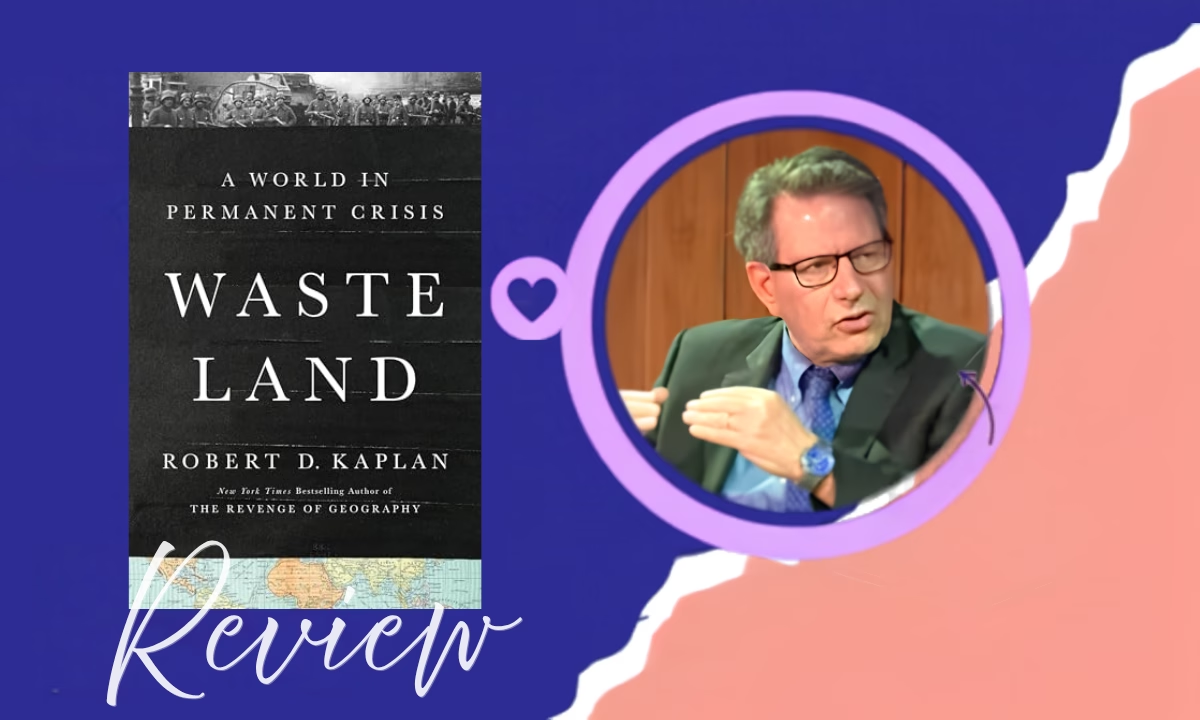
Waste Land: A World in Permanent Crisis by Robert D. Kaplan is a short, dark, 224-page argument that the whole planet now behaves like Weimar Germany: connected enough for a crisis in one place to wound every other place, yet not connected enough to be governed as one. Random House published it on January 28, 2025 (Penguin Random House). My short answer: yes, read it, but read it as a warning and not as a forecast. I finished it in October 2026, and by now it has become a strange scorecard.
It hit shelves with a line suggesting Donald Trump’s political career “may lie in the past tense” (Part I), eight days after Trump was sworn in for a second term (PBS NewsHour). Yet the same book floated a scenario in which Israel’s shadow war with Iran turns into Israel “frontally attacking Iran” (Part II), and on June 13, 2025, that is roughly what happened (Wikipedia summary of the 2025 strikes).
This review sorts the prophecy from the panic and gives you the whole argument, part by part.
Table of Contents
Brief summary of Waste Land
The core claim: The entire world is now a “geopolitical Weimar” (Part I). Technology has shrunk distance so much that a coup in Niger or a war in Ukraine echoes everywhere, but there is no world government to absorb the shocks.
Order before freedom: Kaplan’s most quoted line is that “order must come before freedom, because without order there is no freedom for anyone” (Part I). Everything else in Waste Land hangs on this.
All three great powers are declining: The United States subtly, Russia structurally, China through Xi Jinping’s return to Leninist ideology. Kaplan calls the leadership problem “Shakespearean decline” (Part II).
Wars audit whole societies: Russia’s early failures in Ukraine, especially its missing corps of sergeants and corporals, exposed rot that peacetime hid (Part II).
There is no rules-based order: Only regional balances of power that held long enough to be mistaken for rules (Part II).
Cities and social media are the hidden engine: Kaplan argues that “the primary change in geopolitics is urbanization” (Part III), and that online crowds now produce a bottom-up tyranny of conformity.
The title is literal: T. S. Eliot’s 1922 poem The Waste Land, a heap of cultural fragments, is Kaplan’s image for our civilization (Part III).
The ending is not hopeless: History is a series of hinges, and “Avoiding Weimar’s fate now constitutes the ultimate labor for the world” (Part III, final page).
The 2026 scorecard: Right about an Israel-Iran war, wrong about Trump’s career, and still unresolved on Russia’s collapse and a Taiwan war.
Who will love Waste Land, and who may bounce? If you enjoy books that think through other books, you will probably love it, because Kaplan turns Solzhenitsyn, Spengler, Canetti, Orwell, Ortega y Gasset and Ibn Khaldun into one long argument about why the world feels permanently on fire.
Readers of foreign policy, history students, journalists, and anyone who liked his earlier work like The Revenge of Geography will find it fast and quotable. You may bounce if you want data, charts, or policy recommendations, because there are few of each.
Progressive readers will likely be irritated by the sections that compare “cancel culture” to Stalinism and that praise monarchy, and readers who have already absorbed Steven Pinker’s optimism may find the pessimism unearned in places.
If you only want a quick news explainer on Ukraine or Taiwan, this is the wrong book. If you want a mood, a framework, and a reading list, it is the right one.
What is Waste Land by Robert D. Kaplan about?
Waste Land is a book-length essay arguing that permanent crisis, not a return to calm, is the normal condition of our century. The full title is Waste Land: A World in Permanent Crisis. It was published in the United States by Random House on January 28, 2025, in hardcover, ebook, and a 6-hour-43-minute audiobook, with ISBN 9780593730324 (Penguin Random House).
In the UK, Hurst Publishers released the hardback in January 2025, and a 224-page paperback is listed for September 2026 (Hurst Publishers). The book is dedicated to Devon Cross and opens with an epigraph from the philosopher Roger Scruton warning that hope “untempered by the evidence of history” is dangerous (Epigraph).
Context. This is nonfiction, shelved under geopolitics, international relations and the history of globalization (Library of Congress subject headings printed on the copyright page).
Kaplan wrote it at the Foreign Policy Research Institute in Philadelphia, which he thanks in the acknowledgments, and he notes that parts first appeared in The Wall Street Journal, The New Criterion, The National Interest and The New Statesman (Acknowledgments).
Purpose. Kaplan’s thesis is simple to state and hard to shake: technology has made the world small and intimate, but politics has not caught up, so we live in a “Weimar” stage of transition where nobody really rules and any local fire can spread. His prescription is not a policy program.
It is a temperament: tragic thinking, respect for order and moderation, and a liberalism that is “not too sure that it is right,” a phrase he borrows from the judge Learned Hand (Part III).
Who is Robert D. Kaplan, and why does his pessimism carry weight?
Kaplan’s pessimism carries weight because he has been making a version of this argument for three decades and has seen some of it come true on the ground.
According to his publisher, he is the bestselling author of about twenty books, holds the Robert Strausz-Hupé Chair in Geopolitics at the Foreign Policy Research Institute, reported on foreign affairs for The Atlantic for three decades, served on the Pentagon’s Defense Policy Board and the U.S. Navy’s Executive Panel, and was twice named one of Foreign Policy‘s “Top 100 Global Thinkers” (Penguin Random House).
The book’s front matter lists 23 of his titles, from Surrender or Starve and Balkan Ghosts to The Revenge of Geography, The Tragic Mind and The Loom of Time. The most important one for this book is his February 1994 Atlantic cover story, “The Coming Anarchy” (Wikipedia).
Kaplan revisits it at length in Part I, admitting that critics found it “demoralizing” and that it was “deeply alienating, if not abhorrent, to many” in the optimistic 1990s. He points out that Sierra Leone collapsed in 1999 and Côte d’Ivoire slid into a decade of civil conflict soon after, as he had warned (Part I).
He also writes from personal experience. He mentions embedding with U.S. ground forces during the war on terror, sailing on destroyers and submarines, reading Elias Canetti in Stalinist Romania, and working as a geopolitical consultant for Stratfor and Eurasia Group (Parts I, II and III).
That reporting background matters, because his sharpest claims about Russia’s army come from watching how Western armies work.
What did Waste Land get right and wrong, 21 months later?
Read in late 2026, Waste Land got the shape of the era mostly right and one big domestic prediction wrong. Since many reviews were written in its launch week, I think this is the most useful way to judge it now. Here is my scorecard, limited to things I could verify.
| Kaplan’s claim in Waste Land | What happened | My verdict |
|---|---|---|
| Israel’s shadow war with Iran “may ignite into a full-scale conflict with Israel frontally attacking Iran” (Part II) | Israel began strikes on Iran on June 13, 2025. The U.S. hit Fordow, Natanz and Isfahan on June 22 in Operation Midnight Hammer, and a ceasefire followed on June 24 (Wikipedia; Congressional Research Service) | Right |
| An “Israeli or Israeli-American attack” on Iranian nuclear facilities could shake the regime (Part II) | The joint attack happened. Whether it destabilized clerical rule is a question I cannot answer with verified sources, so I leave it open | Half right, still open |
| Trump, “whose political career may lie in the past tense” (Part I) | Trump was sworn in as the 47th president on January 20, 2025, eight days before the U.S. release (PBS NewsHour) | Wrong |
| Russia’s army was so damaged that, by end of 2023, it had lost 315,000 of 360,000 troops (Part II) | This matches a declassified U.S. intelligence assessment reported in December 2023 (The Defense Post) | Accurate citation |
| The Pentagon projects at least 1,000 Chinese nuclear weapons by 2030 (Part II) | The Pentagon’s 2023 China report did project more than 1,000 operational warheads by 2030 (Air & Space Forces Magazine) | Accurate citation |
| World population will rise “from 8 billion to 10.4 billion” (Part I) | The UN’s 2024 projections put the peak slightly lower, at 10.3 billion in the mid-2080s (Arab News, via Reuters) | Close, slightly dated |
The Trump miss deserves a fair explanation. The Library of Congress cataloguing data printed in the book is dated August 2024, which suggests to me that the manuscript was locked before the November election, though I cannot confirm the exact date he finished writing. Still, the miss is revealing. Kaplan’s whole method assumes that big impersonal forces matter more than any one person, yet the book’s biggest error is about one person.
In a July 2025 interview with the Catalan paper Ara, Kaplan said Trump “isn’t serious enough to be a fascist” (Ara). That is a different claim from the one in the book, and an easier one to defend.
Waste Land summary
Kaplan builds his argument in three movements: first the Weimar analogy and its historical roots, then the decline of the great powers, then the cities and crowds that drive everything from underneath. There are no numbered chapters, just three long parts. Here is each one in enough detail that you will know what the book says, how it gets there, and where it ends.
Part I, Weimar Goes Global: why is the whole world like Weimar Germany?
Kaplan opens with two Berlin novels: Christopher Isherwood’s Goodbye to Berlin and Alfred Döblin’s Berlin Alexanderplatz, published in the fall of 1929, just weeks before the Wall Street crash. He reads them as premonitions. Döblin calls Berlin “Sodom on the eve of its destruction,” and Kaplan uses that image to ask a direct question: “Will we be any the wiser?” (Part I).
What was Weimar? Kaplan explains it through the historians Golo Mann and Gordon A. Craig. Germany after World War I had lost, by his figures, 1.75 million soldiers and almost half a million civilians.
The new constitution, drafted in the town of Weimar, split power among the president, chancellor, Reichstag and the federal states, while Prussia covered two-thirds of the country and Bavaria flirted with secession. Craig’s line sums it up: Weimar’s “normal state was crisis” (Part I).
Private party militias, a political murder (Foreign Minister Walther Rathenau in 1922), Hitler’s failed Beer Hall Putsch in 1923 and constant cabinet collapses followed. Kaplan stresses that there were good years under Gustav Stresemann and a last technocratic chance under Heinrich Brüning, and that Hitler was not inevitable.
The end came through backroom deals by men like Franz von Papen, who believed they had merely “hired” Hitler (Part I).
The analogy. Kaplan’s key move is to scale Weimar up. In his words, “The entire world is one big Weimar now” (Part I): connected enough for one part to mortally influence the others, yet not politically coherent. He is careful to say he sees “no Hitler in our midst” (Part I). The danger is not one dictator but endless emergencies with no night watchman.
Order versus freedom. This is where Kaplan shows his conservative hand. He quotes Winston Churchill’s 1945 view that if the Allies had let the Hohenzollern, Wittelsbach and Habsburg dynasties return to their thrones after 1919, “there would have been no Hitler” (Part I).
Kaplan argues that old monarchies, however corrupt, were “dictatorial without being totalitarian” and that their collapse left vacuums filled by ideology. He extends the logic to Russia in 1917, to the murder of Iraq’s royal family in 1958, and to the fall of the Shah, speculating that a surviving Pahlavi monarchy might have made Iran a “Middle Eastern version of South Korea” (Part I).
Then comes the thesis sentence: order must come first, “because without order there is no freedom for anyone” (Part I).
Solzhenitsyn as the master key. The longest stretch of Part I is a tribute to Aleksandr Solzhenitsyn’s Red Wheel novels, which he wrote mostly during nineteen years of near-isolation in Cavendish, Vermont. Kaplan reads August 1914, November 1916 and March 1917 as a study in how institutions melt. The Russian defeat at Tannenberg, a drunken and risk-averse officer corps, the assassination of the reforming prime minister Pyotr Stolypin in 1911, and the February Revolution that removed the czar all lead, by contingency rather than logic, to Lenin. Kaplan’s portrait of Lenin, via Solzhenitsyn, is of the one focused man in a country of talkers.
He cites Henry Kissinger’s line from A World Restored that the core problem of politics is “the limitation of righteousness” (Part I), and concludes that self-righteousness sits at the heart of the worst tyrannies.
Geography is shrinking. Next Kaplan brings in Halford Mackinder’s 1904 warning that every explosion of social forces would now echo “from the far side of the globe,” and John von Neumann’s mid-century worry that a finite earth would become a force for instability. His own summary: “Geography is not disappearing. It is only shrinking” (Part I).
He cites Ian Bremmer’s idea of a “G-Zero” world, where no group of countries can manage crises together, and Adam Tooze’s crisis maps, in which Kaplan counted nearly three dozen arrows linking Covid, the Ukraine War, food, energy, refugees and stagflation (Part I).
War in a shrunken world. Kaplan sketches a Taiwan war between the world’s three largest economies, fought with automated, AI-assisted naval systems, which could spill deep into mainland China and crash markets. He warns that cyber conflict could do more damage than a nuclear exchange because its red lines are still undrawn.
He then admits, disarmingly, “I do realize how obsessively negative I am being” (Part I), and leans on the strategist Colin S. Gray’s dictum that optimism “is apt to kill with greater certainty” than pessimism.
Nuclear weapons and cool heads. Kaplan revisits Kissinger’s 1957 Nuclear Weapons and Foreign Policy, which predicted that the side losing a limited war is the one most tempted to go nuclear. He applies it to Putin’s veiled threats and to Pakistan. His most original point here is about media. Eisenhower held back from nuclear use several times, and Kaplan links that calm to “the print-and-typewriter age” (Part I).
Today’s leaders are products of a digital-video world that rewards passion. As he puts it, “Weimar had moderate leaders, until one day it didn’t” (Part I).
Revolutionary chieftains. Borrowing Kissinger’s term, Kaplan argues that status quo powers keep trying to integrate revolutionary leaders, while those leaders treat negotiations only as a way “to gain time” until the next aggression (Part I). He applies this to Napoleon, Hitler, Putin and, with more caution, Xi Jinping.
The Pinker debate. Kaplan confronts Steven Pinker’s 2011 book The Better Angels of Our Nature head on. He accepts Pinker’s statistical point that, adjusted for population, World War II ranks lower among history’s atrocities. But he sides with Timothy Snyder’s rebuttal in Foreign Affairs that Pinker “loses sight of the modern world in which we actually live” (Part I), and with Gray’s flat statement: “I do not believe in progress in security affairs.”
He adds Martin van Creveld’s view that for many armed groups fighting is an end in itself, and Jason Stearns’s report that the number of armed groups in Congo doubled to around 120 in a decade (Part I, citing Foreign Affairs, May/June 2022).
Climate, Malthus and Africa. Kaplan quotes the science writer Peter Brannen that “The beast has only just begun to snarl” on climate, defends Thomas Malthus as the thinker we keep needing to refute, and draws on Paul Theroux’s grim travel writing from Angola.
He closes Part I with demographics: Africa, he writes, is 16 percent of the world’s population today and could be almost 40 percent by 2100, and by century’s end there could be seven Africans for every European (Part I).
His conclusion is that humanity is becoming “an ever-tightening, closed system, divided against itself and armed to the teeth” (Part I).
Part II, The Great Powers in Decline: are the United States, Russia and China all declining?
Yes, Kaplan argues, all three are in decline, but in very different ways and at very different speeds. He opens with Henry Adams, who wrote around 1907 that Europe’s permanent problem was Russia and that “The last and highest triumph of history” would be bringing Russia into the Atlantic world (Part II).
The long European war from 1914 to 1989, Kaplan says, proved Adams right, and Ukraine has put us “back in the groove of history” (Part II).
Russia’s long shadow. Kaplan walks through Tannenberg (with Barbara Tuchman’s verdict that the Russian steamroller fell apart “as if it had been put together with pins”), Stalin’s terror-famine in Ukraine, the Battle of Stalingrad where 13,500 Soviet troops were executed by their own side, and the Cold War split of Europe (Part II).
He then blames the 1990s American project of “shock therapy” for opening the vacuum that Putin filled, leaning on the late scholar Stephen F. Cohen, who called it “the worst American foreign policy disaster since Vietnam” (Part II). In Kaplan’s telling, 9/11 was “a head fake,” a distraction while Russia and China rebuilt.
No rules-based order. Ukraine and Gaza, he argues, reveal that there never was a rules-based order, only “regional equilibria,” in the words of the scholar Jakub Grygiel (Part II). The United Nations, which mattered during the black-and-white television era of Khrushchev’s shoe and Moynihan’s speeches, now looks “antiquated” to him, partly because France sits on the Security Council and India does not (Part II).
Globalization 1.0 and 2.0. The 1990s, Kaplan says, were “Globalization 1.0,” a good-news story of new cities and markets in which progress seemed automatic. “The 1990s ended late, on September 11, 2001” (Part II). Covid-19 serves as the rough break into “Globalization 2.0,” which is value-neutral: as good as it is bad, and the very engine of permanent crisis.
His summary of why a smaller world is less safe is my favorite line in Part II: a world united is “a world where there was no place to hide” (Part II).
Shakespearean decline. Kaplan’s phrase for the leadership problem is “Shakespearean decline”: leaders driven by private torments into blunders, from George W. Bush in Iraq to Putin in Ukraine to Xi’s fixation on Taiwan (Part II). He ranks the Cold War presidents from Truman to the elder Bush above their successors, and blames a more hysterical media culture for making presidents “moralistic rather than moral” (Part II).
America’s subtle decline. The United States, he argues, keeps huge geographic advantages: two oceans, a friendly northern neighbor, and the Mississippi, Missouri and Ohio river systems. Its decline is cultural and political, a partisan war “mainly without the shooting” (Part II).
Russia’s fundamental decline. Here Kaplan is at his most vivid. He explains Germany’s gas bargain with Moscow, including Gerhard Schröder’s jobs at Russian energy firms, as a bet on Putin’s rationality that proved “dead wrong” (Part II).
He argues that Putin learned the wrong lesson from cheap wars in Syria and Georgia. Then comes his reporter’s point: a first-world army is built on its NCOs, and Russia’s barely had one, which is why so many Russian generals died near the front early in the war (Part II). His line “wars can be audits of whole societies” (Part II) is the best idea in this section.
He cites losses of 2,200 of 3,500 tanks by the end of 2023, compares the Russian army to “a mob on the move,” and uses Jeane Kirkpatrick’s 1979 essay “Dictatorships and Double Standards” to argue that revolutionary Communist regimes destroy societies so thoroughly that rebuilding takes decades.
His forecast: “Putin’s eventual downfall will more likely lead to anarchy than to stable democracy” (Part II), and the West will face a “Eurasian Question” the way 19th-century diplomats faced the Ottoman “Eastern Question.”
China, from Deng to Xi. Kaplan devotes real admiration to Deng Xiaoping, via Ezra Vogel’s biography, as the man who lifted more people faster than anyone in economic history while avoiding Russian-style shock therapy. “Deng is what is missing in today’s global environment” (Part II). Xi Jinping, by contrast, is a “Leninist ideologue” who has made “struggle” the party’s guiding principle.
Kaplan treats the public removal of Hu Jintao from the party congress stage in October 2022 as the symbolic end of the Deng era; that event was widely reported at the time (Arab News, via AFP/Reuters).
He quotes Kevin Rudd that Xi has been “strangling the goose” that laid the golden egg, and he notes Japan’s planned defense increase of over 50 percent and the AUKUS submarine deal as signs that the Indo-Pacific and NATO are fusing into one theater (Part II).
A geopolitical bear market. Because declining empires get more aggressive and their borderlands more chaotic, Kaplan predicts “a geopolitical bear market” for the foreseeable future (Part II).
He imagines NATO splitting informally into a militant Poland-Ukraine-Romania axis and a softer France-Germany pole, and he expects Europe’s future to be shaped increasingly by migration from Africa and the Middle East, whose combined population he says will grow from 1.7 billion to 4.4 billion this century (Part II).
A new bipolar struggle. Part II ends with a claim that critics have found the most contentious. Kaplan describes a worldwide struggle between status quo powers and revolutionary ones: “Order versus disorder.
That is what it’s about” (Part II). One pole includes Russia, North Korea, China, Iran and its proxies, and what he calls a movement both ancient and post-industrial: anti-Semitism. Israel, in his account, “stands at the heart of this global geopolitical war” because it has not wavered.
This is also where he floats the Israel-Iran scenario that came true in June 2025. His final line for Part II: “Isolationism is the past: full immersion in a chaotic world is the inevitable future” (Part II).
Part III, Crowds and Chaos: why does Kaplan blame cities and social media?
Kaplan blames cities because he believes they are where ideologies are born and crowds form, and social media has turned the whole internet into one city. He opens with a bold claim: “the primary change in geopolitics is urbanization” (Part III).
He reports that over 55 percent of humanity lives in cities, that by 2050 more than two-thirds will, and that the number of cities with tens of millions of people rose from three in 1975 to thirty-four by 2014 (Part III).
From Jane Jacobs to the “generic city.” Kaplan begins with Jane Jacobs’s The Death and Life of Great American Cities and her faith in lively sidewalks mixing classes.
Then he shows how that vision was overturned. Witold Rybczynski, Joel Kotkin and Richard Florida describe wealthy, young, re-segregated “superstar” cities that look alike, while Roger Scruton mourns “the concrete wastes of a modern Western city” (Part III). Cities, Kaplan argues, cut people off from tradition, which makes monarchies, empires and old loyalties dissolve faster.
“The whole web is a city.” This four-word sentence (Part III) is the hinge of the section. Cities incubated Marx, Lenin and Hitler, as well as Kant and Sartre. Social media now replicates the city’s endless, anonymous interactions everywhere. Kaplan quotes Ross Douthat on online life’s “pinball motion between extremes of toxic narcissism and the solidarity of the mob” (Part III).
Spengler’s folk and mob. Kaplan calls Oswald Spengler, author of The Decline of the West (volumes published in 1918 and 1922, per Wikipedia), perhaps the greatest philosopher-historian of all time, while admitting Spengler was “ultra-conservative.” The key nugget: the countryside produces the “folk,” the world-city produces the “mob” (Part III).
In America, Kaplan says, the folk on the right are obsessed with conspiracy theories, while the mob on the left is obsessed with conformity.
Cancel culture and The New York Times. This is the most argued-over section. Kaplan quotes the Northwestern scholar Gary Saul Morson comparing the 2020 riots to pre-Bolshevik Russia, where liberals could not bring themselves to say lawlessness was wrong.
He then calls cancel culture “Stalinism without any of the violence and imprisonment” (Part III), immediately adding, “I may be taking the concept of cancel culture much too far” (Part III).
His case study is the June 2020 resignation of New York Times opinion editor James Bennet after the paper ran Senator Tom Cotton’s op-ed (NBC News). He draws on Hannah Arendt’s idea that tyranny feeds on loneliness, and on Spengler’s warning in The Decline of the West that the press commands readers like “an army” (Part III).
Ibn Khaldun and the cycle of decay. Kaplan pairs Spengler with the 14th-century North African historian Ibn Khaldun, who saw dynasties rise from hardy nomads, grow soft in cities and fall to new nomads. Both thinkers, Kaplan says, saw style and luxury as the start of decline, and he extends this to the media’s worship of youth over age (Part III).
He also lets Spengler go too far and says so: Spengler dismissed modern art, but Kaplan cites Peggy Guggenheim’s collection in Venice as proof that abstraction can point toward a universal aesthetic, not just decadence (Part III).
Why “The Waste Land”? Kaplan’s title comes from T. S. Eliot’s poem, published in 1922 (Britannica), the same year as Spengler’s second volume.
He reads it as a poem about the “breakdown of forms,” where epochs, languages and traditions crash together, ending with the line “These fragments I have shored against my ruins” (Part III). He quotes the critic James Parker that the poem’s “discontinuities…feel like home” today, and Delmore Schwartz’s image of modern life as “a foreign country in which a foreign language is spoken” (Part III).
He then traces three stages of literary response to breakdown: Eliot’s civilizational collapse after World War I, Sartre and Camus’s individual neurosis after World War II, and today’s anxious, self-obsessed individuals regrouping into new online crowds.
Canetti’s lonely crowd. The intellectual climax of Waste Land is Elias Canetti’s Crowds and Power, first published in German in 1960; Canetti won the 1981 Nobel Prize in Literature (NobelPrize.org). Kaplan’s summary: “the mob is made up of lonely people” (Part III).
The lonely individual joins a crowd to escape isolation, feels power for the first time, sees the crowd as pure, and goes hunting for the insufficiently virtuous. Kaplan walks through Canetti’s types, from the “baiting crowd” to the “questioner,” and links them to McCarthy-era hearings and Orwell’s Nineteen Eighty-Four, where Julia says “Always yell with the crowd” (Part III). Huxley’s Brave New World, with its “new forms of drunkenness,” completes the picture.
Bottom-up tyranny, AI and the mass man. The 20th century’s tyranny came from the top down, Kaplan argues, while the 21st century adds tyranny from the bottom up through digital networks.
He is fair enough to note that bottom-up crowds also did good, as in Iran after the death of Mahsa Amini in September 2022 (Part III). He quotes Samuel Huntington that “The faster the enlightenment of the population, the more frequent the overthrow of the government” (Part III), and warns, via Kissinger, Eric Schmidt and Daniel Huttenlocher, that AI may narrow our access to objective truth. José Ortega y Gasset’s “mass man,” who demands convenience as a natural right, and Carl Schorske’s “psychological man,” a creature of feeling and instinct, round out the picture.
China’s surveillance cities, Kaplan admits, might look attractive to most people, yet Camus’s The Rebel reminds him that control always produces revolt.
How it ends. Kaplan warns that fascism and Communism are never dead, “only in occultation,” and quotes Alexander Herzen’s 1848-era prediction that Western thought will pass into history like a body passing into grass.
His answer is historic liberalism, the tradition of Burke, Mill and Isaiah Berlin, practiced with moderation and some respect for national “soil ties.” He reminds us that the 1848 revolutions almost succeeded and that history is “a series of hinges” (Part III).
He ends with the philosopher William MacAskill’s point that “We are the ancients,” admits that whole new cycles of history may overwhelm his argument, and closes: “The direction of history is unknowable” and avoiding Weimar’s fate “constitutes the ultimate labor for the world” (Part III).
Key themes and highlights of Waste Land
The main themes are order versus freedom, the shrinking of geography, tragic thinking versus faith in progress, the power of individual leaders, and the tyranny of crowds. Here is a quick thematic map for students and researchers.
- Order as the precondition of liberty. Kaplan is a classical conservative in the Hobbes and Burke tradition. His examples run from Weimar to post-Soviet Russia to Iraq after the Ba’ath party was disbanded.
- Shrinking geography. Unlike his earlier books, where geography is fate, here geography is being compressed by technology, which makes every place strategic. If you read our review of The Revenge of Geography, you will notice the shift.
- Tragic sensibility. Europeans in 1914 had stopped “thinking tragically in order to avoid tragedy” (Part I). The lesson, repeated throughout, is that anxious foresight is a virtue.
- Contingency and personality. Brüning, von Papen, Stolypin, Kerensky, Deng and Xi show how single people tip history. Ironically, this theme is the one his Trump prediction violated.
- Communism’s afterlife. Russia under Putin and China under Xi are, for Kaplan, still living with Leninist cynicism.
- The crowd. From Solzhenitsyn’s line about the crowd as “both human and inhuman” (Part III) to Canetti’s lonely mob, crowds tie Part I’s revolutions to Part III’s social media.
- Cultural fragmentation. Eliot’s heap of broken images is Kaplan’s master metaphor for the West after the death of traditional, place-rooted cultures.
Does Kaplan support his arguments with evidence?
Partly. Kaplan supports his arguments with history, literature and a small number of well-chosen statistics, but rarely with systematic data. When he does use numbers, the ones I checked hold up, such as the U.S. intelligence estimate of Russian losses and the Pentagon’s warhead projection.
His reasoning is strongest where he has reported on the ground (army culture, West Africa) and weakest where it rests on analogy alone (monarchy, cancel culture).
The Weimar analogy works as a lens for scale. It is less convincing as a predictive model, and Kaplan himself concedes that “Analogies can be futile” (Part I).
Does Waste Land fulfill its purpose?
Mostly, yes. The stated purpose is to make readers consider “that literally anything can happen to us” (Part I), and the book does exactly that. It contributes to the field less through new research than through synthesis: it puts geopolitics, urban studies and literary criticism in one frame, which few foreign-policy books attempt.
G. John Ikenberry’s review in Foreign Affairs called it “a bleak vision of a world in permanent political upheaval” (Foreign Affairs), which is accurate, and that bleakness is the point.
My verdict: is Waste Land worth reading?
Waste Land is a bleak, erudite, frequently brilliant and occasionally maddening book, and I closed it feeling both sharper and slightly scolded. I was moved by how honestly Kaplan admits his own gloom, and annoyed, more than once, by how quickly he reaches for Stalin to describe a newsroom argument.
What I found compelling. The “war as audit” idea is the most useful lens on Russia I have read. The Solzhenitsyn chapter made me want to read The Red Wheel, and Part III’s chain from Spengler to Canetti to Orwell is a superb short course in crowd theory.
I also liked that the book is short. As John West wrote in ASPI’s The Strategist, “Kaplan’s book reads like an essay, despite its length of 224 pages” (The Strategist). And the Iran passage now reads like a real forecast rather than a guess.
What I found weak. First, the monarchy argument. Kaplan’s claim that a surviving Shah might have made Iran a South Korea is speculation presented with confidence, and the book never weighs what those dynasties cost the people they ruled. Second, the Pinker rebuttal is thinner than it looks.
Pinker’s argument is about long-run trends, so pointing to Ukraine and Gaza does not refute it by itself (if you want the other side, see our Better Angels of Our Nature review). Third, the New York Times episode carries more weight than one newsroom dispute can bear. Fourth, the book offers a temperament, not solutions, which the futurist Frank Diana also flagged in his review (Frank Diana).
And of course, there is the Trump line.
What other critics said. Reception split along predictable lines. John Bolton, writing in The Wall Street Journal, called it “Compelling and helpful,” and Admiral James Stavridis praised it as “A cautionary tale of absolute brilliance” (both quoted on the Bookshop.org listing).
The sharpest dissent came from Sam Kahn in Compact, who argued that Kaplan’s anarchy thesis was “conveniently vague” and risked “a revival of the Manichean thinking” of the Cold War (Compact). Poul Houe in Rain Taxi found the gloom “not always sustainable” but still called the book “an important and timely memento” (Rain Taxi).
I land between Bolton and Kahn: the diagnosis is strong, and the framework is too elastic to be tested, except in the few places, like Iran and Trump, where Kaplan made a concrete call.
What books are similar to Waste Land?
The closest books to Waste Land are Kaplan’s own earlier work, the declinist classics he quotes, and the optimists he argues against. Here is how they compare.
| Book | How it relates to Waste Land | Read it if you want |
|---|---|---|
| The Revenge of Geography by Robert D. Kaplan (2012) | His geography-is-fate book; Waste Land updates it for a shrinking world (our review) | The maps behind the mood |
| “The Coming Anarchy” by Robert D. Kaplan (The Atlantic, 1994) | The essay Part I revisits and defends | The original prophecy |
| The Better Angels of Our Nature by Steven Pinker (2011) | The optimistic case Kaplan argues against (our review) | The strongest counterargument |
| The Clash of Civilizations by Samuel P. Huntington | Kaplan borrows Huntington often but says today’s struggle is not a clash of civilizations (our analysis) | Culture-based geopolitics |
| The Decline of the West by Oswald Spengler (1918, 1922) | The intellectual spine of Part III | The original declinist epic |
| Crowds and Power by Elias Canetti (1960) | The source of Kaplan’s crowd theory | The psychology of mobs |
| Prisoners of Geography by Tim Marshall | A more accessible geography primer (our analysis) | A lighter entry point |
| Straw Dogs by John Gray | Another sharp attack on the idea of progress (our summary) | Philosophical pessimism |
If you want the full shelf, our list of the 15 best books on world order and geopolitics puts Waste Land in wider company. And because Kaplan leans so heavily on Orwell and Camus, our pieces on Orwell’s 1984 and Camus’s The Rebel make good companions.
FAQs about Waste Land
Is Waste Land by Robert Kaplan about T. S. Eliot’s poem?
Not directly. It is a geopolitics book that borrows Eliot’s 1922 poem as its central metaphor for a fragmented civilization (Part III).
How long is Waste Land?
The U.S. and UK editions run 224 pages, and the audiobook is 6 hours and 43 minutes (Penguin Random House; Hurst Publishers).
What is the Weimar analogy in Waste Land?
Kaplan argues that the world, like the Weimar Republic from 1918 to 1933, is connected enough for crises in one part to hit all the others, but has no central authority to keep order (Part I).
Does Kaplan offer solutions?
Only broadly: moderation, tragic thinking, respect for order, and a humble liberalism. There is no policy agenda.
Is Waste Land pro-Trump or anti-Trump?
Neither in a partisan sense. Kaplan calls Trump “more vain and superficial than von Papen even” (Part I), while also criticizing left-wing “mobs” and elite media.
Conclusion: who should read Waste Land?
Waste Land is best for readers who already follow world affairs and want a framework for why the news never calms down. Students of international relations, history and political philosophy will get the most from it, along with journalists and policy readers who want a reading list hidden inside an argument.
General readers can handle it, since the prose is clear and the book is short, but they should expect a mood piece built from other books rather than a data-driven forecast.
My recommendation is to read it slowly, keep a pencil handy, and argue with it. Twenty-one months after publication, Kaplan’s big picture of a “geopolitical Weimar” still describes the world I read about every morning, his Iran call came true within six months, and his Trump call failed before the book was even in stores.
That mix is exactly why it is worth your time. It shows you both the power and the limits of thinking in centuries when you live in a news cycle.
Waste Land
Waste Land: A World in Permanent Crisis by Robert D. Kaplan is a short, dark, 224-page argument that the whole planet now behaves like Weimar Germany: connected enough for a crisis in one place to wound every other place, yet not connected enough to be governed as one. Random House published it on January 28, 2025 (Penguin Random House). My short answer: yes, read it, but read it as a warning and not as a forecast. I finished it in October 2026, and by now it has become a strange scorecard.
URL: https://www.sopranu.com/waste-land-robert-kaplan-book-review/
Author: Robert D. Kaplan
4
Pros
- Reading wars as “audits” of whole societies gives a clear explanation of Russia’s failures in Ukraine.
- He predicted that Israel would attack Iran head-on, and it happened in June 2025.
- It is short (224 pages) and easy to read.
- It works as a curated reading list: Solzhenitsyn, Spengler, Canetti, Orwell.
- He admits his own pessimism openly.
- The statistics he cites match published U.S. estimates.
- It makes a fresh link between how media works and how leaders decide.
Cons
- He wrote off Trump’s career in a book that came out eight days after Trump’s second inauguration.
- His nostalgia for monarchy rests on speculation.
- His rebuttal of Pinker is thin.
- He overstates his case on cancel culture.
- It gives a mood but no solutions.
- The Weimar framework is too loose to test.
- Some claims are disputed, like his view of Putin and Germany, and a few figures are slightly out of date.








0 thoughts on “Waste Land Review, Kaplan Misread Trump but Saw the Iran War Coming”