
Last updated on October 17th, 2026 at 09:16 am
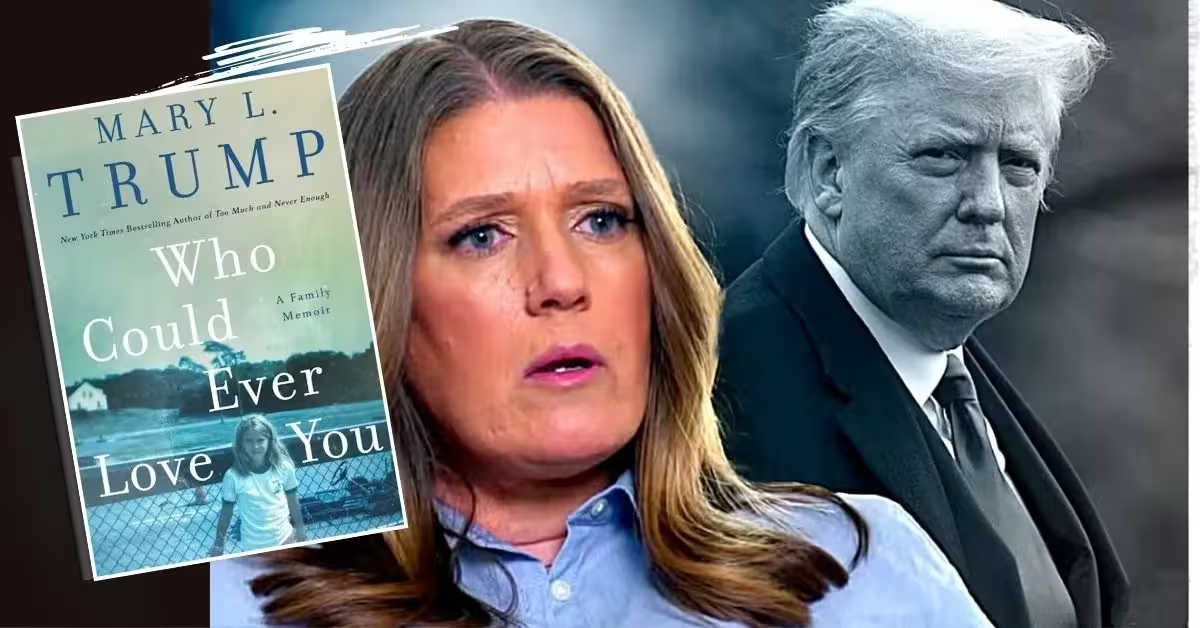
Most political memoirs are written to win arguments. Mary Trump’s third book, Who Could Ever Love You, published in 2024, reads more like an attempt to survive one. It is a family history told from the inside by a woman who says the Trump name has been both her inheritance and her wound.
I approached it warily, expecting another round of attacks on her famous uncle. There are some of those. But the book’s real subject is a lonely childhood, a father who drank himself to death young, and the long work of recovering from a family the author describes as cold, competitive and cruel.
Table of Contents
Where the Book Begins
The prologue opens in 2021 at a clinic where Mary Trump is receiving ketamine treatment for severe depression. She describes it as a last resort. She had become isolated and dissociated, unable to leave her apartment even as the world reopened after the pandemic. When a doctor asks what brought her there, her answer, in effect, is her uncle: the moment Donald Trump became a public figure again, the family story she had tried to leave behind became impossible to escape.
It is a striking way to begin, and an honest one. It also tells the reader what kind of book this is: personal first, political second.
A Childhood Without Shelter
Mary Trump’s portrait of her mother, Linda Clapp, is among the hardest parts of the book. She describes a parent who was distant and indifferent, recalling nights when, as a small child struggling to breathe through asthma attacks, she went to her mother for help and did not get it. Those memories stayed with her into adulthood, and even during her mother’s final illness the relationship never healed.
Her father, Fred Trump Jr., known as Freddy, is the book’s tragic centre. He trained and flew as a commercial pilot for TWA, a career she says his father and younger brother openly mocked as little better than driving a bus. In her account, Fred Trump Sr. had no use for gentleness and steadily crushed his eldest son’s confidence. Freddy’s drinking worsened, his marriage collapsed, and she recounts a frightening incident from her very early childhood involving a hunting rifle. He died in 1981, at forty-two, when Mary was sixteen.
The Inheritance Fight
After Fred Trump Sr. died in 1999, Mary and her brother, Fred Trump III, challenged his will, which they believed unfairly cut out their father’s branch of the family. In retaliation, according to both siblings, the family stopped paying for health insurance that covered Fred III’s infant son, who was seriously ill. The case ended in a settlement. Fred III later gave his own account in his memoir, All in the Family, and the siblings have since grown apart, partly, Mary writes, over his disapproval of her personal life.
Her Uncles
Her memories of Donald Trump and his younger brother Robert are of careless roughness rather than affection: ball games played with too much force, and pain brushed off as nothing. In 2020 Robert Trump went to court to try to stop her first book, Too Much and Never Enough, from being published. He failed, and he died a few weeks later. The book closes this chapter with a quiet scene in New York at night, where she allows herself to feel, at least briefly, that her life might open up again.
Who Mary Trump Is
Born in New York in 1965, Mary Trump studied English literature at Tufts University and then at Columbia, where she was drawn to William Faulkner and his stories of families in decline. She later earned a doctorate in clinical psychology from the Derner Institute at Adelphi University and taught courses in trauma and developmental psychology.
She stayed out of public life until 2020, when Too Much and Never Enough became a bestseller. In that book she argued, as a psychologist, that her uncle’s behaviour reflected deep unresolved damage, while noting that a formal diagnosis would require proper testing. A second book, The Reckoning, followed in 2021, along with a podcast and frequent television commentary. She is openly gay and has a daughter. More of her public story can be followed through The Independent’s coverage.
What I Took From the Book
- Family wounds travel down the generations. The cruelty she describes did not begin with one person, and it did not end with one death.
- Public success can hide private collapse. She was a confident commentator on television while struggling to leave her home.
- A parent’s indifference can be as damaging as open hostility. The asthma memories are a quiet but devastating example.
- Seeking help is not weakness. The book treats treatment for depression as an act of survival, not shame.
- Telling your own story can be a way of taking back control, especially when others have told it for you.
My Verdict
Who Could Ever Love You will not change anyone’s politics. Readers who dislike Donald Trump will find confirmation, and his supporters will see a bitter relative with a grudge. Both reactions miss what is most valuable here: a frank account of growing up unloved in a powerful family, and of the slow, unfinished work of recovery.
It is sometimes repetitive and leans heavily on memories that only the author can vouch for, which is the nature of memoir. As a portrait of a family and a woman trying to step out of its shadow, though, I found it more moving than I expected.
If you are struggling with depression yourself, please speak to a doctor or someone you trust. You do not have to carry it alone.







