
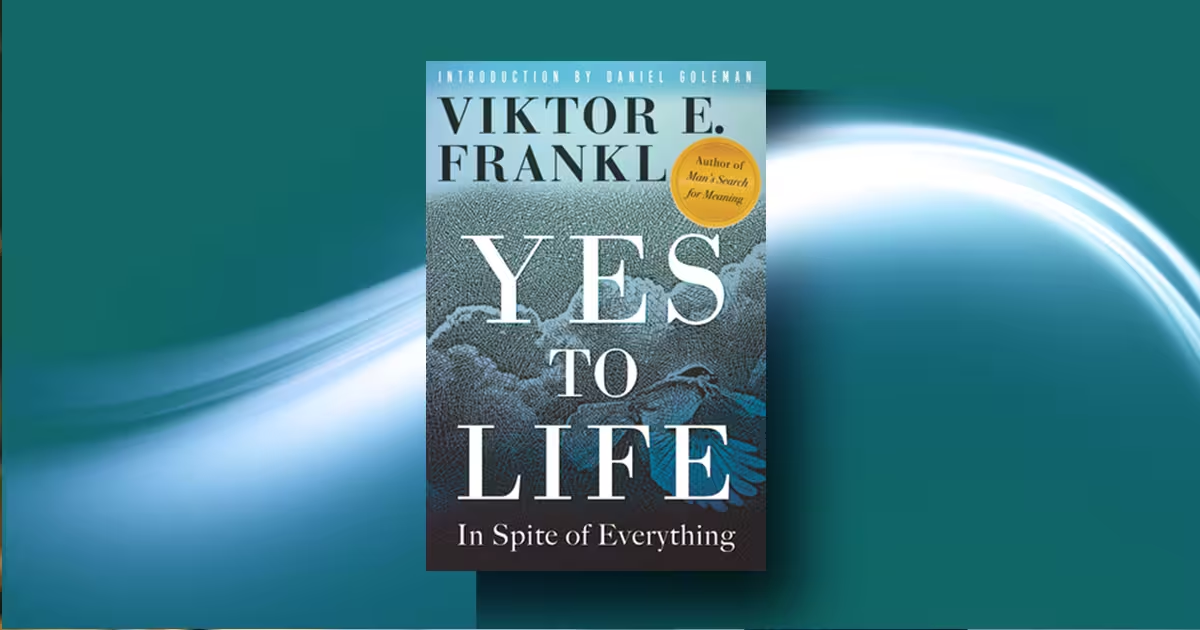
Do you feel tired of shallow happiness advice when life itself feels heavy, unfair, or uncertain? That is why Yes to Life: In Spite of Everything by Viktor E. Frankl felt valuable to me: it does not tell us to feel happy; it asks us to live responsibly, even when happiness is absent.
Yes to Life is best for readers of Man’s Search for Meaning, students of psychology and philosophy, people facing grief or uncertainty, general readers interested in Holocaust literature, mental-health ethics, logotherapy, existential therapy, resilience, and meaning-centered living.
Not for: readers looking for a light self-help book, a step-by-step productivity manual, or a purely biographical Holocaust memoir. This is brief, intense, philosophical, and morally demanding.
Table of Contents
Introduction
Yes to Life: In Spite of Everything is a short but emotionally immense nonfiction book by Viktor E. Frankl, the Austrian psychiatrist, neurologist, Holocaust survivor, and founder of logotherapy.
The lectures behind the book were given in 1946, only months after Frankl’s liberation from a Nazi labor camp. Daniel Goleman’s introduction explains that Frankl delivered these talks in March and April 1946, between the writing and publication of Man’s Search for Meaning.
The German text had first appeared in 1946 through Franz Deuticke, then later re-emerged before appearing in English for the first time in 2020.
In simple terms, what is Yes to Life about? It is about how a human being can still affirm life after propaganda, war, bereavement, illness, disability, concentration camps, death, and moral collapse.
It is not optimism in the easy sense. In fact, Frankl’s optimism is sharpened by pessimism. He does not deny suffering; he asks what kind of person suffering asks us to become.
Frankl’s credentials matter here. According to the Viktor Frankl Institute, he used the term logotherapy as early as 1926 for a meaning-centered approach to mental healing, and the question of meaning and values became the central theme of his life’s work.
The same official biography records that he directed the Neurological Department of the Rothschild Hospital in 1940 and, at personal risk, falsified diagnoses to prevent Nazi “euthanasia” procedures against mentally ill patients.
That background explains why Yes to Life is not merely a philosophical meditation. It is also a medical, ethical, and civilizational argument.
The central thesis is this: life does not become meaningful because it is painless, successful, long, productive, or socially admired. Life becomes meaningful when a person answers the concrete demand of the moment with responsibility. Frankl’s key reversal is: “What does life expect of me?”
Background
Initially, it may seem that Yes to Life is simply a companion to Man’s Search for Meaning. In contrast, I felt it was more like a philosophical emergency address. Frankl was not writing from a comfortable distance. He was speaking to people who had seen Europe collapse morally, politically, and spiritually.
The historical background is severe.
The United States Holocaust Memorial Museum states that Nazi Germany and its collaborators murdered six million Jewish people in the Holocaust, alongside millions of non-Jewish victims.
It also records that people with disabilities in institutions and care facilities numbered an estimated 250,000–300,000 victims, including at least 10,000 children.
This matters because one of Frankl’s major arguments in Yes to Life is directed against the idea that any life can be judged “unworthy” because it is ill, disabled, dependent, or apparently unproductive.
Buchenwald also matters to the title. The USHMM notes that Buchenwald was established in 1937, and that by liberation more than 21,000 people were found in the camp on April 11, 1945.
In Goleman’s introduction, the phrase “yes to life” is linked to a Buchenwald camp song whose lyrics expressed the prisoners’ will to affirm life in spite of terror. Therefore, the title is not decorative. It is a moral claim rescued from a place designed to annihilate moral claims.
Frankl’s own biography intensifies the book. The Viktor Frankl Institute records that in 1942 Frankl, his wife Tilly, and his parents were deported to the Terezin Ghetto; in 1944, Frankl and Tilly, along with his mother, were transported to Auschwitz-Birkenau, where his mother was immediately murdered, and Frankl was later moved to Kaufering and Tuerkheim, Dachau subcamps.
The Institute also states that Frankl was liberated on April 27, 1945, and soon learned of the deaths of his wife, mother, and brother.
With this in mind, Yes to Life is not abstract resilience talk. It is a book written at the edge of despair by someone who had every emotional reason to refuse consolation.
Yes to Life Summary: The Book’s Main Ideas, Fully Explained
1. The first problem: propaganda destroyed the value of life
Frankl begins by asking whether it is still possible to speak of meaning, value, and human dignity after recent history. His answer is complicated.
On one hand, after Nazi defeat, people could again speak freely. On the other hand, words like meaning and dignity had been damaged by propaganda and mass murder. Frankl argues that Nazi ideology had attacked not only people’s bodies but the very idea that human life has value.
A major trait of this book is that Frankl does not treat “meaninglessness” as a private mood only.
He sees it as something societies can produce. When a culture tells workers they are merely economic instruments, when a regime treats prisoners as disposable labor, when medical systems judge the sick by productivity, meaning is socially wounded. This leads to one of the book’s most powerful insights: despair is not always irrational; sometimes despair is the soul’s response to a world that has behaved irrationally.
Nevertheless, Frankl refuses fatalism. He says that after such catastrophe, naive optimism is impossible, but action is still necessary. In other words, the book does not say, “Everything will be fine.”
It says: because everything is not fine, your responsibility matters even more.
2. Happiness is not the purpose of life
One of the most useful parts of Yes to Life is Frankl’s critique of happiness as life’s central goal. Generally, self-help culture tells us to chase happiness, protect our peace, remove discomfort, and maximize pleasure. Frankl’s view is almost the opposite. He argues that happiness cannot be hunted directly. It comes as a result of fulfilling responsibility.
To put it another way, happiness is not the assignment; it is sometimes the after-effect of doing the assignment. Frankl uses examples of people who feel that life has become meaningless because it no longer gives them what they expected.
Then he turns the question around. Life is not primarily something from which I demand satisfaction. Life is something that demands an answer from me.
This is where I felt the book became personal. It made me ask: am I disappointed because life has truly become meaningless, or because I have been asking the wrong question? Frankl’s reversal is not sentimental. It is severe. It removes self-pity without removing pain.
3. Meaning is concrete, not general
Frankl argues that asking for “the meaning of life” in a general way is too vague. He compares it to asking a chess master for the best possible chess move without showing the position on the board. There is no universal move. There is only the right move in a specific situation.
This is why Yes to Life feels more practical than it first appears. Frankl is not asking us to solve existence in theory. He is asking us to answer the next concrete situation.
The question changes from person to person and from hour to hour. What life asks of a parent, a grieving person, a doctor, a worker, an unemployed person, a patient, or a survivor will not be identical.
Accordingly, meaning becomes local. It lives in the hour in front of me. It may be a task I must finish, someone I must love, a pain I must bear without becoming cruel, or a truth I must tell.
4. Meaning comes through action, love, and suffering
Frankl’s most famous framework appears clearly in this book: human beings can find meaning in three main ways. First, through action: doing, creating, working, serving, and bringing something into the world. Second, through experience and love: receiving beauty, nature, art, music, and the presence of another person. Third, through the attitude one takes toward unavoidable suffering.
This is the heart of the Yes to Life. Frankl does not say suffering is good. In fact, he is careful: suffering becomes meaningful only when it is unavoidable. If suffering can be removed, we should remove it. But if it cannot be removed, then the last freedom is how one bears it.
The book’s most tender examples are not heroic in the cinematic sense. One dying patient, no longer able to work, read, listen to music, or speak freely, still thinks of sparing the night nurse unnecessary trouble. Frankl presents this as a human achievement greater than professional success. Likewise, a judge who loses a leg feels that life as a “cripple” has no point, and Frankl gently challenges whether the man’s entire meaningful life can really be cancelled by the loss of one physical capacity.
In truth, this is where Frankl’s book becomes more than philosophy. It becomes a defense of human dignity in conditions where society often looks away.
5. Death does not erase meaning; it creates urgency
Frankl makes a surprising argument about death. He asks us to imagine immortality. If we had endless time, every decision could be postponed forever. Because we are mortal, every moment matters. Our limits make responsibility urgent.
This does not make death pleasant.
Frankl is not trying to beautify mortality. Rather, he argues that finitude gives weight to human choices. If I fail to act, love, forgive, create, or endure today, that exact hour never returns. Yet, if I do act, something is saved into reality.
His line from Hebbel, “Life is not something, it is the opportunity for something!” is a perfect summary of this section.
6. Frankl’s strongest ethical argument: no life is “unworthy”
The second lecture turns to illness, mental illness, disability, euthanasia, and the medical gaze. This is the section that may surprise modern readers most.
Frankl is reacting to the Nazi misuse of “euthanasia,” not primarily to today’s debates about physician-assisted dying. The USHMM explains that in the Nazi context, “euthanasia” became a euphemism for a clandestine murder program targeting patients with mental and physical disabilities.
Historians estimate that the Nazi Euthanasia Program killed about 250,000 men, women, and children.
Frankl’s answer is absolute: doctors are not judges over the worth of a patient’s existence. He criticizes the medical habit of reducing a person to “a case.” He insists that the patient remains a human being who has an illness, not a disease-object that can be evaluated only by usefulness.
This section moved me because it exposes how easily efficiency becomes cruelty. Typically, modern societies do not use Nazi language, but we still often measure people by productivity, youth, beauty, economic contribution, and independence. Frankl pushes back: a person’s value is not the same thing as their utility.
7. Suicide, despair, and the question of public health
Frankl treats suicide as a philosophical and clinical problem. His argument is that suicide does not answer life’s question; it destroys the field in which the answer might still appear.
His short formulation is: “Suicide is never able to solve a problem.”
Because of the subject, it is important to handle this carefully. Frankl’s position should not be read as blame toward people in suicidal crisis. In fact, his life’s work included prevention.
The Viktor Frankl Institute records that he organized youth counseling centers in Vienna in 1928–1929 and, in 1930, organized a special counseling initiative after which student suicides dropped significantly.
The issue remains urgent today. According to the World Health Organization’s March 2025 fact sheet, more than 720,000 people die by suicide every year, suicide is the third leading cause of death among 15–29-year-olds, and 73% of global suicides occur in low- and middle-income countries.
WHO also emphasizes evidence-based prevention: limiting access to means, responsible media reporting, socio-emotional life skills for adolescents, and early identification, assessment, management, and follow-up for people affected by suicidal behavior.
Thus, Frankl’s book should not be used as a substitute for mental-health care. Rather, it gives language to one part of prevention: helping people discover that life may still be asking something of them, even when they cannot yet feel hope.
8. Concentration camp experience: the experiment that tested the philosophy
The third lecture, “Experimentum Crucis,” returns to the camps. Frankl describes prisoners reduced to hunger, fear, apathy, and bodily exhaustion. Yet he rejects the idea that the camp automatically reduced everyone inwardly. Some people regressed, but others achieved moral greatness. The crucial point is that even when everything external was taken, some form of inner freedom remained.
This is where Yes to Life connects most visibly to Man’s Search for Meaning. The argument is not that victims controlled their fate. They obviously did not. The argument is that the Nazis could control circumstances, bodies, hunger, labor, and death, but not every possible inward stance.
Importantly, Frankl does not romanticize the camps.
He remembers the animal-like reduction of life to food, warmth, sleep, and survival. He also admits that the best among the prisoners often did not return, and that survival could feel like undeserved mercy. Because of this, the moral task after survival becomes action in everyday life.
9. The final message: everyday life is where meaning is proved
The ending of Yes to Life is not a grand abstraction. Frankl returns to daily responsibility. He argues that lectures and words are not enough; one must act. Everyday life becomes the place where meaning is either fulfilled or forfeited.
For this reason, the book’s final force is practical. It asks me not merely what I believe about life, but how I answer emails, treat tired people, respond to illness, endure disappointment, use my freedom, and carry my grief. In other words, the book relocates philosophy from the classroom to the kitchen table, the hospital bed, the workplace, the family, and the next hard hour.
Analysis: My Personal Review of Yes to Life
Yes to Life: In Spite of Everything is a small book with the weight of a moral monument. I found it poignant, severe, and strangely consoling—not because it makes life easier, but because it makes suffering less meaningless.
What makes Frankl’s argument effective is that he supports it through several layers of evidence: philosophical reasoning, medical experience, patient stories, suicide-prevention work, and concentration camp testimony.
This combination gives the book unusual authority. A purely philosophical book might have felt too abstract. A purely memoiristic book might have felt too private. Frankl’s power is that he moves between the personal and universal without losing either.
His reasoning is also logically strong. If life’s value depended only on pleasure, then pain would destroy it. If life’s value depended only on productivity, then illness and age would destroy it. If life’s value depended only on success, then failure would destroy it.
Frankl rejects all three foundations. Instead, he places meaning in responsibility, love, moral attitude, and the concrete answer to the present moment.
Moreover, modern research does not prove Frankl’s philosophy, but it does make his intuition look psychologically serious. A 2019 JAMA Network Open cohort study of 6,985 U.S. adults older than 50 found that life purpose was significantly associated with all-cause mortality; those in the lowest purpose category had a higher mortality hazard than those in the highest purpose category after adjustment.
The authors concluded that stronger purpose in life was associated with decreased mortality and that purposeful living may have health benefits.
Still, I would not call Yes to Life an easy book. At times, Frankl’s tone can feel demanding. Readers in fresh grief or clinical depression may find the language of responsibility heavy.
Nevertheless, I think the book’s harshness is also part of its honesty. Frankl is not writing from comfort. He is trying to rebuild a moral vocabulary after a civilization has shown what happens when human beings are ranked, sorted, and discarded.
Strengths and Weaknesses
The greatest strength of Yes to Life is its moral clarity. Frankl does not confuse comfort with meaning. He does not reduce people to symptoms, diagnoses, jobs, youth, usefulness, or happiness.
Above all, he gives dignity back to people whom society often treats as burdens: the sick, the dying, the unemployed, the mentally ill, the disabled, the grieving, and the defeated.
Another strength is the book’s brevity. Because it is based on lectures, it moves quickly. There is no padding. Every section carries weight. Additionally, the book feels urgent because the historical context is so close to the surface. Frankl is not explaining suffering from a safe academic distance; he is speaking from the ashes.
However, there are drawbacks.
First, some examples are medically dated, especially the psychiatric language.
The publication note itself acknowledges that some German medical terms from Frankl’s time were changed because they are no longer acceptable, while other gendered language was retained to preserve the original tone. Second, Frankl’s argument about unavoidable suffering can be misunderstood.
A careless reader might treat it as a command to endure preventable injustice. That would be a serious misreading. Frankl’s own distinction is clear: change fate where possible; where it cannot be changed, change one’s stance.
Third, the book is more lecture than memoir. Readers expecting a full camp narrative may prefer Man’s Search for Meaning. In contrast, readers who want Frankl’s philosophy in a concentrated ethical form may find Yes to Life even more direct.
Comparison: Books like Yes to Life
Compared with Man’s Search for Meaning, Yes to Life is less narrative and more argumentative. Man’s Search for Meaning gives the famous camp memoir and an introduction to logotherapy.
Yes to Life feels like the philosophical workshop behind it: more compressed, more public, more concerned with rebuilding society after moral collapse. The Viktor Frankl Institute records that Man’s Search for Meaning was published in the U.S. in 1959 under the title From Death Camp to Existentialism, while Yes to Life came from Frankl’s 1946 public lectures on meaning, resilience, and embracing life after adversity
Compared with The Doctor and the Soul, Yes to Life is shorter and more accessible. The Institute notes that Frankl began writing the first version of The Doctor and the Soul in 1941, laying out the foundations of logotherapy and existential analysis, but was forced to discard the unpublished manuscript upon arrival at Auschwitz-Birkenau.
Yes to Life does not replace that systematic work, but it distills its ethical pulse.
Compared with existential writers like Camus, Frankl is less interested in absurdity as a final condition. He does not deny absurdity, nihilism, or despair; he simply refuses to stop there. Whereas absurdist literature often asks how to live without ultimate certainty, Frankl asks how to answer responsibly even when certainty is gone.
FAQ
1 . What is the main idea of Yes to Life by Viktor Frankl?
The main idea is that life can remain meaningful under all circumstances when we answer the concrete demands of the moment through responsibility, love, action, and moral attitude.
2. Is Yes to Life the same as Man’s Search for Meaning?
No. It is related, but different. Yes to Life is based on Frankl’s 1946 lectures after liberation, while Man’s Search for Meaning is his better-known camp memoir and logotherapy text.
3. What are the three ways to find meaning according to Frankl?
Frankl presents meaning through doing or creating, experiencing beauty or loving someone, and taking a meaningful stance toward unavoidable suffering.
4. Is Yes to Life a religious book?
Not strictly. It has spiritual and ethical resonance, but its argument is psychological, philosophical, and existential. Religious readers may read it as a call to mission; secular readers may read it as a call to responsibility.
5. Who should read Yes to Life?
Anyone interested in Viktor Frankl, logotherapy, meaning in suffering, moral responsibility, Holocaust literature, existential psychology, or philosophical self-help should read it.
Conclusion
Yes, Yes to Life: In Spite of Everything is worth reading, especially if you want a book that treats meaning as something deeper than mood, success, or comfort. It is suitable for general readers, students, psychologists, philosophers, caregivers, and anyone who has felt that ordinary motivational language is too thin for real suffering.
My final feeling is this: Yes to Life is not a book that pats you on the shoulder. It stands beside you in the ruins and asks what you will do next. That is why it still matters.
Frankl’s great contribution is not that he explains suffering away. He does something harder: he refuses to let suffering have the last word.
Therefore, if you read only one short philosophical book on meaning, dignity, and responsibility after catastrophe, this should be very high on your list.







