
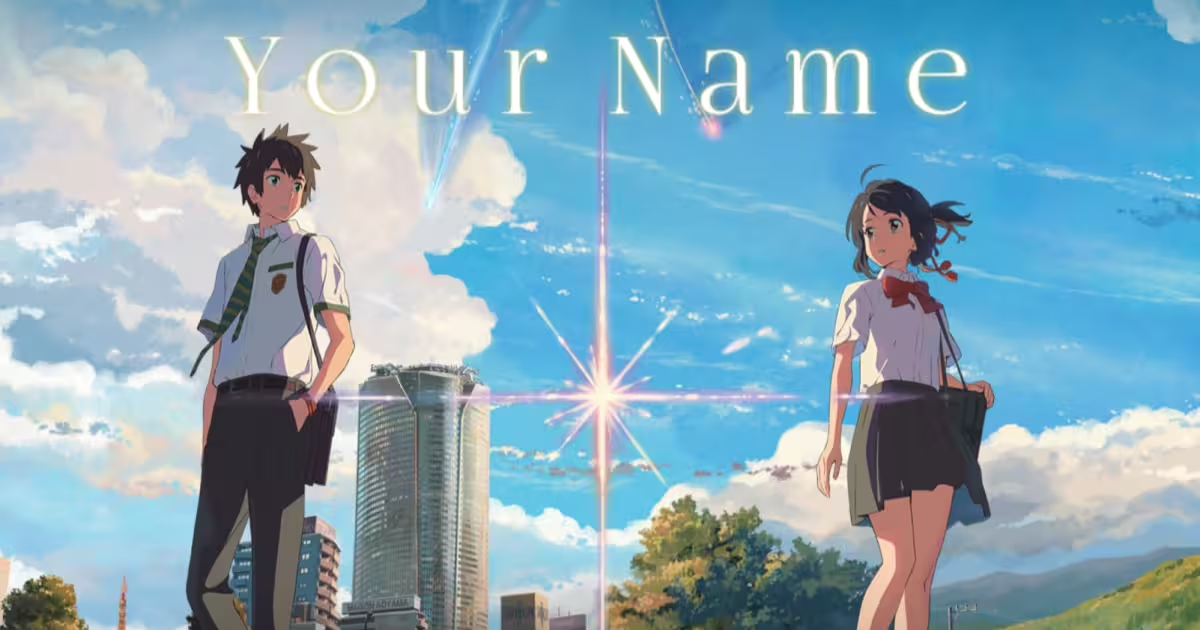
Have you ever woken up feeling like part of you is missing, like you’ve lost a connection you can’t quite name? That’s the quiet ache Makoto Shinkai taps into with Your Name (2016), the Japanese animated film that took the world by storm.
Known in Japan as Kimi no Na wa, this romantic fantasy follows two teenagers who mysteriously swap bodies, weaving together themes of fate, time, and human bonds against the backdrop of a looming disaster.
When I first watched Your Name back in 2017, it hit me harder than I expected.
The visuals were breathtaking, sure, but it was the emotional pull—the way it made me think about lost connections in my own life—that stayed with me. Years later, rewatching it in 2026, it still feels fresh and profoundly moving.
For me, it’s not just one of the best anime films of the 2010s; it’s a masterpiece that redefined what animated storytelling could achieve globally, grossing over $358 million worldwide with re-releases pushing it even higher.
Table of Contents
Background
Makoto Shinkai wrote and directed Your Name after visiting areas devastated by the 2011 Tōhoku earthquake and tsunami. In interviews, he’s shared how seeing ruined towns made him imagine swapping places with those affected—what if we could rewrite tragedy?
This personal reflection shaped the film’s core: natural disasters aren’t just events; they’re disruptions to the threads connecting people across time.
Produced by CoMix Wave Films with a modest budget of about $7.5 million, it exploded in Japan, becoming the highest-grossing film of 2016 there and briefly the top-earning Japanese movie ever (until Demon Slayer overtook it).
Its cultural impact was huge, boosting anime’s mainstream appeal and inspiring everything from tourism to real locations like Hida and Tokyo spots featured in the film.
Even now, with re-releases in 2025 adding to its box office, Your Name remains a touchstone for how stories about loss and hope can resonate universally.
Your Name (2016): At a Glance
Quick Facts
- Original Title: Kimi no Na wa (君の名は。)
- Director & Writer: Makoto Shinkai
- Genre: Animated Romantic Fantasy / Drama
- Release Date: August 26, 2016 (Japan) | Premiered at Anime Expo July 3, 2016
- Runtime: 107 minutes
- Studio: CoMix Wave Films | Distributor: Toho
- Main Voices: Ryūnosuke Kamiki (Taki Tachibana) | Mone Kamishiraishi (Mitsuha Miyamizu)
- Music: Radwimps (iconic tracks: “Zenzenzense”, “Sparkle”, “Nandemonaiya”)
- Box Office: ~$405 million worldwide (with re-releases)
- Accolades: Widely praised; former highest-grossing anime film; multiple awards including Best Animated Feature (LA Film Critics, Sitges, etc.)
One-Line Synopsis
Two high school students from very different worlds mysteriously begin swapping bodies, forming a deep connection that unfolds against breathtaking skies and a looming comet.
Why It Matters
Makoto Shinkai’s masterpiece blends stunning animation, emotional depth, and themes of fate, time, and human bonds. It became a global phenomenon, inspiring tourism to real-life locations and cementing Shinkai’s reputation alongside Studio Ghibli legends.
As of January 2026 (10th Anniversary Updates)
- Theatrical re-release planned for February 13, 2026 in select markets.
- Special film concerts featuring Radwimps scores performed live by the Tokyo Philharmonic Orchestra.
- Live-action remake (Paramount/Bad Robot, directed by Lee Isaac Chung) still in development – no confirmed release yet.
- Shinkai is teasing a brand-new anime film announcement for 2026.
A timeless gem that’s perfect for rewatching – beautiful, heartbreaking, and hopeful all at once!
Your Name Plot Summary
Your Name centers on Mitsuha Miyamizu, a high school girl in rural Itomori, and Taki Tachibana, a boy in bustling Tokyo. Mitsuha dreams of escaping her small-town life, even wishing aloud to be a “handsome Tokyo boy” in her next life. One morning, she wakes up in Taki’s body—and he in hers. This body-swapping starts randomly, happening every few days.
At first, it’s chaotic and funny. Taki (in Mitsuha’s body) fumbles through shrine rituals and school, while Mitsuha (in Taki’s) navigates city life, his part-time job at an Italian restaurant, and even sets him up on a better date with his crush, Miki Okudera.
They leave notes—on phones, paper, even skin—setting rules like “don’t touch anything weird” (though Taki famously ignores that, leading to hilarious and awkward moments).
Gradually, they influence each other’s lives positively: Mitsuha makes Taki more outgoing, and Taki helps Mitsuha gain confidence and popularity.
But things deepen. While in Mitsuha’s body, Taki joins her grandmother Hitoha and sister Yotsuha at the family shrine, learning about “musubi”—the Shinto concept of binding threads, connecting people, time, and even gods. Mitsuha mentions an approaching comet, Tiamat, set to shine brightest during Itomori’s festival.
Then the swaps stop. Taki tries calling Mitsuha but can’t connect. Obsessed, he sketches Itomori from memory and travels there with friends Tsukasa and Okudera. What he finds shatters everything: the town was destroyed three years earlier when comet fragments struck, killing over 500 people—including Mitsuha and her family.
Here’s the twist that elevates the film: Taki and Mitsuha weren’t swapping in real-time. Mitsuha lived in 2013; Taki in 2016. They were separated by three years, connected through some mystical thread of time.
Devastated, Taki visits the shrine crater and drinks the kuchikamizake Mitsuha left as an offering—fermented rice wine made traditionally (and intimately) with her saliva. This sends him into a vision of her life, revealing she once visited Tokyo in 2013 to find him (after early swaps), but he didn’t recognize her. She gave him her red kumihimo braid, which he’s worn as a wrist cord ever since.
Taki wakes in Mitsuha’s body on the day of the 2013 festival—the day of the disaster. With Hitoha’s guidance (she senses the family tradition of such connections), he rallies Mitsuha’s friends Tessie and Sayaka to sabotage the town’s power and broadcast a fake evacuation alert.
Meanwhile, Mitsuha wakes in Taki’s 2016 body.
As twilight falls—”kataware-doki,” a magical time when worlds blur—they finally meet in person at the shrine mountain. It’s heartbreakingly brief. They promise to write names on each other’s hands to remember, but as twilight ends, Mitsuha only manages “I love you” on Taki’s palm before he’s pulled back.
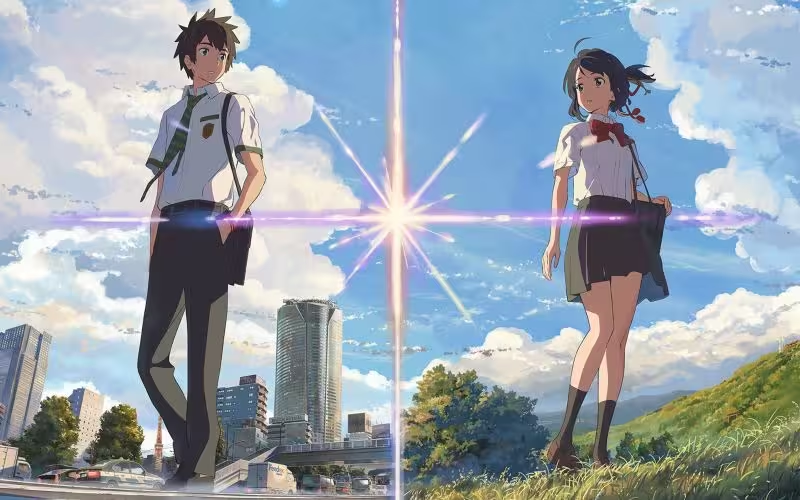
Back in 2013, Mitsuha—fueled by faint memories—convinces her estranged father (the mayor) to evacuate properly. The town is saved, but timelines shift: no one dies, yet memories of each other fade.
Five years later, in 2021-2022, adult Taki feels an unexplained longing. He passes Mitsuha (now in Tokyo) on trains and stairs. Finally, at Suga Shrine steps, they lock eyes and blurt out simultaneously: “Your name is…?”
The ending isn’t a tidy reunion with names exchanged; it’s the raw recognition of a bond that transcended time, disaster, and memory itself. Shinkai leaves it open—they’re starting anew, but that thread pulled them together again.
For me, this resolution is perfect: life isn’t about perfect recall; it’s about the persistent pull toward meaningful connections.
Your Name Analysis
1. Direction and Cinematography
Shinkai’s vision shines through his meticulous world-building. He blends everyday realism with ethereal beauty—Tokyo’s crowded streets contrast Itomori’s serene mountains, and comet-lit skies feel almost tangible.
Techniques like detailed backgrounds (inspired by real locations) and dynamic camera work during swaps make you feel the disorientation. The twilight meeting, with its golden hues and swirling clouds, is pure visual poetry.
2. Acting Performances
Voice acting carries the emotional weight. Ryunosuke Kamiki as Taki brings impulsive energy that softens into quiet determination, while Mone Kamishiraishi’s Mitsuha evolves from frustrated to resilient.
Their chemistry—even across timelines—feels authentic, especially in comedic body-swap scenes and the tearful mountain reunion. Supporting roles, like Etsuko Ichihara’s wise Hitoha, add depth without stealing focus.
3. Script and Dialogue
Shinkai’s screenplay is tight, balancing humor, romance, and tragedy. Dialogue feels natural—teen banter, family tensions, philosophical musings on time.
Pacing builds masterfully: early comedy gives way to mystery, then urgency. Minor weakness? Some exposition via Hitoha feels direct, but it fits the cultural context.
Your Name Themes and Messages
Diving deeper into Your Name (2016), what strikes me most is how Makoto Shinkai weaves a tapestry of profound themes that feel both intimately personal and universally human.
At the core is musubi — that beautiful Shinto concept Hitoha Miyamizu explains to Taki (in Mitsuha’s body) during their visit to the shrine. She describes it as the tying of threads, the binding force that connects people, time, and even the gods. “Knotting thread is musubi. Connecting people is musubi.
Time flowing together is also musubi,” she says. It’s not just a plot device; it’s the film’s philosophical heartbeat.
This idea extends to the famous red thread of fate, symbolized so perfectly by Mitsuha’s crimson kumihimo braid. In East Asian folklore, an invisible red string ties destined lovers, no matter the obstacles.
Here, that literal braid—handed from Mitsuha to Taki in 2013, worn by him unknowingly until 2016—becomes the tangible proof of their bond across a three-year gap.
Even when memories fade, the thread pulls them back together on those Tokyo stairs in 2022. For me, it’s a reminder that some connections aren’t logical or remembered; they’re felt in the gut, that unexplained longing Taki carries through his adult life.
Then there’s the heavy layer of disaster and collective trauma. Shinkai has openly shared how the 2011 Tōhoku earthquake and tsunami shaped this story—he visited devastated areas like Yuriage and felt a profound “what if this was my town?”
The comet Tiamat splitting and destroying Itomori mirrors real catastrophic events: sudden, indiscriminate loss. But unlike reality, where prevention wasn’t possible, the film offers a fantasy of rewriting tragedy. Through their cross-time connection, Taki and Mitsuha avert the deaths of 500 people.
It’s hopeful catharsis—Shinkai processing national grief by imagining human bonds strong enough to bend fate and save lives.
This ties into his so-called “disaster trilogy” (Your Name, Weathering with You in 2019, and Suzume in 2022), where natural calamities aren’t villains but forces that reveal human resilience, love, and sacrifice.
In Your Name, the disaster isn’t punished; it’s altered through empathy and effort. As someone who’s followed Shinkai’s work, I see this as his way of grappling with Japan’s frequent earthquakes and tsunamis—turning helplessness into stories of agency and healing.
The body-swapping adds another rich dimension: empathy through lived experience. Taki and Mitsuha literally walk in each other’s shoes—one in bustling Tokyo, the other in isolated rural Itomori.
It lightly explores gender roles (the comedic breast-groping gags give way to deeper understanding) and broader divides: urban vs. rural, tradition vs. modernity. Mitsuha yearns for city excitement; Taki discovers the quiet beauty of shrine rituals and community.
When they influence each other—Mitsuha making Taki kinder on his date, Taki boosting Mitsuha’s popularity—it shows how understanding “the other” changes us for the better.
In a polarized world, that’s potent: true connection requires inhabiting someone else’s perspective.
Time, memory, and forgetting form a bittersweet thread too. The twist—that they’re separated by years, with swaps happening across timelines—plays with non-linear time, echoing Shinto views of cyclical existence.
Yet the cruelest part is the fading memories: after saving the town, they forget names and faces, retaining only vague emptiness. But feelings linger—that persistent ache driving Taki to search, Mitsuha to move to Tokyo. Shinkai seems to say memory is fragile, but emotional bonds endure.
It’s why the ending hits so hard: they meet as strangers, asking “Your name is…?” No full recall, just renewal. Fate isn’t a fixed destination; it’s something we remake through persistence.
On a personal level, rewatching Your Name in 2026, amid ongoing global crises—climate disasters, lingering post-pandemic isolation—it feels more relevant than ever.
We’ve all felt disconnected, scrolling through digital “threads” that don’t quite satisfy. The film whispers that real musubi persists: across distances, time, even loss.
In Shinkai’s words from interviews, it’s about hope after trauma—dreams and connections saving us when logic fails. For me, it’s why the tears come every time during that twilight meeting or the final stairs scene. Joy in reunion, grief in what was almost lost, ultimate faith in human ties.
Ultimately, Your Name isn’t just a romance or fantasy; it’s a meditation on how we’re all knotted together in ways we can’t always see or remember. In a divided era, it reminds us to reach out, to tie those threads tighter—because they might just pull us through the next disaster, whatever form it takes.
Comparison
Compared to Shinkai’s earlier works like 5 Centimeters per Second (bittersweet distance) or later Weathering with You (climate defiance), Your Name feels more optimistic and accessible.
It stands out from typical body-swap stories (like Freaky Friday) by adding time-bending and catastrophe, making the romance feel cosmic. Unlike Miyazaki’s epics, Shinkai’s intimacy grounds the fantasy.
Audience Appeal/Reception
Your Name appeals broadly—to anime fans, romantics, even casual viewers drawn by hype. It’s family-friendly (mild fanservice aside) yet deep for cinephiles.
Critically acclaimed, it won Best Animated Feature from Los Angeles Film Critics, Sitges Festival, and more; nominated for Japan Academy Prize. No Oscar win, but it qualified and boosted anime’s prestige.
Personal Insight and Lessons: Its Relevance Today
Watching Your Name in 2026, nearly a decade after release, I can’t help connecting it to our world now. The film’s roots in the 2011 disaster echo ongoing crises—climate events, floods, cyclones that displace communities (thinking of recent ones here in Bangladesh, where resilience is daily life).
Shinkai didn’t set out to make “disaster movies,” but his trilogy (Your Name, Weathering with You, Suzume) grapples with how we heal collectively.
For me, the biggest lesson is about connection in an increasingly isolated era. Post-pandemic, many feel that lingering emptiness Taki describes—that search for “something, or someone.”
Social media ties us digitally, yet real “musubi” often fades like memories in the film. The body swaps highlight empathy: living another’s life, even briefly, builds understanding across divides—rural/urban, gender, even time.
Today, amid polarization and digital overload, Your Name reminds us to treasure fleeting bonds. That red thread of fate? It’s not magic; it’s the effort to reach out, remember, and find each other again.
In a time of loss—whether from disasters or drifting apart—the film’s hope endures: no matter the barriers, meaningful connections pull us back. It’s why I rewatch it when life feels disconnected; it reignites that quiet belief in human threads holding us together. (Word count: ~520)
Your Name Quotes
- “I’m always searching for something, for someone. This feeling has possessed me, I think, from that day… the day the stars fell.” – Taki (capturing that unnamed longing)
- “Musubi is the old way of calling the local guardian god… Knotting thread is musubi. Connecting people is musubi.” – Hitoha Miyamizu (explaining the film’s core philosophy)
- “So we don’t forget when we wake up… Let’s write our names on each other.” – Taki and Mitsuha (heart-wrenching moment at twilight)
- Taki and Mitsuha (simultaneously, at the end): “Your name is…?”
Pros and Cons
| Pros | Cons |
|---|---|
| Stunning, detailed animation and visuals that feel alive | Some early pacing feels light before the heavy twists |
| Emotional depth with perfect blend of humor, romance, tragedy | Minor plot conveniences (like the exact twilight timing) |
| Memorable soundtrack by Radwimps that elevates every scene | Fanservice moments might feel dated to some viewers |
| Universal themes of connection and resilience | Ending’s openness frustrates those wanting full closure |
| Masterful twist that recontextualizes everything |
Conclusion
Your Name (2016) remains a timeless gem—visually spectacular, emotionally resonant, and profoundly human. Makoto Shinkai crafted something that transcends anime, speaking to anyone who’s felt an inexplicable pull toward another person or place. If you haven’t seen it, do; if you have, rewatch—it only gets better.
A must-watch for anyone craving stories about love defying time and tragedy.
Rating: 9.5/10







