
Last updated on September 3rd, 2026 at 04:40 pm
What if the world is already sliding toward a new era of great-power conflict, and most people still don’t understand why? From the U.S.-China rivalry to energy crises and the war in Ukraine, making sense of today’s chaos requires a trusted intellectual framework. That’s where this curated guide to the best books on world order and geopolitics comes in—featuring the enduring classics and modern must-reads that diplomats, investors, and university syllabi rely on to decode how power actually works.
This curated list of the 15 best books on world order and geopolitics represents the enduring consensus across foreign-policy circles in 2026 provides you the answers to that.
The list draws from my personal choice, recurring recommendations in think-tank reading lists (Council on Foreign Relations, Brookings, Chatham House, Quincy Institute), top-rated titles on Goodreads, Foreign Affairs “Best of” selections, syllabi at leading universities (Harvard, Georgetown, LSE, Sciences Po), and the books that practitioners, diplomats, and macro investors still quote most frequently.
In an increasingly volatile global landscape—marked by U.S.-China strategic rivalry, Russia’s ongoing war in Ukraine, energy crises, semiconductor supply-chain struggles, and the unmistakable rise of a truly multipolar world—understanding geopolitics and world order has never been more essential.
But understanding geopolitics can feel overwhelming: wars and alliances, trade routes and technology races, ideology and identity, energy and finance—all interacting at once. “World order” is the name we give to the shifting set of rules, power balances, and institutions that shape how countries cooperate, compete, and sometimes collide.
The good news is that you don’t need a PhD to build a strong mental model. The fastest way is to read a small set of high-signal books that explain (1) how power works, (2) why geography still matters, (3) how global systems are built and broken, and (4) what’s changing now—from U.S.–China rivalry to chips, energy, and economic warfare.
Whether you’re a student of international relations, a policy professional, a business leader making high-stakes decisions in global markets, or simply a curious citizen trying to make sense of the daily headlines, the right books can give you the intellectual framework to see the bigger picture clearly and confidently.
These are not trendy new releases (though some recent ones have already earned classic status); they are the works that have proven most insightful, predictive, and indispensable for understanding how power actually works.
This guide curates 15 best books on world order and geopolitics—a balanced canon of classics and modern must-reads. It’s designed for busy readers: each pick includes what it teaches you and why it’s worth your time.
Table of Contents
What “world order” really means
World order isn’t a single master plan. It’s an evolving structure:
- Power: who can shape outcomes (military, economic, technological, informational)
- Rules and legitimacy: the principles states claim to follow (sovereignty, borders, human rights, trade norms)
- Institutions: alliances, treaties, and organizations that stabilize (or fail to stabilize) competition
- Geography and resources: chokepoints, buffer zones, energy routes, demographics, industrial capacity
- Narratives and identity: ideology, nationalism, religion, civilizational identity, domestic politics
A strong reading list should help you see how these layers fit together—and why today’s order feels more contested than it did in the immediate post–Cold War era.
Defines Geopolitics
Geopolitics is the study of how Earth’s geography influences politics and international relations. It serves as a method to understand and predict international political behavior by analyzing geographical variables—such as natural resources, climate, and topography—and focuses on political power linked to geographic space.
The 15 best books on world order and geopolitics
1. World Order by Henry Kissinger
If you want one book that frames the whole topic, start here. In Word Order, Kissinger explains how different regions and civilizations developed distinct ideas of legitimacy and order—from Westphalia in Europe to strategic tradition in China—then asks the big question: can a shared global order exist when the world disagrees on the rules?
Best for: big-picture world order framework, historical perspective.
2. The Grand Chessboard by Zbigniew Brzezinski
Brzezinski’s warning that control of Eurasia is the key to global primacy remains astonishingly prescient almost three decades later. His line “Without Ukraine, Russia ceases to be a Eurasian empire” is still the most-quoted sentence in contemporary geopolitical debate.
Best for: grand strategy, the logic of Eurasian power politics.
3. The Tragedy of Great Power Politics by John J. Mearsheimer
This is the definitive statement of offensive realism: in an anarchic system (no world government), great powers fear each other and pursue regional hegemony for survival. Whether you agree or not, it’s hard to understand modern rivalry—especially U.S.–China—without knowing this framework.
Undoubtedly, The Tragedy of Great Power Politics is one of the best books on world order and geopolitics.
Best for: why great-power competition persists, realism as a toolkit.
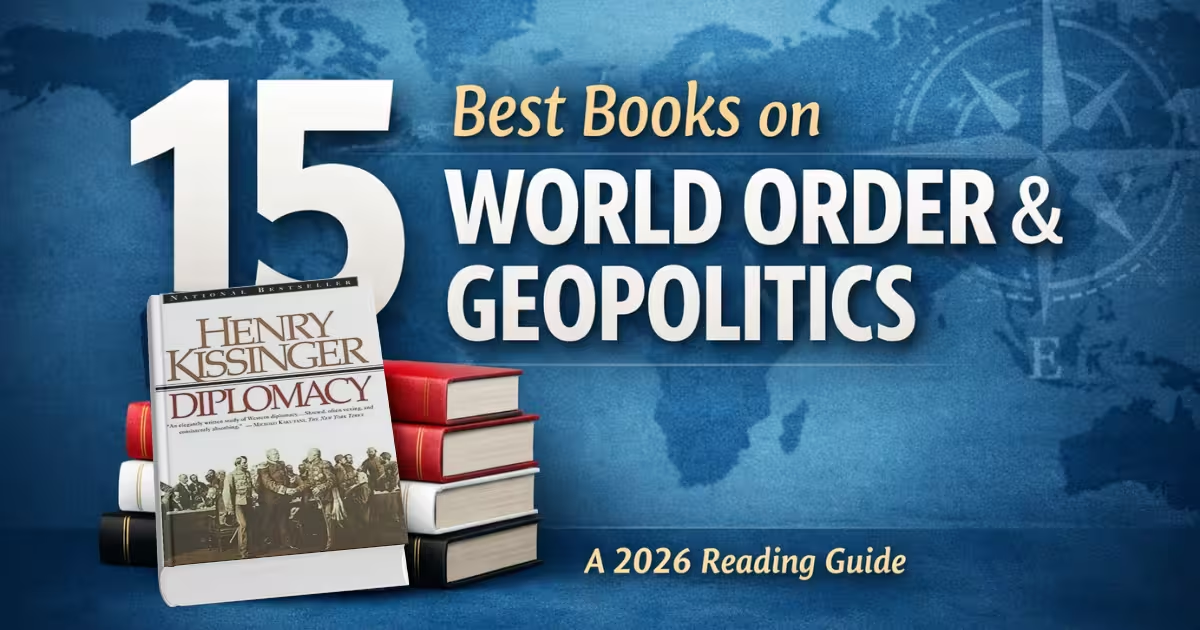
4. Diplomacy by Henry Kissinger
Diplomacy is a sweeping, magisterial history of diplomatic practice from Cardinal Richelieu through the Congress of Vienna, Bismarck, and the Cold War to Nixon’s opening to China. Kissinger illustrates how statesmen have balanced power, legitimacy, and morality across centuries.
No other book better conveys the art of statecraft, the recurring dilemmas of great-power management, and the personal qualities required to navigate them successfully.
Like me, few would dispute that Diplomacy belongs to the best books on world order and geopolitics.
Best for: how foreign policy is made, balance-of-power logic.
5. The Clash of Civilizations and the Remaking of World Order by Samuel P. Huntington
The Clash of Civilizations and the Remaking of World Order is controversial but unavoidable. Huntington argues that post–Cold War conflict increasingly aligns along cultural and civilizational lines rather than ideology alone. Even if you reject the framing, the book forces you to think seriously about identity, cohesion, and fault lines.
It is undeniable that The Clash of Civilizations and the Remaking of World Order is counted among the best books on world order and geopolitics.
Best for: culture/identity as a driver of conflict, debate-starter ideas.
6. Prisoners of Geography by Tim Marshall
Prisoners of Geography is the most accessible geopolitics book for newcomers. Marshall uses maps and constraints—mountains, rivers, ports, and plains—to show why nations behave the way they do. You’ll come away seeing borders and terrain as strategic destiny, not trivia.
Best for: beginners, geography-first explanations that “click.”
7. The Revenge of Geography by Robert D. Kaplan
Kaplan, in The Revenge of Geography, takes Marshall’s geographic determinism deeper, blending it with history, culture, and realist pessimism to forecast future flashpoints from the Indian Ocean to Eastern Europe. His elegant, literary prose makes complex terrain feel vivid and fateful.
A darker, more philosophical companion to Prisoners of Geography that reminds readers geography is not destiny—but it is a powerful constraint..
Best for: a more literary, layered geography + history lens.
8. The Rise and Fall of the Great Powers by Paul Kennedy
Kennedy’s analysis of “imperial overstretch”—when a great power’s global commitments exceed its economic and military resources—has become a classic lens for understanding hegemonic decline.
His historical survey from the Habsburgs to the contemporary United States warned of the dangers facing America decades ago, and the concept continues to frame debates about U.S. strategy in an era of fiscal strain and multiple commitments.
Best for: power cycles, decline dynamics, historical pattern recognition.
9. The Silk Roads by Peter Frankopan
The Silk Roads is a corrective to Euro-centric narratives. Frankopan recenters world history around the corridors connecting Europe, the Middle East, Central Asia, and China—regions that repeatedly become hubs of commerce, ideas, and power.
Best for: historical context that reshapes your mental map.
10. Destined for War: Can America and China Escape Thucydides’s Trap? by Graham Allison
Allison popularized the idea that when a rising power threatens a ruling power, conflict becomes more likely. The “trap” isn’t fate—but it’s a warning about miscalculation, fear, and escalation.
Best for: U.S.–China rivalry framing, strategic risk thinking.
11. The End of the World Is Just the Beginning by Peter Zeihan
A provocative argument about deglobalization, demographics, and how the post–Cold War trade system might fracture. Even if you disagree with some predictions, it’s a useful stress test for your assumptions about supply chains and security guarantees.
Best for: big, bold future scenarios; globalization’s fragility.
12. Chip War: The Fight for the World’s Most Critical Technology by Chris Miller
Chip War: The Fight for the World’s Most Critical Technology is the defining geopolitics book of the 2020s. Miller chronicles how semiconductors became the central chokepoint of global power, tracing the industry’s history from Cold War origins to today’s U.S.-China struggle for technological supremacy.
Clear, gripping, and deeply researched, it explains why chips are now more strategically vital than oil and why export controls have become the new frontline of great-power competition.
Best for: tech geopolitics, U.S.–China competition, Taiwan’s centrality.
13. The Anarchical Society by Hedley Bull
Bull offers a powerful middle path between pure realism and idealism: even without a world government, states form an “international society” with rules, norms, and institutions that maintain order—until they don’t.
Best for: institutions, legitimacy, and how order persists under anarchy.
14. The Future of Power by Joseph S. Nye Jr.
Power isn’t only tanks and GDP. Nye clarifies hard power, soft power, and smart power, and explains how networks, information, and cyber space reshape influence.
There is no question that The Future of Power ranks among the best books on world order and geopolitics. I consider it as valuable as the rest.
Best for: modern influence, narrative power, digital-era statecraft.
15.The End of American World Order by Amitav Acharya
A vital Global South perspective. Acharya argues the world isn’t simply shifting from West to East; it’s becoming “multiplex”—with multiple centers, narratives, and forms of order.
Best for: non-Western lenses, multipolar complexity, order beyond hegemony.
Extremely Close Runner-Ups
- The End of the World Is Just the Beginning by Peter Zeihan
- On China by Henry Kissinger
- The Long Game by Rush Doshi (best book on current Chinese grand strategy)
- Why Nations Fail by Acemoglu & Robinson (economic roots of power)
- The Power of Geography by Tim Marshall (sequel to Prisoners)
Suggested reading order
If you’re starting from zero, this sequence builds comprehension fast:
- Prisoners of Geography (instant intuition)
- World Order (big frame)
- The Grand Chessboard (strategic map of Eurasia)
- The Tragedy of Great Power Politics (core theory)
- The Rise and Fall of the Great Powers (long-cycle patterns)
- Chip War (today’s decisive frontier)
- The Anarchical Society + The Future of Power (institutions + modern influence)
Then read the rest based on your interests (history-heavy, identity/culture, or future scenarios).
How to choose the right book for your goal
- If you want one book: World Order
- If you’re a beginner: Prisoners of Geography
- If you want theory: The Tragedy of Great Power Politics
- If you want history + power cycles: The Rise and Fall of the Great Powers
- If you want modern competition (U.S.–China/Taiwan/tech): Chip War
- If you want institutions and rules: The Anarchical Society
- If you want a Global South lens: The End of American World Order
FAQ
What are the best books to understand geopolitics?
A strong starting set is World Order (Kissinger), Prisoners of Geography (Marshall), The Grand Chessboard (Brzezinski), The Tragedy of Great Power Politics (Mearsheimer), and Chip War (Miller). Together they cover order, geography, strategy, theory, and today’s tech competition.
What is the best beginner book on geopolitics?
Prisoners of Geography is the best beginner-friendly introduction because it explains global strategy using maps and physical constraints in clear, readable language.
Which book best explains U.S.–China rivalry?
Two complementary picks:
- The Tragedy of Great Power Politics (theory of rivalry)
- Chip War (the strategic industrial/tech battleground)
What is “world order” in international relations?
World order is the evolving system of power balances, rules, legitimacy, and institutions that shapes how states behave—cooperating, competing, and managing conflict.
Conclusion
Geopolitics rewards people who can hold multiple layers at once: geography, history, power, institutions, identity, and technology. This of 15 best books on world order and geopolitics is built to give you that layered understanding without drowning you in academic jargon or endless reading.
If you read only a few, make it these three:
- World Order (the master frame)
- Prisoners of Geography (constraints that never go away)
- Chip War (the modern battlefield of power)
From there, the rest of the list helps you develop real fluency—enough to understand not just what’s happening in the world, but why it’s happening, and what might come next.