
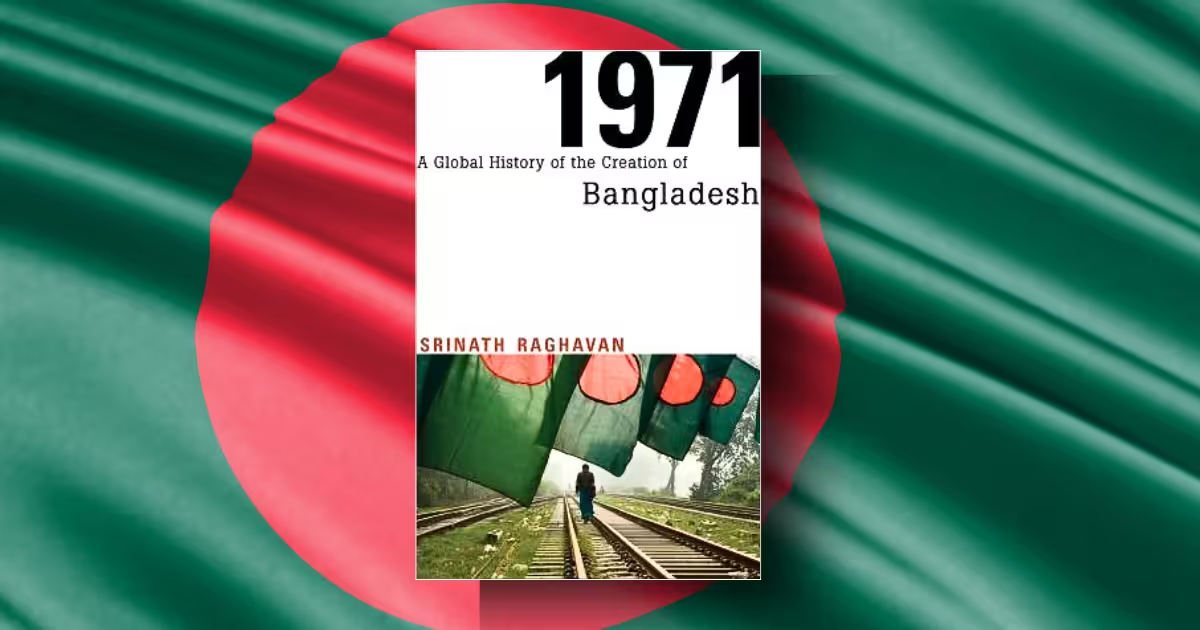
Have you ever wondered how a country can be born not just from the courage of its people, but from the strategic miscalculations of superpowers, the egos of dictators, and a global concert headlined by George Harrison? Srinath Raghavan’s 1971: A Global History of the Creation of Bangladesh is not just another history book; it’s a geopolitical thriller that will fundamentally change how you understand the map of South Asia.
Overview
If you think you know the story of Bangladesh’s independence, the military crackdown, the refugee crisis, and India’s intervention, you’ve only scratched the surface. Raghavan’s book is a masterclass in international history, arguing that the breakup of Pakistan was far from inevitable.
Instead, it was the product of a perfect storm: the global protests of 1968, the Cold War rivalry between the US, USSR, and China, and the early stirrings of globalization.
Who will actually love 1971: A Global History of the Creation of Bangladesh?
History buffs who crave a fresh, non-nationalistic perspective on a pivotal 20th-century event.
Students of international relations and diplomacy, as it dissects the motivations of global superpowers with surgical precision.
Anyone fascinated by the “what ifs” of history, as Raghavan presents a narrative full of contingency and chance.
Readers who appreciate meticulous research, as the book draws on archives from the US, UK, Russia, and Australia.
Who might bounce off it?
If you are looking for a purely human-interest story or a personal memoir of the war, the book’s dense, analytical focus on geopolitics and decision-making might feel a bit dry at times. This is a book about states and their strategies, not just the soldiers and civilians on the ground.
Table of Contents
1. Introduction
Title: 1971: A Global History of the Creation of Bangladesh
Author: Srinath Raghavan
Publication Details: Harvard University Press, Cambridge, Massachusetts, 2013. The Indian edition was published by Permanent Black.
Srinath Raghavan is a distinguished historian and professor of International Relations and History at Ashoka University, India. A non-resident senior fellow at Carnegie India, his primary research focuses on the contemporary and historical aspects of India’s foreign and security policies.
This expertise makes him uniquely qualified to untangle the complex web of international diplomacy that surrounded the 1971 crisis. As a reviewer notes, Raghavan is “intent in upending myths and conventional and perceived wisdom”.
Context of 1971: A Global History of the Creation of Bangladesh
The book is a work of international and diplomatic history. It places the 1971 India-Pakistan war and the creation of Bangladesh within the broader framework of three major global processes: decolonization, the Cold War, and incipient globalization.
Rather than seeing the conflict as a purely South Asian affair, Raghavan argues it was a global event shaped by actors from Washington to Moscow, Beijing to London, and even the global counterculture.
Purpose of 1971: A Global History of the Creation of Bangladesh
Raghavan’s central message is a direct challenge to the prevailing determinism in the historiography of the region. He contends that “there was nothing inevitable about the emergence of an independent Bangladesh in 1971”.
The book sets out to demonstrate that the creation of Bangladesh was “the product of conjuncture and contingency, choice and chance”.
By examining the interplay between domestic, regional, and international dimensions, he aims to provide a more accurate and nuanced explanation for Pakistan’s breakup.
2. Background
To understand the crisis, Raghavan first sets the stage. He walks the reader through the inherent tensions within Pakistan since its creation in 1947.
The “Two Wings” Problem: United Pakistan was a geographic anomaly, two wings separated by 1,000 miles of hostile Indian territory.
Linguistic and Cultural Divide: The central government’s push to make Urdu the sole official language sparked the Bengali Language Movement in 1952. As Raghavan notes, for many in the Bengal delta, this “shattering of the dream of Pakistan” marked a “sharp psychological rupture”.
Economic Exploitation: The economic disparity between the two wings was stark. For instance, foreign exchange earnings from East Pakistan’s jute exports were used to fund the industrialization of West Pakistan. By 1968, the disparity was glaring: the top twenty-two families in Pakistan controlled 66% of the country’s industrial wealth.
Political Marginalization: Despite having a demographic majority, Bengalis were politically sidelined by a West Pakistani bureaucratic-military oligarchy.
The book’s prologue and first two chapters masterfully map this situation, leading up to the “chilling events of Operation Searchlight on March 25 by the Pakistani army in Bangladesh”.
3. 1971: A Global History of the Creation of Bangladesh Summary: A Global Chess Game
What makes this book truly special is its global lens. Raghavan shows that the fate of East Pakistan was not decided in Dhaka or Islamabad alone, but in the chancelleries of the world.
The Tipping Point: 1968 and the Fall of Ayub Khan
The book brilliantly connects the local Pakistani uprising against Ayub Khan to the global student protests of 1968. Raghavan cites a CIA report observing that “youthful dissidence… is a world-wide phenomenon”. In Pakistan, the students’ demands, which included full autonomy for East Pakistan, were influenced by global revolutionary fervor. This movement, which forced Ayub to resign, “shifted the tectonic plates that underlay united Pakistan”.
The Negotiator and the General: The Failure of Politics
Raghavan provides a day-by-day account of the disastrous power-sharing negotiations between the military ruler, General Yahya Khan, and the democratically elected leader of East Pakistan, Sheikh Mujibur Rahman. Yahya and his generals were not committed to a genuine transfer of power.
Instead, they, along with Zulfikar Ali Bhutto, worked to undermine the Awami League’s historic electoral mandate. As Raghavan details, the military’s plan was to prevent the Awami League from governing.
The Reluctant Neighbor: India’s Calculated Gamble
The book debunks the myth that Indira Gandhi had a clear, pre-planned strategy to invade East Pakistan from the start. Raghavan writes: “Contrary to the assertions of Manekshaw and his military colleagues, the prime minister did not contemplate such an intervention in the early stages of the crisis”.
- India’s initial response was marked by circumspection. The primary concern was the threat of a Chinese intervention, a fear that had haunted India since the 1962 war.
- The government was also acutely aware of the international legal and diplomatic implications of interfering in Pakistan’s internal affairs.
- The massive influx of refugees, nearly 10 million by December 1971, was the single most important factor that pushed India toward military action. The cost and security implications of hosting this population became unsustainable.
The Grand Strategists: Nixon, Kissinger, and the “Tilt”
One of the most absorbing sections of the book deals with the United States. Raghavan exposes the cynical “realpolitik” of the Nixon administration, which was willing to turn a blind eye to genocide in East Pakistan to further its own strategic goals.
- The White House’s “tilt” toward Pakistan was not born of deep affection for Islamabad but from a desire to use Pakistan as a conduit to open relations with China.
- Nixon and Kissinger believed that China’s support was crucial to counter the Soviet Union, and they were willing to sacrifice Bangladesh to achieve that end.
- Kissinger even claimed, “All we need is six months,” to complete the opening to China, revealing their short-term thinking in the face of a massive human tragedy.
The Reluctant Russians and the Chinese Puzzle
The Cold War dynamics were complex and not a simple US vs. USSR binary.
Soviet Union: Moscow was actually reluctant to see Pakistan break up. As the book notes, “The Soviet Union and Indian stances on the crisis were not in sync until late in the crisis”.
The Soviets were more concerned about Chinese influence in the region than about supporting Bengali nationalism. The Indo-Soviet Treaty of August 1971, often seen as a Soviet blank check for India, was actually signed partly because Moscow hoped it would restrain India.
China: Beijing was also ambivalent. While it was Pakistan’s ally, China was deeply worried about its own internal politics, the Lin Biao affair was a major distraction, and the threat from the Soviet Union.
As a result, China’s support for Pakistan was cautious and limited, though its posture contributed to India’s strategic anxiety.
Poster Child and Pariah: The Role of Global Public Opinion
In a unique chapter, Raghavan shows how the Bangladesh crisis became a global cause célèbre. This was the first major humanitarian crisis of the modern media age, where images and stories could sway global opinion.
Journalism: Anthony Mascarenhas’s front-page story in the Sunday Times, headlined “Genocide,” cracked the Pakistani censorship wall and changed the international narrative.
Pop Culture: The Concert for Bangladesh, organized by George Harrison and Ravi Shankar, brought the issue to a global youth audience. As Raghavan notes, for a few months, “Bangladesh seemed to distill all the hopes and fears of the Swinging Sixties”.
Humanitarianism: NGOs like Oxfam launched massive relief campaigns and lobbied their governments to act.
Despite this, Bangladesh remained a “pariah” in the UN, where state sovereignty was the overriding principle. The international system was still structured to prevent intervention in a member state’s internal affairs.
The Strange Victory
Raghavan’s analysis of the war’s end is perhaps his most provocative. He argues that India’s spectacular victory was not the result of a master plan.
India’s initial war aims were limited: to capture a portion of East Pakistani territory and install the Bangladesh government there. The capture of Dhaka was not the original objective.
The defeat of the Pakistani army was a result of a combination of military blunders by Pakistan and the sheer momentum of the Indian advance.
Perhaps most surprisingly, Raghavan suggests that India’s “complete victory” may have had long-term negative consequences. He calls the outcome a “grievous strategic error,” arguing that a quicker military intervention earlier in 1971 might have prevented the massive refugee crisis and the political chaos that later engulfed Bangladesh.
4. 1971: A Global History of the Creation of Bangladesh Analysis
My opinion? This book is a monumental achievement in modern history. Reading it, I felt a profound shift in my understanding of a conflict I thought I knew.
Raghavan’s writing, while dense, is remarkably clear and engaging. He doesn’t just tell you what happened; he shows you why it happened, peeling back the layers of decision-making to reveal the fears, ambitions, and miscalculations of the key players.
The author effectively supports his arguments with a staggering amount of evidence. He draws on archives from the United States, Canada, Britain, Germany, Russia, and Australia, as well as Indian archives and oral histories. This multi-archival approach gives his narrative an authority that is hard to dispute.
He fulfills his stated purpose brilliantly, providing a truly global history that reshapes our understanding of the creation of Bangladesh. As one reviewer notes, the book is “fantastic in locating the war of 1971 within varied sets of local and international contexts”.
5. Strengths and Weaknesses
Strengths
Meticulous Research: The book’s primary strength is its exhaustive research. Raghavan has done the painstaking work of digging through archives across the globe, and it shows.
Debunking Myths: It courageously tackles and dismantles the nationalistic myths that have dominated the historiography on all sides, India, Pakistan, and Bangladesh.
Global Perspective: By placing the South Asian crisis within the context of the global Cold War and the 1968 protests, he offers a fresh and compelling interpretation.
Nuanced Portrayal of Leaders: The book provides a fair, if unflinching, assessment of leaders like Indira Gandhi, Nixon, and Yahya Khan, showing them as fallible human beings making decisions under immense pressure.
Weaknesses
Dryness: For a general reader, the level of detail and the focus on diplomatic and strategic analysis can be overwhelming and, at times, dry.
Lack of Human Dimension: Critics have pointed out that the book is conspicuously silent on the extensive history of rape and violence against women during the war. By focusing so heavily on the “grand strategists,” the suffering of ordinary Bengalis is sometimes relegated to the background.
Dense Prose: The writing, while clear, is academic in tone. It is not a breezy read, but requires concentration to follow the complex web of international negotiations.
6. Comparison with Similar Works
Raghavan’s book builds upon but significantly surpasses the previous seminal work on the subject, Richard Sisson and Leo Rose’s War and Secession: Pakistan, India, and the Creation of Bangladesh (1990).
Sisson and Rose provided an excellent account based on interviews with key participants. However, their focus was primarily on the subcontinental actors.
Raghavan goes further by utilizing a vast trove of archival material that was unavailable to Sisson and Rose, and by placing the crisis firmly in its global context. He shows how “global politics meant in the early 1970s” in a way that his predecessors could not.
Another comparable work is Gary Bass’s The Blood Telegram, which also uses declassified US documents to explore the Nixon administration’s policy. However, Raghavan’s book offers a broader, more balanced scope, examining the policies of all the major powers and the interplay between them.
7. Conclusion
1971: A Global History of the Creation of Bangladesh is an indispensable work for anyone seeking to understand the modern history of South Asia.
It is a powerful reminder that history is not a predetermined march of events but a messy, contingent process driven by human choices and global forces.
Who should read it?
This book is highly recommended for students of history, international relations, and political science. It is also essential reading for anyone from India, Pakistan, or Bangladesh who wants to move beyond nationalistic narratives and understand the shared, complex history of their region.
It offers a profound lesson in how the decisions of a few powerful men in distant capitals can have devastating consequences for millions of ordinary people.







