
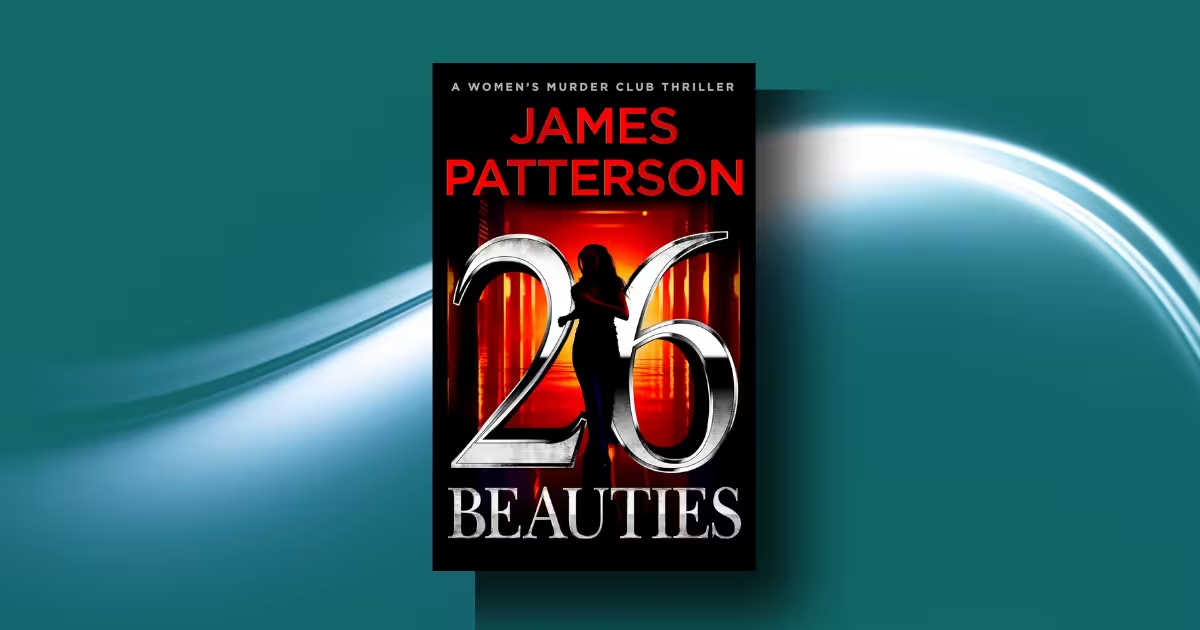
Does the idea of beautiful young women vanishing from city streets — preyed upon by the very people meant to help them — haunt you the way it haunts Lindsay Boxer? Because after turning the last page of 26 Beauties, it will stay with you for a long time.
26 Beauties is a razor-sharp procedural thriller that peels back the glossy surface of San Francisco to expose the human-trafficking networks preying on vulnerable young women — told through the unbreakable bond of four women who refuse to let the forgotten stay forgotten.
26 Beauties is best for fans of the Women’s Murder Club series, readers who enjoy fast-paced police procedurals with emotional depth, those who appreciate multi-protagonist crime fiction, and anyone who wants their thrillers grounded in real-world social urgency.
If you love Karin Slaughter, Lisa Gardner, or Tess Gerritsen, this one is squarely in your wheelhouse.
Not for readers who prefer slow-burn literary fiction or standalone novels that require no context.
While 26 Beauties technically works as a standalone, long-time fans will draw infinitely more pleasure from the twenty-six-book character tapestry beneath it.
Table of Contents
1. Introduction
26 Beauties: A Women’s Murder Club Thriller is the twenty-sixth entry in James Patterson’s globally bestselling Women’s Murder Club series — a milestone number that the book’s very title acknowledges with a wink.
Published in May 2026 by Little, Brown and Company (a division of Hachette Book Group), it continues the story of San Francisco Homicide Sergeant Lindsay Boxer and her trio of brilliant, driven friends: Chief Medical Examiner Dr. Claire Washburn, Chronicle crime reporter Cindy Thomas, and Deputy District Attorney Yuki Castellano.
The series, which Patterson has written primarily in collaboration with Maxine Paetro over the years, began in 2001 with 1st to Die and has become one of the most consistent and commercially successful crime fiction franchises in publishing history.
2. Background
James Patterson was born in Newburgh, New York in 1947 and spent two decades as a top advertising executive at J. Walter Thompson before pivoting full-time to fiction writing at fifty.
His signature style — short, punchy chapters, multiple interlocking POVs, lean prose, and relentless pacing — was partly forged in the discipline of advertising, where every word has to earn its place.
He launched the Women’s Murder Club with 1st to Die in 2001, and the series proved popular enough to spawn a television adaptation on ABC (2007–2008), starring Angie Harmon as Lindsay Boxer.
That show lasted one season, drawing mixed critical reviews while building a loyal audience — the books, however, never stopped selling.
By book twenty-six, Patterson and Paetro have refined their formula to something close to an art form.
The world they’ve built — San Francisco’s Hall of Justice, Susie’s Café, the Tenderloin, Marshall’s Beach, the dynamics inside the Women’s Murder Club — feels as lived-in and real as any fictional universe in contemporary thriller fiction.
26 Beauties inherits that world in full and uses the familiarity of beloved characters to amplify a story about something far grimmer: the systematic targeting of young, vulnerable, and often beautiful women by predators who operate in plain sight.
Human trafficking is not a new subject for crime fiction, but Patterson brings to it a distinctly procedural intimacy.
Rather than treating trafficking as a backdrop for exotic international intrigue, he plants it firmly in the suburbs east of San Francisco, in a youth centre in a quiet town, in the ground-floor rooms of a hotel in the Tenderloin.
That proximity is what makes it feel real — and what makes the stakes feel genuinely personal.
3. 26 Beauties Full Plot Summary
The Celebration Interrupted
The novel opens with a stunning prologue: Tina Barnes — a woman living under a false identity in San Francisco, using the name “Cheyenne” while working at The Brass Ring Gentlemen’s Club — is accosted late at night in a parking lot when her borrowed BMW refuses to start.
A charming, tall man with dark hair offers to help, then produces what looks like an asthma inhaler and sprays her face with a homemade pepper spray.
Tina — whose real name is Audrey Ware, a woman who once snitched on a major Midwest meth operation and has since fled witness protection in Oklahoma — runs into Golden Gate Park. She doesn’t get far.
The story proper begins at the chapter one party thrown by Sergeant Lindsay Boxer in honour of her best friend, Claire Washburn, who has been named medical examiner of the year.
It’s a warm, beautifully staged scene — the Women’s Murder Club at ease, celebrating, laughing.
Lindsay’s husband Joe Molinari mingles with guests; Yuki Castellano teases Lindsay about her imitation Louboutins; Rich Conklin, Lindsay’s partner and Cindy’s husband, trades stories with off-duty officers.
Into this warmth steps Eric Snaff, a strikingly handsome youth services worker with a faded scar on his cheek.
He has crashed the party in desperation: his seventeen-year-old daughter Nicole disappeared three months ago, and he wants Cindy Thomas to investigate.
The evening shifts. Claire’s niece Hope storms out after an awkward confrontation at the party. And Lindsay, sharp as ever, files away everything she observes about Eric Snaff.
Two Bodies, One Pattern
While preparations for Cindy’s investigation are just beginning, two separate but troubling cases land on Lindsay’s desk.
The first: a young woman’s body, battered beyond identification, has washed up on Marshall’s Beach in the Presidio. Cause of death: strangulation. The victim carries no ID.
The second: Claire Washburn, picnicking with her musician husband Edmund in Golden Gate Park, finds a body in the grass. It turns out to be Tina Barnes — the woman from the prologue — killed by blunt force trauma to the throat, her face streaked with a homemade capsaicin spray.
Lindsay begins to wonder. Are these cases connected? T
he Jane Doe from Marshall’s Beach is eventually identified as Donna “Missy” Harris — a young woman from the streets who’d dreamed of being a stand-up comedian.
The connection between the two victims, as Claire eventually discovers, is a microscopic forensic detail: lecithin, an emulsifier used in homemade pepper spray, found on both bodies. Someone used the same improvised weapon on both women.
Meanwhile, Eric Snaff’s story grows more complicated. The San Julio Police Department, when Cindy visits, calmly informs her that their prime suspect in Nicole’s disappearance is Eric himself. Sergeant Stephanie Davis, a sharp, petite detective in a small East Bay town, tells Cindy bluntly: “So was Ted Bundy” charming.
The Investigation Widens
Cindy’s journalistic instincts and Lindsay’s police training start moving in parallel and occasionally intersecting trajectories. Cindy interviews Eric at his immaculately decorated house in Mountain View Acres, and he hands her a handwritten list of suspects.
He has been methodically investigating on his own. He also breaks down crying when Lindsay presses him about whether he had anything to do with Nicole’s disappearance — and his grief looks real, if not conclusive.
Lindsay, still juggling two unsolved homicides and a suspension handed down by her boss (Lieutenant Jackson Brady, who turns out to have orchestrated it deliberately to give her forced rest), reaches out across the Atlantic to Interpol.
She connects with Alain Creasy, a retired French police investigator now working in Lyon — a delightfully warm, Francophile character who quotes The Streets of San Francisco and invites himself to visit San Francisco. His knowledge of international trafficking rings is encyclopaedic.
On the street level, Barry Seifert — the self-styled “Duke of the Tenderloin,” a former tech engineer living rough in San Francisco’s most chaotic neighbourhood — becomes an unlikely asset.
He shows the composite of the Marshall’s Beach victim around the Tenderloin and reports back to Lindsay: strange things are happening. Girls are disappearing. A white SUV is circling certain neighbourhoods.
The Tenderloin Operation
Alain Creasy arrives in San Francisco, and the dynamic between him and Lindsay becomes one of the book’s warmest running threads.
Courtly, well-dressed, fond of Americana and bourbon chicken at mall food courts, Alain navigates the Bay Area’s mean streets with genuine delight and expertise.
Together, they visit Stonestown Galleria, where a witness — Alison Weaver, a City College marketing student who moonlights at The Brass Ring — confirms she spotted Nicole Snaff alive two weeks earlier on an escalator.
Nicole recognised her old soccer rival and immediately looked away.
Their investigation converges on the Garden Spot, a decrepit residential hotel on Ellis Street in the Tenderloin, where young women are drifting in and out in quantities that suggest organised prostitution.
They meet Tex, a large pimp in a cowboy hat who charges protection money. When Tex threatens them, Alain’s surprising physical capability (he has been shot at before, he notes cheerfully) helps defuse the confrontation.
Lindsay ends up body-slamming Tex and moving on.
A shooting incident outside the Luz Hotel — a bullet striking the wall inches above Alain’s head — initially reads as random street violence.
Later, Cindy’s co-investigator, Gina Scrittori, a youth services worker from San Julio, turns out to be the one who tipped off the shooter. Gina has been playing both sides the entire time.
The Trafficking Ring Exposed
The threads begin to braid tightly. Jason Cortlandt, a former youth centre worker on Eric Snaff’s suspect list, is tracked to a remote concrete factory by Cindy, who interviews him alone — a decision Lindsay later scolds her for.
Cortlandt claims he was hospitalised at the VA during Nicole’s disappearance, which checks out. But he levels an accusation at Eric Snaff that sets the final act in motion.
Eric, drunk and desperate, calls Cindy in the middle of the night.
The next morning, Lindsay and Cindy track his phone (with the help of Jake Hunter, a sixteen-year-old tech prodigy whom Lindsay met after he pickpocketed Alain at the mall food court and whom she handles with brisk pragmatic warmth) to the concrete factory, where Eric has cornered Cortlandt at gunpoint on a catwalk above industrial vats.
The confrontation is visceral. Eric, unshaven and hollow-eyed, presses a gun barrel to Cortlandt’s forehead.
Cortlandt confesses, under duress, that he gave Nicole’s phone number to a man named Kyle — a “stringer” who paid three thousand dollars per referral of a young, attractive girl. The confession is filmed on Cindy’s phone. Though legally inadmissible, it cracks the case open.
At the San Julio Police Department, Lindsay leverages the footage to extract a full, usable confession from Cortlandt.
He describes Kyle Anderson — tall, dark-haired, mid-forties, drives a white Range Rover, rents a house in Pacific Heights on Baker Street near the Presidio — as the linchpin of a San Francisco operation funnelling girls to wealthy clients, including some overseas placements to oligarchs and Gulf oil barons.
Lindsay, her suspension quietly lifted by Brady (who engineered the suspension to force her to rest, in one of the novel’s warmest reveals), assembles a team. Rich Conklin disguises himself as a delivery driver — UPS uniform from Marshalls’ clearance rack — and knocks on the Pacific Heights house door to scope the scene.
Three girls are inside. Nicole Snaff is not among them. Kyle is not there either.
The Final Chase
Kyle Anderson is eventually spotted in the Tenderloin, walking with Lizzie Nunez — a young woman who has been weaving in and out of the narrative’s margins throughout the book, desperately searching for a “tall man with dark hair” who might give her a better life. She has found him.
And he has her by the arm when Lindsay and Conklin close in.
Kyle produces a knife, takes Lizzie hostage, presses the blade to her throat, drawing blood. When he is briefly outmanoeuvred, he releases Lizzie, runs, and in the ensuing alley confrontation, uses his homemade pepper-spray inhaler — the same device used on Tina Barnes and Donna Harris — to blind Conklin.
Lindsay, thinking fast, grabs a newspaper from a garbage bin and uses it as a shield, then charges Kyle full-body into a brick wall. He is knocked unconscious.
At the hospital, handcuffed to a bed rail, Kyle Anderson rapidly calculates his odds and begins to bargain.
He offers addresses, phone numbers, names. And then he drops the name that connects everything: Gina Scrittori, the youth services worker who had been helping Cindy investigate, had been quietly feeding girls into Kyle’s network the whole time.
She had been the woman in the white SUV approaching vulnerable girls. She was the shooter’s informant who had tipped Kyle that Lindsay would be on Geary Street the day the shot was fired above her head.
Cindy and Lindsay set up a sting at a café. Kyle calls Gina in; she arrives cheerfully, talks freely about their operation, even mentions a new girl at the youth centre — “an absolute knockout.
She’s seventeen, almost six feet tall.” Gina is arrested mid-sentence. She shoots Kyle a murderous look as she stands up.
The Ending: Resolution and Reunion
Eight girls are recovered. Nicole Snaff is found alive at the Hotel Randall in the Mission, in a room with two other girls, drying her hair with a blue striped towel when the police knock.
The reunion is understated, but the weight of it lands hard.
In a parallel climax, Yuki’s drug-trafficking trial — running as a subplot throughout the novel — ends with terrifying violence when Elio Huerta’s associates smuggle a gun into the courtroom disguised as an inmate’s escort and attempt a prison break.
A bailiff named Frank Hodges is shot dead. Brady, in the gallery with his off-duty backup weapon, kills the shooter with a single shot to the throat. Elio is subdued by two off-duty patrol officers who had been coming to watch the trial every day out of professional curiosity. Angela Torres, the defence attorney, weeps in Yuki’s arms.
The book closes on two notes: warmth and continuity.
At Susie’s Café, the Women’s Murder Club celebrate — with Alain Creasy, with Joe Molinari, with Nicole Snaff and Eric Snaff in the room — and the reunion is everything the prologue’s darkness seemed to forbid.
Claire has a frank conversation with Hope about ZsaZsa, a synthetic marijuana that turns out to be Hope’s sideline hustle (not escort work, as Claire feared). The news is a relief, if not entirely comfortable.
The final scene is Lindsay at home: Joe, Julie, Martha the ageing border collie, peace. And then Brady calls. A body has been found near the Ferry Terminal. Reality comes calling again, as it always does.
4. 26 Beauties Analysis
4.1 26 Beauties Characters
Lindsay Boxer remains the moral and emotional centre of the Women’s Murder Club universe.
In 26 Beauties, she is characteristically relentless but also shown in quieter registers — sitting with Joe at a cliffside lobster roll dinner, reading A Bear Called Paddington to Julie until the little girl drifts off with one arm draped over her stuffed cow, Mrs. Mooey Milkington.
The novel does something subtle and important: it insists on showing us a cop who is not consumed by her cases.
Lindsay’s therapy-informed realisation that work was “keeping her from her best possible relationship with Julie” is threaded lightly but perceptibly through the book, giving her arc an internal dimension beyond the procedural.
Cindy Thomas has perhaps the richest character journey here. Her dogged, sometimes reckless journalism — surveilling a suspect alone, befriending Gina Scrittori without adequate caution, driving out to a concrete factory without backup — gives her both energy and fallibility.
The fact that she is simultaneously writing a book about the investigation adds a layer of self-consciousness about storytelling itself. Her eventual delight that Gina walks into their café trap is one of the book’s most satisfying moments.
Claire Washburn operates across registers: the professional excellence of her pathology work (the lecithin discovery is her finest moment), the warmth of her friendship with Lindsay, and the quietly domestic subplot of worrying about Hope.
Her ritual of filing closed cases — the careful, private ceremony of placing a completed folder in the cabinet — is one of the novel’s most moving passages.
Yuki Castellano carries the courtroom subplot largely on her own, and Patterson gives her enough procedural texture and emotional stakes (Brady’s arrival, the corruption of witnesses, the terrifying courtroom siege) to make her storyline feel urgent rather than peripheral.
Alain Creasy is a genuine delight — perhaps the most charming new character in recent Women’s Murder Club memory.
His ease with French, his amusement at being called a “frog,” his fondness for Van Gogh-patterned shirts and bourbon chicken, his calm when a bullet chips concrete above his head — all of it adds up to a character you genuinely hope appears again.
Kyle Anderson is a smoothly chilling villain: charming, controlled, never melodramatic.
His use of the inhaler as a weapon is genuinely unsettling. The revelation that two of his victims were not intended deaths — that Tina Barnes died because he panicked, that Donna Harris was strangled when she fought back — makes him more disturbing, not less. Malice without premeditation is a particular kind of horror.
Gina Scrittori is the book’s most satisfying twist. Looking back, her early scepticism about any trafficking conspiracy (“girls just run away”) reads differently once her role is revealed — she was protecting her own operation.
The moment she smiles and says “I hope you didn’t hurt her” after the near-shooting of Lindsay, knowing she arranged it, is retrospectively chilling.
4.2 26 Beauties Themes and Symbolism
The invisibility of the vulnerable. The novel’s most persistent thematic note is the ease with which beautiful, troubled young women disappear — and the ease with which that disappearance goes uninvestigated.
The police in San Julio regard Nicole as a probable runaway. The SFPD’s unidentified Marshall’s Beach victim sits unsolved for ten days. Patricia Barnes’s murder drifts between jurisdictions.
The system, Patterson implies, has learned to live with the loss of certain kinds of women. 26 Beauties names this as the predators’ operating environment, not an accident.
Beauty as vulnerability. The title is rich with irony. The twenty-six “beauties” are not trophies; they are targets.
Their attractiveness is the exact quality that makes them exploitable. Kyle Anderson does not need to coerce girls — he needs them to believe in the dream their looks might unlock.
Patterson’s portrayal of the trafficking mechanism is particularly astute here: girls are not kidnapped at gunpoint.
They are invited. The fantasy of escape, of glamour, of a life bigger than Walnut Creek, is the trap’s mechanism. Nicole Snaff herself volunteers: “She just felt like San Julio wasn’t big enough.” The horror is in the seduction.
Female friendship as a counter-system. Against the predatory networks of the novel, the Women’s Murder Club stands as its structural opposite — a group of women who share intelligence, trust each other’s instincts, refuse to let the case be dismissed, and create the kind of interdisciplinary collaboration that the formal system can’t or won’t provide.
The Tenderloin shooting’s resolution depends on Gina being caught in a conversation with a woman (Cindy) she had trusted and underestimated. The Women’s Murder Club’s greatest strength is often the relationships that make it seem merely social.
The limits of the official system. Brady’s orchestrated “suspension” — not a punishment but a welfare check in institutional disguise — gestures at a larger theme: institutions often cannot perform the care they claim to provide, so individuals must improvise.
Jake Hunter’s phone-tracing skills are technically extralegal. The coerced confession is inadmissible.
The DAS case nearly collapses because witnesses are being intimidated out of court. Justice, the novel suggests, is rarely clean. It accretes from unofficial relationships, leverage, personal loyalty.
Pepper spray as a symbol of failed protection. The homemade capsaicin spray that Kyle Anderson uses functions as a leitmotif. Ironically, it echoes the kind of self-defence product marketed to vulnerable women. In Kyle’s hands it is an assault weapon.
Lindsay’s newspaper improvisation — grabbing a broadsheet off a garbage bin to shield her face — reverses the predator-prey dynamic in the most satisfyingly unglamorous way possible.
5. Evaluation
26 Beauties is, in a word, assured — the product of a series confident enough in its machinery to make room for tenderness, and a subject serious enough to keep the thriller engine running at full heat.
5.1 Strengths
The pacing is, as always with Patterson, immaculate. No chapter outstays its welcome; several end on precisely the right phrase.
The Alain Creasy subplot is a genuine addition to the series canon, giving Lindsay a partner who is her intellectual equal without competing with the Women’s Murder Club itself.
The trafficking plot is handled with genuine research and moral seriousness — the mechanics of how girls are recruited, referred, and controlled are plausible and disturbing without being exploitative.
The subplot of Yuki’s courtroom siege is the book’s most viscerally exciting sequence: a bailiff dead, a gunwoman shot in the throat, Brady drawing his backup weapon in a civilian suit. Patterson cuts between this and the café sting arrest of Gina Scrittori with impeccable rhythm.
The lecithin discovery — Claire’s realisation that two apparently unconnected murders share the same forensic trace of a homemade emulsifier — is a genuinely satisfying piece of detective work. The kind of clue that, once revealed, makes you think: of course.
The domestic texture of Lindsay and Joe’s marriage — the lobster rolls on the cliff, the pancake breakfast with Julie, the careful conversation after the shooting — grounds the thriller in something worth protecting. These scenes are brief but weigh heavily in the emotional balance.
5.2 Weaknesses
The Lizzie Nunez subplot, while thematically coherent — she is a girl actively seeking the man who will exploit her, driven by desperation — feels slightly underdeveloped.
Her chapters are vivid, but she does not quite emerge as a full character; she is more a representative figure than a person, which slightly blunts the emotional impact of her rescue from Kyle’s knife.
Gina Scrittori’s betrayal, though satisfying as a thriller twist, perhaps comes slightly too easily. A reader attuned to crime fiction will sense her ambiguity early — her readiness to dismiss the trafficking theory, her aggressive handling of a witness on the pier. The reveal does not quite surprise as much as it confirms.
Some longtime readers may feel that twenty-six instalments have smoothed the rough edges off the characters to a degree.
The Women’s Murder Club members are reliably admirable now in ways that earlier books complicated more. This is a function of series longevity as much as craft — and for many readers, it will be a feature rather than a flaw.
5.4 Comparison with Similar Works
26 Beauties belongs to a rich tradition of American crime procedurals centred on female investigators navigating institutionally resistant environments: Karin Slaughter’s Will Trent and Sara Linton series, Tess Gerritsen’s Rizzoli & Isles novels, Lisa Gardner’s work.
What distinguishes Patterson and Paetro’s series is the ensemble structure — four professionals from interlocking disciplines — which allows the same case to be viewed through forensic, legal, journalistic, and investigative lenses simultaneously.
Among the Women’s Murder Club books themselves, 26 Beauties sits comfortably with the series’ better entries: tighter than some of the mid-run books, more emotionally grounded than the purely plot-driven entries, and possessed of a villain — Kyle Anderson — who is more unsettling precisely because he is more ordinary than charismatic.
Readers interested in the trafficking theme might also reach for Paula Hawkins’s Into the Water, Lisa Jewell’s Then She Was Gone, or Liz Moore’s Long Bright River, all of which circle similar territory with different formal approaches.
6. Personal Insight: Contemporary Relevance — The Reality Behind the Fiction
26 Beauties is fiction, but the world it describes is not.
Human trafficking is one of the most underreported and underinvestigated serious crimes in the United States, and California — where this novel is set — consistently registers among the highest numbers of reported cases in the country.
It is estimated that 199,000 incidents of human trafficking occur in the United States every year.
California consistently has the highest human trafficking rates in the country, with 1,334 cases reported in 2020 alone.
The national picture is worse: the number of persons convicted of a human trafficking offence in US district court increased from 616 in 2013 to 1,008 in 2023.
These numbers represent only detected and prosecuted cases — the vast majority of trafficking activity goes unreported.
Patterson’s novel captures the mechanism with uncomfortable accuracy.
Real trafficking operations rarely involve international criminal masterminds. They rely on low-level recruiters — youth workers, coaches, acquaintances — who are embedded in the communities of their targets.
The “stringer” model, where someone like Jason Cortlandt earns three thousand dollars for a referral, mirrors documented recruitment patterns. Traffickers use technology to recruit, control, market, and exploit vulnerable individuals while evading detection — advertising false job opportunities on social media platforms, using cryptocurrency to transfer funds, and perpetuating online scam operations.
The five most important lessons the novel articulates, drawing on the real world:
Lesson 1: Proximity matters more than distance. Trafficking does not need an international supply chain. The Garden Spot is in a San Francisco neighbourhood; the recruiting happens at suburban malls and youth centres. Awareness has to be local.
Lesson 2: Vulnerability is manufactured, not found. Girls who run away from difficult homes, girls who dream of modelling careers, girls who believe a charming stranger — these are not failures of character. They are predictable responses to structural deprivation. Prevention requires addressing the deprivation, not only the predator.
Lesson 3: System silos protect predators. As Lindsay discovers, a tip passed to the wrong detective in the wrong department goes nowhere. The San Julio police consider Nicole a runaway. The SFPD’s Homicide division is not the right routing for a missing persons case from a different jurisdiction.
Traffickers exploit these gaps with sophisticated skill. (National Human Trafficking Hotline: 1-888-373-7888 — available 24/7, confidential, in over 200 languages.)
Lesson 4: Informal networks can outperform formal institutions. Lindsay’s case breaks not through official channels but through a teenage pickpocket’s Apple contact, a retired French investigator’s Interpol database, a street informant’s social capital, and a reporter’s source network.
This is Patterson’s quiet argument for interdisciplinary, relationship-based approaches to complex crimes. [More at the Polaris Project]
Lesson 5: Fiction builds empathy infrastructure. Around the globe, an estimated 27 million people are exploited for labour, services, and commercial sex.
Numbers that large are cognitively difficult to absorb. Stories about one person — Donna Harris, who wanted to be a stand-up comedian; Tina Barnes, who wore a gold necklace with her real name, Audrey, because her grandmother gave it to her at fourteen — make the number human again.
That is what fiction does, and what 26 Beauties does in particular.
7. Conclusion
26 Beauties is exactly what a twenty-sixth instalment in a long-running series should be: confident, emotionally generous, procedurally sharp, and willing to stretch toward something larger than formula.
What distinguishes 26 Beauties from earlier entries in the series is its insistence on the systemic. The villain here is not just Kyle Anderson; it is the entire ecology that makes Kyle Anderson possible — the siloed institutions, the disposable girls, the trusted adults who betray them.
The Women’s Murder Club’s victory is real, but the final image is telling: a new body near the Ferry Terminal, another call coming in, Lindsay’s phone playing its gulag ringtone. Justice is perpetual, not conclusive.
Final recommendation: Absolutely essential for Women’s Murder Club devotees. Strongly recommended for thriller fans who care about social relevance alongside plot mechanics. One of Patterson’s most purposeful books in years — and, at book twenty-six, that is no small thing.







