
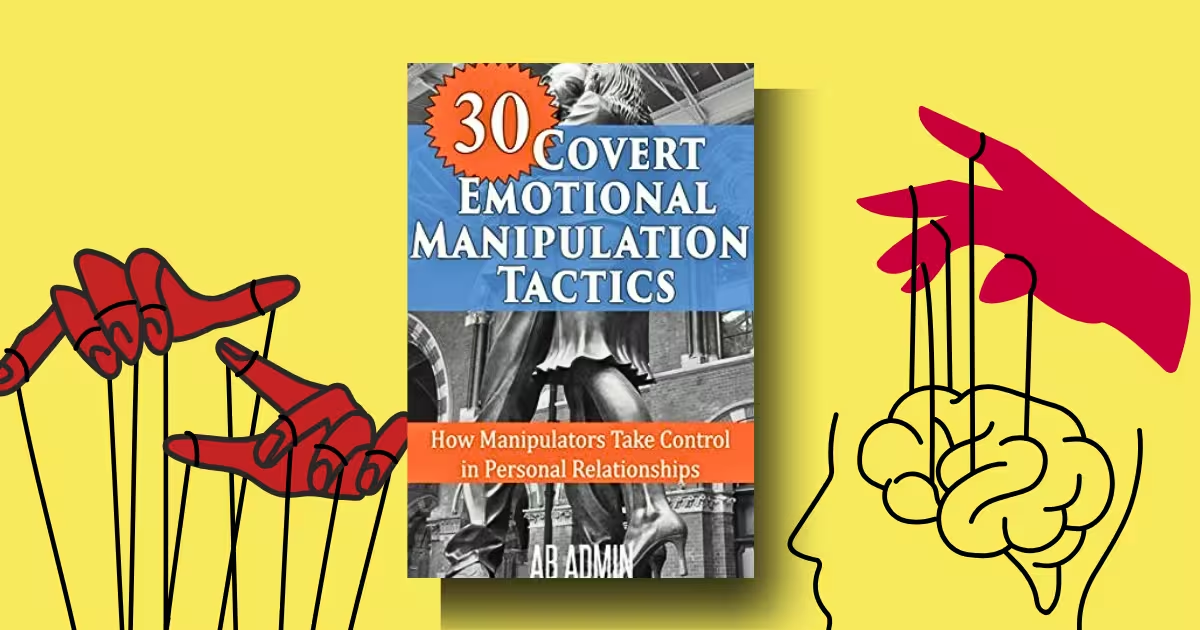
Can a 76-page book really unmask every manipulation tactic you’ve ever endured?
That was the question I kept asking myself when I first picked up Adelyn Birch’s 30 Covert Emotional Manipulation Tactics: How Manipulators Take Control in Personal Relationships. I had already spent countless nights lying awake, replaying conversations with a former partner, trying to pinpoint exactly when things had gone so wrong.
I knew something was off. I felt confused, anxious, and constantly on edge. But I couldn’t name it. I couldn’t see the strings. This book didn’t just give me a name for my experience—it handed me a map of the entire battlefield I had been stumbling through blindly.
Overview
Adelyn Birch’s 30 Covert Emotional Manipulation Tactics is a concise, no-nonsense guide that exposes the hidden methods manipulators use to control others in personal relationships. It’s a pocket-sized arsenal of awareness, designed to help you recognize manipulation not just by its tactics, but by its effects on you.
The book breaks down 30 specific strategies, from love bombing and gaslighting to intermittent reinforcement and the silent treatment, and explains how they work to undermine your self-worth and perceptions.
It is not a deep psychological treatise, but a practical, accessible field guide for anyone who suspects they are being controlled. Birch, drawing from her own experience as a victim of a psychopath, writes with a clear-eyed urgency that cuts through the confusion and self-doubt manipulation breeds.
Best for: Anyone who feels confused, anxious, or “crazy” in a relationship; individuals recovering from a toxic or abusive partnership; people who want to understand the mechanics of emotional abuse; readers who appreciate straightforward, bullet-point style information.
Not for: Those seeking an in-depth academic analysis of personality disorders; readers looking for a step-by-step therapy guide or detailed recovery plan; anyone who prefers long-form, narrative-driven self-help books.
Table of Contents
1. Introduction
30 Covert Emotional Manipulation Tactics: How Manipulators Take Control in Personal Relationships was written by Adelyn Birch and first published on December 26, 2015. Birch is not a psychologist or a professor.
She is a survivor. As the creator of the website Psychopaths and Love, she describes herself as the “former victim of a psychopath” and is passionate about helping others who have experienced similar psychological exploitation. This personal experience is the engine of the book. It is written with the authority of someone who has not just studied the concepts, but lived through their devastating effects.
This is crucial because it shifts the book’s tone from clinical observation to a kind of urgent, protective warning from someone who has been on the other side.
Context of 30 Covert Emotional Manipulation Tactics
The book falls squarely within the self-help and psychology genre, focusing specifically on the subtle and often undetectable forms of emotional abuse that occur in intimate relationships. Birch’s work is part of a larger conversation about “covert” or “hidden” abuse, a topic that has gained significant traction in recent years as more people recognize that abuse isn’t always physical.
It deals with the dark triad of personality types—psychopaths, narcissists, and Machiavellians—who lack empathy and manipulate in a planned, purposeful way. The book’s power lies in its simplicity: it names the invisible forces that make you feel like you’re losing your mind.
Purpose of 30 Covert Emotional Manipulation Tactics
The central thesis of 30 Covert Emotional Manipulation Tactics is straightforward: awareness is your primary defense.
The book aims to illuminate the underhanded methods of control that operate below the level of your conscious awareness. Birch states early on that “covert manipulation operates under the level of your conscious awareness.
Victims usually do not realize they are being manipulated while it is happening.
That is exactly why it is important to become aware of the methods manipulators use”. The book is designed to give you the vocabulary and the framework to identify manipulation, not just by the tactics themselves, but by looking at the profound negative effects they have on you.
It argues that the damage done to your self-worth, confidence, and trust in your own perceptions is the evidence left behind by the crime of manipulation. It is a book about reclaiming your reality.
2. Background
To understand the value of Birch’s book, it helps to understand the landscape it addresses. Emotional abuse and manipulation are distressingly common.
According to a 2023 study published in the Journal of Interpersonal Violence, one in four adolescent daters reported experiencing gaslighting in the past year. A separate study found that gaslighting was present in 54.3% of cases involving psychological aggression, suggesting it is a relatively common, though harmful, dating behavior.
Research from Australia suggests that around 23% of women and 14% of men have experienced emotional abuse by a current or previous partner. Furthermore, a 2023 study in Spain found that 84.4% of women and 80.2% of men had received some type of psychological violence from their last partners.
These statistics are not just numbers; they represent millions of people walking through their daily lives feeling confused, inadequate, and increasingly disconnected from their own sense of self.
The insidious nature of covert manipulation is precisely why books like Birch’s are so vital. The abuse is not always loud or violent. It is often a quiet campaign of control, waged through words and silences, that slowly erodes a person’s foundation.
As Birch notes, the manipulative relationship usually starts with an amazing, idyllic honeymoon phase, making the eventual downturn confusing and easy to blame on oneself. The victim is left trying to “fix” a problem they didn’t create.
This context, the widespread nature of the problem and its silent, creeping onset, makes Birch’s work feel less like a niche interest and more like a public health necessity.
3. 30 Covert Emotional Manipulation Tactics Summary
Reading 30 Covert Emotional Manipulation Tactics felt like finally getting the answer key to a test I had been failing for years. Birch doesn’t waste time. She dives straight into the heart of the matter, giving you the tools to diagnose your own situation. The book is structured to build your awareness from the ground up.
The 19 Signs: A Mirror to Your Soul
Before she even lists the tactics, Birch provides a crucial framework in Chapter Two: 19 signs that you are being manipulated. This is arguably the most powerful section of the book because it bypasses the need to identify specific techniques. Birch argues that you don’t need to know the names of the tactics to know you’re a victim; you only need to look at yourself. She writes, “Those negative effects are the evidence left when the crime of manipulation has taken place”.
As I read through the list, it was like a checklist of my own recent history. Signs like:
- “Your joy at finding love has turned into the fear of losing it.”
- “You never feel sure of where you stand with your partner, which leaves you in a perpetual state of uncertainty and anxiety.”
- “You often feel guilty and find yourself apologizing a lot.”
- “You don’t feel as good about yourself as you did before the relationship.”
Each point struck a chord. Birch makes it clear that if you recognize these feelings in yourself, the manipulation is already happening, regardless of whether you can name the specific tactic being used. This validation alone is a lifeline for someone drowning in self-doubt. It reframes the problem: you aren’t “too sensitive” or “crazy”; you are responding to an abnormal situation.
The 30 Tactics: The Manipulator’s Playbook
1. Intermittent Reinforcement
This tactic is described as the most powerful motivator on the planet. Birch explains that the manipulator gives positive reinforcement—attention, affection, praise—only on a random basis. This unpredictability creates a climate of doubt, fear, and anxiety that compels the victim to desperately seek those rewards. The feeling when the reward finally comes floods the brain with dopamine, creating an addiction. Birch compares it to a lab rat pressing a lever for a randomly dispensed morsel.
She writes, “The rat thinks of nothing else, and either will you”. This explained the emotional roller coaster I had been on, the extreme highs followed by devastating lows. The manipulator’s power comes from being the sole source of relief from the anxiety they themselves created.
2. Negative Reinforcement
The manipulator stops doing something you dislike when you start doing something they like. For example, they withhold affection or give you the silent treatment, and only stop when you comply with their wishes. This makes you more likely to repeat the desired behavior in the future to avoid their hurtful actions.
3. Backing Into an Emotional Corner
The manipulator intentionally provokes you into an emotional meltdown, then uses your reaction against you. They might say you’re “crazy,” “unstable,” or have an “anger problem.” Birch explains, “The manipulator backed you into an emotional corner. Predictably, you came out swinging.” The real issue is ignored, and you’re made to believe you’re the problem.
4. Shifting the Focus
When you confront a manipulator about a concern, they immediately shift attention to your supposed character flaw—insecurity, jealousy, or suspicious nature. Birch gives the example of confronting a cheating partner with evidence, only to have the focus turned to your “invasion of privacy” and “lack of trust.”
5. Premature Disclosure
Manipulators reveal intimate information about themselves early on to create a false sense of intimacy. They share thoughts, feelings, fears, and dreams to gain your trust and encourage you to open up. This normal bonding behavior is exploited to make you feel closer than you really are.
6. Triangulation
The manipulator brings a third person into the relationship dynamic to make you feel insecure. They might talk frequently about an old flame, flirt with someone in front of you, or make unfavorable comparisons. Birch states, “In a healthy relationship, you will know where you stand with your partner. A manipulator creates an ongoing sense of uncertainty.”
7. Blaming the Victim
The manipulator holds you responsible for all the problems in the relationship. As the relationship deteriorates, they claim you are at fault and may even manipulate friends and family to believe this too. Birch notes, “Skilled manipulators always pretend they are, or were, the victim.”
8. Indirect Insults and Abuse
Instead of direct name-calling, manipulators disguise insults as teaching, helping, or giving advice. They might say something like, “You would be less boring as a dance partner if you took a few lessons.” These comments undermine your confidence while appearing sincere.
9. Insinuating Comments or Compliments
The manipulator makes a carefully crafted comment designed to evoke an uncomfortable emotional response. When you take offense, they claim they meant it as a compliment. Birch gives the example of a partner saying, “You could make a lot of money as a prostitute!” after sex, then claiming it was a compliment.
10. Guilt
Manipulators make you feel incredibly guilty for not doing what they want. Statements like, “If you really loved me, you would…” exploit your conscience and desire to be a good person. Birch explains that guilt is an uncomfortable emotion we’re highly motivated to avoid, making us behave as expected.
11. Shame
While guilt is about what you do, shame is about what you are. Manipulators make you feel unworthy of respect through sarcasm, put-downs, or comparisons. Birch quotes clinical psychologist Gershen Kaufman: “Shame is the most disturbing experience individuals ever have about themselves.”
12. Empty Words
Manipulators say exactly what you want to hear—”I love you,” “You’re so special to me”—but their actions tell a different story. Birch advises, “Always remember: Actions speak louder than words. If you ever feel confused because someone tells you that they love you but they don’t act like they do, judge them by their actions alone.”
13. Crazymaking
The manipulator simply denies ever having said something they did say. It could happen a month later, a year later, or a minute later. Birch writes, “If you feel you need to have a tape recorder running whenever you talk to someone, you are a victim of crazymaking.”
14. Gaslighting
The manipulator denies and invalidates reality itself. Statements like “That never happened,” “You’re imagining things,” or “It’s all in your head” distort your perceptions. Birch warns that this leads to anxiety, depression, and confusion until you no longer trust your own mind.
15. Minimizing
When you confront a manipulator about wrongdoing, they convince you it really wasn’t as bad as you think. They say you’re exaggerating or overreacting. Birch states, “You can be sure that if a manipulator uses this tactic, they will engage in the same bad behavior in the future.”
16. The Silent Treatment
Birch describes this tactic as a form of punishment that conveys contempt and induces feelings of powerlessness and shame.
She quotes Steve Becker, LCSW, who calls it “a technique of torture” because human beings need recognition of their existence. The withholding of communication is not just a cooling-off period; it is a calculated power move designed to train you to behave as the manipulator wants. The message is clear: you are not worth their acknowledgment.
17. Lying
Manipulators lie frequently and without remorse. Birch notes, “Manipulators will say anything to get results.” Beyond bald-faced lies, they use lies of omission and vagueness. A particularly effective method is hiding a lie in the middle of a litany of truths.
18. Invalidation
Birch dedicates an entire chapter to invalidation, recognizing it as an especially damaging form of emotional abuse. Invalidation is the act of rejecting, diminishing, or making fun of someone’s feelings. Examples include “It could be worse,” “You shouldn’t feel that way,” and “Get over it”. Birch explains that when we are invalidated, our emotional needs are not being met.
The person is not behaving with empathy. She argues that invalidation is “psychological murder” or “soul murder” because it makes us wonder if something is wrong with us for feeling the way we do.
19. Charm
Skilled manipulators excel at presenting themselves as charming and seductive. Birch quotes Dr. George Simon: “Psychopaths and the other disturbed character types tend to exude a superficial charm or glibness.” This charm disarms your gut instincts and leaves you defenseless.
20. Intentional Forgetting
The manipulator pretends to forget something important to you, like a promise, agreement, or commitment. Birch explains, “When a manipulator ‘forgets’ something that is important to you, they are attempting to evade responsibility by blaming something out of their control.”
21. Brandishing Anger (Traumatic One-Trial Learning)
The manipulator puts on an act of intense anger to shock you into submission. Birch explains this is called ‘traumatic one-trial learning’ because it quickly trains you to avoid confronting, upsetting, or contradicting the manipulator.
22. Scapegoating
The manipulator singles you out and makes you responsible for problems you didn’t cause. Birch defines a scapegoat as “a person or animal that takes on the sins of others.” Skilled manipulators scapegoat on purpose, while others unconsciously project their unwanted thoughts onto another.
23. Belittling
The manipulator diminishes your opinions and ideas verbally or non-verbally through eye-rolls, scoffs, smug smiles, or mocking tones. Birch explains this induces shame and humiliation, crushes your self-esteem, and makes you less willing to voice opinions in the future.
24. Putting You On the Defensive
Many tactics cause you to feel you must verbally defend who you are, what you believe, or what the truth is. Manipulators want to trigger emotional reactions instead of rational responses because calm conversations don’t always go in their favor.
25. Creating Fear
Manipulators create fear of losing them and the relationship. Birch notes, “It’s convenient that the person who created our fear is the only one who can relieve our fear, so we unwittingly end up giving them all the power in the relationship.”
26. The Pity Play
The manipulator inspires your pity by making themselves look like the victim of circumstance. Birch shares her own experience: a married man claimed his wife emotionally neglected him, saying, “I gave up. I put my heart on a shelf. I never dreamed I’d fall in love again!” None of it was true, but it worked.
27. Rationalization
The manipulator creates logical-sounding reasons for their bad behavior to make it seem more acceptable. Examples include, “Every man watches porn! It’s not just me,” or “I’m sorry I hit you. I just lost my mind for a minute because you pushed so many of my buttons.”
28. Flattery
Excessive or false praise is used to ingratiate you to the manipulator. Birch explains flattery can make you feel beautiful, intelligent, appreciated, or special. Subtle forms include being asked for your advice, which conveys respect for your opinions, or having compliments passed to you through others.
29. Love Bombing
A campaign of non-stop positive reinforcement—compliments, declarations of love, constant contact, gifts, and romance—designed to ensnare a target. Birch warns, “A clue that you’re being manipulated with love bombing is the rapid pace set by the manipulator.” It sweeps you off your feet so you don’t think clearly.
30. Trance and Hypnosis
Manipulators induce altered mental states to lower your psychological defenses. This can happen through repetitive elements like music, candlelight, sex, massage, or intense eye contact. Birch explains, “Psychopaths naturally focus intensely on their targets, just as a predator focuses intensely on its prey.” Increased suggestibility makes you more likely to believe their statements.
Key Takeaway
Birch emphasizes that awareness is your primary defense against these tactics. She concludes, “If you keep these rights in mind and guard them, you will not easily become a victim of emotional manipulation.”
The most important thing to remember is that manipulation is not your fault, and recognizing these tactics is the first step toward reclaiming your life.
4. 30 Covert Emotional Manipulation Tactics Analysis
My experience with 30 Covert Emotional Manipulation Tactics was visceral. It was like reading a psychological autopsy of my own past relationship. Birch’s work is a masterclass in clarity. She has taken a complex and confusing subject, emotional abuse, and broken it down into digestible, actionable pieces.
One of the book’s greatest strengths is its validation. For someone who has been gaslit, the feeling of being “crazy” is almost universal.
By providing a concrete list of tactics and their effects, Birch tells her readers: “You are not crazy. This is a real thing that is being done to you.” This is incredibly empowering. The book gives you back your reality. It names the unnameable. I found myself constantly nodding, thinking, “Yes, that’s exactly what happened.”
Furthermore, Birch’s explanation of the mechanics of manipulation is brilliant. By highlighting the role of dopamine and addiction in intermittent reinforcement, she explains why it is so hard to leave a toxic relationship. It’s not a moral failing; it’s a biological and psychological trap.
The victim is not weak; they are caught in an addictive cycle that is meticulously engineered by the abuser. This reframing is compassionate and offers a pathway to self-forgiveness.
However, the book’s brevity is a double-edged sword. While it makes the content accessible and easy to digest, it also means some concepts are not explored in the depth they deserve. As one reviewer noted, “It lacks depth and detail in many parts”.
Birch touches on the concept of the “dark triad” and pathological manipulators, but she doesn’t offer a deep dive into the psychological profiles of these individuals. For someone looking to understand the “why” behind the behavior, this book might feel like a starting point rather than a comprehensive guide.
Another potential criticism is the book’s focus on romantic relationships. Although Birch notes that the tactics are the same as those used by family members, coworkers, and friends, the primary lens is intimate partnerships. Readers dealing with manipulation in other contexts might find they have to do some of the work to translate the examples.
Despite these limitations, Birch’s work is undeniably important. It fulfills its stated purpose with remarkable efficiency. It is a tool for identification and naming. It doesn’t just tell you that you’re being manipulated; it shows you exactly how. This is a vital first step in breaking free. By the end of the book, the fog of confusion begins to lift, and you can see the puppet master’s hands for the first time.
5. Strengths and Weaknesses
My Positive Experience (Strengths)
Exceptional Clarity: The book is incredibly well-organized and uses plain language. Birch avoids academic jargon, making complex psychological concepts accessible to everyone. The format is easy to reference, which is helpful for readers who are still in a confused state.
Powerful Validation: The emphasis on the “19 signs” is a genius move. It allows readers to recognize manipulation by its effects, which is often more obvious than the tactics themselves. This validation can be a lifeline for someone drowning in self-doubt.
Practical and Actionable: Birch doesn’t just describe the problem; she provides a framework for understanding it. The list of tactics serves as a “playbook,” allowing victims to see the game for what it is.
Empathetic and Personal Tone: Birch’s voice is one of a survivor, not just an expert. This creates a sense of solidarity and understanding. You feel like you are being guided by someone who has been where you are and has found a way out.
Focus on the “Addiction” Element: The detailed explanation of intermittent reinforcement and its addictive nature is a standout feature. It explains why victims stay, removing the shame and simplifying the complex emotional entanglement.
My Unpleasant Experience (Weaknesses)
Lack of Depth: The book is very short—often listed as around 60 pages. Many topics, such as the psychology of the manipulator and the recovery process, are only briefly touched upon. Readers looking for a deeper understanding of why abusers behave the way they do may be left wanting more.
Limited Scope: The book focuses almost exclusively on identifying manipulation. It offers limited guidance on what to do after you’ve identified it. While Birch suggests ending the relationship and seeking professional help, she does not provide a detailed roadmap for recovery or rebuilding self-esteem.
Potential for Over-Identification: Some critics have noted that because the book’s list of tactics is so broad, it could lead readers to label normal, albeit flawed, behaviors as manipulation.
Birch acknowledges that people without serious disorders can use manipulation from time to time, but the book doesn’t provide a clear guide for distinguishing between occasional manipulation and a pattern of abuse.
6. Comparison with Similar Works
Birch’s book occupies a specific niche in the literature on manipulation and abuse. Compared to more comprehensive works like George K. Simon’s In Sheep’s Clothing, which delves deeper into the psychology of character-disordered individuals and provides more detailed strategies for dealing with them, Birch’s book is much more concise and focused.
Simon’s book is a deeper dive into the “why,” while Birch’s is a practical guide to the “what” and “how.”
Another similar book is Harriet B. Braiker’s Who’s Pulling Your Strings?. Braiker’s work is also highly practical and focuses on breaking the cycle of manipulation, providing readers with tools to regain control. Birch’s book is arguably a more accessible starting point.
It’s the book you read when you’re not even sure if you’re being manipulated. Braiker’s book is what you might read next, once you’ve confirmed that you are.
Birch’s work is also distinct from books that focus on specific disorders, such as Martha Stout’s The Sociopath Next Door, which is more of a broad exploration of sociopathy in society. Birch keeps her focus tightly on the tactics used in personal relationships, making her book a specialized tool for a specific problem.
It is a field guide, whereas Stout’s work is more of a documentary.
7. Conclusion
30 Covert Emotional Manipulation Tactics by Adelyn Birch is a vital, powerful, and eye-opening book. It is not a replacement for therapy, nor is it a comprehensive guide to psychological healing.
What it is, however, is an exceptional and essential first step. It is the book that breaks the spell. It pulls back the curtain on the Wizard of Oz, revealing the small, frightened man—or in this case, the manipulator—pulling the levers and speaking into a microphone. It gives you the vocabulary to name your experience and the framework to understand what has been happening to you.
Who Should Read This Book?
This book is for anyone who has ever felt confused, anxious, or “crazy” in a relationship. It’s for the person who is constantly apologizing, constantly trying harder, and constantly feeling like they are falling short. It’s for the person who suspects something is wrong but can’t quite put their finger on it.
It is a book for survivors, current victims, and even for friends and family who want to understand what their loved one is going through.
If you are in a relationship that feels like a puzzle you can’t solve, if you find yourself obsessing over every interaction, or if you feel like you’ve lost yourself, this book is for you. Birch offers a lifeline. She doesn’t offer easy answers, but she offers something more important: the truth. And the truth, as they say, will set you free.







