
Last updated on November 6th, 2026 at 11:58 am
Why did I finish this book at two in the morning, walk to the kitchen, and lock my own phone in a drawer for a week? Because Jonathan Haidt does not just describe a mental health crisis among children. in The Anxious Generation, he hands you the evidence, chart after chart, until you cannot look away, and then he tells you exactly what to do about it.
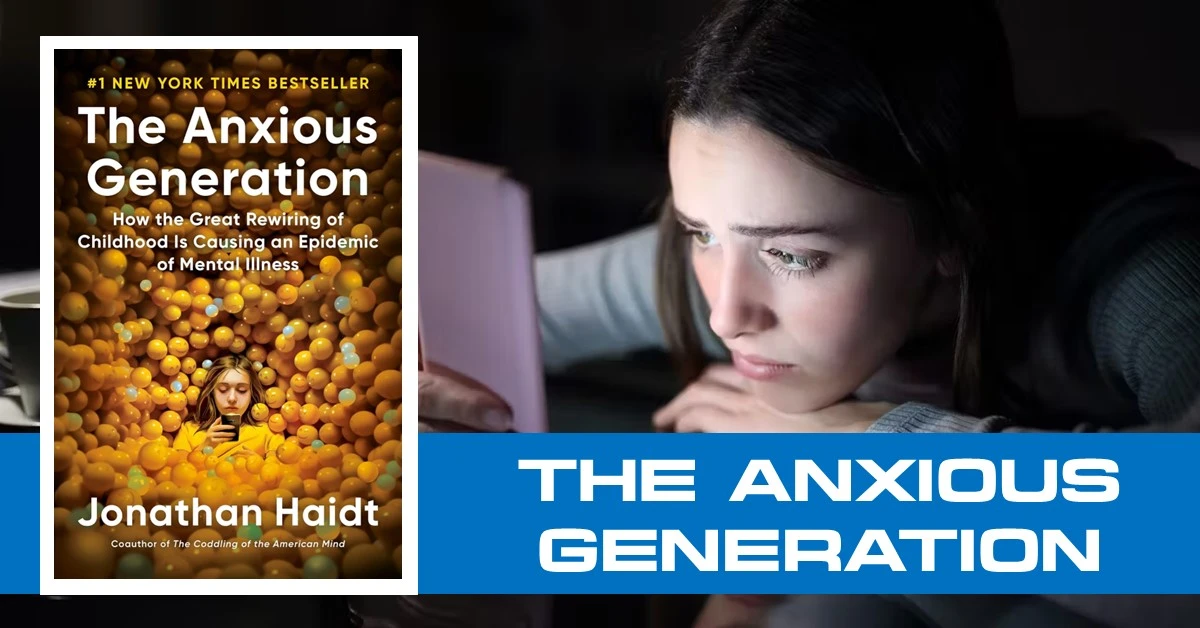
The Anxious Generation (Penguin Press, 2024) is social psychologist Jonathan Haidt’s argument that a “Great Rewiring” of childhood between 2010 and 2015 (the years smartphones, front-facing cameras, and algorithmic social media all converged) is the main driver behind a sharp, international rise in teen anxiety, depression, self-harm, and suicide.
Haidt’s fix is four rules: no smartphones before high school, no social media before 16, phone-free schools, and far more unsupervised play. It is a five-star read for anyone raising, teaching, or worrying about a child, and it has already changed real laws in Australia and dozens of American states.
It is also a genuinely contested book. A respected developmental psychologist called its central claim unproven in the journal Nature, and I will walk you through that fight honestly, not just Haidt’s side of it.
Who This Book Is Best For (And Who Should Skip It)
The Anxious Generation is best for parents of kids aged 4 to 18, teachers, school administrators, pediatricians, youth pastors, policymakers, and any older teen or young adult who wants to understand why their own adolescence felt the way it did.
Not for readers who want a narrow, peer-reviewed academic paper with hedged conclusions on every page. Haidt writes as an advocate, not a neutral referee, and he says so himself. If you already run a strict phone-free household and have read iGen or The Coddling of the American Mind closely, a lot of the early data here will feel familiar, though the later chapters on boys and spirituality still add something new.
Table of Contents
Introduction
The Anxious Generation: How the Great Rewiring of Childhood Is Causing an Epidemic of Mental Illness is a 2024 nonfiction book by Jonathan Haidt, published by Penguin Press. Haidt (pronounced “height”) is the Thomas Cooley Professor of Ethical Leadership at New York University’s Stern School of Business.
He earned his PhD in social psychology from the University of Pennsylvania in 1992, taught at the University of Virginia for sixteen years, and is best known for two earlier books: The Happiness Hypothesis, on ancient wisdom and modern psychology, and The Righteous Mind, on the moral roots of political division.
He also co-wrote The Coddling of the American Mind with the free-speech lawyer Greg Lukianoff, and that book is the direct ancestor of this one.
Here is the book’s context in one line: it is a work of popular social science that reads part diagnosis, part public-health manifesto, aimed at parents and policymakers rather than fellow academics.
Haidt did not originally set out to write it. He told interviewers he had planned a book on how social media was corroding American democracy, and only after drafting the opening chapter on Gen Z’s mental health did he realize that chapter needed to become its own book.
The result draws on his training in moral and cultural psychology plus a large research operation he built with his collaborator Zach Rausch, who maintains an ongoing, publicly viewable archive of studies on the After Babel Substack.
The Anxious Generation‘s central purpose, stated plainly in its introduction, is this: two trends collided to produce the anxious generation. Parents overprotected children in the real world, restricting free play and independence out of fear, starting in the 1980s.
At the same time, those same parents underprotected children in the virtual world, handing them internet-connected smartphones with almost no guardrails, starting around 2010.
Haidt’s own words for the second trend are memorable and worth quoting exactly, because the phrase has become something of a rallying cry: he calls the shift to smartphones and social media “the largest uncontrolled experiment humanity has ever performed on its own children.”
Background
Haidt was not writing in a vacuum. By the early 2020s, U.S. Surgeon General Vivek Murthy had already issued a formal advisory on social media and youth mental health, the Facebook Files leaked by whistleblower Frances Haugen had shown Meta’s own researchers flagging Instagram’s harm to teen girls, and Jean Twenge’s 2017 book iGen had already charted the same generational cliff in the data.
What Haidt added was scale, synthesis, and a call to action built around four specific, low-cost reforms that ordinary families and schools could adopt immediately, without waiting for legislators. That combination, backed by a marketing push and a wave of parent anxiety already primed to receive it, is a large part of why this book did not stay in the review pages. It became policy.
The Anxious Generation Summary
Part 1: The Surge of Suffering
Haidt opens with the numbers. Using the U.S. National Survey on Drug Use and Health, he shows that major depressive episodes among American teen girls held roughly flat through the 2000s, then rose sharply beginning around 2012, an increase of about 150 percent in relative terms.
By 2020, roughly one in four American teen girls had experienced a major depressive episode in the previous year. Boys’ rates rose too, by a similar percentage, though from a lower starting point.
Crucially, Haidt does not rely only on self-reported feelings, which skeptics could dismiss as changing willingness to talk about mental health. He also tracks hospital behavior: emergency room visits for self-harm among girls aged 10 to 14 in the United States nearly tripled between 2010 and 2020, and the suicide rate for that same age group of girls rose 167 percent between 2010 and 2021, according to CDC data he cites.
Boys’ suicide rates rose too, though the pattern is more complicated and, unlike self-harm, boys have always died by suicide at higher rates than girls in Western countries.
He then does the careful work good social science requires: ruling out competitors.
Could it be the 2008 financial crisis? No, he argues, because unemployment kept falling through the 2010s while teen depression kept rising, and the crisis would have hit millennials hardest, not the younger cohort.
Could it be climate anxiety, school shootings, or 9/11-era dread? Haidt notes that collective threats historically pull people together and even lower suicide rates, and that the timing does not fit; Greta Thunberg’s famous UN speech came in 2018, years after the mental health curves had already turned upward. The one variable that fits the timing, the international spread, and the fact that it hit girls hardest is the arrival of smartphones and social-media platforms with “like” and “share” buttons, roughly 2010 to 2012.
He shows the same hockey-stick pattern in the U.K., Canada, Australia, New Zealand, Ireland, and all five Nordic countries, and in a 37-country PISA survey of school loneliness that rose everywhere except in Asian countries.
Part 2: The Backstory, or How Childhood Got Broken Before Phones Even Arrived
This section is the intellectual heart of the book, and it is the part most reviewers skip past to get to social media, which is a mistake, because Haidt’s argument does not work without it. Drawing on play researcher Peter Gray and risk-play researchers Ellen Sandseter and Leif Kennair, Haidt explains that children are, in his word, “antifragile,” a term he borrows from his NYU colleague Nassim Taleb.
Just as a young tree needs wind to grow strong roots, a child needs small doses of risk, boredom, conflict, and failure to develop what Haidt calls a “psychological immune system.”
Free play, especially the physically risky kind (climbing, roughhousing, wandering off, minor daredevil stunts), teaches children to read social cues, negotiate, tolerate frustration, and calibrate real risk for themselves.
That kind of childhood started disappearing in the 1980s, well before the internet, thanks to a spike in parental fear (often disconnected from the actual, falling crime statistics of the era), sensational news coverage of rare abductions, and what Haidt and Lukianoff termed “safetyism” in The Coddling of the American Mind: a culture in which physical and even emotional safety becomes a sacred, non-negotiable value that crowds out every other consideration.
Haidt cites a 2015 Pew survey finding that American parents, on average, believe children should be at least 10 before playing unsupervised in their own front yard and 14 before going to a park alone, even though those same parents were typically given that freedom at 6, 7, or 8.
Haidt then connects this “experience blocker” problem to puberty itself. The adolescent brain is unusually plastic during early puberty, meaning whatever a young teenager spends their time doing gets wired in more permanently, for better or worse.
He walks through rites of passage across cultures and argues that modern life has stripped away the structured challenges that once guided a child toward adult competence, leaving a gap that, in the 2010s, got filled by a phone.
Part 3: The Great Rewiring, or What Phones Actually Do to Kids
This is the section most readers come for, and Haidt organizes it around what he calls the four foundational harms of a phone-based childhood.
Social deprivation. Time spent with friends face to face fell off a cliff after 2010, especially for the youngest teens, well before COVID lockdowns. Even when teens are physically together, the mere presence of a phone on the table measurably reduces the quality and warmth of the conversation, a finding Haidt draws from published lab experiments.
Sleep deprivation. Teens need eight to nine hours of sleep a night, and a phone in the bedroom after 9 p.m. reliably steals it. Haidt cites a review of 36 studies linking heavy social media use to worse sleep and worse mental health, and notes, almost as a dark joke, that Netflix’s own CEO once told investors the company’s real competitor was sleep.
Attention fragmentation. The average teen phone now delivers around 192 notifications a day, roughly one every five minutes of waking life. Citing William James’s 1890 definition of attention as the deliberate withdrawal from some things to focus on others, Haidt argues that a constant stream of “off-ramps” is quietly damaging adolescents’ still-developing executive function, the same skills at the core of self-control and long-term planning.
Addiction. Using Anna Lembke’s dopamine research and product designer Nir Eyal’s own “Hooked” model (external trigger, action, variable reward, investment), Haidt walks through exactly how apps are engineered, deliberately, to exploit the same variable-reward psychology that makes slot machines addictive.
He backs this with internal Meta documents made public by whistleblower Frances Haugen, in which the company’s own researchers describe strategies for keeping teenagers “engaged” for longer.
Why girls got hit harder. Haidt gives four specific mechanisms: girls are more exposed to appearance-based social comparison on visually driven platforms like Instagram; girls’ aggression is more often relational (gossip, exclusion, rumor-spreading) than physical, and social media supercharges exactly that kind of harm; emotional states, especially depression, spread more easily through girls’ tighter social networks, which Haidt links to documented “sociogenic” clusters of symptoms such as sudden tic-like behaviors traceable to specific TikTok influencers; and girls face more direct predation and sexual harassment from adult strangers online.
What happened to boys. Boys’ path to the same crisis runs through video games and pornography rather than Instagram. Citing economist Richard Reeves’s research on the wider decline of boys and men, Haidt describes a generation of boys who traded real-world risk and status-seeking for the virtual kind, sometimes retreating entirely into their bedrooms in patterns that mirror Japan’s “hikikomori” phenomenon.
He notes that a Swedish study found daily pornography use among teenage boys rose from 11 percent in 2004 to 24 percent in 2014, and that boys’ willingness to take physical risks, along with their hospitalization rates for injury, fell sharply after 2010, alongside a rise in the same internalizing symptoms (sadness, hopelessness) once associated mainly with girls.
Spiritual degradation. In the book’s most unusual chapter, Haidt, an avowed atheist, argues that a phone-based life pulls all of us, not just teenagers, downward on what he calls a “vertical” or spiritual axis, away from six ancient practices: shared sacred ritual, embodiment, stillness, self-transcendence, quickness to forgive, and awe in nature.
He is not arguing for religion specifically; he is arguing that these practices are secular-compatible human needs that a scrolling feed cannot satisfy.
Part 4: What We Do About It
Haidt frames the fix as a set of collective action problems: no single parent wants their child to be the only one without Instagram, because that child would be socially isolated, so everyone waits for everyone else to move first, and nobody moves. His answer is four coordinated norms that only work if enough people adopt them together:
- No smartphones before high school (basic phones only until roughly age 14).
- No social media before 16.
- Phone-free schools, using lockable pouches or lockers for the entire school day.
- Far more unsupervised play and childhood independence, restored deliberately.
He then addresses each stakeholder in turn. Governments and tech companies should adopt a legal “duty of care,” raise the effective age of internet adulthood from 13 to 16, and build real age verification instead of a checkbox.
Schools should go phone-free bell to bell and build more unstructured “play clubs,” pointing to his own nonprofit initiative, the Let Grow Project. Parents get a long, practical, age-by-age list of suggestions, from delaying the first phone to encouraging sleepovers, walking to school in groups, and taking a gap year. The book closes with two calls to action he says matter more than any law: speak up in your own community, and link up with other parents so that no single family has to go first alone.
The Anxious Generation Analysis
I came into The Anxious Generation already convinced that something had gone wrong with how children spend their time, and I left it more convinced, but also more careful, and I think that second reaction is the honest one.
Haidt is at his most persuasive when he is triangulating: showing the same mental health cliff in self-reported surveys, hospital admissions, and suicide statistics, across a dozen countries, all beginning within a few years of each other.
That kind of convergent evidence, from independent data sources that could not have contaminated one another, is genuinely hard to explain away with a single alternative theory, and I have not found one that fits as well as his does.
Where I think The Anxious Generation strains is in the leap from “social media use correlates with worse mental health, and there are experiments showing some causal effect on individuals” to the much larger claim that this one factor is “the single largest reason” for a generational crisis across dozens of different countries, cultures, welfare systems, and school systems.
Haidt does supply experimental evidence, not just correlation, and I found the group-level studies (what happened to mental health when Facebook rolled out to new colleges, or when high-speed internet arrived in different Spanish regions at different times) more convincing than the individual-level lab studies, which tend to show smaller effects.
Still, “a major contributing cause” and “the single largest reason” are different claims, and the book sometimes blurs the two for narrative momentum. I will say more about this in the next section, because it is not just my opinion; it is the substance of a genuine, ongoing scientific argument.
The chapters on boys and on spirituality are, in my reading, the most underrated parts of the book. Most magazine coverage of The Anxious Generation focuses on girls and Instagram, which is understandable given the data, but Haidt’s material on hikikomori-style withdrawal, the collapse in boys’ willingness to take physical risks, and the specific mechanics of pornography and gaming addiction adds real, underappreciated texture that I have not seen covered as thoroughly anywhere else on this topic.
What Has Happened Since 2024: The Part Most Reviews Leave Out
Here is where a review written in 2024 and a review written today, in July 2026, have to say very different things, and it is the main reason I wanted to write this piece instead of pointing you to an old review.
The Anxious Generation became a policy document. On December 10, 2025, Australia became the first country in the world to enforce a nationwide ban on social media accounts for anyone under 16, requiring platforms including TikTok, Instagram, Snapchat, Facebook, and Reddit to take “reasonable steps” to remove or block underage users or face fines up to roughly 49.5 million Australian dollars.
According to CNN and CBS News reporting on the law’s origin, South Australian premier Peter Malinauskas has publicly credited his wife’s reading of The Anxious Generation with pushing him to draft the first version of the law, which then spread to the national level within about seven months.
Haidt himself publicly welcomed the ban on social media, calling it a way of “freeing kids under 16 from the social media trap.”
The United Kingdom is now drafting similar legislation with cross-party support, Malaysia has targeted a comparable ban for 2026, and in the United States more than 28 states had passed some form of phone-free schools law by early 2026, according to trackers maintained by ExcelinEd and the KFF health policy organization.
The Anxious Generation has not stopped selling. The Anxious Generation topped the nonfiction list five times in 2024 and, as of June 2026, had spent 113 consecutive weeks on the list. It was named a best book of the year by the Wall Street Journal, the New York Times Book Review, the Washington Post, Time, The Economist, and others, was one of Barack Obama’s favorite books of that year, and was a finalist for a PEN literary award.
The science is genuinely, seriously contested, and you should know that before you buy in fully. In March 2024, developmental psychologist Candice Odgers, of UC Irvine and Duke University, reviewed the book for the journal Nature and argued that most of the published research does not show a large or consistent negative effect of social media on youth mental health, and that Haidt’s “rewiring” language overstates what the neuroscience actually shows.
She suggested reverse causation is possible: perhaps already-anxious teens retreat to their phones, rather than phones causing the anxiety.
Haidt responded publicly and at length, pointing to a running tally he keeps with Zach Rausch of 22 experimental studies (16 of which found evidence of harm) and 9 quasi-experiments (8 of which found evidence of harm), arguing Odgers had cited only the one outlier.
In 2026, Science editor-in-chief Holden Thorp added a more pointed question in an expert roundup: given Haidt’s outsized public influence, did he owe readers a clearer signal that the underlying science remains disputed among specialists? Haidt’s answer, reported in that piece, was that he did not think so.
I am not a psychologist, and I am not going to pretend I can settle a dispute between career researchers who have spent decades on this exact question. What I can tell you, honestly, is that this is not a fringe objection from one contrarian.
It comes from a well-published researcher, published in one of the two or three most respected science journals in the world, and it deserves a place in any honest review of this book, alongside the very real fact that the book’s diagnosis (something did change for adolescent mental health around 2010 to 2012) is much less disputed than its precise explanation for why.
Strengths and Weaknesses
What I loved. The Anxious Generation is genuinely, uncomfortably readable for something built on hundreds of citations. Haidt writes like a teacher who wants you to remember the material, not impress you with it, and the graphs do real argumentative work rather than decorating the page.
The four-part structure (data, backstory, harms, solutions) gives the book a shape that most books in this genre lack, and the final section actually tells you what to do on Monday morning, which is rarer than it should be in books about a crisis.
What frustrated me. Haidt is an advocate first, which he freely admits, and advocacy writing tends to present its own evidence more confidently than the underlying data always supports, particularly when he moves from “social media harms some teenagers under some conditions” to sweeping, generation-wide causal claims.
A handful of the book’s most viral statistics (the 192 daily notifications figure, some of the screen-time averages) come from single studies rather than convergent evidence, and a more cautious writer might have hedged them harder.
I also noticed, as other reviewers have, that Haidt sometimes folds together very different online activities (passive scrolling, active gaming, one-on-one texting, pornography) under a single “phone-based childhood” umbrella, which makes for a clean narrative but can flatten real differences that matter for parents trying to make practical decisions.
How It Compares to Similar Books
If you have read Haidt and Lukianoff’s earlier The Coddling of the American Mind, this book is its natural sequel, extending the safetyism argument from college campuses down into elementary school playgrounds.
Jean Twenge’s iGen (2017) got to the underlying generational data years earlier and remains the more cautious, more academic sibling text; Haidt leans on it constantly and even co-authored research with Twenge that appears in this book.
Anna Lembke’s Dopamine Nation, which I reviewed separately here on Sopranu, supplies the neuroscience of craving that Haidt borrows for his addiction chapter, and reading the two together fills in gaps either book leaves on its own.
Johann Hari’s Stolen Focus, also reviewed here, covers similar ground on attention fragmentation from a journalist’s rather than a psychologist’s vantage point and reaches gentler, more individually focused conclusions.
Adam Alter’s Irresistible got to the “apps are designed like slot machines” argument years before Haidt did, and readers who want the design and behavioral-economics side of this story in more depth should start there. And if you want the male-specific angle Haidt only sketches in chapter seven, Richard Reeves’s Of Boys and Men, cited repeatedly in this book, makes the fuller case.
Frequently Asked Questions
Is The Anxious Generation worth reading in 2026, two years after it came out? Yes, and arguably more so now than in 2024, because you can read it alongside the real-world results of the policies it inspired, from Australia’s under-16 social media ban to dozens of American phone-free school laws.
What are Jonathan Haidt’s four rules from the book? No smartphones before high school, no social media before age 16, phone-free schools, and far more unsupervised play and childhood independence.
Is the book’s science actually settled? No. The timing and international spread of the teen mental health decline are well documented and largely undisputed. The specific causal weight of social media, as opposed to other contributing factors, remains an active, published disagreement among researchers, most visibly between Haidt and Candice Odgers in the journal Nature.
Does The Anxious Generation blame parents? Not entirely. Haidt argues parents were reacting rationally to bad incentives and a culture of fear, and he spends more energy on tech company design choices and collective action failures than on individual blame.
How long is The Anxious Generation? The hardcover runs a little over 380 pages of main text, with roughly 100 additional pages of endnotes and references documenting Haidt’s sources.
Conclusion
I recommend The Anxious Generation without hesitation to any parent, teacher, or policymaker, with one honest caveat attached: read it as a passionate, well-researched argument from a genuine expert, not as the final, settled word on adolescent mental health.
Haidt’s diagnosis of what changed in childhood since the 1980s, the loss of free play, the rise of safetyism, and the sudden arrival of an attention-hungry phone in every child’s pocket, rings true to almost everyone who lived through it, and his four proposed fixes cost nothing and require no new law to start tonight.
Whether social media deserves quite as much of the blame as Haidt gives it is a genuinely open scientific question, and a smart reader can hold both things at once: The Anxious Generation changed my house rules, and it changed national law in Australia, while a respected scientist in Nature still thinks it overreaches.
Read it for the alarm it correctly raises, argue with it for the certainty it sometimes claims, and decide for yourself.
For more on the attention economy and the books shaping this exact conversation, see my reviews of Johann Hari’s Stolen Focus, Anna Lembke’s Dopamine Nation, Adam Alter’s Irresistible, and my roundup of 7 books to help you stop phone addiction.
Related reading: End Times Fascism Review, a Chilling Diagnosis With a Hopeful Cure







