


Last updated on July 12th, 2026 at 03:54 pm
Do you check your phone before you’re even fully out of bed? I did, for years, until I actually counted how many times a day I was doing it and stopped pretending it was just a harmless habit. If any part of that sounds familiar, you’re not weak-willed and you’re not alone. The list of books to stop phone addiction help you to overcome your phone addiction.
You’re using a product built by some of the smartest people in the world, engineered specifically so you’d have a hard time putting it down. The good news is that a handful of researchers, psychiatrists, and journalists have spent the last decade figuring out exactly how that engineering works, and what actually helps.
The list rounded up 7 books on breaking up with your phone in 2026. This guide covers all five, plus two more that fill real gaps (the book that started the “attention economy” conversation, and the one every parent is talking about right now).
Below, they’re grouped by what you’re actually trying to do: understand the problem, fix the problem, or understand what the problem is costing you. There’s also a comparison table, a short quiz-style guide for picking your first read, and answers to the questions people search for most on this topic.
If you only read one book: start with How to Break Up with Your Phone by Catherine Price if you want a step-by-step plan, or Dopamine Nation by Dr. Anna Lembke if you want to understand the “why” first.
Parents worried about a kid’s phone use should go straight to The Anxious Generation by Jonathan Haidt. Full breakdown of all seven books, with real quotes and who each one is actually for, below.
Table of Contents
The numbers behind the headline
According to Reviews.org’s 2026 Cell Phone Usage Report, the average American now picks up their phone 186 times a day and spends just over five hours on it, roughly 83 days a year. Eighty percent of us check the phone within ten minutes of waking up, before we’ve brushed our teeth or spoken to another human.
And 46 percent of Americans now describe themselves as “addicted” to their phone, a number that’s climbed almost 3 percentage points in the last year alone.
Those numbers aren’t a moral failing. They’re the intended result of a business model. That’s the argument running through nearly every book on this list, and it’s a genuinely useful reframe if you’ve ever beaten yourself up for “lacking discipline.
Pick the stage that matches where you are right now.
Books to stop phone addiction
Stage 1: Books that explain why you can’t stop
1. Irresistible by Adam Alter (2017)

Alter, a marketing professor at NYU, spends this book walking through exactly how companies engineer products to hold your attention: Facebook’s early decision to test the “like” button is one of his central examples, since it taps directly into the human need to feel noticed.
Alter’s core argument is that compulsive phone use behaves like a behavioral addiction, not a chemical one. As he puts it, addiction “doesn’t involve directly introducing chemicals to your system,” but it can produce many of the same effects.
Yunyu Xiao, an assistant professor of population health sciences at Weill Cornell Medical College, has pointed to this book specifically for reframing compulsive scrolling as a real behavioral addiction rather than a personal weakness.
Best for: Anyone who wants the design playbook, the actual mechanics tech companies use to keep you scrolling.
2. Dopamine Nation by Dr. Anna Lembke (2021)
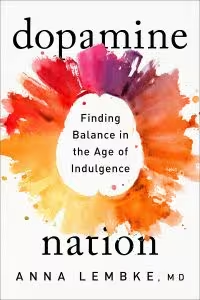
Lembke is a psychiatrist at Stanford who runs an addiction clinic, and this book looks at how constant access to high-reward stimulation, including phones, junk food, gambling, and social media, throws off the brain’s pleasure-pain balance.
She lays out practical strategies too, like keeping separate devices for work and personal use, and she pushes what she calls “radical honesty” about how dependent we’ve become on quick hits of stimulation. Her line on this is direct: dependence, she argues, isn’t “a matter of weakness or lack of willpower.”
Sally Gainsbury, who directs the gambling treatment and research clinic at the University of Sydney, has said this book does a good job showing how our favorite products “hijack” the brain’s reward pathways rather than simply reflecting bad choices.
Best for: Anyone who wants an actual clinician’s take on what’s happening in your brain, not just a metaphor.
3. Stolen Focus by Johann Hari (2022)
Hari spent three years interviewing over 200 experts across a dozen countries trying to figure out why attention spans have collapsed.
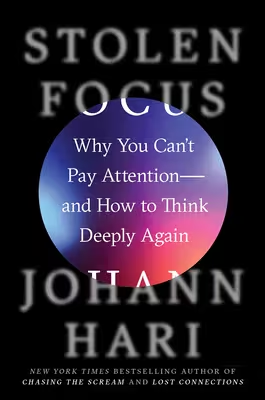
He found that the average American office worker manages roughly three minutes of focus before switching tasks, and that this isn’t really an individual failing, it’s the product of twelve overlapping causes, from sleep loss to constant task-switching to the design of the apps themselves.
His central line: “Slowness nurtures attention, and speed shatters it.” Worth knowing before you pick this one up: Hari has faced public criticism in the past over accuracy in his journalism, and some psychologists have pushed back on parts of his evidence here too.
The book is still widely read and cited, but it’s fair to treat it as one strong argument in an ongoing debate rather than the final word on the science.
Best for: Readers who want the widest-angle view, covering everything from Big Tech incentives to sleep to diet.
Stage 2: Books with an actual plan
4. How to Break Up with Your Phone by Catherine Price (2018, revised 2024)

Price is a science journalist who wrote this after going through her own phone struggles, and it’s the most practical book on this list.
The first half explains how phones are built to be hard to put down. The second half is a genuinely usable 30-day plan: tracking how often you pick up your phone, building in a pause before you unlock it, and slowly redesigning your relationship with the device instead of quitting cold turkey. Her central idea is simple: “Our lives are what we pay attention to.”
Mollie Candib, a therapist based in New York City, has recommended this book specifically because it “really meets people where they are,” rather than demanding total abstinence.
Best for: Anyone who wants a plan they can start tonight, with no lecture required.
5. Digital Minimalism by Cal Newport (2019)
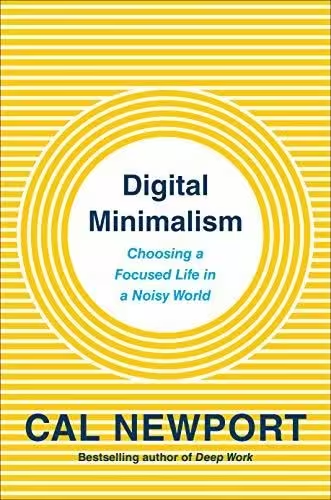
Newport, a computer science professor at Georgetown, argues that neither quick fixes nor total abstinence actually work long-term.
Instead, he lays out a 30-day “digital declutter”: cut every optional app and platform for a month, rebuild your leisure time around things that actually satisfy you, and then reintroduce technology deliberately, one tool at a time, only if it earns its place. His line on why this matters gets quoted often for a reason: “Humans are not wired to be constantly wired.”
He also points to long-term studies showing that even short breaks from optional technology can reduce depression and anxiety symptoms, not just make you feel vaguely better for a day or two.
Best for: People who’ve tried small tweaks before and need a full reset with a clear structure.
Stage 3: Books about what it’s actually costing you
6. Reclaiming Conversation by Sherry Turkle (2015)

Turkle is a psychologist and sociologist at MIT who has studied our relationship with technology for over three decades, and this book takes a different angle than the others on this list.
Instead of focusing on what happens while you’re online, she focuses on what you lose by not being present offline: the ability to sit with boredom, to tolerate solitude, to have the kind of meandering conversation that actually builds empathy.
Built from five years of interviews with parents, teachers, and students, her argument is that constant connection is quietly eroding our capacity to be alone with our own thoughts. As she puts it, “Solitude is where we learn to trust our imaginations.”
Best for: Anyone whose real complaint isn’t screen time exactly, it’s that their relationships feel thinner than they used to.
7. The Anxious Generation by Jonathan Haidt (2024)

This is the newest book on the list, and arguably the one with the most cultural weight right now. Haidt, a social psychologist at NYU, lays out data showing that rates of teen depression, anxiety, self-harm, and suicide rose sharply starting in the early 2010s, across many countries at once, right alongside the shift from what he calls a “play-based childhood” to a phone-based one.
He details more than a dozen ways this shift hits kids: lost sleep, lost in-person friend time (down roughly 50 percent since 2012, by his count), and near-constant social comparison.
He proposes four concrete fixes, including no smartphones before high school and phone-free school days. If you’re a parent, teacher, or anyone raising kids in this environment, this is the book everyone else has probably already read.
Best for: Parents, teachers, and anyone raising or working with kids right now.
How the seven books compare
| Book | Author | Best for | What you actually get |
|---|---|---|---|
| Irresistible | Adam Alter | Understanding the design tricks | A marketing professor’s breakdown of how apps are built to hook you |
| Dopamine Nation | Dr. Anna Lembke | Understanding the brain chemistry | A Stanford psychiatrist’s take on pleasure, pain, and balance |
| Stolen Focus | Johann Hari | The widest-angle view | Twelve causes of the attention crisis, from sleep to Big Tech |
| How to Break Up with Your Phone | Catherine Price | A plan you can start tonight | A 30-day, step-by-step habit-change guide |
| Digital Minimalism | Cal Newport | A full reset, not a tweak | A 30-day digital declutter plus a philosophy to keep it going |
| Reclaiming Conversation | Sherry Turkle | What you’re losing socially | Research on solitude, empathy, and face-to-face talk |
| The Anxious Generation | Jonathan Haidt | Parents and educators | Data on kids and phones, plus four concrete policy fixes |
Which one should you actually start with?
If you’re not sure where to start, ask yourself one question: do you understand why you can’t put the phone down, or do you just want to stop?
If you don’t yet understand the “why,” start with Dopamine Nation or Irresistible. You’ll probably feel less guilty by the end of either one, and that matters, because guilt is a bad motivator for actual change.
If you already know the why and just want the how, skip straight to How to Break Up with Your Phone. It’s the most concrete plan of the seven, and it doesn’t ask you to give up your phone entirely, just to use it on your own terms.
If your problem feels less like “I use my phone too much” and more like “my relationships feel worse than they used to,” Reclaiming Conversation will probably land harder than any productivity-style guide.
And if this is about your kids rather than yourself, start and end with The Anxious Generation. It’s written for exactly that conversation.
Frequently asked questions
Do books about phone addiction actually help you use your phone less?
They won’t do the work for you, but the ones with a structured plan (Price’s 30-day breakup, Newport’s digital declutter) give you something more useful than willpower alone: a concrete sequence of steps and a way to track progress.
Research on friction-based interventions, like adding a short pause before opening an app, has shown reductions in app-opening behavior of more than 50 percent in some studies, which lines up with what these books recommend.
What’s the best book about phone addiction for someone who’s never tried to cut back before?
“How to Break Up with Your Phone” by Catherine Price. It doesn’t assume you already know the science, and the 30-day structure means you’re never staring at a blank page wondering what to do next.
Is phone or screen addiction a real, diagnosable condition?
Not officially, at least not yet. Gambling disorder is currently the only behavioral addiction with a formal diagnosis in the DSM-5, and internet gaming disorder is listed only as a condition warranting further study.
That said, researchers like Lembke and Alter argue the behavior patterns, tolerance, withdrawal-like irritability, and loss of control, closely mirror substance addiction, even without a chemical trigger.
How long does a digital detox or digital declutter actually take?
Most structured programs run 30 days. Cal Newport’s digital declutter and Catherine Price’s phone breakup plan are both built around a month, which seems to be roughly how long it takes to notice which apps you actually miss versus which ones you just used out of habit.
What’s the best book about screen time for parents specifically?
“The Anxious Generation” by Jonathan Haidt, without much competition right now. It’s the most data-heavy of the seven and speaks directly to school policy and parenting decisions, not just personal habits.
Final thought
None of these authors are telling you to throw your phone in a lake. Every single one of them still uses a smartphone. The actual argument, across all seven books, is smaller and more useful than that: figure out what you actually want your attention to go toward, and then build a few real boundaries so the phone stops making that decision for you. That’s a lot more doable than “quitting” anything.
Sources and further reading
- Reviews.org. “Cell Phone Usage Stats 2026.”
- Pauso. “Screen Time Statistics 2026.”
- DemandSage. “Average Screen Time Statistics 2026.”
- Alter, Adam. Irresistible: The Rise of Addictive Technology and the Business of Keeping Us Hooked. Penguin Press, 2017.
- Lembke, Anna. Dopamine Nation: Finding Balance in the Age of Indulgence. Dutton, 2021.
- Hari, Johann. Stolen Focus: Why You Can’t Pay Attention. Crown, 2022.
- Price, Catherine. How to Break Up with Your Phone: The 30-Day Plan to Take Back Your Life. Ten Speed Press, 2018 (revised 2024).
- Newport, Cal. Digital Minimalism: Choosing a Focused Life in a Noisy World. Portfolio, 2019.
- Turkle, Sherry. Reclaiming Conversation: The Power of Talk in a Digital Age. Penguin Press, 2015.
- Haidt, Jonathan. The Anxious Generation: How the Great Rewiring of Childhood Is Causing an Epidemic of Mental Illness. Penguin Press, 2024.
- Wikipedia. “Stolen Focus.” (background on critical reception)