

Last updated on May 16th, 2026 at 01:51 pm
Why do men across every culture and civilization consistently fall for youth and beauty while women—no matter how wealthy or independent—keep gravitating toward status and power? Why is sex even a thing, when cloning yourself would be twice as efficient? The Red Queen by Matt Ridley will answer those questions in ways that may disturb you, delight you, and make it almost impossible to look at another human being the same way again.
The Red Queen is best for readers curious about evolutionary psychology, human sexuality, biology, and the deep “why” behind love, jealousy, attraction, and intelligence.
Perfect for science enthusiasts, students of anthropology, psychology, or biology, and anyone who has ever wondered why human beings behave the way they do in relationships.
Also ideal for readers who enjoy Richard Dawkins, Steven Pinker, or Robert Wright.
Not for those who want a purely political or cultural reading of gender and sexuality without biological grounding. If the phrase “evolutionary psychology” makes you bristle defensively before you even open the book, you may find Ridley’s arguments provocative to the point of irritation.
It’s also not for those seeking a light, anecdotal read — this book is dense with science, though written accessibly.
Table of Contents
1. Introduction
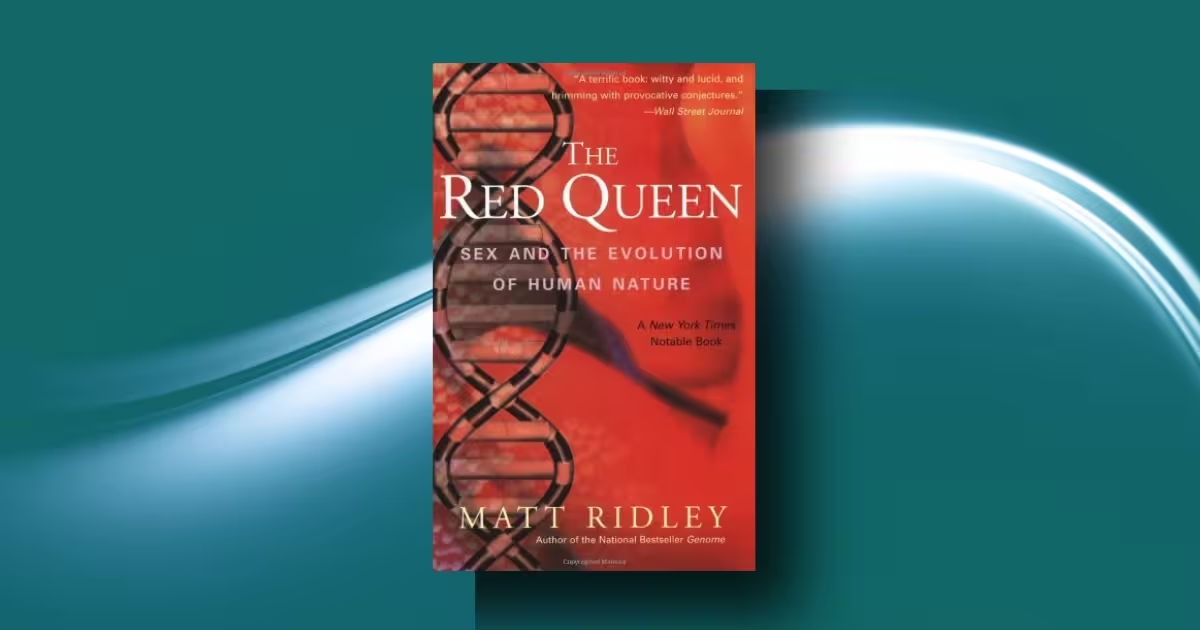
Title: The Red Queen: Sex and the Evolution of Human Nature
Author: Matt Ridley (Matthew White Ridley, 5th Viscount Ridley)
First Published: 1993, Viking (UK) / Penguin Books
Perennial Edition: 2003, HarperCollins Publishers
The Red Queen is a work of popular evolutionary science — simultaneously a biology book, a psychology text, a philosophical provocation, and one of the most ambitious attempts to decode what makes us human.
Matt Ridley, formerly a science editor at The Economist and later a journalist, science writer, and visiting professor at Cold Spring Harbor Laboratory, brings together more than sixty interviews with leading evolutionary biologists, anthropologists, and geneticists to produce something that reads less like a textbook and more like a detective novel about the human condition.
The book takes its title from Lewis Carroll’s Through the Looking-Glass, in which the Red Queen tells Alice: “Now, here, you see, it takes all the running you can do to keep in the same place.”
In evolutionary biology, this metaphor — known as the Red Queen hypothesis — captures a central truth: that species must constantly evolve not to get ahead, but merely to survive against enemies (parasites, predators, rivals) that are themselves constantly evolving. The Red Queen was shortlisted for the 1994 Rhône-Poulenc Prize (now the Royal Society Prizes for Science Books).
Ridley’s central thesis is audacious and sweeping: few, if any, aspects of human nature can be understood apart from sex and sexual reproduction.
Not just reproduction in the narrow, biological sense — but the entire apparatus of human psychology: why we love, whom we find attractive, why men and women think differently, why we are so intelligent, why we feel jealousy, why marriage exists, and even why we have immune systems.
All of it, Ridley argues, traces back to the evolutionary pressures of sexual reproduction.
2. Background
When The Red Queen was published in 1993, evolutionary psychology was still a young and embattled discipline.
The dominant forces in the social sciences — sociology, cultural anthropology, developmental psychology — were firmly committed to what Ridley calls the blank-slate view: that human behavior is the product of culture and upbringing, not biology; that the mind arrives in the world empty, and society writes upon it.
Ridley respectfully, and sometimes not so respectfully, demolishes this consensus.
He does so not through ideology but through an avalanche of empirical evidence, stretching from the genetics of parasites to the mating customs of the Inca Empire, from the sex lives of bdelloid rotifers (tiny freshwater animals that haven’t had sex in 40 to 80 million years) to the fantasy lives of Californian university students.
The intellectual climate has shifted considerably since 1993, but the core argument of The Red Queen remains fiercely relevant — perhaps more so today, when questions about gender, sexuality, attraction, and human nature are more politically charged than ever. Ridley does not pretend to have all the answers.
What he does, brilliantly, is lay out the scientific landscape and trust the reader to navigate it.
3. Summary: What I Learned from The Red Queen — Chapter by Chapter
Reading The Red Queen is like sitting down with a very clever, very enthusiastic scientist who has read everything and wants to share all of it.
I’m going to walk you through the book’s ten chapters so thoroughly that you’ll carry its key ideas with you whether or not you ever pick up the book itself.
Chapter 1: Human Nature
Ridley opens with a surgeon’s analogy.
A surgeon who opens up a body knows exactly what he’ll find inside — the stomach is always in roughly the same place, the heart always has four chambers. Ridley’s contention is that the same predictability applies to the human mind: “It is the assumption of this book that there is also, in the same way, a typical human nature.”
That human nature, he argues, is not the product of culture alone.
It is the product of millions of years of evolution, shaped primarily by the demands of reproduction. He cites Weismann’s insight from the 1880s — that the germ-plasm (eggs and sperm) is kept separate from the body, meaning experiences during a lifetime cannot be biologically inherited — as the foundation of modern genetics.
Building on Richard Dawkins’s gene-centered view of evolution, Ridley makes the case that bodies exist to serve genes, not the other way around: “The ability to reproduce is what makes living things different from rocks.”
He is careful to note that acknowledging evolved human nature does not mean surrendering free will or excusing bad behavior. What it does mean is that “there is no nature that exists devoid of nurture; there is no nurture that develops without nature.”
The two are inseparable.
The chapter introduces the three great implications of sex for human nature: first, that sex produces uniqueness — no two people are genetically identical (except identical twins); second, that there are two human natures — male and female — shaped by different evolutionary pressures; and third, that sexual competition drives mate selection, creating what Darwin called sexual selection — the force responsible for the peacock’s tail, and, Ridley will argue, for the human intellect itself.
Chapter 2: The Enigma — Why Does Sex Exist?
This is the book’s philosophical engine room, and it is genuinely extraordinary. Sex, biologically speaking, is expensive.
An asexual organism can produce twice as many offspring as a sexual one (since every asexual individual can bear young, not just half). If natural selection rewards reproductive efficiency, why hasn’t asexual reproduction taken over?
Ridley frames the question through a delightful thought experiment involving a Martian researcher named Zog, who returns from Earth bewildered: “Why don’t they just clone themselves as we do? Why do they need two creatures to have one baby? Why do males exist? Why? Why? Why?”
The conventional answer — that sex speeds up evolution by creating genetic variation — was demolished by George Williams in 1966, who showed it committed the logical error of treating evolution as a goal rather than a process.
Sex doesn’t exist to help a species evolve faster. It must confer an immediate advantage to individual organisms, or it would be wiped out by the more fecund asexual alternatives.
This chapter walks through three competing ecological theories: the Vicar of Bray hypothesis (sex speeds evolution — now largely discredited), the tangled bank hypothesis (sex helps offspring diversify to exploit different ecological niches — also largely rejected), and the emerging Red Queen hypothesis, which Ridley will develop in the next chapter.
The setup is masterful: by the time you finish Chapter 2, you are genuinely puzzled — and ready to be persuaded.
Chapter 3: The Power of Parasites
This is where The Red Queen finds its beating heart, and for me, it’s the most electrifying chapter in the book. Ridley’s answer to the enigma of sex is parasites.
Consider the epidemics that have swept through human history: measles after AD 165, smallpox after AD 251, bubonic plague after 1348, syphilis after 1492, tuberculosis after 1800. “The ‘great war’ of 1914–18 killed 25 million people in four years. The influenza epidemic that followed killed 25 million in four months.”
Parasites — viruses, bacteria, fungi — are the single greatest cause of death in the history of life on Earth. There may be more bacterial cells in and on a human body at this moment than there are human cells.
Here is the Red Queen logic: parasites evolve to crack the biochemical locks of their hosts. Hosts evolve new locks. Parasites evolve new keys.
This co-evolutionary arms race never ends. The only way a host can stay ahead of its parasites is to constantly reshuffle its genetic combinations — to produce offspring whose biochemical locks are different from the parents’.
That is precisely what sex does. Sex is not about reproduction; it is about producing immunological diversity. As Ridley writes: “Sex, according to the Red Queen theory, has nothing to do with adapting to the inanimate world…but is all about combating the enemy that fights back.”
This is why, Ridley explains, the most polymorphic genes in the human genome — genes with many different versions floating through the population — are precisely the genes involved in disease resistance, including the histocompatibility genes (which determine why transplants are so difficult).
We are genetically diverse because diversity is our only defense against parasites that evolve far faster than we do. AIDS mutates as much in ten years as human DNA does in ten million. We keep the genetic library large so that no single parasite can find all the keys.
In 1991, Adrian Hill and colleagues at Oxford found that one histocompatibility gene, HLA-Bw53, is common where malaria is prevalent and rare elsewhere — children who lack it are more susceptible to malaria.
The Red Queen is at work in real time, in our blood.
Chapter 4: Genetic Mutiny and Gender
This chapter goes deep into the origin of the two sexes — and it is stranger than anything most people have imagined.
Ridley begins with the puzzle of why there are two sexes at all, rather than three or one. The answer involves a kind of civil war inside the cell.
Inside your cells are organelles — mitochondria and chloroplasts — that carry their own DNA, inherited only through the mother. These organelle genes have their own evolutionary interests, which sometimes conflict with the nucleus’s interests. In hermaphroditic organisms, organelle genes are “tempted” to destroy the male reproductive function to force all resources into female reproduction (through which they can be transmitted). Plants are full of such male-sterile genes, locked in constant battle with nuclear “fertility restorer” genes.
The solution life hit upon was elegant and ruthless: separate the two sexes completely.
Males and females specialize. Organelle genes go only through the female line. The battle is won — temporarily — by bureaucratic segregation.
Ridley also explores the Trivers-Willard hypothesis: that parents in good condition tend to have more sons, while those in poor condition have more daughters.
This is because sons are high-risk, high-reward (a dominant son can father many more offspring), while daughters are lower-risk but also lower-reward.
Studies of Venezuelan opossums fed sardines — well-fed mothers had a 1.4:1 male-to-female ratio versus the 1:1 ratio of unfed mothers — provide striking evidence.
The Inca’s all-male President list (ninety sons to sixty-three daughters across US presidents), the data on dominant female spider monkeys producing more sons, and Valerie Grant’s 1966 study linking maternal personality dominance to having sons all suggest this mechanism operates in humans too.
Chapter 5: The Peacock’s Tale — Sexual Selection
This is the book’s most visually satisfying chapter, and one that delivers genuine aha moments.
Charles Darwin was puzzled by the peacock’s tail — it seemed to contradict natural selection, since a tail so elaborate and heavy must make the bird slower and more vulnerable to predators.
He proposed that it was the product of sexual selection: peahens prefer it, and so it spreads even at a cost to survival.
Ridley traces the fierce debate between two rival theories of sexual selection:
- Fisher’s runaway selection: female preferences for any trait (however arbitrary) become self-reinforcing, producing ever-more-exaggerated male ornaments, until the cost becomes prohibitive.
- Zahavi’s handicap principle: ornaments are honest signals of genetic quality precisely because they are costly. Only a genuinely healthy, well-nourished male can afford to grow and maintain a spectacular tail. Females who choose such males get disease-resistant genes for their offspring.
The Hamilton-Zuk hypothesis connects both theories to parasites: bright, elaborate plumage signals resistance to parasites.
Studies of red grouse in Scotland confirmed that the brightness of a male’s wattles (the red patch above the eye) correlates with his parasite load, and females prefer males with brighter wattles.
Female choice is not arbitrary: it tracks health.
Ridley also introduces Michael Ryan’s stunning discovery with túngara frogs: female frogs’ brains are pre-wired to prefer calls that didn’t exist yet in their species’ males — the preference evolved first, and males evolved to exploit it.
Alexandra Basolo found the same thing in fish: female platyfish prefer males with sworded tails before swordtail fish even existed.
This “sensory bias” theory suggests that male ornaments evolve to exploit pre-existing female sensory systems.
Chapter 6: Polygamy and the Nature of Men
Here the book turns to human beings with full force, and Ridley doesn’t pull his punches.
The Sun-King Atahualpa of the Inca kept fifteen hundred concubines in each of many “houses of virgins,” while the legal harem size descended with social rank: great lords had more than seven hundred women; leaders of vassal nations, thirty; ordinary men, none.
The Inca case is an extreme example of a pattern Ridley finds near-universal in history: “Throughout history powerful men have usually had more than one mate each.”
Why? Because of what Robert Trivers identified in 1972 as parental investment theory: the sex that invests more in offspring becomes the choosy sex; the sex that invests less becomes the competing sex.
In humans, nine months of pregnancy versus five minutes of sex creates an enormous asymmetry. “A peacock grants a peahen one tiny favor: a batch of sperm and nothing else.”
Men can, in theory, father multiple children simultaneously; women cannot. The result is that men evolved to seek quantity of mates and women to seek quality.
Evidence for this comes from multiple sources. Among male gay men in San Francisco before AIDS, 75% had more than a hundred sexual partners and 25% more than a thousand.
Donald Symons argued this isn’t about homosexuality — it’s about maleness: “I am suggesting that heterosexual men would be as likely as homosexual men to have sex most often with strangers…if women were interested in these activities.” Lesbians, by contrast, form long, faithful partnerships and rarely have more than ten lifetime partners.
Ridley navigates the political sensitivity carefully, noting: “I am trying to describe the nature of humans, not prescribe their morality. That something is natural does not make it right.”
Chapter 7: Monogamy and the Nature of Women
If Chapter 6 is about why men are the way they are, Chapter 7 asks why most societies end up monogamous nonetheless — and the answer is surprisingly sympathetic to women.
Ridley draws on game theory, developed by John Maynard Smith, to show that monogamy often wins as a strategic equilibrium: when a junior male can gain more by helping raise children than by competing for a harem, monogamy spreads.
The chapter explores concealed ovulation — the fact that women, unlike most primates, show no external sign of when they are fertile.
This is extraordinary and unique to humans.
Ridley surveys multiple theories: concealed ovulation could encourage constant male attention and investment (if a man never knows when his partner is fertile, he must stay close), or it could allow women to seek “extra-pair copulations” with genetically superior males while retaining their pair-bond partner’s investment.
Studies by Robin Baker and Mark Bellis found that women’s bodies retain more sperm from extra-pair copulations than from their regular partners — a finding suggesting that female orgasm timing is strategic, not random.
While controversial, the data suggest that a woman is statistically more likely to conceive from an adulterous liaison than from her husband.
Chapter 8: Sexing the Mind
“Men and women have different minds because they have had different evolutionary ambitions and rewards.”
This chapter tackles the politically explosive question of psychological sex differences with unusual intellectual courage.
Ridley reviews the evidence for hormonal influence on the brain.
The brain begins as female unless exposed to testosterone; a surge of testosterone in the womb six weeks after conception begins masculinizing the male brain, and a second surge at puberty “develops the photograph.”
Girls with congenital adrenal hyperplasia (exposed to abnormal levels of androgens in the womb) show markedly more tomboyish behavior and better spatial skills. Boys exposed to female hormones in utero show the reverse.
What emerges are consistent, cross-cultural differences in cognitive style: men tend to outperform women on spatial navigation and certain mathematical tasks; women outperform men in verbal fluency, reading emotions, and social intuition.
These are statistical differences — enormous individual variation exists — but they are real and cross-cultural.
The Israeli kibbutz experiment is particularly striking: after decades of deliberately abolishing sex roles, “kibbutz life is actually more sexist than life in the rest of Israel.” Three generations of egalitarian conditioning could not override what Ridley believes are evolved preferences.
He makes a point that few others make: “The bizarre thing about this assertion of different natures is that it is a thoroughly feminist assertion.” If women run organizations differently — with more cooperation, less ego — then they cannot also be identical to men. You cannot claim a difference and deny it simultaneously.
Chapter 9: The Uses of Beauty
Why do we find some faces beautiful and others not? The Red Queen argues that beauty is not culturally arbitrary — it is a biologically honest signal of health, youth, fertility, and genetic quality.
David Buss surveyed mate preferences across thirty-three countries and more than ten thousand people.
The result was consistent: men valued youth and physical attractiveness more than women; women valued wealth, status, and ambition more than men. When critics objected that this is because women lack economic power, Buss looked again: “American women who make more money than the average American woman pay more attention than average to the wealth of potential spouses, not less.”
High-earning women want even higher-earning men. As Bruce Ellis put it: “Women’s sexual tastes become more, rather than less, discriminating as their wealth, power, and social status increase.”
Ridley examines the science of facial symmetry (which signals developmental health), the preference for an hourglass figure (waist-to-hip ratio around 0.7 in all cultures studied), and the near-universal preference for smooth, clear skin as a sign of youth and health.
Fashion itself, he argues, functions as a signaling system: wearing what is expensive and rare advertises social status, because only successful individuals can afford it.
Fashion’s constant changing prevents cheap imitation from undermining the signal’s honesty.
Chapter 10: The Intellectual Chess Game — Sex and Intelligence
The book ends with its most daring argument: that human intelligence is itself a product of sexual selection.
Ridley surveys competing theories for why humans evolved such disproportionately large brains — the toolmaking hypothesis, the hunting hypothesis, the ecological hypothesis — and finds them all insufficient. Baboons hunt, lions cooperate, apes make tools.
None needed philosophy.
The answer, following Nicholas Humphrey and Richard Alexander, is that human brains grew big primarily to compete with other humans: to deceive, detect deceit, manipulate, build coalitions, seduce, and outwit. “Only humans themselves could provide the necessary challenge to explain their own evolution,” wrote Alexander. And crucially, sexual competition was the primary arena: big-brained men were better at winning mates; big-brained women were better at judging men and forming alliances.
The brain, Ridley suggests, is a kind of peacock’s tail — an elaborate ornament evolved through sexual competition.
Geoffrey Miller (cited throughout) has extended this argument: humor, music, creativity, storytelling — all the distinctively human traits that seem evolutionarily gratuitous — may be fitness signals, the cognitive equivalents of the peacock’s tail. The universe of human culture may be, at its deepest root, a vast sexual display.
The epilogue, “The Self-Domesticated Ape,” closes with characteristic wit: “Humanity is, of course, morally free to make and remake itself infinitely, but we do not do so. We stick to the same monotonously human pattern of organizing our affairs.”
4. Analysis — My Commentary on The Red Queen
The Red Queen is a genuinely important book — one of those rare works of popular science that changes the way you think about yourself and everyone around you.
It is, in my view, among the top five works ever written on evolutionary psychology, alongside Richard Dawkins’s The Selfish Gene, Steven Pinker’s The Blank Slate, Robert Wright’s The Moral Animal, and E. O. Wilson’s Sociobiology.
What sets Ridley apart is not just the breadth of his synthesis — though the breadth is staggering — but his willingness to follow the evidence wherever it leads, even into politically uncomfortable territory.
He writes with equal fairness about male polygamous instincts and female social intelligence, about the evolutionary roots of both patriarchy and female mate discrimination, about biological sex differences without apologizing for them or weaponizing them.
That intellectual honesty is rare and precious.
The chapter on parasites alone is worth the price of the book. The Red Queen hypothesis — that sex exists primarily as an arms race against parasites — is one of those ideas that, once encountered, can never be unthought.
The influenza statistic (25 million dead in four months versus 25 million dead in four years of World War I) landed in my mind like a physical blow.
The writing is lucid, witty, and occasionally brilliant. Ridley has the gift of the precise analogy: sex as a lottery, genes as recipes rather than blueprints, the peacock’s tail as an honest advertisement, the brain as a biological chess player.
5. Strengths and Weaknesses
Strengths
Scientific rigor disguised as readable prose. Ridley interviewed more than sixty researchers and read hundreds of papers. The book is dense with real data — Venezuelan opossums, New Zealand personality studies, thirty-three-country mate preference surveys, kibbutz experiments — while never becoming dry.
Intellectual honesty. Ridley acknowledges when the evidence is contested. He presents competing theories (Fisher vs. Zahavi, tangled bank vs. Red Queen) with genuine fairness before making his case.
The parasite-sex link. This alone makes the book essential reading. Before The Red Queen, I had no idea that sexual reproduction might exist primarily to defeat disease. After it, I cannot think about evolution without this lens.
Scope. The book weaves together genetics, evolutionary biology, anthropology, psychology, game theory, paleontology, and history into a coherent argument. That is an extraordinary achievement.
Weaknesses
Some sections have aged. Published in 1993, the book occasionally relies on studies that have since been contested or refined — particularly some of the data on psychological sex differences and concealed ovulation. The field has moved fast, and some specifics need updating.
The human intelligence chapter is undercooked. The argument that intelligence is a sexually selected trait — a kind of cognitive peacock’s tail — is tantalizing but frustratingly thin.
Ridley gestures at Geoffrey Miller’s work without fully developing it. (Miller later did so himself in The Mating Mind, published in 2000.)
Political caution sometimes borders on excessive hedging. Ridley repeatedly emphasizes that evolutionary accounts of behavior carry no moral implications — which is true — but the repetition can feel defensive, as if anticipating attacks.
6. Similar Works: Books like The Red Queen
Richard Dawkins, The Selfish Gene (1976): The intellectual grandfather of The Red Queen. Ridley builds explicitly on Dawkins’s gene-centered view of evolution. Where Dawkins is philosophical and polemical, Ridley is more empirical and applied. Both are essential.
Robert Wright, The Moral Animal (1994): Published a year after The Red Queen, Wright covers much of the same ground — male polygamous instincts, female mate selection, the evolutionary roots of morality — with a more personal, journalistic approach (using Darwin’s life as a case study). The two books complement each other beautifully.
Steven Pinker, The Blank Slate (2002): Pinker takes up the political battle Ridley is somewhat cautious about, making the case for universal human nature against the social-science establishment more combatively. The Blank Slate is The Red Queen‘s natural successor.
Geoffrey Miller, The Mating Mind (2000): Develops the sexual selection theory of human intelligence that Ridley only sketches in Chapter 10. If The Red Queen is the introduction, The Mating Mind is the full argument.
Sarah Blaffer Hrdy, Mother Nature (1999): An important feminist corrective and complement to The Red Queen. Hrdy explores female reproductive strategies, infanticide, cooperation, and the evolution of maternal instincts with equal rigor and far more focus on female agency.
Desmond Morris, The Naked Ape (1967): An earlier, less rigorous attempt at the same project. The Red Queen renders it largely obsolete, though Morris’s readable style is still charming.
7. Conclusion
The Red Queen: Sex and the Evolution of Human Nature is a book that deserves to be read by anyone who has ever wondered — seriously wondered — why human beings are the way they are.
It is demanding, occasionally provocative, and consistently rewarding. It does not tell you that your choices are determined or your nature is fixed.
What it does tell you is that your choices, your desires, your fears, and your intelligence all have a history millions of years deep — a history written in the language of sex, survival, and the endless, pitiless competition of genes.
Matt Ridley concludes: “Humanity is, of course, morally free to make and remake itself infinitely, but we do not do so.”
Understanding why we don’t — understanding the deep evolutionary grammar of human desire — is, I think, one of the most important intellectual projects of our time. The Red Queen remains one of its finest contributions.
Recommended for: General readers with intellectual curiosity, students of evolutionary psychology, anthropology, biology, philosophy of mind, and gender studies. Suitable for both specialists and non-specialists, though readers without any science background may find some chapters challenging.
References and further reading: Matt Ridley’s official writing has appeared in The Times (London), The Wall Street Journal, and The Economist. The Red Queen hypothesis is discussed extensively in Leigh Van Valen’s 1973 paper “A new evolutionary law” (Evolutionary Theory 1:1–30) and in W. D. Hamilton’s seminal papers on host-parasite coevolution. For further exploration, see also: The Selfish Gene (Dawkins, 1976), The Moral Animal (Wright, 1994), The Blank Slate (Pinker, 2002), The Mating Mind (Miller, 2000), and Mother Nature (Hrdy, 1999). According to the BBC, the 1918 influenza pandemic remains one of the deadliest disease events in recorded human history, killing an estimated 50–100 million people worldwide — a figure that underlines Ridley’s point about the lethal power of parasites.