
Last updated on May 7th, 2026 at 05:08 pm
Do you remember that moment of electric connection when someone’s words—not their body, not their résumé—made your heart race and your mind spark? Why does a clever joke, a beautifully crafted story, or an act of unexpected generosity feel more seductive than a perfect jawline? I picked up Geoffrey Miller’s The Mating Mind because I needed to understand why I fall in love with minds, not just faces.
And honestly? “The Mating Mind: How Sexual Choice Shaped the Evolution of Human Nature” didn’t just answer my question—it rewired how I see every dinner-party conversation, every burst of laughter, and every creative impulse I’ve ever had.
Table of Contents
1. Introduction
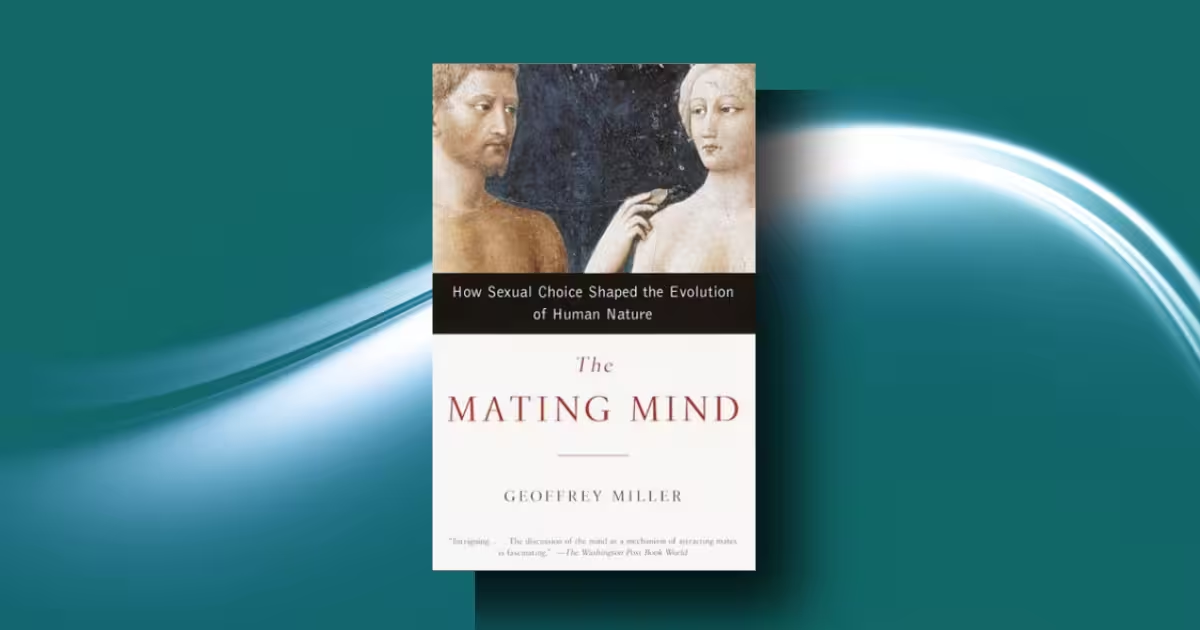
“The Mating Mind: How Sexual Choice Shaped the Evolution of Human Nature” is a groundbreaking work by evolutionary psychologist Geoffrey Miller, first published in hardcover by Doubleday (New York) on April 18, 2000, and in the UK by William Heinemann, with the Anchor Books paperback following in 2001. Spanning 503 pages of dense, witty, and provocative argumentation, it arrives with a substantial bibliography of over 460 references.
Miller, born in 1965 in Cincinnati, earned his B.A. in Biology and Psychology from Columbia University and his Ph.D. in Cognitive Psychology from Stanford University before holding research and teaching positions at University College London, the London School of Economics, UCLA, and the University of New Mexico.
His subsequent books—Mating Intelligence (2008), Spent (2009), Mate (2015), and Virtue Signaling (2019)—have cemented his reputation as one of evolutionary psychology’s most original and irreverent thinkers.
But The Mating Mind remains his magnum opus, the book that took Darwin’s “other” theory—sexual selection through mate choice—and thrust it into the center of the debate about what made us human.
Context
For over a century after Darwin’s The Descent of Man, and Selection in Relation to Sex (1871), evolutionary biology was dominated by Herbert Spencer’s catchy but misleading phrase “survival of the fittest.”
Natural selection—the idea that traits spread because they help organisms survive—became the default explanation for everything from the giraffe’s neck to the human brain.
But survival selection hit a wall when confronted with the most distinctively human traits: language, art, music, humor, morality, and creative intelligence.
Why would evolution produce a brain that composes symphonies, tells campfire stories, and agonizes over ethical dilemmas—none of which help you find more food or avoid more predators?
Miller’s answer, rooted firmly in Darwin’s long-neglected insight, is that our minds evolved not primarily as survival machines but as courtship machines. The human brain, he argues, is the peacock’s tail of our species—a magnificent, costly, and conspicuously useless ornament whose biological function is to attract sexual partners and advertise genetic fitness.
Purpose
The Mating Mind’s central idea is stated with remarkable clarity early on: “This book proposes that our minds evolved not just as survival machines, but as courtship machines.
Every one of our ancestors managed not just to live for a while, but to convince at least one sexual partner to have enough sex to produce offspring. Those proto-humans that did not attract sexual interest did not become our ancestors, no matter how good they were at surviving.”
Miller aims to demonstrate that sexual selection through mate choice—a process distinct from natural selection—can account for the most puzzling and seemingly extravagant features of the human mind: our capacities for art, music, morality, language, humor, and creativity.
2. Background: The Century of Neglect
To understand why The Mating Mind was so revolutionary in 2000, you have to appreciate a staggering historical fact: sexual selection theory was exiled from mainstream biology for almost exactly a century.
Darwin himself devoted over 500 pages of The Descent of Man to sexual selection—far more space than he gave to human origins. Yet after his death in 1882, the theory was systematically attacked, dismissed, and forgotten.
Alfred Russel Wallace, co-discoverer of natural selection, was sexual selection’s most influential critic.
He argued that bright male plumage was merely a side-effect of “surplus energy” rather than the outcome of female choice. Thomas Hunt Morgan, the Nobel Prize-winning geneticist, declared in 1903 that “the theory meets with fatal objections at every turn.”
Julian Huxley, in his 1942 textbook Evolution: The Modern Synthesis, treated sexual selection as a marginal, almost criminal force.
Even in the 1930s, after Ronald Fisher had developed rigorous mathematical models showing that runaway sexual selection and fitness indicators could indeed work, the idea languished.
Miller traces this rejection not to scientific evidence—the mountain of data Darwin presented in The Descent of Man was never seriously challenged—but to what he calls “ideological biases in 19th-century natural history, especially the unthinking sexism of most biologists other than Darwin.” Victorian male scientists simply could not accept that female animals, with their supposedly limited cognitive capacities, could drive evolution through their sexual whims.
The result was a tragedy for science: “Almost all of 20th-century psychology developed without considering the possibility that sexual selection through mate choice might have played a role in the evolution of human behavior, the human mind, human culture, or human society.”
The revival began in the 1970s and 1980s with Amotz Zahavi’s handicap principle, the mathematical models of Russell Lande and Mark Kirkpatrick, and experimental work by Malte Andersson, Michael Ryan, and dozens of others.
By the time Miller wrote The Mating Mind, sexual selection had become “the hottest area of evolutionary biology,” but its implications for human mental evolution remained almost entirely unexplored. Miller’s book was the first sustained attempt to bridge that gap.
3. The Mating Mind Summary
The Three Problems That Survival Selection Cannot Solve
Miller opens brilliantly by identifying three interconnected puzzles that any adequate theory of human mental evolution must solve.
First, large brains evolved in vanishingly few species: “over 99 percent of animal species thrive with brains much smaller than a chimpanzee’s.” If big brains were so useful for survival, why didn’t convergent evolution produce them in hundreds of lineages, the way it produced eyes, wings, and claws?
Second, there was an enormous lag between brain expansion and apparent survival payoffs: our ancestors’ brains tripled in size between 2.5 million and 100,000 years ago, yet for most of that period they made the same crude stone handaxes with no technological progress whatsoever. “Arguably, one could not ask for a worse correlation between growth in a biological organ and evidence of its supposed survival benefits.”
Third, nobody has identified plausible survival payoffs for our most cherished abilities: “Linguistics textbooks do not include a good evolutionary theory of language origins, because there are none. Cultural anthropology textbooks present no good evolutionary theories of art, music, or religion, because there are none.”
These three problems, Miller argues, “compound one another. They roam around like a gang, knocking the sense out of any innocent young theories that happen to stroll along.” Sexual selection cuts through the knot: it is fickle, unpredictable, and diversifying—it never happens the same way twice.
That explains uniqueness. It favors traits for their reproductive benefits, not survival benefits—that explains the lag.
And it thrives on costly, conspicuous display—that explains art, music, humor, and language.
Darwin’s Prodigy: A History of Sexual Selection
Miller devotes an entire chapter (“Darwin’s Prodigy”) to the intellectual history of sexual selection, and it reads like a scientific thriller. Darwin was so troubled by the peacock’s tail that he once confessed to his son Francis: “The sight of a feather in a peacock’s tail, whenever I gaze at it, makes me sick!”
The tail seemed to mock his theory that natural selection shapes every trait to some survival purpose.
Darwin’s solution—that female aesthetic preferences drive the evolution of male ornaments—was so radical that it “was not only atheism, but indecent atheism.” Miller notes the delicious irony: “It was one thing for a generalized Nature to replace God as the creative force.
It was much more radical to replace an omniscient Creator with the pebble-sized brains of lower animals lusting after one another.”
Ronald Fisher revived the theory in the 1930s with two key innovations.
First, the runaway process: if females prefer a trait (say, longer tails), and that trait is heritable, then both the trait and the preference can spiral upward in a self-reinforcing positive-feedback loop.
Second, fitness indicators: sexual ornaments may evolve because they honestly advertise genetic quality, health, and condition—what Fisher called “general vigor and fitness.”
Then, in 1975, Israeli biologist Amotz Zahavi proposed the handicap principle, which Miller calls one of the most counterintuitive yet powerful ideas in all of biology.
The principle states that sexual ornaments must be costly to be reliable. A peacock’s tail is heavy, cumbersome, and dangerous—but that’s precisely the point. “Unfit peacocks might be able to grow large tails, but they would not be strong enough to carry them while finding food, or fast enough to escape from predators.
Only highly fit peacocks can afford very large tails.” The handicap principle, once fiercely resisted by biologists, is now a cornerstone of sexual selection theory.
The Runaway Brain
In his most provocative early move in The Mating Mind, Miller applies Fisher’s runaway model directly to human brain evolution.
Imagine hominid females developing a sexual preference for creative intelligence. Males with higher creative intelligence attract more partners and produce more offspring, who inherit both the intelligence and the preference for intelligence. A positive-feedback loop ignites. “Brain size would have tripled in 20,000 years, not 2 million years,” Miller estimates—runaway is almost too fast.
But Miller is admirably honest about the model’s limitations.
Runaway should produce huge sex differences (peacocks vs. peahens), yet human men and women differ minimally in brain size (male brains average 1,440 grams vs. female 1,250 grams, shrinking to only 100 grams after correcting for body size) and show no sex difference in general intelligence. “The best analysis has been done by Arthur Jensen in his 1998 book The g factor1, and he concluded that ‘The sex difference in psychometric g is either totally nonexistent or is of uncertain direction and of inconsequential magnitude.’”
Furthermore, runaway cannot explain the multi-step progressive trend toward larger brains over 2 million years.
So Miller refines his theory: rather than pure runaway, the human brain evolved through sexual selection as a fitness indicator, a process compatible with mutual mate choice. This shift, which occupies the middle chapters of The Mating Mind, is where the theory becomes genuinely compelling.
Miller explores runaway sexual selection, where:
- Preferences (e.g., intelligence)
- and traits (e.g., intelligence itself)
👉 reinforce each other over generations.
Result: rapid brain expansion (2.5 million → 100,000 years ago)
A Mind Fit for Mating: Fitness Indicators and the Handicap Principle
“Our brains are only 2 percent of our body weight, but they consume 15 percent of our oxygen intake, 25 percent of our metabolic energy, and 40 percent of our blood glucose.”
For survivalists, these costs have always been a problem demanding justification through commensurate survival benefits.
For Miller, they are precisely the point: “The brain’s costs are what make it a good fitness indicator. Sexual selection made our brains wasteful, if not wasted: it transformed a small, efficient ape-style brain into a huge, energy-hungry handicap spewing out luxury behaviors like conversation, music, and art.”
This is where Miller introduces an idea that I found both unsettling and thrilling.
The human brain may be the most mutation-sensitive organ in the body. Geneticists estimate that about half of our 80,000 genes are involved in brain development, with perhaps a third active only in the brain.
Every new harmful mutation—and we each carry an estimated 1.6 to 3 new harmful mutations that neither parent had—has a roughly 50% chance of impairing some aspect of brain function. “The brain probably has a larger mutational target size than any other organ. Of all the new mutations that mess up something during human development, half of them mess up something in the human brain.”
This vulnerability is not a design flaw—it is a feature.
It means that the brain’s performance during courtship reveals an enormous amount of genetic information.
When you display your wit, your vocabulary, your musical ability, or your kindness, you are not just entertaining a potential partner. You are broadcasting the integrity of tens of thousands of genes, each one having successfully navigated the developmental gauntlet from conception to adulthood without succumbing to a harmful mutation.
Your conversation is, quite literally, a genetic audit.
Ornamental Genius: The Mind as Entertainment System
One of Miller’s most delightful rhetorical moves is his rejection of the dominant metaphors in cognitive science. “The mind as a Swiss army knife,” “the mind as a computer for processing information,” “the mind as a Machiavellian intelligence center”—all, he argues, miss the point.
Instead, he proposes something radically different: the mind as an entertainment system that evolved to stimulate other minds.
“Imagine a species that stumbles into an evolutionary utopia in which sexual selection is no longer driven by male competition for dominance and display but by mutual choice for mutual pleasure. The males who deliver the greatest rapture to females are sexually favored, passing on the pleasure-giving abilities to both sons and daughters.
Equally, those females who deliver the greatest bliss and contentment to males are favored, passing on their pleasure-giving abilities to their offspring.”

Miller draws an analogy between sexual selection and the marketing revolution that swept through American business in the 1950s.
Just as Procter & Gamble shifted from a production orientation (make things efficiently) to a marketing orientation (fulfill consumer desires), evolution under sexual selection shifts from survival efficiency to courtship appeal. “Any animal that persisted in a production orientation, an obsession with food and survival, lost out to competitors that adopted a marketing orientation, an obsession with profiting genetically by pleasing the opposite sex.”
He concludes with a line that hums with provocative energy: “We are walking, talking advertisements for our genes.”
The sensory bias component of the theory adds another layer.
Animals do not evolve sexual preferences in a vacuum—their existing senses and cognitive biases shape what they find attractive. Primate color vision, for instance, evolved partly to detect ripe fruit. That sensory bias may have influenced which sexual ornaments proved appealing.
Miller generalizes this: our mental quirks—our love of novelty, our hunger for narrative, our attraction to symmetry, our delight in rhythm—may have channeled sexual selection toward particular forms of courtship display.
Courtship in the Pleistocene: How Our Ancestors Actually Chose Mates
Miller devotes a vivid chapter to reconstructing the social and sexual world of our Pleistocene ancestors. The picture is not the cartoonish “cave-man clubbing cave-woman” of popular imagination but something far more nuanced and, in its way, more romantic.
Our ancestors lived in small, mobile bands of perhaps 20 to 100 individuals, in the mixed savanna, scrub, and forest of sub-Saharan Africa. “During the days, women would have gathered fruits, vegetables, tubers, berries, and nuts to feed themselves and their children. Men would have tried to show off by hunting game, usually unsuccessfully, returning home empty-handed to beg some yams from the more pragmatic womenfolk.”
Life expectancy was not short because of constant violence but because of the accumulated risks of a foraging lifestyle. “Our ancestors did not spend all their time worrying about survival problems. They were among the longest-lived species on the planet, which implies that their daily risk of death was minuscule. Like most great apes, they probably spent their time worrying about social and sexual problems.”
Mating, Miller argues, was neither the rigid monogamy of Christian tradition nor the winner-take-all polygyny of elephant seals. The evidence—moderate sex differences in body size, anthropological records of hunter-gatherer societies, and comparative primate data—points to moderate polygyny with serial monogamy.
Most children were born to couples who stayed together for several years, not for life.
This created the conditions for mutual mate choice and for sexual selection to operate on both sexes.
Crucially, before modern market economies, you could not outsource your courtship. “During human evolution, one’s ability to make a good living did not automatically mean that one could buy a desired sexual partner good-quality entertainment. If you were a prehistoric hominid, you would have had to do the entertaining yourself.
If you did not make a desired mate laugh, nobody would do it for you. And if they did, your date would probably run off with them instead of you.”
Bodies of Evidence: The Penis, The Breast, The Buttocks, The Face
Miller’s analysis of the human body as a canvas of sexual selection is simultaneously rigorous and playfully irreverent. He devotes an entire chapter to demonstrating that our most distinctively human physical traits—our penises, breasts, buttocks, beards, and facial features—bear the unmistakable signature of sexual choice.
The Penis: “Adult male humans have the longest, thickest, and most flexible penises of any living primate.” Gorilla penises average under 2 inches erect; chimpanzee penises about 3 inches; human penises over 5 inches.
Miller argues this cannot be explained by sperm competition (chimps face far more sperm competition yet have smaller penises) or dominance displays (dominant gorillas sport 1-inch penises). The human penis evolved through female choice as a tactile stimulator for copulatory courtship—a pleasure-delivery device whose size and flexibility reflect ancestral female preferences.
In a memorable line: “If we were a species in which males dominated the sexual system, we would have one-inch penises like dominant gorillas. The large male penis is a product of female choice in evolution.”
Breasts: Human females are the only primates with permanently enlarged, fatty breasts. Most primate females are flat-chested even when lactating. Miller argues breasts evolved through male mate choice as combined indicators of youth (pertness signals age), developmental stability (symmetry signals genetic quality), and nutritional condition (fat reserves signal foraging ability and fertility).
The fact that dieting shrinks breasts first is not coincidental—it is a feature of their design as honest condition-dependent signals.
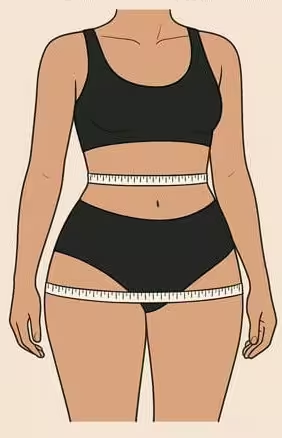
Buttocks and Waists: Building on Dev Singh’s research, Miller notes that men across cultures prefer women with waist-to-hip ratios around 0.72, a reliable indicator of youth, health, and fertility.
The Face: Miller’s argument about faces is particularly pointed: “We pick the one part of the body where fitness differences are most manifest, and regard that as the seat of personhood. Where mutations show their effects most readily is where we direct our sexual judgment and social attention.”
Female buttocks, like breasts, are unique among primates—permanently protruding, fat-amplified, and sexually differentiated—suggesting intense male mate choice during human evolution.
Handaxes: The First Works of Art?
One of The Mating Mind’s most intriguing sections concerns the Acheulean handaxe—a teardrop-shaped stone tool manufactured by Homo erectus from about 1.6 million years ago until about 200,000 years ago.
Handaxes were produced in staggering numbers across Africa, Europe, and Asia, with a consistent design that cannot be explained by cultural imitation alone (which would have produced far more variation over such vast spans of time and space).
Drawing on the work of science writer Marek Kohn and archaeologist Steven Mithen, Miller presents the handaxe as a sexually selected fitness indicator. “Many of the finest handaxes show no sign of use: no visible chips, and no evidence of edge wear under the electron microscope.” Some—like the “Furze Platt Giant” at over a foot long—are impractically large, while others are too small to be useful.
Modern flint-knappers with 25 years of experience take about 20 minutes to make a decent handaxe, compared to a couple of minutes for a simple cutting edge. The learning curve is steep: about six months to master the basics, years to achieve perfection.
As Kohn noted, “A handaxe is a measure of strength, skill and character.”
Its demanding production requires physical strength, hand-eye coordination, pain tolerance (from flying rock shards), patience, and resistance to infection (from cuts).
Its bilateral symmetry makes perfection easy to assess but hard to achieve—precisely the properties of a good fitness indicator. “In one neat package, the handaxe combines instinct and learning, strength and skill, blood and flint, sex and survival, art and craft, familiarity and mystery.”
Arts of Seduction: Bowerbirds and the Origin of Aesthetics
Miller’s chapter on art is where The Mating Mind reaches its most lyrical heights—and where his argument, in my view, becomes almost impossible to resist.
He takes a “bottom-up” approach, looking not at the masterpieces of the Italian Renaissance but at the visual ornamentation that surrounds ordinary human life: clothing, jewelry, home decoration, body painting. “There is no clear line between fashion and art, between ornamenting our bodies and beautifying our lives.”
His key biological analogy is the bowerbird—one of the very few non-human animals that construct purely aesthetic displays beyond their bodies.

Male bowerbirds build enormous, elaborate courtship nests ornamented with colorful flowers, fruits, shells, and butterfly wings. “If you could interview a male Satin Bowerbird for Artforum magazine, he might say something like ‘I find this implacable urge for self-expression, for playing with color and form for their own sake, quite inexplicable… It is a happy coincidence that females sometimes come to my gallery openings and appreciate my work, but it would be an insult to suggest that I create in order to procreate.’”
The joke, of course, is that bowerbird art is patently a product of sexual selection. Miller suggests human art may be no different.
Miller then advances what I consider The Mating Mind’s most powerful single argument: beauty equals difficulty.
Our aesthetic preferences, he argues, are not arbitrary sensory biases but finely tuned adaptations for assessing the fitness of the artist. “We find attractive those things that could have been produced only by people with attractive, high-fitness qualities such as health, energy, endurance, hand-eye coordination, fine motor control, intelligence, creativity, access to rare materials, the ability to learn difficult skills, and lots of free time.”
This explains why mechanical reproduction has so profoundly disrupted our aesthetic instincts.
When spoons were made by hand, those with the most perfect symmetry, smoothest finish, and most intricate ornamentation were the most beautiful.
Once machines could produce perfect symmetry cheaply, aesthetics shifted toward conspicuously handmade irregularity. “A modern artisan’s ability to make any sort of spoon from raw metal is considered wondrous.” The same logic explains the crisis of representation after photography: painters could no longer compete on realism, so they invented impressionism, cubism, and abstraction—genres that foregrounded handmade authenticity over representational skill.
Miller’s analysis of the common museum-goer’s complaint—“My child could have done that”—is delicious: “To say ‘My child could have done that’ could mean ‘I cannot discern here any signs of learned skill that would distinguish an adult expert from an immature novice.’ The ‘Any idiot’ comment could mean ‘I cannot judge the artist’s general intelligence level from this work.’”
These are not philistine reactions but the legitimate frustration of psychological adaptations designed to assess artistic fitness indicators being thwarted by art that deliberately obscures them.
One of The Mating Mind’s most powerful sections argues:
“The production of useless ornamentation… is just what sexual selection is good at.”
Art is not useless—it’s a signal of fitness.
Why?
- It’s costly
- It requires skill
- It signals intelligence and creativity
Virtues of Good Breeding: Morality as Sexual Display
If the art chapter is The Mating Mind’s aesthetic peak, the morality chapter is its ethical heart—and the one I found most personally transformative. “David Buss’s study of global sexual preferences found that ‘kindness’ was the single most important feature desired in a sexual partner by both men and women in every one of the 37 cultures he studied. It ranked above intelligence, above beauty, and above status.”
Miller argues that much of human morality—especially the generosity, sympathy, and fairness that go beyond the demands of kinship and reciprocity—evolved through sexual selection as costly displays of fitness. This solves a problem that had bedeviled evolutionary theorists: how could apparently selfless altruism toward non-relatives possibly evolve? The answer is that kindness is sexually attractive.
Drawing on Amotz and Avishag Zahavi’s observations of Arabian babblers (birds that compete to perform altruistic acts like sentinel duty and food-sharing), Miller suggests that “altruistic acts” function as Zahavian handicaps: they are costly, conspicuous, and condition-dependent, and therefore reliable indicators of the altruist’s fitness.
Only individuals in excellent condition can afford to be generous. Mate choice for generosity therefore favors genes for both generosity and the good condition that makes it possible.
He applies this to a series of human moral behaviors: leadership (the peacekeeping abilities that confer high status even in chimpanzees), charity (why we donate time when donating money would be more efficient, why charities offer badges and tote bags, why fashion cycles dominate giving), sexual fidelity (romantic love as a costly, honest signal of commitment), good fathering (male care for step-children as courtship effort directed at the mother), and sportsmanship (fair play as a way to maximize the information about fitness conveyed by athletic competition).
Oscar Wilde’s An Ideal Husband becomes a text for evolutionary analysis: “The drama’s theme is that men and women are under very strong pressure to make a credible show of high moral stature to their lovers and spouses.” Miller wryly observes that “Immoral acts are mainly those we would be embarrassed by if our boyfriend or girlfriend found out about them.”
Morality and Virtue as Signals
Even morality is reinterpreted:
- Kindness = signal of good genes
- Generosity = signal of resources
- Integrity = signal of reliability
👉 Virtue becomes sexual advertisement
Cyrano and Scheherazade: Language as Verbal Courtship
Miller’s chapter on language is, for me, the book’s tour de force. He confronts head-on the central puzzle of language evolution: speech appears altruistic.
Speaking costs time and energy, and the information benefits flow mainly to the listener. Natural selection should favor reluctant talkers and eager listeners. Yet the opposite is true: “People compete to say things. They strive to be heard. When they appear to be listening, they are often mentally rehearsing their next contribution to the discourse rather than absorbing what was just said by others.”
The solution: speech is not altruistic information-sharing but competitive self-display.
Language evolved as verbal courtship.
The hidden benefit of speaking is reproductive. This explains why our speaking apparatus has been dramatically re-engineered while our hearing apparatus remains evolutionarily conservative; why “boy meets girl” means “boy and girl talk”; and why verbal fluency blossoms precisely during adolescence, when courtship begins.
Miller marshals evidence from vocabulary size (average adult knows 60,000 words, but the most frequent 100 account for 60% of conversation and the most frequent 4,000 for 98%—why learn the other 56,000 if not for display?), from poetry (meter, rhythm, and rhyme as verbal handicaps that make communication harder but more impressive), from gossip (not just social grooming but status display), and from the Cyrano de Bergerac archetype (the articulate but physically odd suitor whose verbal brilliance wins love).
One of his most striking arguments concerns vocabulary size as an intelligence indicator.
The WAIS-R intelligence test shows minimum IQ thresholds for comprehending certain words: IQ 80 for “fabric,” “enormous,” and “conceal”; IQ 90 for “designate,” “ponder,” and “reluctant.” “If you are flirting with someone, and they say they would like to ‘consume’ your body in a passionate embrace, but they do not understand when you say you are ‘reluctant,’ you can probably infer they have an IQ between 80 and 90.
We make these sorts of inferences quite automatically and unconsciously, of course.”
The Scheherazade strategy3—keeping sexual partners interested through sustained verbal entertainment—is Miller’s term for the female counter-strategy to male sexual novelty-seeking.
Just as Scheherazade saved her life by telling the sultan a thousand and one nights of stories, ancestral women kept useful males around by making monogamy conversationally interesting. “Long after partners grow overfamiliar with each other’s bodies, the Scheherazade strategy—trying to keep conversations interesting throughout a relationship—keeps them from growing bored with each other’s company.”
The Wit to Woo: Creativity, Humor, and Proteanism
Miller’s final substantive chapter connects human creativity to the ancient biological phenomenon of protean behavior—adaptively unpredictable behavior that evolved to foil predators and competitors.
Rabbits zigzag erratically; moths tumble and power-dive when they hear bat sonar; octopuses convulse through color changes to confuse predators. All these behaviors work by being unpredictable.
Human creativity, Miller argues, is proteanism harnessed and amplified by sexual selection for courtship display.
Humor is the premier example: “An appreciation of humor is an important part of mate choice too.
One of the strongest and most puzzling findings from evolutionary psychology research has been the value that people around the world place on a good sense of humor.” A GSOH (Good Sense of Humor) is one of the most frequently requested traits in personal advertisements because humor reliably indicates intelligence, creativity, youthfulness, and protean mental agility—all of which advertise fitness.
He quotes Arthur Koestler’s The Act of Creation (1964), which struggled to find a survival function for laughter: “What is the survival value of the involuntary, simultaneous contraction of fifteen facial muscles associated with certain noises which are often irrepressible?
Laughter is a reflex, but unique in that it serves no apparent biological purpose; one might call it a luxury reflex.”
Miller’s answer: it is a luxury, and that is precisely its evolutionary point. “This book has repeatedly celebrated this ‘element of frivolity’ that sexual selection introduces into the cosmos.”
4. The Mating Mind Analysis
The Mating Mindis, quite simply, one of the most important and delightfully subversive books on human nature ever written.* It sits on my shelf alongside Richard Dawkins’ The Selfish Gene, Steven Pinker’s How the Mind Works, and Jared Diamond’s The Third Chimpanzee—but it does something none of those books quite manage. It makes you fall back in love with being human.
Where other evolutionary psychology books can leave you feeling like a lumbering robot programmed by selfish genes, Miller’s vision is almost romantic: our most cherished capacities—art, kindness, creativity, wit—are not evolutionary accidents but the direct products of millions of years of ancestors choosing each other for their beautiful minds.
The Mating Mind’s central argument is, in my assessment, substantially persuasive. Miller does not claim that sexual selection explains everything about the human mind—he explicitly limits his theory to the uniquely human 10% or so of our psychological adaptations that distinguish us from other apes. But within that domain, he makes a case that is difficult to dismiss.
The hallmarks of sexually selected traits—high cost, conspicuous display, large individual differences, high heritability, strong condition-dependence, and minimal correlation with survival utility—fit our most distinctive mental capacities remarkably well.
That said,The Mating Mind has received serious scholarly criticism, and I would be remiss not to acknowledge it. Some evolutionary biologists, such as James R. Roney, have described Miller’s theories as “seductive but improbable.”
Anthropologist John Wagner, writing in the journal Human Nature, argued that Miller makes an error in opposing natural selection and sexual selection as if they were mutually exclusive—in reality, they operate simultaneously and interact in complex ways.
Linguist Ted Briscoe has challenged Miller’s argument that large vocabulary size evolved through sexual selection, arguing instead that power-law distributions in language organization are evidence of dynamical systems processes rather than sexual display.
There is also the valid criticism, voiced by reviewer Timothy Horvath, that “the Mating Mind may overstate the case in terms of the pervasiveness of sexual selection, it adds analytical terms to the conversation that will prove indispensable.”
The Mating Mind sometimes reads as though every human excellence—from Picasso’s paintings to Rockefeller’s philanthropy—can be reduced to a single evolutionary mechanism. This is Miller being provocative rather than precise, but it can feel reductive.
My own reservation concerns the near-total absence of music. For a book that promises to explain art, language, morality, and creativity—and that draws so heavily on analogies with bird song—the omission of music is conspicuous. Miller acknowledges this in the Epilogue, calling music “a scientifically challenging and emotionally charged topic, and one I hope to address elsewhere.” But its absence from a book about the mating mind is like omitting the heart from a book about circulation.
5. Strengths and Weaknesses: My Pleasant and Unpleasant Experiences
What I Loved
The prose is a genuine pleasure. Miller writes with the fluency, wit, and epigrammatic flair of a gifted novelist. Lines like “In poetic terms, I wondered whether the mind evolved by moonlight” and “Evolution does not have a Protestant work ethic. It does not get tax credits for research and development” are not merely decorative—they crystallize complex ideas into memorable images.
The intellectual honesty is exceptional. Miller repeatedly acknowledges the limitations of his own arguments. He devotes an entire section to why the simple runaway brain theory doesn’t work (“a single sustained runaway event would have been at least a hundred times too fast to explain human brain evolution”).
He admits when evidence is lacking and when further research is needed. This is a provisional theory under construction, not a doctrine set in stone.
The scope is breathtaking. Miller draws on primatology, paleoanthropology, behavior genetics, psychometrics, game theory, sociolinguistics, art history, and literary criticism—and somehow makes it all cohere. The Mating Mind feels like the beginning of a genuine consilience between the sciences and the humanities, something E. O. Wilson called for but few have achieved.
The moral vision is unexpectedly humane. Far from reducing human virtue to animal lust, Miller’s theory elevates our capacities for kindness, creativity, and love to the status of evolutionary achievements. “Human altruism is not an evolutionary paradox. It is a sexual ornament.” That sentence changed how I think about goodness.
What Frustrated Me
The first third is slow. Miller spends over 150 pages on sexual selection theory and its history before arriving at his original arguments about the human mind. For readers already familiar with evolutionary biology, this can feel like marking time. One reviewer noted that “by the time we did get to the chapters on art, morality, and creative intelligence, it felt a little anti-climactic.”
The theory can explain too much. At times, sexual selection seems to function as a universal solvent that can dissolve any human trait into a courtship display. When every behavior—from tipping waiters to composing symphonies—is interpreted through the same lens, the theory risks unfalsifiability. Miller acknowledges this danger but doesn’t entirely escape it.
Music is missing. I’ve said it before, but it bears repeating. For a book subtitled “How Sexual Choice Shaped the Evolution of Human Nature,” the omission of music—perhaps the most obviously sexual of all the arts—is baffling. Miller promises to address it in future work, but its absence weakens the book’s comprehensiveness.
Some arguments are speculative to the point of fragility. The claim that handaxes were sexual displays, while fascinating, remains controversial among archaeologists. Critics have pointed out that many handaxes show clear evidence of practical use, and that the “sexy handaxe theory” may overstate the case.
7. Comparison with Similar Works
The Mating Mind occupies a unique position in the evolutionary psychology canon, though it inevitably invites comparison with several landmark works.
Steven Pinker’s How the Mind Works (1997) is the most direct antecedent and foil. Pinker argued that art, music, humor, and religion are not adaptations but “cheesecake”—cultural inventions that exploit pre-existing mental circuits without improving fitness.
Miller explicitly positions his The Mating Mind as a rebuttal, writing that Pinker “overlooked the possible role of sexual selection in shaping conspicuous display behaviors such as art and music.”
Where Pinker sees the mind as a pragmatic problem-solver, Miller sees it as a magnificent sexual ornament. Pinker’s book is more comprehensive; Miller’s is more revolutionary.
Richard Dawkins’ The Selfish Gene (1976) provided the gene’s-eye-view of evolution that makes Miller’s theory possible.
Dawkins also gave early, sympathetic attention to Zahavi’s handicap principle. But Dawkins never applied sexual selection systematically to human mental evolution—that is Miller’s distinctive contribution.
Matt Ridley’s The Red Queen (1993) explored sexual selection’s role in human evolution but focused more on sex differences, mating strategies, and the evolutionary origins of sex itself. Ridley gave Miller’s runaway brain theory early attention in his final chapter but did not develop it into a full theory of mental evolution.
Robin Dunbar’s Grooming, Gossip, and the Evolution of Language (1996) proposed that language evolved for social bonding and gossip. Miller engages with Dunbar’s theory respectfully but offers a different emphasis: gossip is not just social grooming but competitive verbal display.
Dunbar’s own data—showing that males shift toward intellectual display topics when females are present—actually supports Miller’s sexual selection view.
David Buss’s The Evolution of Desire (1994) documented human mate preferences across cultures with unprecedented rigor, providing the empirical foundation on which Miller builds. Buss showed that kindness and intelligence are universally valued in mates; Miller explains why.
8. Conclusion
The Mating Mind is not for everyone, and it doesn’t pretend to be. It is a serious work of evolutionary science that demands intellectual engagement.
If you are looking for a dating advice book, this is emphatically not it—as one Amazon reviewer put it, “If you are in research then it might be helpful. Otherwise, the book is not much helpful for who are looking for Dating and sexual mating strategy.”
But if you are any of the following, The Mating Mind will reward you richly:
A curious general reader who has ever wondered why humans make art, tell jokes, fall in love through conversation, or feel moral outrage at unfairness. Miller’s answers are not the final word, but they are the most stimulating conversation-starters I have encountered.
A student or researcher in psychology, anthropology, biology, or the humanities who wants to understand how evolutionary theory can illuminate culture without reducing it to genetic determinism.
Miller’s framework—especially his marketing metaphor and his emphasis on mate choice as an intelligent, directional force—offers a genuine alternative to both blank-slate environmentalism and crude biological reductionism.
An artist, musician, writer, or performer who has felt condescended to by evolutionary psychologists who dismiss the arts as “biologically frivolous” (Pinker’s phrase). Miller takes art seriously as an adaptation—indeed, as perhaps the human adaptation.
Anyone navigating the complexities of modern courtship who wants to understand why conversation, humor, and character matter so intensely in romantic attraction. You will not get pickup lines or seduction techniques. You will get something better: a deep evolutionary rationale for why being an interesting, generous, creative person is the most attractive thing you can be.
On the other hand, if you are looking for a breezy pop-science read with simple takeaways, or if you find evolutionary explanations inherently distasteful, The Mating Mind will likely frustrate you.
Notes
- The factor (general intelligence factor) is a psychometric construct representing a shared, underlying cognitive capability that influences performance across diverse mental tasks. ↩︎
- A waist-to-hip ratio (WHR) around 0.7 is often cited as the ideal, scientifically-backed indicator of health and attractiveness for women, reflecting an hourglass figure. ↩︎
- The Scheherazade strategy is a method of using storytelling, suspense, and delayed gratification to influence, manage, or change the perspective of a powerful, hostile listener. Originating from One Thousand and One Nights, it involves ending stories on cliffhangers to create a “thousand and one nights” of dialogue, ultimately stopping a “massacre” (or harmful behavior) by engaging the sultan’s intellect and empathy over time. ↩︎







