
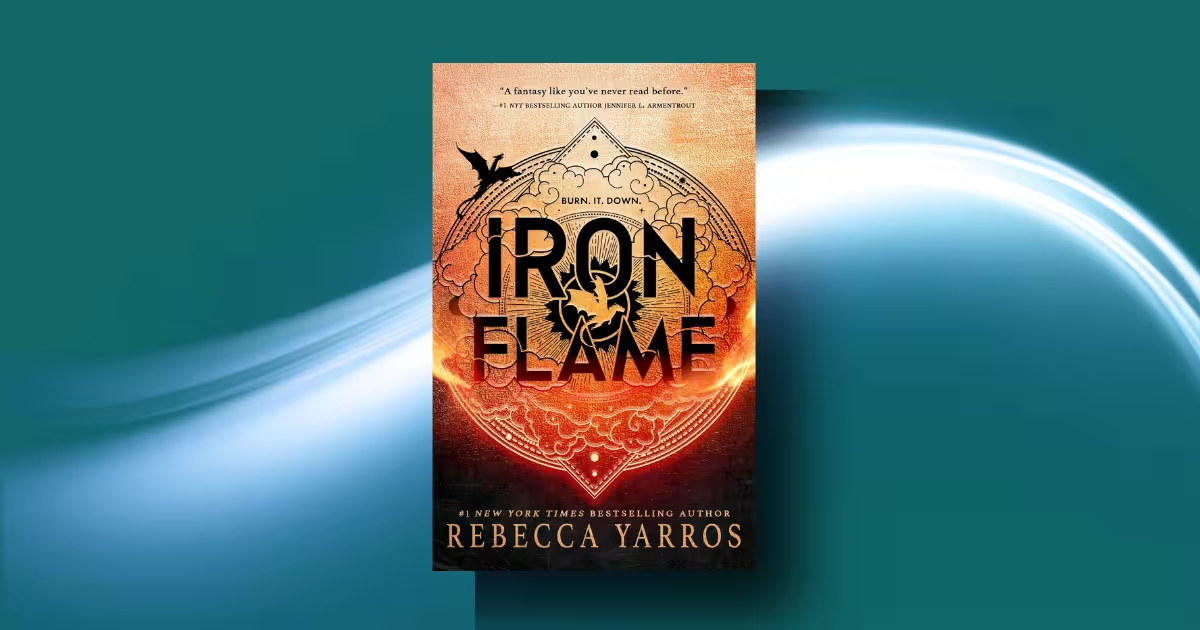
Did you ever wonder why a story can make you feel entirely hollowed out yet fiercely alive, long after the final page is turned? Iron Flame forces us to confront the terrifying reality that the truth doesn’t set us free—it just raises the stakes of our survival.
Best idea in a sentence: Rebecca Yarros’s Iron Flame is an intense, high-stakes expansion of The Empyrean series that shifts the narrative from individual survival to an all-out revolutionary war against institutional deceit, ultimately proving that true power lies not in raw magic, but in the brutal choices made for love and loyalty.
Iron Flame is an absolute masterpiece for dark academia devotees, epic fantasy enthusiasts, and readers who crave complex, morally grey character dynamics paired with meticulous world-building.
Conversely, it is decidedly not for those looking for a breezy, fast-paced escapist read, or individuals who are easily frustrated by heavy emotional angst, dense political exposition, and systemic trauma.
Table of Contents
1. Introduction
Iron Flame by Rebecca Yarros is the highly anticipated second installment in The Empyrean series. Published on November 7, 2023, by Red Tower Books (an imprint of Entangled Publishing) in the United States and by Piatkus in Great Britain, this 640-page contemporary epic immediately secured its position as a global cultural phenomenon.
Coming on the heels of the explosive success of Fourth Wing, this dark academia romantasy continues the perilous, dragon-ridden journey of Violet Sorrengail within the ruthless confines of Basgiath War College.
2. Background
To truly appreciate Iron Flame, one must look at its unique literary positioning. Yarros masterfully blends elements of traditional high fantasy—reminiscent of the intricate dragon hierarchies found in Christopher Paolini’s Inheritence Cycle—with the cutthroat institutional survival dynamics of The Hunger Games.
The novel arrived during a massive cultural resurgence of the “romantasy” genre, where political stakes and romantic vulnerabilities carry equal, devastating weight.
Furthermore, Yarros explicitly dedicates the work to her “fellow zebras,” drawing from her personal experience with Ehlers-Danlos Syndrome to ground Violet’s physical realities.
Statistically, according to data from organizations like the EDS Society, the condition affects approximately 1 in 5,000 individuals globally, yet it remains profoundly underrepresented in mainstream heroic literature.
This specific background elevates the text from a simple fantasy adventure to a pioneering piece of inclusive, contemporary representation.
3. Iron Flame Summary
The narrative structure of Iron Flame is divided into two distinct, high-stakes acts, tracking Violet Sorrengail’s survival during her second year at Basgiath War College and the subsequent open rebellion in Aretia.
Part I: The Crucible of Basgiath
The story commences directly in the aftermath of the devastating battle of Resson.
Violet is reeling from a cascade of reality-shattering revelations: the hidden continent-spanning war against the venin—corrupted, soul-draining dark wielders—is real; her country, Navarre, has spent four centuries fabricating history to hide this threat; and her older brother, Brennan, whom she believed dead for six years, is alive and leading the Aretian resistance movement.
Most painful of all is her profound crisis of faith in her lover, Xaden Riorson, who kept these monumental secrets from her.
Despite her emotional lacerations, Violet must return to Basgiath War College for her Second Year studies in the Rider Quadrant.
Her survival is complicated by her deployment to Samara, an outpost on the frontline, which forces an excruciating physical separation from Xaden. Her return is marked by extreme peril.
The traditional brutality of the college has been weaponized against her by the new Vice Commandant, Major Varis, and the sadistic interrogator, Varrish. Varrish is convinced that Violet is concealing forbidden knowledge regarding the events at Resson and her missing classmates.
Throughout her grueling training, Violet is subjected to targeted psychological and physical torture designed to break her spirit and force her to reveal the location of the resistance.
She must navigate complex coursework, including advanced combat tactics and flight maneuvers, while secretly plotting to steal critical information from the college archives. Her core mission is to find an instructional manual on how to raise the magical wards that protect cities from the venin’s dark magic.
The tension reaches a boiling point when Violet is captured by Varrish and subjected to intense, agonizing interrogation sessions.
Varrish attempts to use Violet’s deep bond with her dragons, Tairn and the adolescent Andarna, against her.
However, Xaden compromises his own safety, returning to Basgiath alongside members of the “marked ones”—the children of executed rebels—to launch a daring rescue operation. In a chaotic, bloody confrontation, Varrish is successfully eliminated, forcing Violet and her closest allies—including Rhiannon, Ridoc, and Sawyer—to make an irreversible choice.
Realizing that staying means certain execution or forced compliance, they orchestrate a massive, high-risk defection, leading a contingent of riders and their dragons away from Basgiath to join the revolution in Aretia.
Part II: The Siege of Aretia and the Final Conflagration
Upon arriving in the hidden, ruined city of Aretia, the defectors face a cold reception from the Aretian Assembly, who are deeply skeptical of Navarre’s sudden refugees.
Brennan, utilizing his unique signet as a mender, works alongside Xaden to fortify the city.
The core challenge facing the resistance is technological and magical: they must forge specialized daggers made of alloy capable of killing venin, and they must figure out how to ignite the ancient Aretian wardstone to protect the valley from an impending invasion.
Violet throws herself into deciphering the ancient journals of the first six dragon riders, searching for the precise methodology required to activate the wardstone.
Her research reveals a devastating cost: the stone can only be fully ignited through the sacrifice of a rider possessing an incredibly rare and powerful signet, combined with the pure, concentrated dragon fire of the unique lineages. As the internal political squabbles of the assembly drag on, the venin launch a calculated, multi-pronged offensive.
They bypass the main military defenses of Navarre, aiming directly at the unprotected borders and targeting civilian populations to drain the land of its magical essence.
The narrative reaches its catastrophic climax at the Battle of Basgiath. The venin forces launch a massive siege against the war college, aiming to destroy the central wardstone and completely leave Navarre defenseless.
The Aretian resistance, realizing that the fall of Basgiath means the destruction of the entire continent, makes the tactical decision to return and fight alongside their former oppressors.
The sky becomes a chaotic, terrifying expanse of dragon fire, lightning, and tearing claws as hundreds of riders clash with the venin and their terrifying flying beasts, the wyvern.
During the height of the battle, Violet’s mother, General Lilith Sorrengail, makes the ultimate sacrifice. Realizing that the wardstone requires an immense infusion of raw power to ignite and save her children, Lilith uses her signet—allowing her to channel the pure power of storms and wind—to fully charge the stone, killing herself in the process.
The wards roar back to life, instantly disintegrating the low-level wyvern and driving back the venin leadership.
However, the victory is utterly hollowed out by a final, horrifying twist. In the shadow of the ignited wardstone, Xaden is forced into a brutal duel with a powerful venin general.
Pushed to the absolute limits of his physical endurance and desperate to save Violet from being consumed by dark magic, Xaden makes a tragic choice: he reaches down into the earth and draws power directly from the source, bypassing his dragon bond. By doing so, Xaden corrupts his own soul, transforming into a neo-venin.
The novel concludes with a devastating emotional cliffhanger: Violet wakes up to realize that the man she loves is now the very monster they have been fighting against, setting up a dark, agonizing path forward for the remaining books.
4. Iron Flame Analysis
4.1. Characters
Violet Sorrengail: Violet’s transformation in Iron Flame is an extraordinary study in resilience under extreme pressure. No longer just trying to survive the physical trials of the quadrant, she must now bear the psychological weight of an entire revolution.
Her Ehlers-Danlos-like physical fragility is never treated as a flaw, but rather as a tactical reality she continuously adapts to. Her deepest struggle is emotional; she demands complete transparency from Xaden, yet finds herself drowning in the necessary secrecy of war.
Her intellectual capacity becomes her greatest weapon as she solves the riddle of the wardstone.
Xaden Riorson: Xaden’s arc shifts from the enigmatic, untouchable leader to a deeply vulnerable young man carrying the burden of hundreds of lives.
His absolute devotion to Violet becomes both his greatest strength and his fatal flaw. The revelation of his second signet—the illegal and highly dangerous ability to read intentions—deepens his moral ambiguity.
His tragic transformation at the end of the novel highlights his core motivation: he would gladly damn his own soul to hell if it keeps Violet alive.
The Supporting Ensemble: Iron Flame significantly enriches its secondary cast. Brennan Sorrengail provides a fascinating dynamic as the resurrected brother torn between military pragmatism and familial love.
Rhiannon Matthias steps up as a pillar of unwavering loyalty and fierce leadership, demonstrating the power of foundational friendship.
Dain Aetos undergoes a complex, painful redemption arc; once seen as a bureaucratic traitor, his eventual realization of his father’s corruption allows him to assist the resistance, shifting him from a black-and-white antagonist into a nuanced, tragic figure.
4.2. Iron Flame Themes and Symbolism
The thematic framework of Iron Flame revolves heavily around the corruption of institutional power and history.
Navarre’s literal erasing of the venin from historical records serves as a brilliant allegory for how real-world nations manipulate history to protect their internal stability.
This thematic exploration is perfectly summarized in the text when Violet observes the stark reality of their education:
“We are taught that Navarre is the beacon of safety, but safety built on a foundation of lies is just a comfortable prison.”
Another core theme is the nature of sacrifice and codependency. The novel constantly asks: How much of yourself can you sacrifice for the person you love before you become the monster?
Symbolism is woven throughout the text. The Wardstones symbolize isolationism and the false security of ignorance—they keep the darkness out, but they also trap the citizens inside a vacuum of state-sponsored propaganda.
The Dragons (Tairn, Sgaeyl, and Andarna) represent ancient, uncorrupted truth and natural power. Andarna’s physical evolution into a unique iron-scaled dragon symbolizes Violet’s own hidden, unconventional strength that defies the established categories of the world.
5. Evaluation
Iron Flame is a monumental, breathtakingly ambitious sequel that expands its universe with a raw, visceral intensity.
Expressing my feeling in one sentence: Iron Flame is a groundbreaking, magnificent, and emotionally agonizing fantasy epic that shatters the comfortable tropes of its genre to deliver a searing commentary on loyalty and institutional deceit.
Strengths: The world-building is remarkably vivid and expansive, seamlessly transitioning from the claustrophobic classrooms of Basgiath to the rugged, defiant peaks of Aretia.
Yarros’s prose handles action sequences with a kinetic masterclass efficiency; the final aerial battle is a cinematic triumph.
The emotional stakes between Violet and Xaden are palpably tense, filled with genuine psychological complexity rather than simple, unearned romantic conflict.
Weaknesses: The novel does suffer from noticeable pacing inconsistencies in its middle act. The extensive sequences dedicated to translating ancient journals and navigating Aretian political bureaucracy can feel repetitive, occasionally stalling the narrative momentum built up in the first half of the book.
Impact and Controversy: Intellectually and emotionally, the novel leaves an indelible mark. The shocking final pages sparked intense debate within the literary community regarding the boundaries of romantic sacrifice, leaving readers in a state of collective, existential devastation.
5.1 Comparison with Similar Works
| Metric | Iron Flame by Rebecca Yarros | A Court of Mist and Fury by Sarah J. Maas | The Hunger Games by Suzanne Collins |
|---|---|---|---|
| Core Theme | Institutional deceit & systemic war | Healing from trauma & finding true agency | Rebellion against an oppressive regime |
| Romantic Dynamic | High angst, deep codependency, moral corruption | Soulmate empowerment, collaborative healing | Survival-driven, tragic love triangle |
| Magic/World System | Strict dragon-bond, signets, ward mechanics | Fae courts, soft/high magic capabilities | Technological dystopia, non-magical |
| Pacing | Dense, exposition-heavy middle | Balanced character growth and world shifts | Fast-paced, relentless narrative drive |
6. Personal Insight with Contemporary Educational Relevance
The primary educational takeaway from Iron Flame lies in its profound exploration of historical revisionism and media literacy.
Navarre’s systematic deletion of the venin from textbook records mirrors real-world historical omissions where nations rewrite or suppress uncomfortable historical truths to maintain cultural hegemony or public compliance.
In our contemporary digital landscape, where the proliferation of generative artificial intelligence and misinformation makes discerning objective truth increasingly difficult, Iron Flame serves as an urgent, fantastical allegory for critical thinking. Five essential life lessons emerge from this narrative:
Question the Archive: Never accept official state or institutional narratives without verifying alternative sources and looking for systemic omissions.
True Strength is Multi-Dimensional: Physical limitations do not dictate an individual’s capacity for leadership or heroic impact; strategic intelligence is often the ultimate equalizer.
Transparency is the Bedrock of Trust: Secrets kept for “protection” are still weapons that ultimately erode the foundations of human relationships.
Complacency is a Form of Complicity: Living comfortably inside protective walls while ignoring the destruction of those outside is a profound moral failure.
Love Requires Accountability: True love does not mean blindly accepting a partner’s toxic or destructive choices; it requires holding each other to a higher ethical standard, even when it tears you apart.
7. Iron Flame Quotes
Here are the most significant, full-spoiler quotes that define the thematic weight of the novel:
“I will not leave you. I will not die. I will look for you in every sky, in every shadow, until we are both dust, and even then, I will find you.”
— Xaden to Violet, emphasizing their intense, eternal codependency.“The right way isn’t always the safe way, Violet. Sometimes, you have to burn down the world you know to build one that actually deserves to stand.”
— Brennan Sorrengail, outlining the brutal ethos of the Aretian revolution.“You want me to be the good guy? I’ve never been the good guy. I’m the monster who keeps the other monsters away from you.”
— Xaden’s chilling declaration before his final, dark transformation.
8. Conclusion
Ultimately, Iron Flame stands as a fierce, unforgettable testament to the power of contemporary fantasy.
It is a story that refuses to give its characters or its readers an easy exit, choosing instead to explore the dark, muddy depths of war, systemic deceit, and emotional vulnerability.
This novel is unreservedly recommended for fans of high-stakes fantasy romance, deep political intrigue, and complex character development.
It is an absolute must-read that solidifies Rebecca Yarros as one of the most prominent voices in modern epic fantasy, leaving an indelible mark on the literary landscape that will keep readers waiting in eager anticipation for the next chapter of the revolution.







