
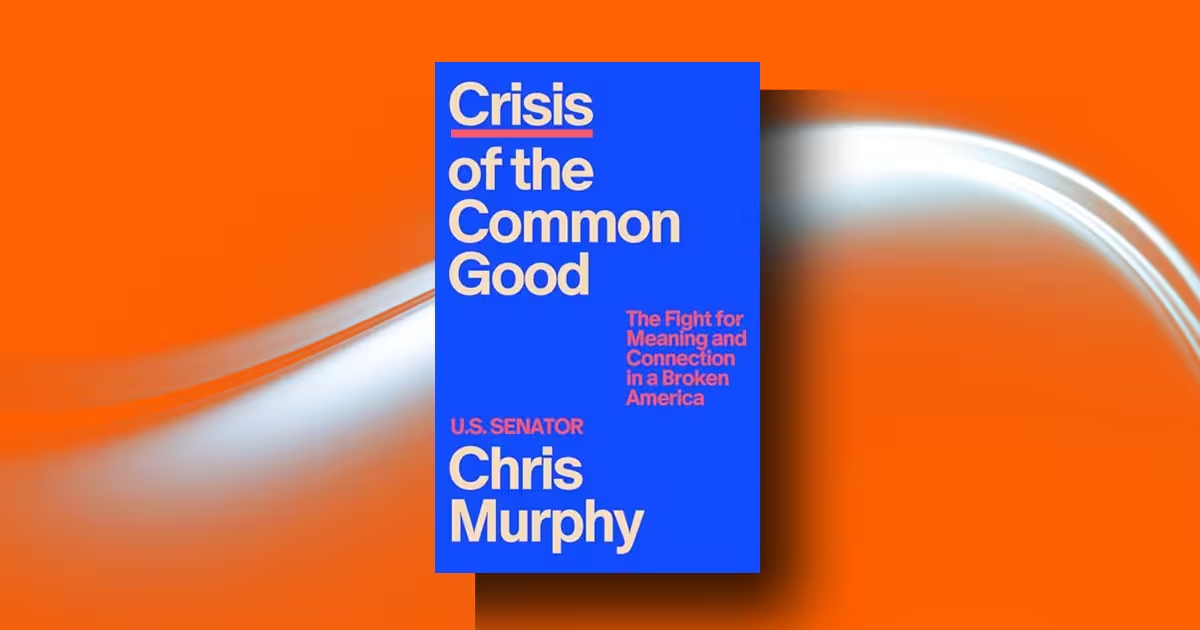
Do you feel that modern life gives us more choice, more screens, more shopping, and still less meaning? Chris Murphy’s Crisis of the Common Good made me sit with that uncomfortable question, because it argues that America is not only politically divided but spiritually disconnected.
Crisis of the Common Good is best for readers who enjoy political nonfiction, social criticism, books about loneliness and community, critiques of capitalism, and thoughtful debates about technology, corruption, education, and civic life. It is also best for readers who want to understand why “common good” politics is returning as a serious phrase in American public life.
Crisis of the Common Good is not for readers who want a neutral, detached policy manual, a purely academic sociology book, or a book that avoids Donald Trump, capitalism, religion, inequality, and moral language. Murphy is a Democratic senator, and although he tries to build a cross-partisan case, his political judgments are unmistakable.
Table of Contents
Introduction
Crisis of the Common Good: The Fight for Meaning and Connection in a Broken America is a nonfiction political and social-analysis book by U.S. Senator Chris Murphy of Connecticut. It was published by Farrar, Straus and Giroux in 2026. Murphy is not writing as a distant scholar.
He writes as a politician, father, sports parent, Connecticut walker, and worried American who believes that the United States has lost something deeper than legislative consensus.
Briefly, the book is about America’s collapse of shared purpose. Murphy’s argument is not simply that people disagree about taxes, immigration, guns, religion, universities, or Donald Trump.
In other words, he does not treat polarization as the disease itself. He treats it as a symptom of a deeper civic illness: the decline of the public commons, the weakening of local institutions, the worship of profit and consumption, the loneliness created by technology, the caste-like function of college credentials, and the normalization of corruption.
The book’s central thesis is blunt: America moved from a “we” society toward a “me” society, and that transition has made people poorer in meaning even where they are richer in goods. Murphy organizes this argument around six “cults”: profit, everywhere, technology, consumption, credentialism, and corruption.
He then argues for a “cult of the common good,” not as blind ideology, but as a renewed national devotion to dignity, neighborliness, work, place, fairness, and public purpose.
What makes Crisis of the Common Good personally compelling is that it does not begin with a theory. It begins with a father watching youth hockey become another profit machine.
That is a smart opening because many readers may not begin a political book caring about antitrust law or Citizens United. Yet almost everyone understands the sadness of a child’s game being turned into a subscription service. Murphy’s phrase — “Everything in America not nailed down has become a commodity” — captures the emotional center of the book.
Background: Why this book matters now
Initially, it may seem that Crisis of the Common Good is another anti-Trump book. It is not. Trump is everywhere in the book, but Murphy’s more interesting claim is that Trump is a symptom of a hollowed-out society, not the sole creator of it.
He argues that if America defeats one political figure without rebuilding social trust, local belonging, and economic dignity, another demagogue will simply inherit the opening.
That is why the book connects politics to loneliness.
The U.S. Surgeon General’s work on social connection gives Murphy’s concern a broader public-health frame: social isolation increases premature-mortality risk, and weak social relationships are associated with higher risk of heart disease and stroke. [HHS-SocialConnection] This matters because Murphy is not only saying, “America should be nicer.”
He is saying that disconnection changes health, democracy, identity, and political behavior.
The book also arrives at a moment when unions, antitrust, AI regulation, loneliness, national service, higher-education distrust, and political corruption are all high-search, high-interest topics. Crisis of the Common Good is best approached as a book about why America feels lonely even when it is hyperconnected.
Crisis of the Common Good Summary
Murphy begins with youth sports. His son’s hockey league, in Murphy’s telling, has been professionalized and monetized in ways that make childhood feel like a private-equity asset. Parents cannot simply film games freely; access is channeled through paid systems.
What should be a shared ritual becomes a revenue stream. This leads to the book’s first emotional realization: when even children’s games are structured around extraction, adults begin to feel that nothing sacred remains.
From there, Murphy moves backward into his own childhood in Wethersfield, Connecticut. He remembers Little League teams sponsored by civic groups such as Civitan, the Elks, Rotary, Lions, and public-safety organizations.
Traditionally, these groups were imperfect. They excluded many people, especially women and nonwhite Americans, and often reflected old hierarchies.
Yet they also built parks, funded scholarships, sponsored children’s teams, organized local service, and gave ordinary people a structure for belonging. Murphy does not romanticize them completely, but he does mourn the disappearance of their function.
1. The Cult of Profit
The first cult is profit. Murphy argues that American capitalism once had a stronger social contract: companies still pursued profit, but they also recognized obligations to workers and communities.
He contrasts that older model with the modern shareholder-first economy, where workers become costs, towns become disposable, and corporate executives become loyal mainly to investors.
His story of Izzy from Willimantic is one of the most human parts of the book. Izzy worked for Walmart for seventeen years, yet in old age he survives on limited income, shared housing, and very little dignity. Murphy uses him not as a statistic but as a moral witness. Accordingly, the question becomes: what does work mean if loyalty is never returned?
The chapter then moves to Appalachia and the collapse of furniture manufacturing. Broyhill Furniture once offered stable jobs in North Carolina. Walmart and other big-box models, coupled with global sourcing, helped undermine local businesses and local manufacturing.
Murphy links this to Milton Friedman’s 1970 argument that the social responsibility of business is to increase profits, treating that essay as a moral turning point in American corporate life.
The strongest comparison in this chapter is between General Motors in 1970 and Walmart in the twenty-first century. Murphy argues that GM-era Detroit, despite racism and sexism, gave many workers stable wages, pensions, health benefits, union identity, and community attachment. In contrast, Walmart symbolizes a low-wage, anti-union, shareholder-driven economy.
The point is not that 1970s Detroit was paradise. It was not. The point is that a worker could imagine dignity, mobility, and belonging in a way many workers today cannot.
Importantly, Murphy does not reject capitalism. He rejects capitalism without a social contract. He wants higher wages, stronger unions, employee ownership, corporate-governance reform, antitrust, and industrial policy that rewards domestic production. In fact, public support for unions remains high: Gallup data reported by Axios showed 70% of Americans approving of unions in 2024, even while union membership remained much lower.
2. The Cult of Everywhere
The second cult is “everywhere,” Murphy’s term for the flattening of local identity. He remembers Wethersfield Supermarket, where a deli worker gave children slices of cheese, and local drugstores where residents knew the owner.
These examples may sound small, yet that is exactly the point. Place is built from repeated small encounters. A town becomes a town because the same faces, stores, streets, schools, churches, and rituals gather meaning over time.
In contrast, chain stores, online shopping, distant hospital ownership, nationalized culture, and corporate mergers make places feel interchangeable. Generally, globalization is sold as convenience. Murphy admits that it delivers convenience and low prices.
Nevertheless, it also weakens the “middle ring” of human relationships: teachers, shopkeepers, neighbors, church acquaintances, Little League parents, and local newspaper readers.
The loss of the Hartford Whalers becomes one of the chapter’s most memorable examples. Hartford once had a professional hockey team that helped the city feel nationally visible. When ownership and corporate leadership became less locally rooted and more profit-maximizing, the team left. The loss was not just entertainment; it was civic identity.
A major trait of this chapter is Murphy’s defense of place without embracing xenophobia.
He distinguishes healthy local belonging from exclusionary nationalism. That distinction matters. A love of place can unite neighbors, but it can also become a weapon against outsiders.
Murphy argues that Trump exploits the hunger for belonging by turning it into grievance against immigrants, minorities, universities, and “elites.” In contrast, a common-good politics would rebuild local power without scapegoating vulnerable groups.
3. The Cult of Technology
The third cult is technology. This is one of the book’s most urgent sections because it connects loneliness, democracy, children, social media, AI, and corporate power. Murphy argues that smartphones and social media have accelerated a “Great Withdrawal” from face-to-face life.
cHe claims that adults and teenagers spent less time socializing with friends between 2013 and 2019, and he worries that artificial intelligence will deepen the retreat from human contact
The book’s discussion of Hannah Arendt is particularly effective. Murphy reads Arendt as a thinker of loneliness and tyranny, not merely totalitarian ideology. The danger is that isolated people crave belonging so badly that they become vulnerable to movements offering simple enemies and total explanations. In contrast, ordinary institutions — even a neighborhood chess club — become democratic safeguards because they gather people in real space for real purposes.
This section made me pause the most. Technology is not treated as a gadget problem but as a spiritual and political environment. Murphy’s fear is not only that people scroll too much. His fear is that a handful of technology executives can shape attention, speech, politics, friendship, and soon even reasoning itself.
As a result, the common good requires regulation: limits on children’s access, liability for platform harms, labels for AI-generated content, data-center accountability, and renewed incentives for nonvirtual life.
4. The Cult of Consumption
The fourth cult is consumption. Murphy’s argument here is that Americans have been taught to behave less like citizens and more like buyers. After 9/11, instead of asking the country for shared sacrifice, leaders encouraged spending and tourism.
Traditionally, citizenship implied duty, service, and sacrifice. In contrast, consumer citizenship says: buy more, upgrade more, express yourself through products, and let the market provide meaning.
The chapter also explores “skyboxification,” a term associated with Michael Sandel: the sorting of rich and poor into different lanes of life. Wealthier people get better airport lines, better school options, better seats, better theme-park experiences, and even more convenient healthcare.
This is not just inequality. It is a daily ritual of separation. It tells people, again and again, that they do not share a common fate.
Murphy is persuasive when he says some parts of life should not be fully marketized. Emergency rooms, schools, youth sports, prisons, and basic civic spaces should not be organized primarily around extraction. In other words, the question is not whether people should enjoy comfort or buy nice things. The question is whether buying becomes the only recognized form of agency.
5. The Cult of Credentialism
The fifth cult is credentialism. Murphy argues that the college degree has become a dividing line in American life, shaping wages, health, marriage prospects, political identity, and social respect. The problem is not education itself. The problem is a society that treats non-degree holders as failures while making degrees more expensive and less accessible.
This chapter sits beside books like Michael Sandel’s The Tyranny of Merit, Daniel Markovits’s The Meritocracy Trap, Richard Reeves’s Dream Hoarders, and Bryan Caplan’s The Case Against Education. Murphy’s contribution is to connect credentialism to humiliation. If a country says college is the route to dignity but then prices many people out, the result is not only debt. It is resentment, shame, and political alienation.
Notably, Murphy criticizes elite universities for admissions advantages that benefit donors and alumni, as well as the luxury arms race that makes higher education feel like a country club.
Yet he does not argue against higher learning. Rather, he wants a more plural economy of dignity: vocational pathways, apprenticeships, public investment, less degree inflation, and respect for work that does not require elite credentials.
6. The Cult of Corruption
The sixth cult is corruption. This chapter argues that money has captured politics so thoroughly that Americans have become numb to it. Murphy begins with the physical geography of Washington influence: call rooms, fundraisers, lobbyists, donors, campaign consultants, and the constant demand for money.
The result is spiritual as much as institutional. If citizens believe the system is rigged, they stop seeing democracy as a shared project.
Citizens United appears as a key legal and symbolic moment because it helped unleash corporate and billionaire spending. Murphy also discusses crypto money, anonymous donations, revolving-door lobbying, and the idea that both parties have been shaped by donor power.
His proposed reforms include public financing, donation disclosure, stronger revolving-door restrictions, and a democracy in which ordinary citizens feel that they matter.
This is where the book’s Trump critique becomes sharpest. Murphy argues that Trump did not invent corruption but normalized a shameless version of it. However, the deeper problem is cultural: if America worships winning, money, and personal gain, then corruption begins to look like the reward for success.
That is the dangerous moral shift Murphy wants readers to see.
Crisis of the Common Good Analysis
Crisis of the Common Good is an important, poignant, and emotionally intelligent political book. What stayed with me was not only the policy agenda but the sadness beneath it: the feeling that modern America keeps giving people substitutes for belonging. Screens instead of friends. Products instead of purpose. Credentials instead of dignity.
National rage instead of local trust. Influencers instead of neighbors.
Still, I would not call the book perfectly balanced. Murphy’s diagnosis is broad, sometimes too broad. Nearly every modern problem is folded into the six-cults framework.
At times, this gives the book great thematic power; at other times, it risks making one idea explain too much. Because of this, readers who disagree with Murphy politically may feel that he underestimates progressive responsibility for some cultural breakdowns or overstates the explanatory power of Trumpism.
Nevertheless, the book succeeds because it is not merely policy. It is moral storytelling.
Murphy’s best passages are rooted in concrete scenes: a hockey rink, a local supermarket, a lonely retired worker, a lost sports team, a community gathering, a city with Christmas lights paid for by strangers. The line “kindness doesn’t need an audience” beautifully captures the alternative world Murphy wants: one where goodness is not always monetized, branded, optimized, or turned into content.
Does Murphy support his arguments with evidence? Largely, yes. He draws on sociology, political theory, economics, public-health research, labor history, higher-education criticism, and American political history.
The book’s “Note on Sources” includes major works by Robert Putnam, Michael Sandel, Hannah Arendt, Daniel Markovits, Richard Reeves, J. D. Vance, Lizabeth Cohen, Arlie Hochschild, Jonathan Haidt, and others.
Furthermore, his public-health concern about loneliness is supported by broader official evidence: HHS states that connection plays a critical role in individual, community, and societal health.
Where the book is most convincing is in showing that loneliness is not only private sadness. It can become political material. A lonely person looks for belonging. A humiliated worker looks for dignity.
A town without identity looks for a story. A citizen without power looks for someone to blame. Therefore, if democratic politics does not offer meaning, demagogic politics will.
Strengths and weaknesses
The greatest strength of Crisis of the Common Good is its ability to connect policy to feeling. Many political books speak in programs, numbers, and enemies. Murphy speaks in broken rituals. Youth sports, local stores, unions, churches, schools, downtowns, and civic clubs become evidence that meaning is built socially.
Another strength is its refusal to accept the old left-right map as destiny. Murphy sees possible agreement around worker power, antitrust, AI regulation, localism, anti-corruption reforms, and family-supporting wages. Whether that coalition can actually exist is uncertain, but the attempt is valuable.
A third strength is the book’s language of dignity. Murphy understands that people do not only want higher income. They want agency, respect, usefulness, and connection. In fact, that is the most educational part of the book: it teaches readers to see economic policy as a spiritual architecture.
The weaknesses are real. First, the book sometimes compresses complex causes into one moral arc: common good declined, cults rose, Trump exploited the emptiness. That is powerful but not always sufficiently granular.
Second, Murphy’s position as a sitting Democratic senator means readers will naturally ask where his own party failed. He does address Democrats, but some readers may want a tougher self-critique. Third, the book’s solutions are ambitious, and some — such as national service or major AI restrictions — require political trust that the book itself admits has eroded.
Still, the positive experience outweighed the negative for me. I did not always agree with every solution, but I felt the central pain of the book was true: many people are materially busy, digitally connected, politically stimulated, and emotionally homeless.
Comparison with similar books
If you liked David Brooks’s The Second Mountain, you may appreciate Murphy’s argument that achievement alone cannot satisfy a human life. Probinism already has a related review of Brooks’s book framed around a “life beyond achievement,” which pairs naturally with Murphy’s critique of consumption and credentialism.
If you liked Viktor Frankl’s work on meaning, Murphy’s book is less existential and more political, but the overlap is clear: people need a reason to live beyond comfort. Yes to Life also fits this theme of meaning after ruin.
If you liked Robert Putnam’s Bowling Alone, Murphy’s book feels like a 2026 political sequel. Putnam diagnosed civic decline; Murphy asks how that decline becomes populism, loneliness, and democratic danger.
If you liked Michael Sandel’s The Tyranny of Merit, Murphy’s credentialism chapter will feel familiar. Sandel focuses on meritocratic humiliation; Murphy turns that humiliation into part of a wider crisis of belonging.
If you liked Neil Postman’s Amusing Ourselves to Death or Jonathan Haidt’s work on social media, Murphy’s technology chapter will interest you. His focus is not merely distraction but the replacement of human relation and moral reasoning by platforms and AI.
Conclusion
Yes, especially if you want a political book that treats loneliness, work, technology, corruption, and meaning as connected problems. Crisis of the Common Good is suitable for general readers, political readers, students of sociology, and anyone trying to understand why America feels so angry despite its wealth.
It is not a neutral book, and it is not trying to be. It is a plea. Murphy’s most important sentence is short enough to remember: “Our mission cannot be merely electoral. It must be spiritual.” That is the book’s heartbeat.
Elections matter, laws matter, and institutions matter. Yet Murphy’s deeper point is that democracy also needs people who feel bound to one another.
Ultimately, this book left me asking a question I could not easily dismiss: what if America’s real crisis is not only that people disagree, but that too many people no longer feel needed? If that is true, then the common good is not a slogan. It is a survival strategy.







