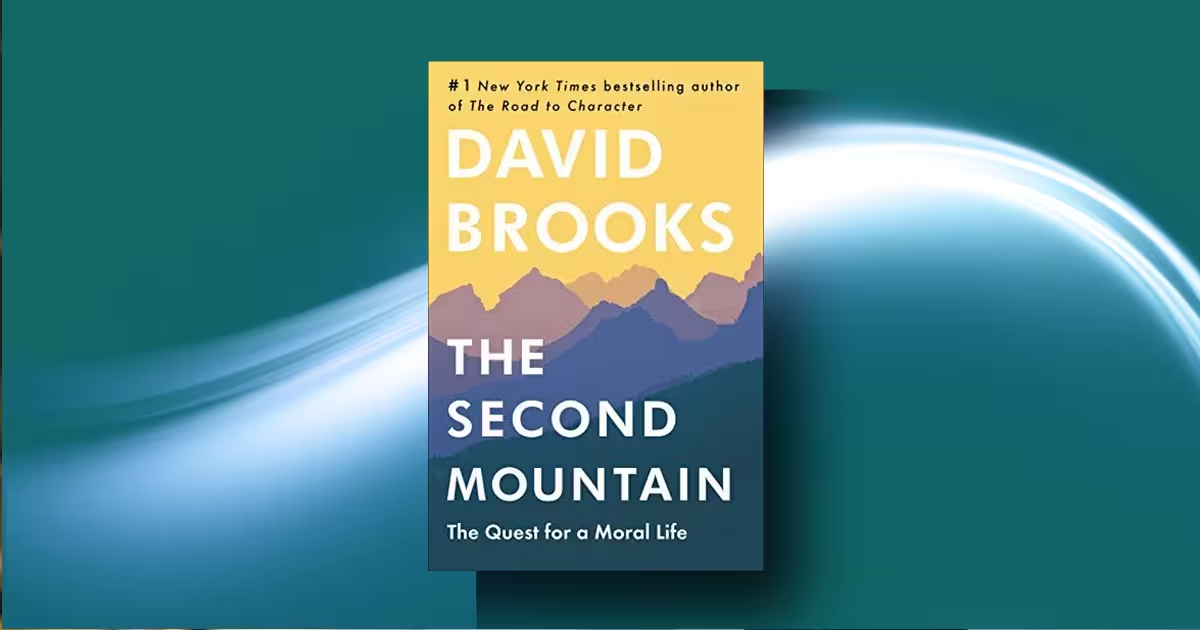
Does your career success feel strangely hollow — like you climbed the right mountain and found nothing at the top? The Second Mountain by David Brooks is the book that will not only diagnose that emptiness but hand you a map to something richer, more grounded, and far more alive.
The Second Mountain is best for anyone who has hit a milestone — a promotion, a graduation, a personal achievement — and felt oddly deflated. Anyone going through a divorce, career crisis, or a season of quiet despair. People asking big questions about purpose, meaning, vocation, marriage, faith, and community.
Readers who loved Viktor Frankl’s Man’s Search for Meaning, Cal Newport’s So Good They Can’t Ignore You, or Robert Bellah’s Habits of the Heart. Academics, journalists, spiritual seekers, and thoughtful professionals in their thirties and beyond.
Not for readers expecting a self-help quick-fix or a listicle of productivity hacks. Those who are firmly anti-religious will find some sections uncomfortable, though not impenetrable. Also, if you want a politically neutral read, be aware that Brooks writes from a culturally conservative, though broadly humanist, vantage point.
Table of Contents
1. Introduction
The Second Mountain: The Quest for a Moral Life was written by David Brooks and published in April 2019 by Random House. Brooks — born in 1961 — is a conservative political commentator, long-running New York Times op-ed columnist, former senior editor at The Weekly Standard, and bestselling author of Bobos in Paradise (2000) and The Road to Character (2015).
He is also a professor of practice at Yale University and the founder of Weave: The Social Fabric Project at the Aspen Institute. The Second Mountain became a #1 New York Times bestseller within weeks of publication.
Broadly, The Second Mountain sits at the intersection of self-help, social philosophy, moral psychology, and spiritual memoir.
It is a book about the anatomy of a meaningful life — about why the modern Western gospel of individual achievement, freedom, and self-fulfillment quietly destroys the very people who succeed at it, and about what Brooks calls the “second-mountain” life of deep commitment, radical relationality, and moral joy.
The book’s central idea, stated plainly by Brooks himself, is that “the rampant individualism of our current culture is a catastrophe.” His argument is that over the past sixty years, Western society has swung so far toward the self — individual success, self-fulfillment, personal freedom, self-actualization — that we have shredded the social fabric, produced epidemic loneliness, rising suicide rates, and a crisis of meaning.
The remedy, he proposes, is a wholesale cultural shift from a “first mountain” mindset of achievement and acquisition to a “second mountain” life of committed love, vocation, faith, and community service.
2. Background
David Brooks is unusually candid about what drove him to write this book. In 2013, his twenty-seven-year marriage ended. His children were becoming adults and leaving home.
His political conservatism had grown out of step with its own movement. Many of his social connections — mostly from the conservative intellectual world — dissolved. He found himself, as he puts it, “unplanted, lonely, humiliated, scattered,” walking through his days in what felt like permanent emotional drunkenness, his playlists full of Irish heartbreak songs by Sinéad O’Connor and Snow Patrol.
This personal valley — combined with what he observed in American public life, the explosion of tribalism, distrust, and disconnection — became the laboratory from which The Second Mountain was born.
As he writes: “I’ve written this book, in part, to remind myself of the kind of life I want to live.” It is, consequently, a book saturated with the kind of hard-won, first-person honesty that most public intellectuals carefully avoid.
3. The Second Mountain Summary and Discussion
The Two Mountains: What They Are
Brooks opens with one of the most arresting images in recent popular nonfiction. He describes two kinds of people: those climbing their first mountain, and those who have found their second.
The first mountain, he says, is the mountain our culture builds for us.
It is the mountain of career achievement, personal success, financial security, and self-expression. “On the first mountain, we all have to perform certain life tasks: establish an identity, separate from our parents, cultivate our talents, build a secure ego, and try to make a mark in the world.”
The second mountain is different in character and in texture. It is the mountain of deep, irrevocable commitment. Of giving yourself away. Of serving something larger than yourself — not because you have to, but because you cannot not.
As Brooks writes: “If the first mountain is about building up the ego and defining the self, the second mountain is about shedding the ego and losing the self. If the first mountain is about acquisition, the second mountain is about contribution.”
This distinction — sharp, memorable, genuinely illuminating — is the book’s organizing spine. And it immediately raises a question: How do most of us get from one to the other?
Part I: The Valley and the Wilderness
The answer, unfortunately, involves suffering.
Brooks traces two dominant cultural paths that young people follow into early adulthood. The first he calls the aesthetic life — the Instagram life, the relentless accumulation of experiences, the Burning Man visits and SoulCycle classes and meditation retreats, all wonderful individually, but adding up to precisely nothing.
As he puts it, “if you say yes to everything year after year, you end up leading what Kierkegaard lamented as an aesthetic style of life… you will hover above everything but never land.”
The second path is the insecure overachiever — the person who treats adulthood as an extension of school, chasing gold stars at McKinsey or Goldman Sachs, measuring self-worth through status, and gradually becoming, in Brooks’s unforgettable phrase, someone who is “more boring and half-hearted at age thirty-five than they were at twenty.” This is the state Kierkegaard called acedia — the quieting of passion, the lack of care, the soul set on permanent warm.
Typically, what derails both paths is the valley — a season of suffering. A divorce. A career implosion. A health crisis. A loved one’s death. A slow creeping malaise that one day refuses to be ignored.
Brooks uses Tolstoy as the archetype: a man who had one of the most successful first mountains in human history — War and Peace, Anna Karenina, literary immortality — and yet still found himself removing the ropes from his room so he could not hang himself. “Wealth and fame and accomplishment do not spare anybody from the valley,” Brooks observes.
This leads to what he calls the telos crisis — a crisis of purpose.
When you don’t know what your life is for, any setback can produce total collapse. As Nietzsche wrote, he who has a “why” can endure almost any “how.” Without the why, even ordinary life becomes unbearable.
Nevertheless, the valley is not the end.
It is, in Brooks’s framing, a fortunate fall — a painful but necessary passage. The wilderness that follows the valley is the space where the old ego-self is stripped away, and the deeper heart and soul are given room to emerge.
Brooks cites Moses, who fled into the wilderness a failure, and found there not just solitude but himself. The wilderness, in Brooks’s reading, is where you learn to “listen to your life” — to sit in the uncertainty long enough to hear what it is that you were actually called to do.
Significantly, Brooks draws a distinction between the heart — the seat of desire and longing, the part of you that yearns to fuse with something or someone — and the soul — the moral, transcendent piece of consciousness that yearns for righteousness and meaning.
Both, he argues, are starved by the first-mountain life. Both are nourished by the second.
Part II: Vocation — The Annunciation Moment
Brooks devotes one of the book’s most practically useful sections to vocation. The distinction he draws between a vocation and a career is one of the most clarifying ideas in contemporary writing on work and meaning.
A career mentality, he explains, is frontal-lobe territory: assess your marketable talents, survey opportunities, follow incentives, climb. A vocation, by contrast, “destines a man to emancipate himself from the herd and from its well-worn paths… anyone with a vocation hears the voice of the inner man: He is called.” (Brooks here quotes Carl Jung.) The vocation isn’t chosen so much as it chooses you.
He uses George Orwell as the central illustration — a man who knew early he was a writer, drifted away from it for years, and then was essentially conquered by his calling in Spain in 1936. “It was almost as if there’d been a kind of fire smoldering in him all his life which suddenly broke into flame.” His vocation took, in George Bernard Shaw’s phrase, “a mob of appetites and organized them into an army of purposes and principles.”
Brooks also describes what he calls the Annunciation Moment — those rare occasions when a vocation arrives not gradually but all at once, as an overwhelming summons.
And he describes the role of mentors in helping young people hear and follow their vocational call, as well as the reality of mastery — the years of disciplined, committed practice that distinguish a vocation truly lived from one merely flirted with.
Part III: Marriage — The Maximum Commitment
The book’s section on marriage is one of its most humane and, at times, personally vulnerable sections. Brooks argues for what he calls the maximum marriage — not a contractual partnership for mutual benefit, but a covenant that transforms both parties.
He draws a critical distinction between a contract and a covenant (citing Rabbi Jonathan Sacks): “A contract is a transaction. A covenant is a relationship… a contract is about interests. A covenant is about identity. It is about you and me coming together to form an ‘us.’ That is why contracts benefit, but covenants transform.”
Brooks traces the stages of intimacy with genuine care — from the initial falling in love, through the deeper stages of vulnerability, interdependence, and what he calls fusion — that state in which, as an old man in Louis de Bernières’s novel Captain Corelli’s Mandolin says to his daughter: “Love itself is what is left over when being in love has burned away… your mother and I had it, we had roots that grew towards each other underground, and when all the pretty blossoms had fallen from our branches we found that we were one tree and not two.”
The marriage decision itself, Brooks argues, is not primarily about compatibility scores or personality matching. It is about choosing the person alongside whom you want to pursue moral joy — the person who calls forth your best self.
Part IV: Philosophy and Faith — The Intellectual and Spiritual Commitment
Brooks is careful throughout the book not to insist on a particular faith tradition, but he is equally clear that intellectual and spiritual commitments are necessary anchors of the second-mountain life. He describes both intellectual commitments — the adoption of a coherent philosophical worldview — and religious commitment — the surrender to a tradition and community larger than oneself.
The section on faith contains some of the book’s most moving passages, including the story of Etty Hillesum, a young Dutch Jewish woman in Amsterdam during the Nazi occupation. Hillesum began adulthood, in her own words, as “a weakling and a nonentity adrift and tossed by the waves.”
But as the Holocaust closed in around her, she underwent a profound transformation: she stopped trying to manage her own internal drama and began turning outward with radical compassion.
She volunteered to accompany her people to the Westerbork transit camp, caring for those awaiting deportation to Auschwitz. The other inmates described her as radiant. She died in Auschwitz on November 30, 1943, but she left behind a diary of such incandescence that it reads, Brooks writes, like a document from another moral universe.
Hillesum’s story is the book’s emotional summit — a demonstration that the second-mountain life is not theory. It has been lived, in the most extreme circumstances imaginable, by real human beings.
Part V: Community — The Weavers and the Relationalist Manifesto
The book’s final section describes the grassroots community builders whom Brooks encountered through his Weave: The Social Fabric Project at the Aspen Institute — people whom he calls Weavers.
These are the Stephanie Hruzeks running after-school programs in Houston, the Jade Bocks helping children process grief in Albuquerque, the Kennedy Odedes building schools for girls in a Nairobi slum, the Kathy Fletchers hosting twenty-six neighbourhood children every Thursday for dinner in Washington, D.C.
Brooks identifies several shared traits among these people. They have usually passed through a personal valley. They did not choose their work so much as their work chose them — “I didn’t choose this job. It chose me.” They operate through deep, sustained, one-on-one relationships rather than through systems or services.
They exhibit what Brooks calls bright sadness — a joyful awareness that is infused with the weight of human pain. And they tend to say, with a slight bewilderment at anyone who lives otherwise: “What I do is as simple and common as the laughter of a child.”
The book concludes with Brooks’s Relationalist Manifesto — a cultural call to arms.
He argues that the social architecture of the twenty-first century must shift from individualism to what he calls relationalism: a worldview that places love, community, and covenant — not freedom, autonomy, and self-actualization — at the center of the good life.
He marshals statistics to support the social crisis: since 1999, the U.S. suicide rate rose by 30 percent. Between 2006 and 2016, suicide rates among ten-to-seventeen-year-olds rose by 70 percent.
Roughly 45,000 Americans killed themselves every year at the time of writing. In 1950, less than 10 percent of U.S. households were single-person households; by the time Brooks was writing, nearly 30 percent were. Only 8 percent of Americans reported having meaningful conversations with their neighbors in any given year.
Former U.S. Surgeon General Vivek Murthy declared in the Harvard Business Review that the most common pathology he saw during his years caring for patients was not heart disease or diabetes — it was loneliness.
Brooks’s argument is that these are not random misfortunes. They are the predictable harvest of sixty years of hyper-individualism.
Joy vs. Happiness: The Core Distinction
Running through the entire book is a distinction between happiness and joy that Brooks considers foundational. Happiness, he argues, “involves a victory for the self, an expansion of self. Happiness comes as we move toward our goals, when things go our way.”
Joy, by contrast, “tends to involve some transcendence of self. It’s when the skin barrier between you and some other person or entity fades away and you feel fused together.” Happiness is the proper goal of the first mountain. Joy is the north star of the second.
He describes five layers of joy: physical joy (flow and collective movement); collective effervescence (the dancing, the celebration); emotional joy (the bursting of love at the sight of a newborn); spiritual joy (the falcon on the windowsill, the mystical hush of nature); and transcendent joy (the dissolution of self into something boundaryless and eternal).
Above all of these, he posits moral joy — the steady, permanent, luminous state of people who have given themselves away so completely that their giving has become their nature.
As Miroslav Volf, the Yale professor of theology whom Brooks cites, puts it: “Joy is the emotional dimension of life that goes well and that is led well.” It is not the icing on the cake. It is the substance of the cake itself.
4. The Second Mountain Analysis
The Second Mountain is, in my honest reading, one of the most important and most personally courageous books written by a prominent American public intellectual in the twenty-first century. It is not a perfect book — no book of this ambition and scope could be — but it is a genuinely brave one.
What makes it remarkable is Brooks’s willingness to use his own failures as moral data. He does not preach from a height. He writes, as he says, like a beggar showing other beggars where he found bread. His confessions about his failed marriage, his workaholism, his emotional unavailability, his failures of omission toward the people he loved — these are not affectations of humility.
They ring entirely true, and they give the book a weight that purely theoretical accounts of meaning and morality never achieve.
Furthermore, the book’s intellectual range is stunning.
Brooks draws on Tolstoy, Dostoyevsky, Kierkegaard, C.S. Lewis, Hannah Arendt, Viktor Frankl, Dorothy Day, George Orwell, Etty Hillesum, Augustine, Kant, Aristotle, Dante, Wordsworth, and dozens of contemporary social scientists, psychologists, and theologians. He synthesizes all of this with the ease of someone who has spent decades at the intersection of intellectual life and popular journalism.
The four-commitments framework — vocation, marriage, philosophy/faith, community — is genuinely useful. It is concrete without being reductive. It gives the reader something to actually do with the book’s ideas.
And the statistical case for the social crisis is hard to dismiss. When the life expectancy of the wealthiest nation in history begins contracting — a trend that hadn’t been seen since the flu pandemic of 1918 — something is profoundly wrong at the level of culture, not just policy.
5. Strengths and Weaknesses
Strengths
The book’s greatest strength is its emotional honesty. Brooks is not a saint performing humility; he is a specific human being confessing specific failures, and it is profoundly disarming.
Additionally, the section on vocation is among the finest practical treatments of the subject in popular nonfiction. The profiles of the Weavers — the Kathy Fletchers, the Kennedy Odedes, the Sarah Adkinses — are reported with a journalist’s eye and a moralist’s soul, and they are often genuinely moving.
The distinction between happiness and joy is philosophically clear and experientially accurate in a way that most readers will immediately recognize. Moreover, the book is beautifully written — Brooks is a stylist, and at its best the prose has a measured urgency that is entirely its own.
Weaknesses
The book is not without its problems. Its weakest section is arguably on faith. Brooks is personally drawn toward religion, and his treatment of religious commitment sometimes tips into what even sympathetic readers might recognize as special pleading.
Those without religious inclinations may find the later chapters of the faith section difficult to enter fully.
Additionally, the book’s social prescriptions in the Relationalist Manifesto section are more aspirational than concrete — it is one thing to diagnose hyper-individualism as a cultural catastrophe and quite another to specify how a society of 330 million people reverses a sixty-year cultural drift.
Critics have noted, fairly, that the book’s examples of second-mountain living tend to come from affluent, well-connected circles — people who have the luxury of choosing their vocation and their community rather than having both chosen for them by economic necessity.
Finally, some reviewers felt that Brooks occasionally conflates personal moral renewal with structural social change, two enterprises that require very different tools.
6. Books Like The Second Mountain
Readers who find themselves gripped by The Second Mountain will benefit enormously from engaging with the broader conversation it belongs to:
Viktor Frankl, Man’s Search for Meaning (1946): The foundational text on finding meaning through commitment and suffering, referenced approvingly throughout Brooks’s book.
Robert Bellah et al., Habits of the Heart (1985): A landmark sociological study of American individualism that Brooks explicitly acknowledges as a predecessor.
Parker Palmer, Let Your Life Speak (2000): A quieter, more personal exploration of vocation and listening to one’s life, entirely consonant with Brooks’s approach.
Sebastian Junger, Tribe (2016): A compact, powerful argument — referenced directly by Brooks — that humans thrive in community and wither in isolation.
Robert Putnam, Bowling Alone (2000): The statistical bible of American social disconnection, providing the empirical bedrock for Brooks’s social argument.
Richard Rohr, Falling Upward (2011): The Franciscan friar whose concept of bright sadness Brooks borrows directly for his portrait of the Weavers.
David Brooks, The Road to Character (2015): Brooks’s own previous book, which he describes in The Second Mountain as useful but incomplete — still encased in the prison of individualism.
Cal Newport, So Good They Can’t Ignore You (2012): A secular, pragmatic approach to vocation that complements and in some ways challenges Brooks’s more spiritual framing.
7. Conclusion
The Second Mountain: The Quest for a Moral Life is a rare book — one that is simultaneously a work of social criticism, spiritual memoir, practical ethics, and moral journalism.
It is not a book that tells you what to do in ten easy steps. It is a book that tells you what kind of person to become and why that transformation, difficult and costly as it is, leads to the only kind of life that actually satisfies.
The four commitments Brooks advocates — to a vocation, to a marriage, to a philosophy or faith, and to a community — are not presented as obligations but as invitations.
As he writes: “The most complete definition of a commitment is this: falling in love with something and then building a structure of behavior around it for those moments when love falters.” That definition is both simple and staggering. It captures something true about the architecture of a worthy life.
Whether you are twenty-five and climbing your first mountain with everything you have, or fifty and standing at its summit wondering why the view doesn’t feel as good as you expected, The Second Mountain will speak to you directly.
It did to me. It is the kind of book that doesn’t just describe a better life — it makes you ache for one.
Overall verdict: Exceptional. Read it slowly, read it with a pencil, and read it again.