
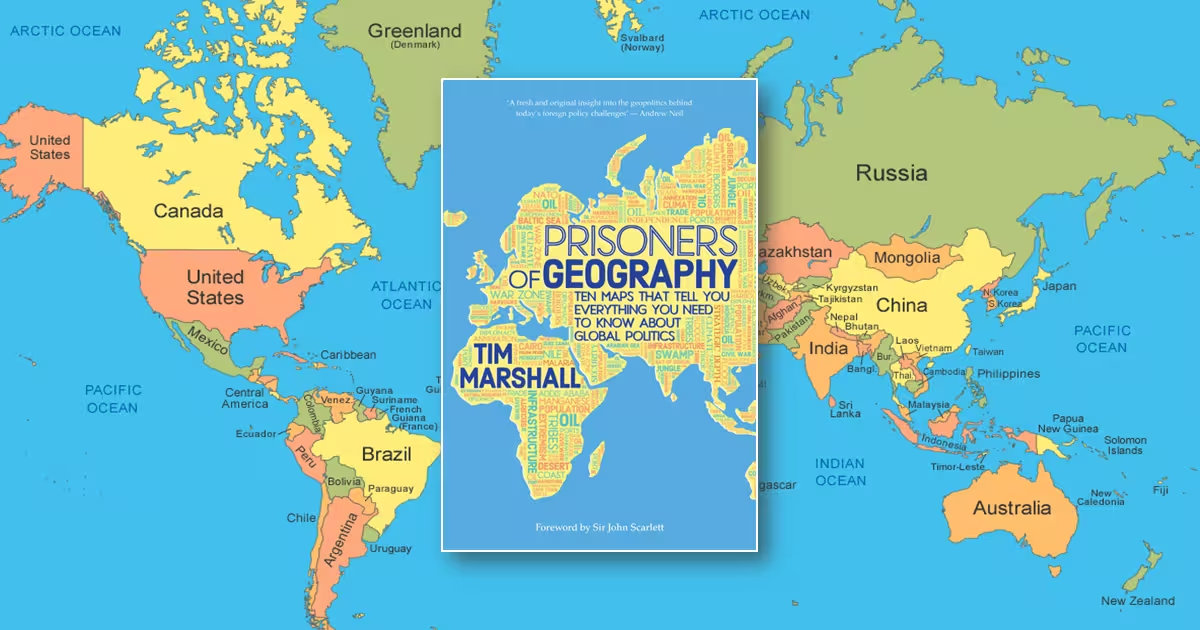
Did you ever stare at a headline — Russia seizing territory, China building islands in the sea, the Middle East fracturing again — and feel an unsettling sense that the world keeps repeating itself, that nobody in power seems to learn, that the same tragedies replay on different stages? Prisoners of Geography: Ten Maps That Tell You Everything You Need to Know About Global Politics by Tim Marshall will not merely explain those headlines to you. It will make you feel, possibly for the first time, that the whole thing makes perfect, chilling sense.
Prisoners of Geography can benefit curious readers who follow world news but feel lost in the complexity; students of international relations, history, political science, and geography; journalists; policy researchers; anyone who has ever asked “why does Russia always do this?” or “why is the Middle East always on fire?”; readers who enjoyed Yuval Noah Harari’s Sapiens, Jared Diamond’s Guns, Germs, and Steel, or Henry Kissinger’s World Order.
Prisoners of Geography is not for readers seeking purely literary prose or narrative storytelling; those who want deep academic geopolitical theory with extensive footnotes; anyone who finds geopolitics dry regardless of presentation; or readers expecting a detailed, granular focus on a single country rather than a sweeping global survey.
Table of Contents
1. Introduction
Prisoners of Geography: Ten Maps That Tell You Everything You Need to Know About Global Politics is a 2015 non-fiction work by Tim Marshall, published by Elliott and Thompson in the UK and Scribner in the US.
It was a Number 1 Sunday Times bestseller and has since sold over two million copies worldwide, been translated into dozens of languages, and spawned a sequel, The Power of Geography (2021). In 2025, a revised tenth-anniversary edition was released, updating the book’s coverage through the most recent geopolitical developments.
Tim Marshall spent more than twenty-five years as a foreign affairs journalist and served as diplomatic editor and foreign affairs editor at Sky News.
He reported from the frontlines in the Balkans during the 1990s wars, embedded with Northern Alliance forces in Afghanistan after September 11, and covered the Syrian civil war from the ground. He is not an armchair theorist. Every argument in Prisoners of Geography arrives wrapped in the red dust of genuine field experience.
Prisoners of Geography is, at its core, about this central thesis: geography is not backdrop to history. Geography is history. The physical landscape — mountains, rivers, plains, deserts, seas — imprisons the decisions of leaders, determines the ambitions of nations, and shapes the conflicts that define our world.
As Marshall writes plainly in the Introduction: “The landscape imprisons their leaders, giving them fewer choices and less room to manoeuvre than you might think.” Technology may seem to have made geography irrelevant, he argues, but it has only bent the rules, not broken them.
The rules still apply.
Prisoners of Geography is one of the best 15 geopolitics books.
2. Background
Prisoners of Geography‘s intellectual lineage runs back to the father of geopolitics, Sir Halford Mackinder, whose 1904 paper “The Geographical Pivot of History” introduced the idea that whoever controls the Eurasian “Heartland” controls the world.
Marshall does not cite Mackinder slavishly, but the same fundamental instinct — that terrain determines power — animates every chapter. More recently, Robert Kaplan’s The Revenge of Geography (2012) and Jared Diamond’s Guns, Germs, and Steel (1997) covered adjacent intellectual territory.
Marshall’s distinct achievement is accessibility. Where Kaplan writes for specialists and Diamond writes for scientists, Marshall writes for anyone who watches the evening news.
Prisoners of Geography arrived in 2015 at an ideal historical moment. Russia had just annexed Crimea in 2014. China was building artificial islands in the South China Sea.
Islamic State had bulldozed the Iraqi-Syrian border in the summer of 2014, broadcasting the moment online. The Middle East was in full fracture. Readers were desperate for a framework. Prisoners of Geography provided one.
3. Prisoners of Geography Summary
Russia: The Flat Trap
Marshall opens, brilliantly, with Vladimir Putin — not as a villain, but as a man trapped. He writes that Putin perhaps goes to sleep each night and asks God: “Why didn’t you put some mountains in Ukraine?” The observation is disarming in its simplicity, but it unlocks the entire logic of Russian foreign policy.
Russia, Prisoners of Geography explains, is vast — six million square miles, eleven time zones, the largest country on earth. And yet the central problem of Russian security has never changed across the centuries. To the west, there are no mountains.
The North European Plain stretches from France across Poland all the way to Russia’s heartland. Historically, the Poles came across it in 1605, the Swedes under Charles XII in 1708, Napoleon in 1812, and the Germans in both 1914 and 1941. If you count from Napoleon through to 1945, Russia was invaded via the same flat corridor roughly once every thirty-three years.
No wonder Russian leaders, from Ivan the Terrible to Peter the Great to Stalin to Putin, have consistently pushed outward in every direction — not from imperial greed alone, but from geographic terror.
Moreover, Russia has never solved its most fundamental strategic weakness: it lacks a warm-water port with open access to the world’s major shipping lanes. Vladivostok on the Pacific is ice-locked for approximately four months a year and enclosed by Japanese and Russian territorial waters.
The Arctic ports freeze for months. The Black Sea port of Sevastopol, seized when Russia annexed Crimea in 2014, is bottled up by the Turkish-controlled Bosphorus Strait under the Montreux Convention of 1936. Marshall argues this is precisely why Putin “had” to annex Crimea the moment a pro-Western Ukrainian government threatened to revoke Russia’s lease on the port.
It was not optional aggression; it was geographically compelled survival strategy. As Marshall notes: “He would not be the man who ‘lost Crimea’, and with it the only proper warm-water port his country had access to.”
Russia also uses energy as political power — a theme Marshall tracks carefully. On average, more than 25 per cent of Europe’s gas and oil comes from Russia.
Latvia, Slovakia, Finland, and Estonia are 100 per cent reliant on Russian gas. Germany, with its Nord Stream pipeline, receives around 50 per cent of its gas from Russia.
This geographic dependency gives Moscow a foreign policy lever it uses with relentless efficiency, and explains why European criticism of Russian aggression is always more restrained than American criticism.
China: The Island Chain Problem
The China chapter begins with a remarkable image from 2006: a Chinese Song-class attack submarine surfacing in the middle of a twelve-ship American carrier battle group in the East China Sea without being detected.
The Americans were, as Marshall writes, “amazed and angry in equal measure.” The signal was unmistakable — China was declaring itself a maritime power after four thousand years of thinking entirely in terms of land.
China’s geographic situation is, in many respects, enviable. Its northern border with Mongolia is buffered by the Gobi Desert, a natural early warning system. Its western borders rise into the Tibetan Plateau and then the Karakoram Range, mountains so formidable that they effectively separate China from India militarily. China’s long southern borders with Vietnam, Laos, and Burma consist of jungle hill country that makes invasion impractical.
The Mongols were the last foreign force to successfully conquer China, and that was in 1279 CE under Kublai Khan. Since then, geography has been China’s shield.
China’s annexation of Tibet in 1951 was, Marshall argues, not ideological but geographic.
Tibet gives China control of the sources of three great rivers — the Yellow, Yangtze, and Mekong — which is why Tibet is known as “China’s Water Tower.”
More importantly, control of Tibet prevents India from ever holding the commanding heights of the Tibetan Plateau, from which large military forces could descend into the Chinese heartland. The actor Richard Gere and the Free Tibet movement, Marshall notes with characteristic directness, stand little chance against the Communist Party’s geopolitical logic. “In a battle between the Dalai Lama, the Tibetan independence movement, Hollywood stars and the Chinese Communist Party — which rules the world’s second-largest economy — there is only going to be one winner.”
The Uighur situation in Xinjiang is similarly geographic in its roots. Xinjiang borders eight countries and contains oil reserves and China’s nuclear weapons testing sites.
Xinjiang is too strategically important to allow any independence movement to gain momentum, so Beijing responds with settlement, suppression, and economic investment simultaneously.
The central challenge China faces now, however, is maritime. It is hemmed in to the east and south by what it calls the “First Island Chain” — Japan, the Ryukyu Islands including Okinawa (where the US military maintains a massive base), Taiwan, and the Philippines. China cannot reach the Pacific or the Indian Ocean without passing through waters watched, and in wartime blockaded, by rivals.
Marshall writes that the South China Sea is to China in the twenty-first century what the Caribbean was to the United States at the beginning of the twentieth century — a body of water it must dominate to project global power.
China’s building of ports in Burma, Bangladesh, Pakistan, and Sri Lanka is part of this long-term strategy to break out of the island chain and secure sea lanes to the Persian Gulf.
The USA: The Geographic Winner
Marshall has a passage that captures America’s geographic blessing with memorable concision.
He invites the reader to imagine winning the lottery and being offered a country to buy, and says the first property the estate agent would show you is the United States. “It’s in a wonderful neighbourhood, the views are marvellous and there are some terrific water features, the transport links are excellent; and the neighbours? The neighbours are great, no trouble at all.”
The Mississippi river basin — with more miles of navigable river than the rest of the world combined — was the key to American destiny.
The Louisiana Purchase of 1803, in which the US bought an area the size of Spain, Italy, France, the UK, and Germany combined from France for $15 million, gave America mastery of this waterway system.
As the American historian Henry Adams wrote at the time, “Never did the United States get so much for so little.” That purchase, combined with the transcontinental railroad opening in 1869, the acquisition of Alaska for $7.2 million in 1867 (mocked at the time as “Seward’s folly”), and the securing of Hawaii in 1898, made the United States a two-ocean superpower. It has ocean buffers on both coasts, friendly neighbours to the north and south, and the most productive agricultural land in the world.
Marshall is clear-eyed about American decline narratives. He quotes the Prussian statesman Otto von Bismarck: “God takes special care of drunks, children and the United States of America.”
The United States still spends more on research and development for its military than the combined military budgets of all other NATO countries.
Its population is not ageing as rapidly as Europe’s or Japan’s. A 2013 Gallup study showed that 25 per cent of all people hoping to emigrate put the USA as their first choice of destination, and in the same year Shanghai University listed seventeen of the world’s top twenty universities as American. Reports of America’s decline, Marshall concludes, are greatly exaggerated.
Western Europe: The Gift of Navigable Rivers
Europe’s rise to world dominance was not, Marshall argues, the result of cultural or intellectual superiority.
It was the result of geography. Western Europe has no true deserts, no frozen wastelands except in the far north, and earthquakes, volcanoes, and flooding are rare. Its rivers — the Rhine, the Rhône, the Danube, the Thames, the Seine — are long, flat, navigable, and made for trade. They empty into coastlines abundant with natural harbours.
As Marshall puts it succinctly: these were the conditions that allowed surplus food to be grown, traded, and converted into the towns and ideas that eventually sparked the Industrial Revolution.
The Danube alone, at 1,780 miles in length, passes through or borders eighteen countries. It was the border of the Roman Empire, one of the great trading routes of medieval times, and gave rise to the modern capitals of Vienna, Bratislava, Budapest, and Belgrade. Europe’s history of perpetual warfare was not a failure of civilisation — it was a geographic inevitability. The mountains, valleys, and separate river systems created hundreds of distinct linguistic communities which could not easily absorb each other.
Unlike the United States, which expanded across a single vast plain under one language, Europe grew organically from dozens of geographic cells.
The chapter on Western Europe is also where Marshall addresses the deeper logic of the European Union.
It was created, he argues bluntly, so that France and Germany “could hug each other so tightly in a loving embrace that neither would be able to get an arm free with which to punch the other.”
Helmut Kohl’s warning, made upon leaving the German Chancellorship in 1998, haunts the chapter: Kohl said he was the last German leader who had lived through the Second World War, and feared that the current generation, having grown up with peace as the norm, could not imagine the alternative — and therefore would not nurture it.
Africa: The Continent Geography Abandoned
The Africa chapter is the most poignant in Prisoners of Geography. Marshall does not blame Africans for Africa’s struggles; he blames coastlines, rivers, disease, and the arbitrary lines drawn by European colonists in 1884 at the Berlin Conference, lines that ignored every geographic, linguistic, and ethnic reality on the ground.
Africa’s rivers are spectacular but commercially useless. The Zambezi runs for 1,600 miles through six countries, but drops from 4,900 feet to sea level in a series of falls and rapids that prevent navigation between sections.
The Congo, the Niger, the Nile — none of them connect to each other in the way the Rhine connects to the Danube, or the Ohio connects to the Mississippi. This disconnection prevented the formation of large trading regions, the emergence of shared languages for commerce, and the accumulation of the wealth that would have funded technological development.
Africa’s coastline is smooth and harbour-poor. Unlike the jagged coastlines of Europe and North America, which created natural deep-water harbours at every inlet, Africa’s coast offered European ships almost nowhere to safely anchor.
Once the Europeans did land, they struggled to penetrate more than 100 miles inland due to the river falls, the tropical diseases, and the climate. The result, as Marshall argues, is that sub-Saharan Africa developed in almost total isolation from the Eurasian land mass for thousands of years, during which ideas and technology flowed east to west and west to east across Eurasia, never reaching south across the Sahara and the oceans in meaningful quantities.
Then the Europeans arrived, stayed long enough to steal the resources and the people, drew lines on maps, created fictional nation-states out of dozens of competing ethnic groups, and left.
The Democratic Republic of the Congo is Marshall’s most devastating example: a country bigger than Germany, France, and Spain combined, containing the second-largest rainforest on earth, divided among more than 200 ethnic groups, with six million deaths since the late 1990s in wars the outside world barely covers.
The DRC, he writes bluntly, “was never whole. It is simply to keep the pieces apart until a way can be found to join them sensibly and peacefully. The European colonialist created an egg without a chicken.”
The Middle East: Lines Drawn in Sand, Redrawn in Blood
The famous opening of the Middle East chapter features an Islamic State propaganda video from 2014 showing a bulldozer pushing the Iraqi-Syrian border — a mound of sand — out of existence.
A fighter declares: “We are destroying the borders and breaking the barriers.” The Sykes-Picot Agreement of 1916, Marshall explains, was the original act of geographic violence. British diplomat Sir Mark Sykes took a chinagraph pencil and drew a line across a map from Haifa on the Mediterranean to Kirkuk in northeast Iraq. Everything north of the line went to France; everything south went to Britain.
No Arabs were consulted. People who had lived for centuries as members of tribes, not nations, suddenly found themselves divided by lines they had never chosen and forced to build national identities from scratch inside those artificial boxes.
The consequences are still bleeding.
Iraq, as the Ottomans well understood, was three distinct geographic entities: a Kurdish mountain region in the north, a Sunni Arab flatland in the centre, and a Shia Arab marshland and delta in the south. The British looked at this space and divided the three into one, which Marshall calls “a logical impossibility Christians can resolve through the Holy Trinity, but which in Iraq has resulted in an unholy mess.” The Shia never accepted Sunni domination.
The Kurds never accepted either. Only a strong man with a fearsome security apparatus could hold it together, and when Saddam Hussein was removed, what had been frozen with fear thawed into sectarian war.
India and Pakistan: Two Nations, One Wound
At least a million people died in the partition of British India in August 1947. Fifteen million were displaced in one of the largest forced migrations in human history.
Marshall is unsparing about British responsibility: the announcement on June 3, 1947 that Britain would withdraw gave India and Pakistan seventy-three days to negotiate the terms. They were all but gone by August 15. “The British, exhausted by two world wars, and aware that the days of empire were coming to a close, did not cover themselves in glory in the manner of their leaving.”
Pakistan received 17 per cent of the financial reserves of the pre-partition government, the most troublesome border in the subcontinent (the North West Frontier with Afghanistan), and a state split into two non-contiguous regions separated by 1,000 miles of Indian territory — a situation that predictably collapsed in 1971 when East Pakistan became Bangladesh.
The name Pakistan itself is an acronym: P for Punjab, A for Afghania, K for Kashmir, S for Sindh, TAN for Baluchistan — five distinct regions each with their own language, none of which easily identifies as a unified nation.
The Kashmir dispute sits at the heart of the India-Pakistan relationship like a splinter too deep to remove.
Both countries have fought four major wars. Both possess nuclear weapons.
Marshall writes that in 1999 both countries came close to nuclear exchange over the Kargil conflict in Kashmir before American diplomacy intervened. He quotes Indian military analyst Dr. Amarjit Singh, writing in 2014: “It is better for India to brave a costly nuclear attack by Pakistan, and get it over with even at the cost of tens of millions of deaths, than suffer ignominy and pain day in and day out through a thousand cuts and wasted energy in unrealized potential.”
This is the depth of feeling, Marshall notes, on both sides.
Korea and Japan: The Geography of Dread
Seoul, the capital of South Korea, lies 35 miles south of the demilitarised zone (DMZ). Nearly half of South Korea’s 50 million people live in the greater Seoul region.
North Korea has an estimated 10,000 artillery pieces dug into the hills above the DMZ. Two analysts writing for Foreign Policy, Victor Cha and David Chang, estimated that North Korean forces could fire up to 500,000 rounds toward the city in the first hour of conflict. Divide that estimate by five, and the results would still be catastrophic.
This is not hypothetical drama — it is geographic reality that freezes every political actor in the region.
Japan’s situation is shaped by its island geography. At its closest point, Japan is 120 miles from the Eurasian land mass — far enough to have never been successfully invaded.
The Mongols tried twice, in the thirteenth century, and were beaten back by weather both times. The seas were whipped by what the Japanese called kamikaze, “Divine Wind.” This island security allowed Japan to develop a distinct culture over centuries, to industrialise rapidly in the nineteenth century, and then to overstretch catastrophically in the twentieth.
Japan has almost no natural resources: limited coal, almost no oil, very little natural gas. It was the desperate hunger for resources that drove Japan across China in the 1930s and Southeast Asia in the 1940s, ultimately colliding with the United States in a war Japan could not win.
Latin America: Geography as a Ceiling
Latin America, Marshall argues, is proof that you can bring Old World knowledge and technology to new territory and still fail if the geography is against you.
The Andes, running 4,500 miles along the Pacific coast, cut most of the continent’s west off from its east. There are no navigable rivers connecting the Pacific coast to the Atlantic interior. South America has no equivalent of the Mississippi basin. Brazil’s rivers are unnavigable in ways that preclude the kind of inland trade that built America.
According to the geopolitical intelligence company Stratfor, Brazil’s seven largest ports combined can handle fewer goods per year than the single American port of New Orleans.
The colonial legacy made it worse.
Where in the United States land was sold or given to small independent farmers, in Latin America European elites created a culture of great landowners and serfs. Cities were built at the coasts rather than at geographic centres, meaning internal regions were never connected to each other — only to foreign markets.
Two hundred years after independence, the total population of Latin America exceeds 600 million people, and yet its combined GDP is roughly equivalent to that of France and the UK together, which have a combined population of about 125 million.
The Arctic: The Final Frontier
The Arctic chapter is a warning. Global warming is melting the Arctic ice cap, and as it retreats, it is exposing two things: vast energy reserves and new shipping lanes.
The United States Geological Survey estimated in 2008 that the Arctic holds 1,670 trillion cubic feet of natural gas, 44 billion barrels of natural gas liquids, and 90 billion barrels of oil. Russia, which has 32 icebreakers (six of them nuclear-powered, the only such vessels in the world), is building Arctic military bases, constructing new naval ports on the Novosibirsk Islands, and placing a legal claim on the Lomonosov Ridge that, if recognised, would extend Russian sovereignty all the way to the North Pole.
The United States, by contrast, has one functioning heavy icebreaker. As US Coast Guard captain Melissa Bert told a Washington strategic studies centre: “They have cities in the Arctic, we only have villages.”
The Conclusion returns to Prisoners of Geography‘s governing metaphor. Geography is a prison, but not a permanent one — human ingenuity can bend its rules, even if it cannot break them entirely.
A century from now, Marshall writes, Russia will still be looking anxiously westward across what will remain flat land. India and China will still be separated by the Himalayas. The Gulf of Mexico will still define Caribbean geopolitics. Geography does not change on human timescales. Leaders do.
4. At-a-glance highlights of Prisoners of Geography
The 10 Regions & What Geography Means for Each
Russia — No mountains to the west means the North European Plain is a permanent invasion corridor. Russia has been invaded via it roughly once every 33 years over 500 years. Putin’s seizure of Crimea was geographically compelled: Sevastopol is Russia’s only warm-water port with ocean access. Russia also weaponises energy — over 25% of Europe’s gas comes from Russia, leaving many countries with compromised foreign policy.
China — Protected on almost every land border: Gobi Desert to the north, Himalayas and Karakoram to the west and southwest, jungle to the south. Tibet was annexed not for ideology but to control the sources of three great rivers and prevent India from ever holding those heights.
China’s urgent challenge now is maritime — the First Island Chain (Japan, Taiwan, Philippines) blocks its access to the Pacific and Indian Oceans, making the South China Sea a strategic obsession.
USA — The geographic lottery winner. The Mississippi river basin has more navigable river miles than the rest of the world combined.
The Louisiana Purchase of 1803 ($15 million for an area the size of Spain, France, Italy, UK, and Germany combined) secured this advantage. Ocean buffers on both coasts, friendly neighbours north and south. Reports of American decline, Marshall argues, are consistently exaggerated.
Western Europe — Europe’s rivers are flat, long, and navigable — made for trade. Its coastlines are packed with natural harbours. This geography created surplus food, trading towns, the Industrial Revolution, and eventually nation-states. The EU exists, at its core, so France and Germany cannot go to war again.
Helmut Kohl warned in 1998 that he was the last German leader who had lived through WWII, and feared the next generation would not appreciate what peace cost.
Africa — Africa’s rivers are spectacular and commercially useless — they drop off plateaus in falls and rapids that prevent navigation between sections. Its coastline is smooth and harbour-poor. Sub-Saharan Africa developed in near-total geographic isolation from Eurasia for millennia.
Then European colonists drew arbitrary lines at the 1884 Berlin Conference, created fictional nation-states from hundreds of ethnic groups, extracted wealth, and left. The DRC alone has seen six million deaths since the late 1990s in wars the world barely notices.
Middle East — The Sykes-Picot Agreement of 1916: a British diplomat drew a pencil line across a map and divided the Ottoman Middle East between Britain and France.
No Arabs consulted. Iraq was three distinct geographic and ethnic zones (Kurdish north, Sunni Arab centre, Shia Arab south) forced into one artificial state. The Islamic State bulldozer video of 2014, pushing the Iraqi-Syrian border — a mound of sand — out of existence, was the logical conclusion of drawing lines that ignored geography.
India & Pakistan — At least one million people died in the 1947 partition. Fifteen million were displaced in 73 days. Pakistan received 17% of pre-partition financial reserves and inherited the most troublesome border in the subcontinent. The two countries have fought four major wars. Both have nuclear weapons.
The distance from the Indian border to Islamabad is less than 250 miles of mostly flat ground. Kashmir is the splinter that cannot be removed — it is about water, strategic depth, and national identity simultaneously.
Korea & Japan — Seoul sits 35 miles from the DMZ. Nearly half of South Korea’s 50 million people live in the greater Seoul region. North Korea has an estimated 10,000 artillery pieces dug into the hills above that border. Japan’s island geography kept it safely isolated for centuries, then gave it no natural resources — no coal, no oil, no gas — which drove its catastrophic resource wars across Asia in the 1930s and 40s.
Latin America — The Andes run 4,500 miles along the Pacific coast, cutting the continent in two. No river system equivalent to the Mississippi connects the interior to global trade. Brazil’s seven largest ports combined handle fewer goods than the single port of New Orleans. 600 million people, GDP roughly equal to France and the UK combined (125 million people). Geography imposed a ceiling that politics has never managed to lift.
The Arctic — Melting ice is exposing an estimated 90 billion barrels of oil and 1,670 trillion cubic feet of natural gas. Russia has 32 icebreakers (6 nuclear-powered, the only ones in the world) and is building Arctic military bases. The US has one functioning heavy icebreaker.
Russia in 2007 planted a titanium flag on the seabed of the North Pole, 13,980 feet down. A US Coast Guard captain summarised the imbalance: “They have cities in the Arctic, we only have villages.”
Key Quotes from Prisoners of Geography
“The landscape imprisons their leaders, giving them fewer choices and less room to manoeuvre than you might think.”
“If God had built mountains in Ukraine, then the great expanse of flatland that is the North European Plain would not be such encouraging territory from which to attack Russia repeatedly.”
“China is a civilisation pretending to be a nation.” — Lucian Pye, quoted by Marshall
“We’ve broken Sykes-Picot!” — Islamic State fighter, 2014
“A century from now, Russia will still be looking anxiously westward across what will remain flatland.”
Numbers Worth Knowing
$15 million — what the US paid for the Louisiana Purchase (1803), doubling the country’s size
33 years — average interval at which Russia was invaded from the west, 1605–1945
25%+ — Europe’s average dependency on Russian gas
6 million — deaths in DRC wars since the late 1990s
32 vs 1 — Russian icebreakers versus US functioning heavy icebreakers
35 miles — distance from the DMZ to Seoul
90 billion barrels — estimated Arctic oil reserves
10,000 — North Korean artillery pieces pointed at the greater Seoul area
73 days — time Britain gave India and Pakistan to arrange partition in 1947
5. Prisoners of Geography Analysis
Prisoners of Geography is one of the genuinely important books of our time — not merely important as a publishing phenomenon (though it is that too), but important in the way a well-chosen lens changes everything you see through it.
I picked it up the way one picks up most books in the genre, with the mild scepticism that any single explanatory framework always earns. I put it down feeling that I had been given something close to an operating system for reading the news.
What Marshall excels at is collapsing the gap between abstraction and event.
When he explains why Russia annexed Crimea, he is not offering a political opinion; he is explaining the geographic logic so clearly that one wonders why every news anchor since 2014 has not simply shown a map of the Black Sea and the Bosphorus and asked: what did anyone think Russia was going to do?
When he describes why the Sykes-Picot lines were doomed from the start, he is not indulging in anti-Western grievance; he is demonstrating that lines on maps are not political decisions in isolation, but interventions in physical geography with predictable consequences.
What is equally compelling is the honesty Marshall brings to the hardest cases. He does not pretend that geography excuses atrocity — he does not say China’s occupation of Tibet is acceptable because of the Tibetan Plateau’s strategic value, only that it is explicable, and that confusing inexplicability with injustice is a category error that has led Western policymakers astray for decades.
Similarly, his analysis of Russia’s behaviour is not apologetics for Putin. It is an argument that Putin is the latest in a long line of Russian leaders who have faced the same geographic dilemma and responded in roughly the same way.
Accordingly, I believe Prisoners of Geography is genuinely groundbreaking in the scope of what it achieves in a relatively slim volume. It gives the general reader a framework for understanding geopolitics that previously required a university degree and three decades of foreign correspondence to develop.
6. Strengths and Weaknesses
Strengths: The writing is crisp, controlled, and genuinely entertaining. Marshall has a dry wit that prevents the material from becoming a lecture. The structure is elegant: ten chapters, each built around a different region, each accompanied by a map.
Prisoners of Geography is also remarkably prescient.
The chapter on Russia reads like a brief for the 2022 invasion of Ukraine, written seven years earlier. The chapter on China reads like a strategic risk assessment that any government would be wise to take seriously. The chapter on the Arctic reads like a warning that the world has still not adequately heeded.
Weaknesses: Prisoners of Geography‘s most legitimate criticism is that it can underweight human agency and ideology. Not every political decision can be derived from a map.
The Arab Spring was not primarily a geographic event.
The rise of religious extremism has cultural and ideological roots that geography alone cannot explain. Some critics have noted that Marshall’s chapter on the Middle East occasionally conflates geographic determinism with cultural stereotyping, presenting Arab political dysfunction as an almost inevitable product of the landscape rather than a product of specific historical decisions made by specific actors.
Prisoners of Geography also pays minimal attention to sub-Saharan Africa’s recent economic growth story, which cannot be fully accommodated within a deterministic geographic framework. Canada, Australia, and Indonesia — countries whose geographic situations deserve extended analysis — receive only passing mentions.
There is also a structural imbalance. The Russia chapter is the richest and most analytically complete. Later chapters, particularly Korea and Japan and Latin America, feel somewhat compressed by comparison, touching the surface of geographic logic without fully excavating it. Nevertheless, these are criticisms of proportion rather than of foundation.
Prisoners of Geography‘s core argument stands.
7. Comparison with Similar Works
Prisoners of Geography exists in a rich intellectual tradition. Jared Diamond’s Guns, Germs, and Steel (1997), according to a National Geographic citation also referenced in Marshall’s bibliography, made the foundational argument that geography and environment rather than race or culture explain the divergent fates of civilisations — why some societies developed guns, germs, and steel and others did not.
Diamond’s scope is 13,000 years; Marshall’s is primarily the last two centuries. Diamond is the deeper thinker; Marshall is the better journalist.
Robert Kaplan’s The Revenge of Geography (2012), cited in Marshall’s bibliography, covers similar terrain to Prisoners of Geography but is more densely theoretical and writes with an explicit foreign policy agenda. Kaplan is persuasive but requires patience. Marshall is persuasive and requires only a free afternoon.
Henry Kissinger’s World Order (2014), recently reviewed at Probinism.com, is a useful companion volume that examines how different civilisations have constructed systems of international order throughout history. Where Kissinger examines order, Marshall examines constraint. Together they provide the structural and the deterministic halves of a complete picture of global politics.
Ian Morris’s Why the West Rules — For Now (2010) similarly argues that geography has been the fundamental driver of historical change, but through a much longer historical arc and a more academic apparatus. For readers who want the deeper intellectual scaffolding, Morris is the natural next step after Marshall.
For those specifically interested in the Middle East aspects of Prisoners of Geography, Reza Aslan’s No God but God and Eugene Rogan’s The Arabs: A History provide essential complementary reading on the human and cultural dimensions that Marshall’s geographic framework necessarily elides.
8. Conclusion
You must read Prisoners of Geography.
Prisoners of Geography is the rare non-fiction book that earns the word indispensable. Tim Marshall has taken the most daunting subject in contemporary public life — the simultaneous incomprehensibility of a dozen different geopolitical crises — and made it legible, navigable, and even, in places, beautiful.
Every reader of Prisoners of Geography comes out the other side seeing the world differently. Not in the shallow way of having absorbed a list of facts, but in the deeper way of having been given new eyes for the landscape.
In 2025, with Russia’s war in Ukraine grinding into its third year, China’s naval posture in the South China Sea sharpening daily, the Arctic opening to competition that the world has no adequate regulatory framework to manage, and the fractures of post-colonial Africa and the Middle East still bleeding along the same geographic fault lines Marshall identified, the book is more relevant than it was when first published.
The 2025 tenth-anniversary revised edition is precisely the right moment to encounter it, because it now includes the events Marshall’s framework predicted.







