
Last updated on June 13th, 2026 at 02:57 pm
Did you ever wonder why the most passionate arguments for freedom — those that move crowds, ignite revolutions, and bring tyrants to their knees — so often end in new forms of tyranny? That is exactly the agonizing paradox at the heart of The Social Contract by Jean-Jacques Rousseau, a book that promised humanity its dignity back and, in the very same breath, handed authoritarian regimes their most elegant philosophical justification.
The Social Contract is best for students of political philosophy, history lovers, readers curious about democracy’s contradictions, anyone asking why modern governments still struggle between individual freedom and collective obligation, and those who want to understand the intellectual roots of the French Revolution.
Not for readers wanting a light, breezy political primer. This is dense, paradoxical, and at times deeply unsettling. If you prefer your philosophy tidy and morally comfortable, Rousseau will make you squirm — which, frankly, is part of the point.
Table of Contents
1. Introduction
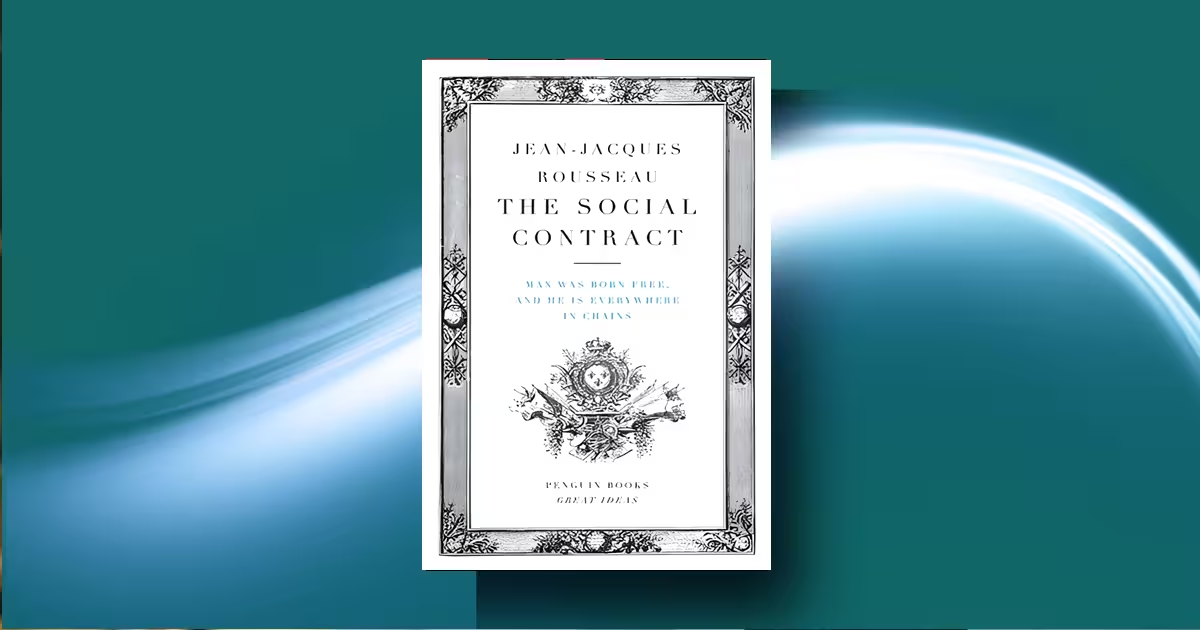
The Social Contract (full title: Du Contrat Social, ou Principes du droit politique), written by Jean-Jacques Rousseau (1712–1778), was first published in 1762 by Marc-Michel Rey in Amsterdam. The edition reviewed here is the Yale University Press edition (2002), edited by Susan Dunn, which pairs Rousseau’s text with his two companion Discourses and scholarly essays by Robert N. Bellah, Gita May, David Bromwich, and Conor Cruise O’Brien.
Context: The Social Contract sits squarely in the tradition of 18th-century Enlightenment political philosophy. Rousseau was a Genevan-born writer, composer, and thinker who had already scandalized Paris with his Discourse on the Sciences and Arts (1750) and his Discourse on the Origin of Inequality (1755).
This third major work, commonly called The Social Contract, completes what editor Susan Dunn aptly calls his “political triptych.” It is, at once, a work of political theory, utopian vision, and — as centuries of hindsight have made clear — a document of terrifying consequence.
Purpose: Rousseau opens with the famous declarative sentence that has never lost its charge: “Man was born free, and everywhere he is in chains.” The book’s central argument is to answer the question that logically follows — what makes political authority legitimate?
Rousseau’s answer is radical: the only just state is one where the people govern themselves through a collective act of will, surrendering individual interests to the “General Will,” which always aims at the common good of all. He does not merely theorize about governments that exist. He proposes what a truly legitimate one would look like.
And in doing so, he changed the world.
2. Background
To read The Social Contract without understanding the man who wrote it is to miss half the story. Rousseau was born in Geneva on 28 June 1712, to a Protestant family of French origin.
His mother died in childbirth, and his early life was marked by instability — apprenticeships, wandering, patronage from wealthy women, and a gnawing sense of humiliation whenever he entered the gilded salons of the French Enlightenment.
He knew Voltaire, Diderot, Rameau — the greatest minds of his century — and he collaborated with them before turning against them. His 1749 “illumination on the road to Vincennes,” as he called it, was his turning point: while meditating on an essay competition question — Has the revival of the sciences and arts contributed to improving morality? — he experienced what he described as a sudden, overwhelming conviction that civilization, far from elevating humanity, had corrupted it.
His answer, the Discourse on the Sciences and Arts, won the prize at the Dijon Academy competition in 1750 and made him famous overnight.
That conviction — that society had gone catastrophically wrong and needed to be rebuilt on rational, moral foundations — drove everything he wrote thereafter.
By the time he published The Social Contract in 1762, an arrest warrant had been issued for him in France and Geneva (largely because of his companion work Emile, which contained heterodox religious views), and he spent years in exile and wandering. He died on 2 July 1778, five days after his sixty-sixth birthday, at Ermenonville, outside Paris.
Sixteen years later, in 1794, his remains were installed in the Panthéon, the resting place of France’s national heroes.
Lord Acton, the great British historian, once wrote — and this is worth pausing on — that Rousseau “produced more effect with his pen than Aristotle, or Cicero, or St. Augustine, or St. Thomas Aquinas, or any other man who ever lived.” Whether one agrees or not, the claim forces a reckoning with what is in this short, dense, paradox-filled book.
3. Summary of The Social Contract
The First and Second Discourses: The Foundation
Because the Yale edition includes Rousseau’s two Discourses, and because they are essential context for The Social Contract itself, they deserve attention before the main event.
In the First Discourse (1750), Rousseau argued — shockingly, scandalously — that the advancement of the sciences and the arts had not improved human morality but degraded it.
He looked at the polished, sophisticated world of 18th-century Paris and saw, beneath the glittering surface, a civilization of “happy slaves” — people who had traded authentic virtue for the performance of it, and genuine freedom for the appearance of civilization.
As Dunn summarizes in the introduction, Rousseau believed that the Enlightenment’s pursuit of knowledge had produced individuals who resembled citizens but were not: “We have physicists, geometers, chemists, astronomers, poets, musicians, painters,” Rousseau wrote, “we no longer have citizens.”
The Second Discourse (1755) took the argument deeper, into the question of why inequality had come to define human life. Rousseau imagined a hypothetical “state of nature” — not Hobbes’s war of all against all, but something more like a dormant, solitary existence where people were free, equal, and self-sufficient. They felt no great need for each other, formed no lasting bonds, and lived in harmony because their desires never exceeded their needs.
There was neither cooperation nor conflict.
The fall began, Rousseau argued, when human beings started comparing themselves to one another.
The desire for esteem — for being seen as superior — drove private property, division of labor, economic inequality, and ultimately the political subjugation of the many by the few.
In a devastating phrase, he described the psychological consequence: people came to experience their worth only through the appraising eyes of rivals, and in seeking the regard of others it became “more important to appear than to be.”
The rich, threatened by disorder and seeking to protect their property, then made an offer to the poor: enter into a “social contract” — accept laws and a ruler — and receive peace and security in exchange for freedom. This was, Rousseau concluded, a fraud. It institutionalized the power of those who already had it. “The usurpations of the rich, the pillagings of the poor, the unbridled passions of all,” he wrote, had rendered men “avaricious, wicked and ambitious.”
The Second Discourse ends in a vision of despotism — the final stage of a long, catastrophic spiral — and in the barely suppressed suggestion that revolution may be the only way out.
The Social Contract: The Argument
The Social Contract opens with one of the most electrifying sentences in the history of political thought: *”Man was born free, and everywhere he is in chains. Many a one believes himself the master of others, and yet he is a greater slave than they.
How has this change come about? I do not know. What can make it legitimate? I believe I can settle this question.”*
This is the territory Rousseau intends to map: not the corrupt world as it is, but the conditions under which political authority would be legitimate. His answer unfolds across four books, dense with argument, paradox, and occasional self-contradiction.
Book I: The Social Pact
Rousseau begins by demolishing existing justifications for political authority. Might cannot make right. The “right of the strongest” is not a right at all — it is merely force, and “as soon as men can disobey with impunity, they can do so legitimately.” Slavery cannot be consensual, because to renounce one’s freedom is to renounce one’s humanity itself: “To renounce one’s liberty is to renounce one’s essence as a human being, the rights and also the duties of humanity.”
Paternal authority, natural hierarchy, conquest — Rousseau dismisses them all. The only basis for legitimate government is convention, freely entered. But what kind of convention?
The fundamental problem, as Rousseau frames it, is this: “To find a form of association that may defend and protect with the whole force of the community the person and property of every associate, and by means of which each, joining together with all, may nevertheless obey only himself, and remain as free as before.”
His solution is the social pact: each person alienates themselves entirely to the community. Not to a ruler, not to a king — but to the collective body of all citizens. In this way, since each gives themselves to all, they give themselves to no one in particular. They gain civic liberty and moral equality in exchange for natural liberty.
The body that emerges — the “republic” or “body politic” — is the sovereign, and its active expression is the General Will.
This is the most original and most troubling idea in the book.
The General Will
Rousseau defines the General Will as the will that citizens would hold if they were capable of thinking entirely as members of the community rather than as private individuals. It is not the sum of individual wills, nor the will of the majority (which can be corrupt or mistaken), nor a compromise among competing interests.
It is a theoretical construct — the infallible, unchanging expression of the common good of all, “always constant, unalterable, and pure,” as Rousseau writes in Book IV, Chapter I.
This is where the book becomes simultaneously its most visionary and its most dangerous. The General Will is not discovered through debate or democratic deliberation.
Citizens are meant to vote not to express their personal preferences but to “discover” what the General Will already is. Rousseau explicitly opposes representative democracy — representatives would rob citizens of their sovereignty and their civic duty.
He is also suspicious of political parties and factions, because these lead citizens to identify with partial interests rather than the general good.
Crucially, citizens who disagree with the General Will are simply wrong. As Rousseau writes in Book I, Chapter VII, in words that have haunted political philosophy ever since: “Whoever refuses to obey the general will shall be constrained to do so by the whole body: which means nothing else than that he shall be forced to be free.”
Forced to be free. Three words. The most debated, the most disturbing, and the most consequential three words in the book. Rousseau intends them sincerely: obedience to the General Will is true freedom because it is obedience to the collective rational conscience that citizens would choose were they fully enlightened. But the logic, taken to its endpoint, licenses coercion in the name of liberation.
Book II: Law and the Legislator
In Book II, Rousseau turns to the question of how laws are made. Sovereignty — the General Will — is inalienable and indivisible. No one can exercise it on the people’s behalf; it can only be expressed by the people themselves.
Laws, therefore, must come from the people as a whole and apply to the community as a whole, never singling out individuals by name: “The law may indeed decree that there shall be privileges, but cannot confer them on any person by name.”
But here Rousseau introduces one of his most paradoxical and striking figures: the Legislator. Because the people cannot know in advance what laws would best suit their nature, they require a superior, quasi-divine figure — someone of extraordinary wisdom and disinterestedness — who frames the initial constitution and laws for the nation.
Rousseau invokes Lycurgus of Sparta, Numa of Rome, and Moses as historical examples. This Legislator must understand human passions without being subject to them. As Rousseau writes: “Gods would be necessary to give laws to men.”
Once the laws are established, the Legislator withdraws. Thereafter, citizens ratify or reject laws through their assemblies, seeking always to discover the General Will.
Book III: Government
If the sovereign (the people) holds legislative power, who holds executive power? For Rousseau, “government” — whether monarchy, aristocracy, or democracy — is merely the servant of the sovereign, a commission that can be revoked.
Democracy in the strict sense — where the people govern themselves directly — is, he admits, more suited to gods than to men. He shows a surprisingly pragmatic side here: different forms of government suit different climates, populations, and sizes of state. Small states may suit democratic government; large ones may require monarchy.
What matters is that the government never usurps sovereignty, and that citizens periodically reassemble to ratify the arrangement. Government, in Rousseau’s vision, is always provisional and always subordinate to the General Will.
Book IV: Voting, Tribunals, and Civil Religion
The final book addresses practical matters of governance: how voting works, the role of the Roman dictatorship as an emergency institution, the function of censorship in maintaining public morality, and — most provocatively — civil religion.
For Rousseau, no healthy political community can exist without a civil religion: a set of simple dogmas — belief in God, the afterlife, the sanctity of the social contract, and the prohibition of intolerance — that bind citizens’ hearts to the state.
Those who refuse to affirm these dogmas can be banished. Those who affirm them and then act against them are to be put to death for lying before the law. “If any one, after publicly acknowledging these dogmas, behaves like an unbeliever in them,” Rousseau wrote, “he should be punished with death; he has committed the greatest of crimes, he has lied before the laws.”
A censorial tribunal would also guide and shape public opinion, preventing corruption and ensuring citizens remain oriented toward the General Will.
The Full Arc
To put it plainly: Rousseau begins with man’s freedom, traces its loss through the development of civilization and inequality, and then proposes a radically original political community — one in which citizens freely surrender themselves to the collective will and, in doing so, become more free, not less.
The chain of logic is internally coherent.
The problem is its execution, and Rousseau himself was aware of the difficulty: he admitted, near the end of his life, that he himself could never have lived in such a community. “I was never really suited to civil society, with all its burdens, obligations and duties,” he confessed. “My independent nature refused the submissions and compromises necessary in communal life.”
4. The Social Contract Analysis
The Social Contract is one of the most groundbreaking, maddening, and morally urgent books I have ever read. It is the kind of work that makes you put it down, stare at the ceiling, and argue with a man who has been dead for nearly two and a half centuries.
There is no other response to Rousseau — he demands one.
What Rousseau achieves in this slim volume is astonishing. He exposes the lie at the heart of most political authority — that force, tradition, or divine right can confer legitimacy — and replaces it with a genuinely radical principle: the only just state is one that the people themselves have, in the deepest sense, willed.
This insight is foundational to modern democracy.
The opening words of the American Constitution — “We the People” — are, as editor Susan Dunn notes, “more Rousseauian in spirit than Jefferson’s mention of the ‘consent of the governed’ in the Declaration of Independence.”Kennedy’s inaugural challenge — “Ask not what your country can do for you, ask what you can do for your country” — is Rousseau speaking through a Boston accent.
Moreover, Rousseau’s diagnosis of inequality — his identification of how the desire for esteem, for the regard of others, corrodes authentic selfhood — is psychologically precise in a way that still feels entirely modern. What Thorstein Veblen would later name “conspicuous consumption” in 1899, Rousseau had already identified and anatomized a century earlier.
That people view themselves through the eyes of rivals, that social competition produces alienation rather than fulfillment, that appearing matters more to most people than being — these insights feel as true in the age of social media as they did in 18th-century Paris.
Yet the book’s central concept, the General Will, is where brilliance slides into something that should disturb every reader who values pluralism and dissent. The General Will is infallible, by definition. It cannot be wrong.
Those who disagree with it are not expressing a legitimate alternative view — they are simply in error, held captive by their private, selfish interests. There is no legitimate opposition in Rousseau’s state. There are no political parties. No minority rights. No structural protection for dissent.
A “board of censors” shapes and declares public opinion. Those who publicly acknowledge the dogmas of civil religion and then act against them are to be executed.
The word that comes to mind is totalitarianism. Not in Rousseau’s intention — his goal was freedom, morality, and community — but in the logic of the system he designs. As editor Dunn argues with devastating clarity, Rousseau’s ideal political community, “through the sheer force of its coercive and unitary communitarian spirit, comes to dominate every aspect of human life — intellectual life, social life, moral life. This is the very definition of modern totalitarianism.”
The French Revolution proved it. Robespierre, who had met Rousseau in 1778 and pledged to be “constantly faithful to the inspiration” he drew from Rousseau’s writings, used the concept of the General Will as his ideological weapon.
The Jacobins declared themselves the voice of the General Will. Dissenters were not merely political opponents — they were enemies of the common good, traitors to be eliminated. The Terror of 1793–1794 mandated the death penalty for any attempt to threaten the unity of the Republic.
As Napoleon later commented with a bitter clarity, “He was a madman, your Rousseau. It was he who led us into our present predicament.”
This is not to say that Rousseau caused the Terror, which would be a simplification. But as the historian François Furet argued, Rousseau “provided the terms in which the logic of events could be interpreted.” The cult of unity, the denunciation of factions, the equation of dissent with treason — all of these had their philosophical home in The Social Contract.
By contrast, James Madison, writing Federalist No. 10 twenty-five years after Rousseau, built his vision of constitutional government on precisely the opposite premise: that conflict among factions is not only inevitable but necessary. “As long as the reason of man continues fallible, and he is at liberty to exercise it, different opinions will be formed.” Where Rousseau wanted harmony, Madison wanted checks and balances.
Where Rousseau banned factions, Madison institutionalized them. The result, as Dunn notes, is that the United States and Britain — both built on the tolerance of conflict — survived the catastrophes of the 20th century with their governments intact, while states built on the Rousseauian fantasy of unanimity descended into horror.
Yet — and this is what makes Rousseau impossible to simply dismiss — his positive vision of a community oriented toward the common good, his concept of “positive freedom” (freedom for a higher purpose rather than freedom from constraint), and his critique of a society in which people are slaves to artificial desires they have been manipulated into wanting, remain deeply compelling.
They are the intellectual ancestors of every communitarian movement, every call for civic sacrifice, every criticism of market individualism. When we feel that something is wrong with a society in which inequality is extreme and belonging has been hollowed out, Rousseau is the one who named that feeling first and most forcefully.
5. Strengths and Weaknesses
Strengths
The diagnostic power of The Social Contract and its companion Discourses is remarkable. Rousseau’s account of how inequality develops — from the first comparisons between neighbors, to private property, to political subjugation — is not just historically provocative but philosophically precise.
His insistence that natural freedom and civilized freedom are qualitatively different things opened a philosophical debate that continues today under the terms of positive and negative liberty (a distinction that Isaiah Berlin, in his famous 1958 essay, would still be elaborating two centuries later).
The prose, at its best, has the quality of a manifesto — compressed, declarative, willing to shock. The opening of Book I is not rhetoric for rhetoric’s sake; it is a moral reckoning.
Furthermore, Rousseau’s willingness to acknowledge complexity, to admit that his ideal state is probably unrealizable for most peoples, and to confess that he himself could not live within it, gives the book an unusual and somewhat endearing honesty.
Weaknesses
The General Will is an unfalsifiable concept. Rousseau himself admits that the General Will can differ from the will of the majority — and yet provides no reliable mechanism for determining what the General Will actually is. This conceptual gap is not a minor problem; it is the gap through which authoritarians drive.
If the General Will is always right but no individual or group can reliably identify it, then whoever claims to speak for it — and speaks loudly enough — wins. That is the Jacobins. That is the 20th century’s one-party democracies.
Rousseau’s rejection of representative democracy is also a weakness that becomes glaring at scale. His vision presupposes a relatively small, homogeneous community — something closer to an ancient Greek city-state than a modern nation of millions. He never resolves this tension, and he knows it.
His hostility to factions and parties is not just politically impractical — it is, as Madison demonstrated, inimical to freedom itself.
Additionally, there is Rousseau’s treatment of women — largely absent from the political community — and his assumption of cultural and social homogeneity that sits uncomfortably with contemporary understandings of pluralism. These are not peripheral flaws; they reveal the limits of his vision.
6. Comparison with Similar Works
Thomas Hobbes, Leviathan (1651): Hobbes is Rousseau’s most important interlocutor. Both imagine a state of nature and a social contract emerging from it.
But where Hobbes sees natural man as violent and the state of nature as “solitary, poor, nasty, brutish, and short” — requiring absolute sovereign power to contain — Rousseau sees natural man as innocent and blames civilization for corruption.
The two books are, in a sense, mirror images: Hobbes justifies authority to prevent chaos; Rousseau questions whether any existing authority is truly just.
John Locke, Two Treatises of Government (1689): Locke also grounds political authority in consent.
But for Locke, the social contract protects pre-existing natural rights (life, liberty, property), and the people retain the right to overthrow a government that violates these rights. Rousseau’s vision is more radical and more communitarian: natural rights matter less than the community’s collective will.
James Madison, Federalist No. 10 (1787): This is the most instructive comparison. Madison’s answer to the problem of faction — embrace it, institutionalize it, use it to prevent tyranny — is the direct practical counterpoint to Rousseau’s attempt to eliminate it. Read them together, and you understand why American and French democracy diverged so dramatically after 1789.
Alexis de Tocqueville, Democracy in America (1835): Tocqueville, who admired both Madison and Rousseau, offered a synthesis that remains compelling: self-interested citizens, when genuinely engaged in local self-government and civic associations, develop what he called “enlightened self-interest” — a public-spiritedness that emerges not from suppression of the self but from its expansion.
This is perhaps the most humane response to the problem Rousseau posed.
7. Conclusion
The Social Contract is a dangerous book. I mean that as the highest praise I can give it. Only ideas that matter are dangerous.
Only books that get close to something true about politics, freedom, and human nature generate the kind of historical force that The Social Contract generated — launching a revolution, inspiring totalitarians, and simultaneously providing the intellectual foundation for genuine democratic aspiration.
Rousseau was right about the diagnosis: civilization, as it has developed, has produced staggering inequality, alienation, and the enslavement of people to desires that serve power rather than humanity. He was also right that political authority requires a moral foundation — that force alone cannot confer legitimacy, and that the consent of the governed is not a slogan but a necessity.
Where he went wrong, and dangerously so, was in his solution: in the concept of a General Will that cannot be questioned, in the elimination of dissent, in the civil religion that punishes heretics with death, in the dream of unanimity that, when pursued by actual human beings in actual revolutions, produces the guillotine.
Read this book. Read it as a student reads a master who is also profoundly mistaken in places that matter enormously. Read it as a warning about what happens when the aspiration for community becomes the repression of difference.
And read it as a reminder that the most important political questions — what makes authority legitimate, what we owe each other, how much of ourselves we can give to a community without losing ourselves entirely — have not been settled, and may never be.
As Rousseau himself might have agreed: the search is the point.
Who Should Read This: Students of philosophy, politics, and history; anyone interested in the intellectual origins of modern democracy and totalitarianism; readers of Hobbes, Locke, and Tocqueville; and anyone who has ever felt the tension between belonging to a community and remaining free within it.







