
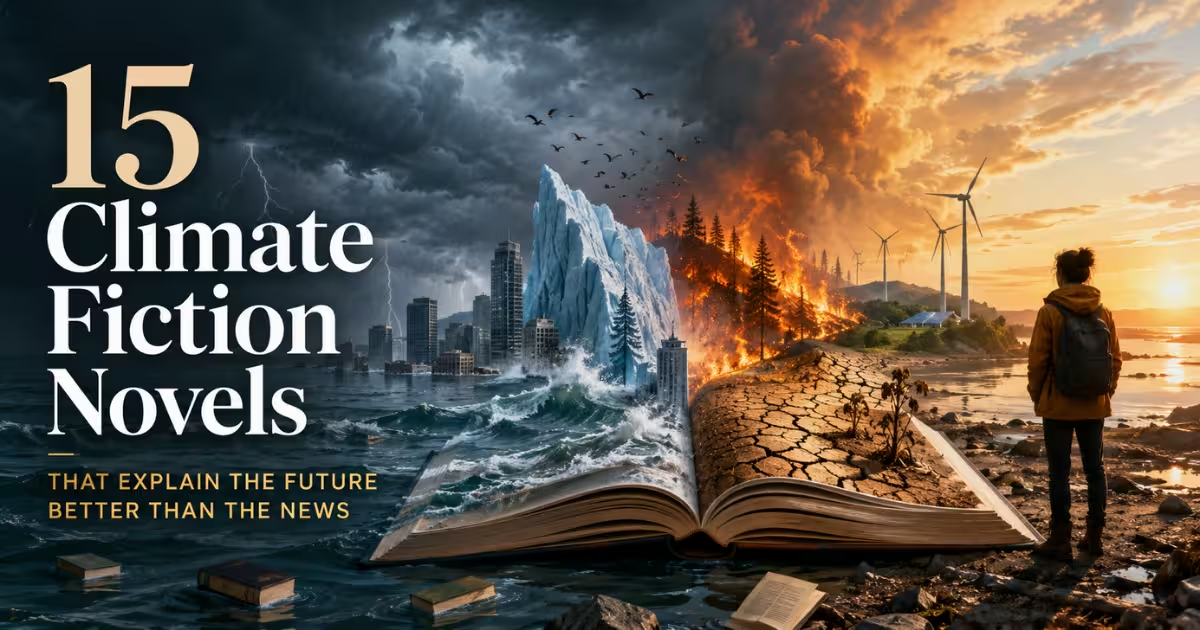
The news cycle gives you climate change in fragments: a wildfire here, a flood there, a graph that spikes and then disappears from the feed by Thursday. Climate fiction does something the news structurally cannot. It gives you a complete world, lived in by characters who have to eat, work, fall in love, and raise children inside the climate future we are currently only glimpsing in headlines.
That difference in form is also a difference in understanding.
A statistic about sea-level rise tells you a number. A novel about sea-level rise tells you what happens to the people who used to own the building that’s now underwater, and what they do next.
This is the appeal of what’s commonly called cli-fi, a term that has been credited at various points to writer and editor Dan Bloom as a contraction of “climate fiction,” modeled on “sci-fi.”
The exact year of its coinage is disputed across sources, but its function is not: cli-fi names a body of speculative and literary fiction in which a changed or changing climate is not background scenery but a structural force shaping plot, character, and consequence.
Margaret Atwood, whose own work sits at the genre’s foundation, has called some of these books “ustopian,” meaning both utopian and dystopian at once, depending on which character you’re following and which decade you’ve landed in.
What follows is a list of fifteen climate fiction novels that, between them, cover almost every register the genre can hit: bureaucratic optimism, drought-fueled noir, hurricane elegy, geoengineering thriller, and quiet rural realism. Read together, they form something closer to a forecast than a news segment ever could, because they don’t just tell you what might happen. They tell you what it might feel like.
Table of Contents
Why Climate Fiction Outpaces the News Cycle
News reporting on climate change is, almost by design, episodic. A story breaks, it runs for a cycle or two, and then attention moves elsewhere, regardless of whether the underlying crisis has resolved. Climate fiction does not have this problem, because a novel’s job is to follow consequence all the way through.
When Kim Stanley Robinson’s The Ministry for the Future opens with a heatwave in India, the book doesn’t cut away after the disaster segment ends. It stays with the survivor, Frank May, for hundreds of pages, tracking what a catastrophic climate event does to a single nervous system over years, not news cycles.
This sustained attention is part of why climate fiction has become such a productive lens for understanding climate change as a lived phenomenon rather than a policy abstraction.
A novel can put you inside a water rights negotiation, a refugee camp, or a geoengineering control room in a way that a quarterly emissions report cannot. The genre also tends to be more honest than headlines about uncertainty.
These books rarely promise a single outcome. They show multiple plausible futures, sometimes within the same novel, which is closer to how climate science itself actually talks about risk than the news ever manages to be.
The List: 15 Climate Fiction Novels for the Climate-Curious Reader
1. The Ministry for the Future by Kim Stanley Robinson
Kim Stanley Robinson’s 2020 novel opens with a heatwave in India so catastrophic it functions as the book’s inciting incident, killing millions and triggering the formation of a fictional UN agency tasked with advocating for future generations.
The Ministry for the Future is, structurally, an unusual kind of climate fiction novel: it is told through a kaleidoscope of vignettes, eyewitness reports, and first-person chapters from voices ranging from refugees to glaciologists to, in some chapters, non-human narrators like a carbon atom.
Robinson is less interested in a conventional plot than in modeling, in granular and researched detail, what an actual global response to the climate crisis could look like across the 2020s through the 2040s, including carbon quantitative easing, rewilding, and geoengineering experiments in Antarctica.
What makes this book essential climate fiction is its refusal to choose between hope and horror. It begins in catastrophe and ends, after considerable difficulty, in something resembling functional global cooperation, making it one of the few major works in the genre to take seriously the question of what success might actually look like, mess and moral compromise included.
2. Parable of the Sower by Octavia Butler
Octavia Butler’s 1993 novel is frequently cited as one of the genre’s founding texts, in part because of how eerily its setting anticipated real conditions decades later.
Told through the diary entries of fifteen-year-old Lauren Olamina between 2024 and 2027, the book is set in a Los Angeles-adjacent California devastated by drought, wealth inequality, and the collapse of basic civic order.
Lauren has a condition called hyperempathy syndrome, which causes her to physically feel the pain of those around her, a detail that turns the climate-fueled violence of the book into something visceral rather than abstract.
After her gated community is destroyed, Lauren leads a group of survivors on a journey north, developing along the way a new belief system called Earthseed, built around the axiom “God is Change.”
Butler wrote the novel as an extrapolation of trends she observed in the late 1980s and early 1990s: gated communities, drug addiction, and a widening gap between rich and poor, intensified by climate-driven scarcity.
The book took twenty-seven years to reach the New York Times bestseller list, finally arriving there in 2020, a delay that says as much about how long it took readers to catch up to Butler’s foresight as it does about the book itself.
3. The Deluge by Stephen Markley
At nearly 900 pages, Stephen Markley’s 2023 novel The Deluge is less a single story than an ecosystem of stories, tracking a sprawling cast of scientists, activists, hedge fund executives, addicts, and eco-terrorists across more than three decades, from 2013 into the 2040s.
The novel opens with a scientist discovering that methane hydrates are beginning to melt, a discovery he calls a “tombstone domino,” and proceeds to weave together the political, financial, and personal fallout of escalating climate disaster across the United States.
What sets The Deluge apart from other entries on this list is its scope and its refusal to flinch from the ugliness of the response to climate change as much as the climate change itself. It depicts not just floods and fires but the political backlash, disinformation campaigns, and authoritarian movements that climate stress tends to generate.
One reviewer who had already read Ministry for the Future, Termination Shock, and Parable of the Sower described being blown away by how much further Markley’s novel pushed the genre’s scope, suggesting it could anchor an entire semester of climate fiction study on its own.
4. Termination Shock by Neal Stephenson
Neal Stephenson’s 2021 technothriller opens with one of the more memorable cold opens in recent climate fiction: the Queen of the Netherlands crash-landing a plane after a herd of feral hogs invades a Texas runway.
From there, the novel follows a Texan billionaire, T.R. Schmidt, who decides to take unilateral action on global warming by building a massive underground gun that fires sulfur dioxide into the stratosphere, mimicking the cooling effect of a major volcanic eruption.
The technique, known as solar geoengineering, becomes the novel’s central ethical and geopolitical fault line: it might buy humanity time, but it does so unevenly, helping some regions and harming others, and raising the terrifying possibility of “termination shock,” a sudden and deadly rebound in temperature if the intervention is ever abruptly stopped.
Stephenson assembles a genuinely global cast, including a Dutch queen, a Comanche veteran, a Sikh martial artist, and a Chinese intelligence operative, to dramatize just how unevenly the costs and benefits of a unilateral climate fix would be distributed.
It’s a useful corrective to the idea that any single engineering solution to climate change could be simple, clean, or universally welcomed.
5. New York 2140 by Kim Stanley Robinson
Robinson’s 2017 novel imagines Manhattan more than a century after a catastrophic fifty-foot rise in sea level has submerged much of Lower Manhattan and turned the city into a kind of “SuperVenice,” with canals replacing streets and skybridges connecting towers above the waterline.
The novel follows nine residents of a single shared high-rise building, including a market trader, a police inspector, an internet-famous environmental activist, and two coders attempting to hack the global financial system, as their separate storylines converge around a mysterious disappearance and a corporate plot to buy out the building.
Robinson has been candid that the fifty-foot rise depicted in the novel is more extreme than current scientific projections, which generally suggest a rise of three to fifteen feet by 2140 under most scenarios, though some estimates for far higher warming scenarios run considerably higher by the year 2300.
The exaggeration is deliberate: Robinson wanted a setting recognizable as New York while still being severe enough to force a genuine reckoning with what adaptation, rather than mere survival, could look like.
The novel doubles as a sharp critique of unregulated financial markets, suggesting that capitalism’s appetite for profit doesn’t pause for catastrophe; it just finds new things to speculate on.
6. The Water Knife by Paolo Bacigalupi
Paolo Bacigalupi’s 2015 novel imagines an American Southwest brought to its knees by drought, where states fight each other, sometimes violently, over dwindling rights to the Colorado River.
The protagonist, Angel Velasquez, is a “water knife,” an enforcer for the Southern Nevada Water Authority whose job is to secure water rights for his employer by any means necessary, including sabotage and violence.
The plot follows Angel to a collapsing Phoenix, where rumors of a transformative new water source draw him into a three-way collision with a Texan refugee and a journalist who has made the dying city her beat.
The novel grew out of Bacigalupi’s earlier short story “The Tamarisk Hunter,” and its world-building leans hard into plausibility: dust storms, cartel-like water districts, and a federal government too weakened to mediate the conflict. It’s a noir thriller first and a climate parable second, which is exactly why it lands as effectively as it does; the water crisis isn’t a metaphor here, it’s the plot engine.
7. Flight Behavior by Barbara Kingsolver
Barbara Kingsolver’s 2012 novel takes the smallest possible aperture on climate change and makes it devastating.
Dellarobia Turnbow, an unhappy young farm wife in rural Tennessee, is on her way to begin an affair when she stumbles across what looks like a mountainside on fire, but is in fact millions of monarch butterflies that have inexplicably overwintered in Appalachia instead of their usual home in Mexico.
The discovery draws a team of scientists to set up a research lab on the Turnbow family’s land, and the resulting collision between rural Appalachian skepticism and outside scientific authority becomes the novel’s real subject.
Kingsolver, who has described the book as “a fictional story within a plausible biological framework,” is less interested in spectacle than in the social mechanics of climate denial: how poverty, religious belief, and a justified distrust of condescending outsiders combine to make abstract science feel irrelevant to people focused on immediate survival.
It remains one of the sharpest fictional treatments of why climate communication so often fails, and to whom.
8. American War by Omar El Akkad
Omar El Akkad’s 2017 debut imagines a Second American Civil War fought between 2074 and 2093, sparked not by slavery but by a federal ban on fossil fuels that several Southern states refuse to accept.
By this point in the novel’s timeline, climate change has already reshaped the country’s geography: much of Florida and Louisiana have been lost to rising seas, and Texas has been absorbed back into Mexico.
The story follows Sarat Chestnut from childhood in a Mississippi refugee camp through her radicalization into one of the war’s most committed and violent partisans, reconstructed after her death by a nephew piecing together her diaries.
El Akkad, a journalist who covered the war in Afghanistan and the military trials at Guantanamo Bay before writing fiction, brings a reporter’s eye for the mechanics of conflict, including waterboarding, rendition, and biological warfare, all transplanted onto American soil.
The novel arrived in the cultural moment following the 2016 U.S. election, and its vision of an irreparably divided country at war with itself struck many readers and critics as uncomfortably immediate rather than speculative.
9. How Beautiful We Were by Imbolo Mbue
Imbolo Mbue’s 2021 novel is set in the fictional village of Kosawa, in an unnamed African country closely resembling her native Cameroon, where an American oil company called Pexton has spent decades extracting oil and, in the process, poisoning the village’s water, air, and farmland.
The story opens in October 1980, with Kosawa’s children dying from contaminated water and a Pexton delegation arriving to offer hollow reassurances rather than real remedy.
When the village’s resident madman steals the keys to the delegation’s car, the villagers seize on the opportunity to take the oil executives hostage, an act of resistance that triggers a brutal military crackdown and sets off a multigenerational fight for justice.
Told from rotating perspectives, including a haunting collective “we” voice belonging to the village’s children, the novel follows the Nangi family and especially Thula, a girl who grows into a revolutionary, across decades of struggle.
Mbue’s novel is a reminder that climate fiction doesn’t require a futuristic setting; environmental injustice driven by extraction and corporate impunity has already been reshaping lives for generations, and the genre is just as suited to looking backward as forward.
10. The Windup Girl by Paolo Bacigalupi
Bacigalupi’s Hugo and Nebula Award–winning 2009 debut imagines a post-oil future Bangkok, centuries after fossil fuels have been exhausted and genetically engineered crops, deliberately bred sterile by powerful “calorie companies,” have collapsed global agriculture into a series of corporate monopolies.
Bangkok itself survives only because of constant, labor-intensive pumping to hold back the risen sea. Anderson Lake, an undercover company operative searching the city’s markets for extinct foodstuffs, becomes entangled with Emiko, the titular “windup girl,” a genetically engineered being designed to serve a wealthy Japanese businessman and then abandoned to the city’s streets.
The novel coined and popularized the term “biopunk” for its particular fusion of cyberpunk sensibilities with biotechnology and ecological collapse, and it remains a genre touchstone for imagining what happens when intellectual property law, genetic engineering, and resource scarcity collide.
Its vision of “calorie companies” enforcing global dependency through engineered plagues and sterile seed stock feels less like science fiction and more like an extrapolation of existing agricultural patent disputes pushed to their most extreme logical endpoint.
11. Gold Fame Citrus by Claire Vaye Watkins
Claire Vaye Watkins’s 2015 debut novel imagines a California so thoroughly drained of water that an enormous, slowly advancing desert called the Amargosa Dune Sea has begun swallowing mountain ranges and emptying cities.
Luz and Ray, a couple squatting in an abandoned Laurel Canyon mansion, impulsively take in a neglected toddler named Ig at a rave and attempt to flee California for the wetter, greener East, only to run out of gas and fall in with a cult-like colony of dune-dwellers led by a charismatic dowser who claims he can still find water no one else believes exists.
Watkins, who grew up in the Mojave Desert, builds her California-in-collapse around the displaced “Mojav” refugees, a clear and deliberate echo of the Dust Bowl-era Okies, complete with the racism and brutal mistreatment that displaced populations historically face.
The novel’s real achievement is scale: it makes the human drama feel appropriately small and fragile against a desert landscape vast enough to erase entire cities, which is precisely the disorientation that genuine climate displacement tends to produce.
12. The Light Pirate by Lily Brooks-Dalton
Lily Brooks-Dalton’s 2022 novel begins with a hurricane so severe that a woman named Frida gives birth alone, mid-storm, to a daughter she names Wanda after the hurricane itself. The novel then follows Wanda across an entire lifetime as her hometown of Rudder, a fictional small Florida community, is slowly and then rapidly reclaimed by rising water, worsening storms, and a crumbling electrical grid that her father, a lineman, spends his life trying to hold together.
Structured in four parts named Power, Water, Light, and Time, the novel traces both Florida’s literal disappearance beneath the waves and a quieter, more intimate story about a family that refuses to leave the place that is killing it.
Brooks-Dalton wrote much of the novel during residencies in Florida, soaking in the state’s hurricane season rhythms years before Hurricane Ian made landfall in 2022 and became, for many readers in the state, the real-world echo the novel had already imagined.
The book blends magical realism, in the form of a mysterious bioluminescence that begins to follow Wanda, with unflinching ecological realism, making it one of the more formally inventive entries in contemporary climate fiction.
13. The Great Transition by Nick Fuller Googins
Nick Fuller Googins’s 2023 debut imagines a rare thing in climate fiction: a successful outcome.
The novel is set sixteen years after “Day Zero,” the day humanity finally reached net-zero carbon emissions following a global mobilization called the Great Transition, in which private corporations were dismantled in favor of cooperatives and every adult is required to perform two weeks of civil service per year.
Teenager Emi Vargas, born after the worst of the crisis, has grown up being told how lucky she is, until the public assassination of a group of so-called “climate criminals” causes her mother, Kristina, a possible suspect, to disappear.
The novel alternates between Emi’s present-day search for her mother and flashbacks to the brutal Transition years her parents lived through, including coastal flooding, the submersion of the Everglades, and devastating Gulf Coast hurricanes.
Reviewers have praised the book specifically for refusing climate doom and nihilism in favor of what one outlet called clear-eyed utopian thinking, demonstrating that hope and hard-won mutual aid can be every bit as dramatically compelling as collapse.
14. The Wall by John Lanchester
John Lanchester’s 2019 novel, longlisted for the Booker Prize, imagines a near-future Britain after a vaguely defined climate catastrophe known only as “the Change,” following which the entire island has been encircled by a 6,000-mile concrete barrier. The wall serves a double purpose: it holds back rising seas, and it keeps out climate refugees, referred to throughout the novel only as “the Others.”
Every young citizen, including the novel’s protagonist, Joseph Kavanagh, must spend two years as a “Defender,” patrolling the wall around the clock; if even one Other successfully breaches it during a Defender’s watch, that Defender is cast out to sea in their place.
Lanchester has said the novel came to him first as a dream of a cold wall holding back water, and he has described positing roughly a four-degree Celsius temperature increase as the underlying mechanism, severe enough to disrupt the Gulf Stream and leave Britain colder, not warmer.
The novel doubles as a meditation on generational guilt, with young Defenders openly resenting the older generation that “irretrievably” broke the climate and then expects gratitude for being born into the consequences, a resentment that reads as a fairly direct extrapolation of contemporary intergenerational climate anxiety.
15. Oryx and Crake by Margaret Atwood
Margaret Atwood’s 2003 novel, Oryx and Crake, the first in her MaddAddam trilogy, is set in a future shaped less by direct climate catastrophe than by the corporate biotechnology and unchecked genetic engineering that often accompany ecological collapse in cli-fi narratives.
The novel follows Snowman, formerly known as Jimmy, who may be the last unmodified human alive after a global pandemic, deliberately engineered by his childhood best friend Crake and unleashed through a supposedly beneficial pill called BlyssPluss, wipes out nearly all of humanity.
Snowman lives in the aftermath as a reluctant guardian to the Crakers, a peaceful, genetically engineered humanoid species Crake designed to replace humanity, while flashbacks gradually reveal how the world’s corporate compounds, environmental devastation, and casual disregard for biological ethics led to the catastrophe.
Atwood was shortlisted for the Booker Prize for the novel, and it remains one of the most frequently cited works in any discussion of speculative climate and biotech fiction, in part because of how precisely it anticipates the entanglement of corporate power, genetic manipulation, and ecological fragility, a combination that feels less far-fetched with each passing year.
Climate Fiction Beyond the Core Fifteen
The fifteen novels above are not the only worthwhile entry points into climate fiction, and readers who finish this list looking for more have a deep bench to draw from.
The Overstory by Richard Powers — Nine strangers’ lives entwine through their connection to trees, building toward a radical act of environmental defiance; won the 2019 Pulitzer Prize for Fiction.
Migrations by Charlotte McConaghy — A grief-stricken woman talks her way onto a fishing boat to follow what may be the final migration of the world’s last Arctic terns, in a near-future emptied of wildlife.
Gun Island by Amitav Ghosh — A rare-book dealer chases a seventeenth-century Bengali legend from the flooding Sundarbans to sinking Venice, written by an author who has openly argued that literary fiction has been too slow to take climate change seriously.
How High We Go in the Dark by Sequoia Nagamatsu — Linked stories trace generations of grief, ritual, and reinvention after a virus released from melting Siberian permafrost reshapes human civilization.
The Drowned World by J.G. Ballard — Published in 1962, decades before “cli-fi” existed as a term, this novel imagines London submerged beneath a tropical lagoon after solar radiation melts the polar ice caps.
The Swan Book by Alexis Wright — An Indigenous Australian novel following a mute young Aboriginal woman, Oblivia, and her bond with black swans in a climate-ravaged, near-future Australia still living under government intervention.
Bewilderment by Richard Powers — A widowed astrobiologist searches the cosmos for life while raising his grieving, neurodivergent son on Earth, pairing planetary-scale science with intimate ecological loss.
Wild Dark Shore by Charlotte McConaghy – On a remote, wind-lashed island off the Australian coast, a family guarding a priceless seed bank confronts the rising ocean and a mysterious castaway, unearthing secrets as the sea threatens to swallow their home. A gripping blend of ecological grief, survival, and gothic suspense.
Hum by Helen Phillips – In a hyper-surveilled, ecologically frayed near-future, a mother struggling with job loss to intelligent robots and climate anxiety chooses a dangerous facial-altering procedure to give her children the “softer” life they deserve. A razor-sharp fable about parenting, technology, and the ambient terror of a world slipping away.
After the Flood by Kassandra Montag – In a world mostly drowned, a fierce mother sails treacherous waters with her young daughter, risking everything to find the other child she lost years ago. A taut, sea-swept adventure that turns sea-level rise into a deeply personal story of hope and maternal ferocity.
Frequently Asked Questions About Climate Fiction
What is climate fiction, exactly?
Climate fiction, often shortened to cli-fi, is a genre of speculative or literary fiction in which climate change, whether already underway, newly catastrophic, or successfully addressed, functions as a central force shaping plot and character rather than as background detail.
The term is widely credited to writer Dan Bloom, though sources differ on the exact year of its coinage, with some pointing to the late 2000s and others to 2011 or later.
Is climate fiction always dystopian?
No. While much of the genre’s best-known work, including several novels on this list, depicts dystopian collapse, books like The Ministry for the Future and The Great Transition explicitly center on successful, if difficult, climate action. Atwood has used the term “ustopia” to describe novels that blend utopian and dystopian elements simultaneously, which describes a meaningful share of the genre.
Which climate fiction novel is the best starting point for a new reader?
There’s no single right answer, since the genre spans techno-thrillers, literary realism, and speculative epics. Readers who want a grounded, character-driven entry point often start with Flight Behavior or The Light Pirate.
Readers drawn to political and systems-level thinking tend to start with The Ministry for the Future. Readers who want pure narrative drive often start with The Water Knife or American War.
Are these novels based on real climate science?
Most of the authors on this list did substantial research, and several, including Bacigalupi, Lanchester, and Robinson, have spoken publicly about consulting climate scientists or scientific literature while writing. That said, these are works of fiction, and several authors, Robinson among them, have been explicit that certain details, such as the fifty-foot sea-level rise in New York 2140, are deliberately more extreme than current mainstream projections in order to dramatize adaptation at full scale.
How is climate fiction different from traditional science fiction?
The core distinction is that climate fiction requires climate change, whether anthropogenic warming, geoengineering, or large-scale ecological disruption, to be central to the plot rather than incidental world-building.
A novel can be set in the future and involve advanced technology without qualifying as cli-fi; what defines the genre is that a changed climate is actively shaping what the characters can do and what they must survive.







