
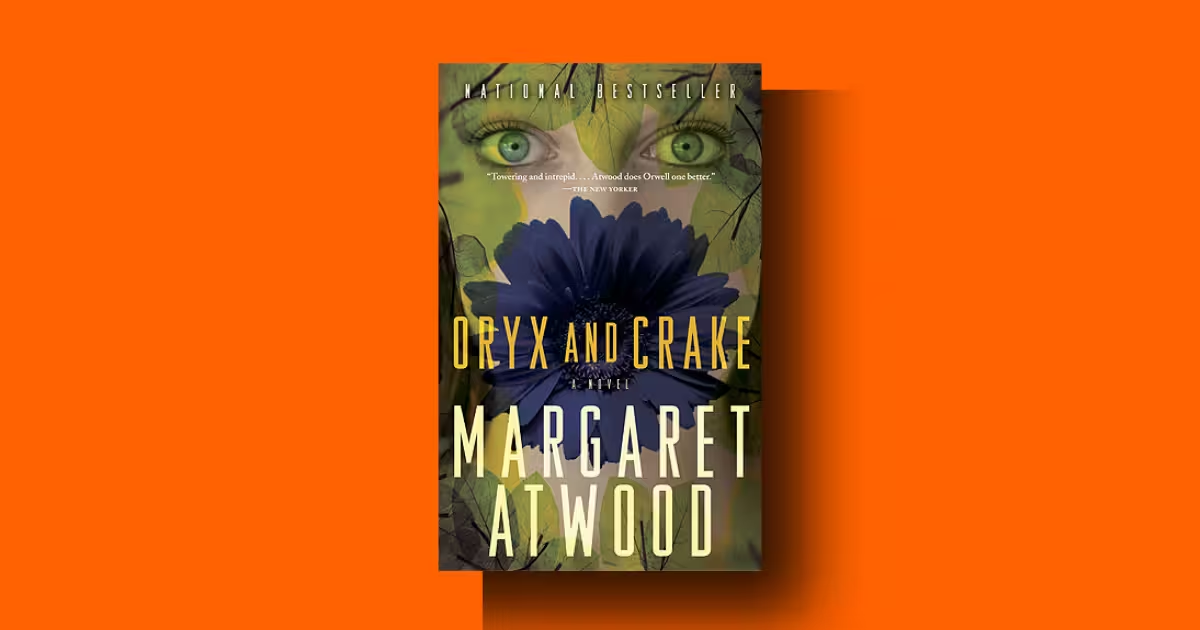
What if a genius decided to wipe out humanity and start over? That’s the terrifying premise of Oryx and Crake—Margaret Atwood’s prophetic dystopian novel about genetic engineering, corporate greed, and the end of the world as we know it.
Oryx and Crake is a blistering speculative fiction masterpiece that forces us to confront the terrifying consequences of playing God with genetics, the fragility of human civilization, and the haunting question of what truly makes us human in a world where humanity has engineered its own obsolescence.
Oryx and Crake is best for readers who love dystopian fiction with intellectual heft, fans of The Handmaid’s Tale, Brave New World, or Never Let Me Go, and anyone fascinated by bioethics, climate collapse, and corporate overreach.
Not for those seeking light, uplifting reads, readers triggered by graphic depictions of child exploitation or violence, or anyone who prefers tidy, morally unambiguous endings.
Table of Contents
1. Introduction
Title: Oryx and Crake
Author: Margaret Atwood
Publication Date: 2003
Publisher: McClelland and Stewart (Canada), Bloomsbury (UK), Doubleday (U.S.)
Genre: Speculative Fiction, Dystopian Fiction, Post-Apocalyptic Fiction
Pages: 448 (first edition)
Awards/Recognition: Shortlisted for the 2003 Man Booker Prize, shortlisted for the 2004 Orange Prize, and finalist for the Giller Prize and Governor General’s Literary Award.
Oryx and Crake is the first installment of Atwood’s acclaimed MaddAddam trilogy, followed by The Year of the Flood (2009) and MaddAddam (2013).
Atwood herself described the novel as “speculative fiction” rather than pure science fiction because it deals with things we can already do or begin to do, rather than impossible technologies. This distinction is crucial—the horrors depicted in the novel are chillingly plausible.
2. Background
Atwood wrote Oryx and Crake in the early 2000s, a period marked by rapid advancements in genetic engineering, the mapping of the human genome, and growing anxieties about climate change and corporate consolidation of power.
The novel reflects these fears, extrapolating them into a near-future where biotechnology conglomerates have replaced governments, and the line between human and animal has become dangerously blurred.
The book also engages with contemporary debates about the devaluation of the humanities in favor of STEM fields, the ethics of genetic modification, and the consequences of environmental destruction. Atwood draws on a rich tradition of dystopian literature—from Aldous Huxley’s Brave New World to George Orwell’s 1984—while forging her own uniquely dark and witty voice.
3. Oryx and Crake Summary
The Present: Snowman’s World
The novel opens with a man called Snowman waking before dawn in a tree, wrapped in a decaying bedsheet, listening to the tide. He is the apparent last human survivor of a global catastrophe.
The world he inhabits is one of ruins—abandoned corporate compounds, crumbling pleeblands (the slums outside the Compounds), and a landscape overrun by genetically modified creatures: wolvogs (wolf-dog hybrids), rakunks (raccoon-skunk hybrids), and pigoons (pigs engineered to grow human organs).
Snowman lives among the “Crakers”—a race of genetically engineered, beautiful, peaceful humanoids created by his former best friend, Crake. The Crakers are vegetarian, immune to UV radiation, have built-in insect repellent, and reproduce only during scheduled mating cycles.
They are innocent, trusting, and utterly dependent on Snowman, whom they regard as a prophet of sorts. He has created an elaborate mythology for them, telling them that Crake and Oryx watch over them from the sky.
Snowman’s daily routine is a grim comedy of survival: he scratches his bug bites, eats mangoes and canned Sveltana No-Meat Cocktail Sausages, and tries to remember the words he once knew. He is haunted by the voices of his past—especially Oryx, the woman he loved, who now speaks to him only in fragments. He is lonely, filthy, and slowly starving to death.
The Past: Jimmy’s Childhood
The narrative then shifts to Snowman’s past life as Jimmy. Jimmy grows up in the OrganInc Farms Compound, where his father works as a genographer—one of the architects of the pigoon project, which genetically engineers pigs to grow human organs.
Jimmy’s mother is a microbiologist who quits her job to stay home with him, but she descends into depression and eventually abandons the family, leaving a note and taking Jimmy’s beloved pet rakunk, Killer, with her.
Jimmy is a “word person” in a world that values numbers and science. He struggles academically, failing to measure up to the genius standards of the Compound schools. His father remarries Ramona, a lab technician, and Jimmy feels increasingly isolated.
Jimmy and Crake: The Friendship
Jimmy’s life changes when Crake (then known as Glenn) arrives at his school. Crake is brilliant, aloof, and intellectually formidable. The two form an unlikely friendship, bonding over computer games, watching violent and pornographic websites, and smoking weed. Crake is fascinated by Extinctathon, an online game that catalogs extinct species, and Jimmy is drawn to Crake’s confidence and intelligence.
During their teenage years, they discover a child pornography site called HottTots, where Jimmy first sees a young girl who will later become Oryx. Jimmy is haunted by her image, feeling both guilt and desire.
The Adult Years: Crake’s Plan Unfolds
Jimmy attends the Martha Graham Academy, a second-rate arts college, while Crake goes to the prestigious Watson-Crick Institute. Crake eventually recruits Jimmy to work at RejoovenEsense, a mega-corporation, where Crake is heading a secret project called Paradice.
Crake reveals his grand plan to Jimmy: the BlyssPluss Pill, a miracle drug that promises protection from STDs, enhanced libido, and prolonged youth. However, the pill also contains a hidden sterilizing agent and a time-released super-virus called JUVE (Jetspeed Ultra Virus Extraordinary).
Crake intends to wipe out most of humanity and replace them with the Crakers—his genetically engineered master race.
At Paradice, Jimmy encounters Oryx again—she is now a young woman working as a teacher for the Crakers. Jimmy and Oryx begin a passionate affair, conducted in secret behind Crake’s back. Oryx is enigmatic, evasive about her past, and seems to accept her exploitation with a serene detachment that frustrates and angers Jimmy.
The Apocalypse: Betrayal and Collapse
The JUVE virus is released through the BlyssPluss Pill, and the world descends into chaos. As the pandemic rages, Jimmy seals himself inside the Paradice dome with the Crakers, locking out the infected.
Crake arrives at the airlock, wounded and carrying Oryx. In a shocking climax, Crake slits Oryx’s throat in front of Jimmy. Jimmy shoots Crake in response. He is now alone with the Crakers and the corpses of his two closest companions.
The Aftermath: Snowman’s Mission
Jimmy renames himself Snowman and leads the Crakers out of Paradice to the seashore, where they establish a new home. He creates a mythology for them, casting Crake and Oryx as benevolent deities.
In the present timeline, Snowman learns from the Crakers that three other humans—two men and a woman—have been spotted nearby. He arms himself with a spraygun and limps toward their camp, uncertain whether they will be friends or foes.
The novel ends on a cliffhanger: Snowman stands at the edge of the trees, watching the strangers, his watch showing “zero hour”. He must decide whether to approach them, kill them, or flee.
4. Oryx and Crake Analysis
4.1. Oryx and Crake Characters
Snowman / Jimmy
Jimmy is the novel’s protagonist and narrator. He is a “word person” in a world dominated by “numbers people”—scientists and engineers who view art and language as frivolous. His journey from a neglected, mediocre child to a guilt-ridden survivor is the emotional core of the novel.
As Snowman, he is a tragicomic figure: part prophet, part buffoon, part Orpheus. He is haunted by his past failures—his inability to save his mother, his complicity in Crake’s plan, and his helplessness at Oryx’s death. Yet he persists, caring for the Crakers out of a sense of duty and a desperate need for meaning.
Crake (Glenn)
Crake is the novel’s antihero and villain.
He is a genius who believes he can perfect humanity by eliminating its “flaws”: jealousy, violence, territoriality, and religion. He is cold, calculating, and seemingly devoid of empathy.
However, his relationship with Oryx reveals a hidden vulnerability—he loves her, or at least is obsessed with her. Crake’s grand plan is both utopian and genocidal: he wants to create a world without suffering, but he is willing to destroy the existing world to achieve it.
His final act—killing Oryx in front of Jimmy—is a moment of pure nihilism, suggesting that even his love is just another form of control.
Oryx
Oryx is the novel’s most enigmatic character. She is a survivor of horrific child exploitation—sold by her impoverished family, forced into pornography, and passed from man to man. Yet she refuses to be a victim.
She is relentlessly optimistic, peaceful, and accepting. She tells Jimmy, “Everything has a price”. She admires Crake’s vision because she believes he wants to end human suffering. Her death at Crake’s hands is both a sacrifice and a mercy—she is freed from a world she never truly belonged to.
The Crakers
The Crakers are genetically engineered humanoids who represent Crake’s ideal of humanity. They are beautiful, peaceful, and innocent. They have no concept of jealousy, violence, or private property.
They eat only grass and leaves, reproduce on a set schedule, and purr to heal wounds. However, they are also childlike and dependent, lacking the curiosity and creativity that define human culture.
Snowman’s relationship with them is complex: he is their protector, but he also resents their simplicity and mourns the loss of the complex, messy world they have replaced.
4.2. Oryx and Crake Themes and Symbolism
The Dehumanization of Science and Corporate Greed
The novel is a scathing critique of unchecked scientific progress and corporate power. The Compounds—walled cities where the wealthy live—are like modern-day castles, protecting the elite from the “pleeblands”.
The corporations treat human life as disposable, creating diseases to sell cures. Crake’s plan to wipe out humanity is the logical endpoint of this mindset: if humans are the problem, why not engineer a “better” version?
The Fragility of Language and Memory
Jimmy/Snowman is obsessed with words. He collects archaic terms and mourns their loss. In the post-apocalyptic world, language is disintegrating: the Crakers have a limited vocabulary, and Snowman struggles to remember even simple concepts like “bread” and “toast”. The novel suggests that civilization is built on language, and when language dies, so does humanity.
Art vs. Science
Jimmy represents art and humanities; Crake represents science and numbers. The novel suggests that a world without art is a world without meaning. Jimmy argues that “when any civilization is dust and ashes, art is all that’s left over”.
Crake dismisses art as “an empty drainpipe” for getting laid. Their conflict reflects a broader cultural anxiety about the devaluation of the humanities in favor of STEM.
The Blurring of Human and Animal
The novel is filled with hybrid creatures: pigoons, wolvogs, rakunks, and the Crakers themselves. These hybrids challenge the boundary between human and animal. The Crakers are more “human” than many humans in the novel—they are peaceful, cooperative, and kind—yet they are also genetically engineered and lack human culture.
The novel asks: what does it mean to be human? Is it biology, or is it something else?
The Myth of the Noble Savage
The Crakers are a version of the “noble savage”—innocent, uncorrupted, and living in harmony with nature. However, the novel is ambivalent about this ideal. The Crakers are also passive and dependent, lacking the creativity and ambition that drive human progress. Snowman’s mythology for them is a form of control, suggesting that even “utopian” societies require hierarchy and belief.
Symbolism: The Watch and “Zero Hour”
Snowman’s broken watch is a powerful symbol. It shows “zero hour”—the moment when time stopped. It represents the end of history, the collapse of civilization, and Snowman’s own psychological stasis. He is trapped in the past, unable to move forward.
Symbolism: The Snowman
Snowman’s name is ironic. He is not a jolly figure made of snow but the “Abominable Snowman”—a mythical, elusive creature. He is both human and inhuman, existing and not existing. He is a ghost, haunting the ruins of a dead world.
5. Oryx and Crake Evaluation
Oryx and Crake is a landmark work of speculative fiction—a dark, witty, and terrifyingly plausible vision of the future. Atwood’s prose is spare and precise, her structure tight, and her observation of the human condition both profound and impish.
The novel is a page-turner, a mystery, an adventure story, and a brilliant meditation on love, loss, and the meaning of humanity. It left me shaken, exhilarated, and desperate to read the rest of the trilogy.
5.1. Strengths / Positive Experiences
World-Building: Atwood’s vision of the near-future is chillingly believable. The Compounds, the pleeblands, the genetically modified creatures, and the corporate dystopia feel all too real.
Characterization: Jimmy/Snowman is a deeply flawed, deeply human protagonist. His self-loathing, guilt, and desperate need for connection are painfully relatable. Oryx is a haunting enigma, and Crake is a villain you can almost understand.
Thematic Depth: The novel tackles big ideas—bioethics, environmental collapse, the nature of humanity—without ever feeling preachy.
Humor: Despite its dark subject matter, the novel is often very funny. Snowman’s internal monologue, his desperate attempts to explain concepts like “toast” to the Crakers, and his ironic self-awareness provide moments of levity.
5.2. Weaknesses / Negative Experiences
Pacing: The alternating timelines can be disorienting. Some readers may find the flashbacks slow, while others may wish for more of Snowman’s present-day struggle.
Oryx’s Characterization: Oryx is deliberately enigmatic, but some readers may find her passivity frustrating. Her refusal to be angry or victimized can feel unrealistic.
The Ending: The cliffhanger ending is satisfying in its ambiguity, but it also feels abrupt. Readers who prefer closure may be left wanting more.
5.3. Impact and Controversy
The novel has been praised for its prophetic vision of genetic engineering and corporate power. It has also been criticized for its graphic depictions of child exploitation and violence. Some readers have found Oryx’s story exploitative, arguing that her suffering is used to motivate Jimmy’s character arc.
Others have defended Atwood, arguing that she is critiquing, not endorsing, such exploitation.
5.4. Comparison with Similar Works
Oryx and Crake is often compared to:
Aldous Huxley’s Brave New World: Both novels depict a world where genetic engineering and social control create a docile population. However, Atwood’s vision is more cynical and less optimistic about the possibility of escape.
Kazuo Ishiguro’s Never Let Me Go: Both novels explore the ethics of creating humans for specific purposes. However, Ishiguro’s novel is more melancholic, while Atwood’s is more satirical.
Emily St. John Mandel’s Station Eleven: Both novels depict a post-apocalyptic world where art and culture struggle to survive. However, Station Eleven is more hopeful, while Oryx and Crake is more despairing.
Anthony Burgess’s A Clockwork Orange: Both novels are dystopian classics that explore the nature of violence and free will.
6. Personal Insight with Contemporary Educational Relevance
The Lesson of Unintended Consequences
Oryx and Crake is a cautionary tale about the dangers of playing God with genetics and the environment. Atwood’s novel was published in 2003, but its themes are more relevant than ever in 2026. We are living in an age of rapid biotechnological advancement, from CRISPR gene editing to AI-driven drug discovery. The novel forces us to ask: who benefits from these technologies, and who pays the price?
Five Original Lessons from Oryx and Crake
- Technology Without Ethics Is a Weapon: Crake’s genius is used to create a genocide, not a utopia. The novel reminds us that scientific progress is not inherently good; it depends on the values of those who wield it.
- The Humanities Are Not Frivolous: Jimmy’s “word person” skills are dismissed by the scientific elite, but they are essential for storytelling, empathy, and moral reasoning. In a world that increasingly values STEM over the arts, Atwood argues that we ignore the humanities at our peril.
- The Past Is Not a Luxury; It’s a Necessity: Crake wants to erase history and start over, but Snowman knows that without memory, there is no identity. The novel warns us that forgetting the past—especially its atrocities—dooms us to repeat it.
- Victimhood Is Not the Only Story: Oryx refuses to be defined by her trauma. She chooses optimism and agency, even in the face of unimaginable suffering. Her story challenges us to see survivors as more than their wounds.
- Survival Is Not the Same as Living: Snowman survives the apocalypse, but he is not really alive. He is haunted, lonely, and barely functional. The novel suggests that mere survival is not enough; we need connection, meaning, and purpose.
7. Oryx and Crake Quotes
“When any civilization is dust and ashes, art is all that’s left over. Images, words, music. Imaginative structures. Meaning — human meaning, that is — is defined by them.”
“He wears it now as his only talisman. A blank face is what it shows him: zero hour.”
“What is toast? Toast is when you take a piece of bread — What is bread? Bread is when you take some flour — What is flour? We’ll skip that part, it’s too complicated.”
“Everything has a price.”
“Crake made the bones of the Children of Crake out of the coral on the beach, and then he made their flesh out of a mango.”
“As soon as they start doing art, we’re in trouble. Symbolic thinking of any kind would signal downfall.”
“I’m going away now.” — Alex the parrot
“We understand more than we know.”
8. Conclusion
Oryx and Crake is a masterpiece of speculative fiction that demands to be read and discussed. It is a dark, funny, and deeply unsettling exploration of humanity’s capacity for both creation and destruction. Atwood’s prose is razor-sharp, her characters are unforgettable, and her vision of the future is chillingly plausible.
I recommend this novel to anyone who loves dystopian fiction, fans of Atwood’s other works, and readers who are not afraid to confront uncomfortable truths about our world. It is a book that will stay with you long after you’ve turned the last page—and it will make you think twice about the pills you take, the technology you use, and the world you are leaving for future generations.
Final verdict: Essential reading for the 21st century.







