
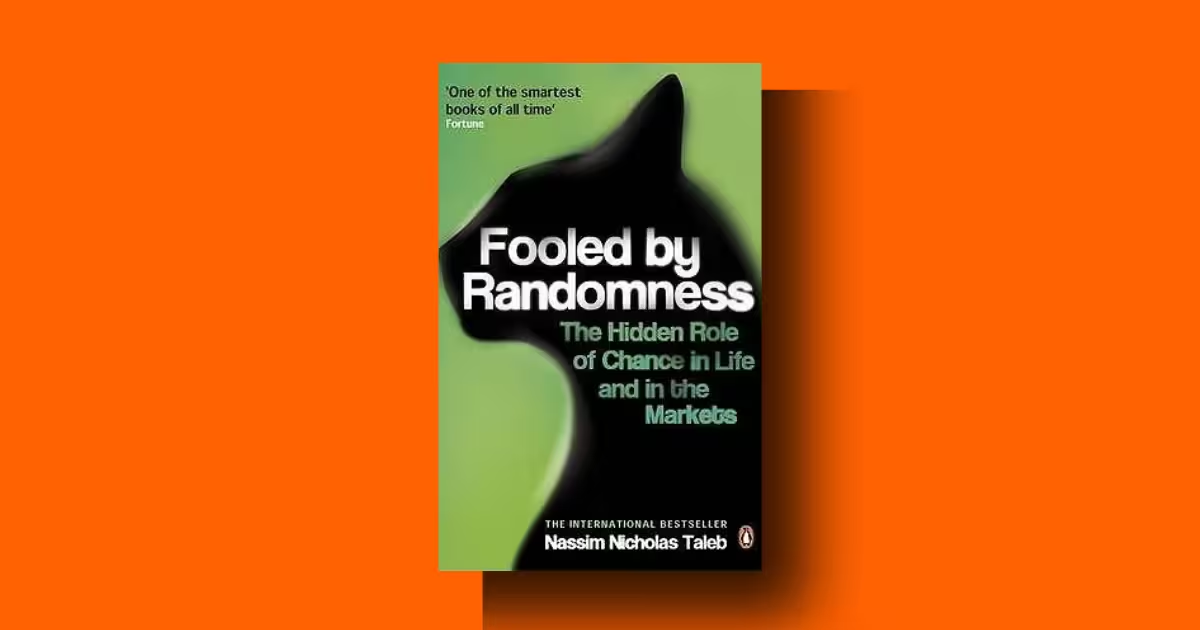
Ever find yourself staring at a colleague’s promotion or a neighbor’s new Porsche, wondering what they have that you don’t? Do you secretly believe that your failures are just bad luck, while your successes are pure talent? If so, you’re not alone—and you’re exactly who Nassim Nicholas Taleb is talking to in his groundbreaking book, Fooled by Randomness: The Hidden Role of Chance in Life and in the Markets.
This book won’t just change how you see the world; it will make you question everything you thought you knew about success, failure, and the stories we tell ourselves to make sense of it all.
Fooled by Randomness is a philosophical and practical exploration of how we consistently misinterpret the role of chance in our lives. Taleb, a former trader turned scholar, argues that we are biologically and culturally ill-equipped to deal with randomness. We tend to attribute success to skill and failure to bad luck, ignoring the massive role that probability plays in shaping our outcomes.
The book is a call for intellectual humility, urging us to judge decisions by their process rather than their outcomes and to protect ourselves from the devastating impact of rare, unpredictable events—what he later termed “Black Swans.”
Fooled by Randomness is best for:
- Anyone working in high-stakes, high-uncertainty environments (finance, entrepreneurship, politics).
- People who are tired of self-help books that promise a clear formula for success.
- Critical thinkers who enjoy having their assumptions challenged.
- Those who want to understand the psychological biases that lead to poor decision-making.
Not for:
- Readers looking for a step-by-step guide to getting rich or a “how-to” manual.
- Those who prefer a straightforward, linear narrative without digressions.
- Anyone easily put off by an author who is openly arrogant and opinionated.
- People who believe that hard work alone is the sole determinant of success.
Table of Contents
1. Introduction
Fooled by Randomness: The Hidden Role of Chance in Life and in the Markets is the first book in Nassim Nicholas Taleb’s landmark Incerto series, a five-volume exploration of uncertainty, probability, and human error. First published in 2001 (with a second edition updated in 2004), the book has since become a modern classic, translated into over thirty languages.
Context
The book is a unique blend of memoir, philosophy, and financial analysis. Taleb draws on his extensive experience as a quantitative trader on Wall Street to illustrate how professionals in the financial markets—often the most confident in their abilities—are frequently the most fooled by randomness.
However, its lessons extend far beyond trading floors, applying to everything from career choices to medical diagnoses and even how we view history. The book is set against the backdrop of the most conspicuous forum in which luck is mistaken for skill: the world of trading.
Purpose
The central thesis of Fooled by Randomness is that we systematically underestimate the role of chance in our lives. Taleb argues that “mild success can be explainable by skills and labor.
Wild success is attributable to variance”. His goal is not to deny the importance of skill or hard work, but to recalibrate our understanding of their relative importance, especially in professions where randomness plays a large role.
He wants to make us aware of our cognitive biases—like the survivorship bias and hindsight bias—so that we can make better decisions and lead more resilient lives.
2. Background
Nassim Nicholas Taleb is uniquely qualified to write about randomness.
Born in Lebanon in 1960 to a prominent Greek Orthodox family, his life was marked by the abrupt reversal of fortune that came with the Lebanese Civil War. This personal experience with instability and the fragility of wealth deeply influenced his worldview.
He holds a PhD from the University of Paris and an MBA from the Wharton School, but his real education came from twenty-one years as a risk-taking quantitative trader. He is currently a Distinguished Professor of Risk Engineering at New York University.
This combination of practical experience and academic rigor gives Taleb a unique authority. He’s not just a theorist; he’s someone who has had his own money on the line, who has seen colleagues “blow up” (lose everything) because they failed to understand the risks they were taking.
He has also personally profited from financial crises, including the 1987 stock market crash, which further validates his insights from a practitioner’s standpoint.
3. Fooled by Randomness Summary
This book is dense with ideas. To truly understand it, we need to break down its core concepts. Here’s what I took away from reading it.
The Russian Roulette Analogy
Taleb introduces the powerful concept of “alternative histories” early on. Imagine a tycoon offering you $10 million to play a game of Russian roulette. You have a five-in-six chance of walking away rich and a one-in-six chance of dying.
If you survive and become a millionaire, does that make you a skilled investor? Of course not. You were just lucky. The problem is that we don’t see the alternative histories where you died. We only see the winner.
Taleb uses this to argue that we should judge decisions not by their outcomes, but by the quality of the decision-making process itself.
A “good” decision can have a bad outcome, and a “bad” decision can have a good outcome. This is a fundamental point that most people, especially in business, fail to grasp. The value of a decision should be judged not on its outcome, but on whether it was the best possible choice at the time.
The Problem of Induction and the Black Swan
A major theme of the book is the problem of induction, famously illustrated by the “black swan” problem. For centuries, all Europeans had ever seen were white swans.
Based on this overwhelming evidence, they concluded that all swans were white. Then, they discovered Australia and found black swans. The single observation of a black swan was enough to invalidate the centuries of “proof” that all swans were white.
Taleb argues that we make this mistake all the time. We look at past data—say, the stock market’s performance over the last ten years—and assume that the future will look like the past. We fail to account for the “black swan,” the rare, unpredictable, high-impact event that can completely change everything.
These events, like the 2008 financial crisis or the rise of the internet, are almost impossible to predict, but they have a disproportionate impact on our lives.
Survivorship Bias: The Cemetery of the Unseen
One of the most powerful concepts in the book is the survivorship bias. This is the logical error of concentrating on the people or things that “survived” some process and inadvertently overlooking those that did not because of their lack of visibility. Taleb explains this with the simple example of the monkeys and the typewriters.
If you put an infinite number of monkeys in front of typewriters, one of them will eventually type out the complete works of Shakespeare.
But would you then invest your life savings in that monkey to write Hamlet? No, because its “success” was purely random.
We do the same thing when we look at successful people. We see the billionaires and the celebrities and we try to copy their habits, believing that those habits led to their success. But we don’t see the thousands of other people who had the same habits and failed. Taleb calls these people the “cemetery of the unseen”.
They are the failed entrepreneurs, the unpublished authors, the traders who blew up their accounts. By ignoring them, we vastly overestimate the probability of success and misunderstand the true role of luck.
Skewness and Asymmetry: Why “Bullish” or “Bearish” Are Meaningless
Taleb introduces the concept of skewness to explain why the terms “bullish” and “bearish” are often misleading. He uses a simple example: a bet where you have a 999 in 1000 chance of winning $1, and a 1 in 1000 chance of losing $10,000. While you’re “right” 99.9% of the time, the expected value of the bet is negative (you lose $9 on average).
The outcome is skewed. He asks, are you bullish or bearish on this bet? It’s a trick question because the frequency of wins is irrelevant; it’s the magnitude of the outcome that matters.
This is why he says that “bullish” or “bearish” are terms used by people who don’t have to put their money where their mouth is—like television commentators. A true risk-taker cares not about how often they’re right, but about how much they make when they are right and how much they lose when they are wrong.
The Hindsight Bias and the Illusion of Understanding
Another key bias Taleb discusses is the hindsight bias. This is the “I-knew-it-all-along” effect. Once an event has happened, we tend to believe that it was predictable and that we would have seen it coming. This is a dangerous illusion because it makes us overconfident in our ability to predict the future.
Taleb uses the example of the journalist George Will, who criticized economist Robert Shiller for predicting a market crash that hadn’t happened yet. Will argued that since Shiller had been “wrong” in the past, his current warnings were invalid.
Taleb points out that this is a fallacy. Shiller was making a probabilistic argument, not a prophecy. He wasn’t saying the market would crash, only that it was overvalued and that a crash was more likely.
The fact that it hadn’t crashed yet didn’t make him wrong; it just meant the “black swan” hadn’t appeared yet. As Taleb writes, “No matter how sophisticated our choices, how good we are at dominating the odds, randomness will have the last word”.
Noise vs. Signal: The Dentist’s Dilemma
Perhaps the most practical insight in the book is the distinction between noise and signal. Taleb uses the example of a dentist who is an excellent investor, expected to earn a 15% return with a 10% volatility per annum.
If this dentist checks his portfolio every second, he will see a profit 50.02% of the time and a loss 49.98% of the time. He will be emotionally drained by the constant, meaningless fluctuations (the noise).
However, if he only checks his portfolio once a year, he will see a profit 93% of the time. The signal—the actual performance of his strategy—is much clearer. Taleb’s point is that our emotions are not designed to handle high-frequency data. We react to the noise as if it were a signal, leading to stress, poor decisions, and a general feeling of being overwhelmed. His solution? “I prefer to read poetry”.
By reducing our exposure to information, especially the news, we can filter out the noise and focus on what really matters.
4. Fooled by Randomness Analysis
Fooled by Randomness is an outstanding and important book. It is a rare work that manages to be both intellectually rigorous and deeply personal, blending memoir, philosophy, and finance into a coherent and compelling argument.
Taleb’s writing is passionate, often abrasive, and unapologetically opinionated. This is not a dry, academic treatise; it’s a polemic, and it’s all the more effective for it.
Evaluation
Taleb effectively supports his arguments with a mix of personal anecdotes, historical examples, and logical thought experiments. He doesn’t rely on complex equations or dense statistical analysis to make his point (though he is clearly capable of them). Instead, he uses clear, accessible language and memorable stories to illustrate his ideas.
The book’s strength lies in its ability to make you question your own assumptions. After reading it, you start to see the role of randomness everywhere—in the success of a business, the outcome of an election, or even your own career path. It is a humbling experience.
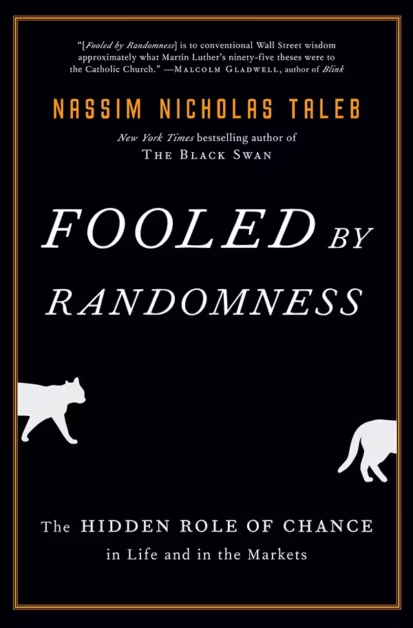
However, Taleb’s approach is not without its weaknesses. He is often scathing in his criticism of others, particularly academics, journalists, and “empty suits” in the corporate world. While this can be entertaining, it can also be off-putting. Some readers have found his tone to be arrogant and self-congratulatory.
Furthermore, the book is more successful at diagnosing the problem than at offering practical solutions. It excels at outlining the problem of misattributing success and failure, but it offers limited practical guidance on how to navigate a world of randomness.
5. Strengths and Weaknesses
Strengths
Powerful Core Ideas: The concepts of survivorship bias, the black swan, and the distinction between noise and signal are incredibly powerful and have broad applications.
Engaging, Memorable Writing: Taleb uses vivid anecdotes and thought experiments (like Russian roulette) to make complex ideas accessible.
Practical Wisdom: The book offers concrete advice, such as reducing exposure to the news and judging decisions by their process rather than their outcome.
Intellectual Humility: The book’s central message—that we know less than we think we do—is a valuable antidote to the arrogance of modern life.
Weaknesses
Author’s Tone: Taleb’s writing can be arrogant and dismissive, which may alienate some readers.
Lack of Structure: The book can feel like a collection of rants and digressions rather than a tightly argued thesis.
Overly Abstract: At times, the book can be dense and philosophical, relying on complex terminology that may not resonate with all readers.
No Clear Roadmap: While it identifies the problem, it doesn’t offer a clear step-by-step guide for making decisions in an uncertain world.
Limited Practical Solutions: The book is more about explaining the problem than providing a clear guide on how to apply these lessons.
6. Comparison with Similar Works
Fooled by Randomness is often compared to other works that challenge conventional wisdom about success and decision-making.
Daniel Kahneman’s Thinking, Fast and Slow: Both books explore cognitive biases, but Kahneman’s work is more systematic and academic, drawing on decades of experimental research. Taleb’s book is more personal and polemical, drawing on his own experiences as a trader.
Malcolm Gladwell’s Outliers: Gladwell also explores the role of luck and circumstance in success, but he tends to focus on more deterministic factors like the “10,000-hour rule.” Taleb argues that luck is far more random and unpredictable.
Nassim Nicholas Taleb’s The Black Swan: This is the sequel to Fooled by Randomness and focuses specifically on the concept of rare, high-impact events. Fooled by Randomness is a broader introduction to Taleb’s philosophy.
7. Conclusion
Fooled by Randomness is a must-read for anyone who wants to understand the hidden role of chance in our lives. It is a thought-provoking and unsettling book that challenges our most fundamental assumptions about success, failure, and the nature of reality.
It will make you more humble, more skeptical, and, hopefully, better equipped to navigate a world that is far more random than we care to admit.
I would recommend this book to anyone working in a high-stakes, high-uncertainty environment—finance, entrepreneurship, politics—but also to anyone who is simply curious about why things happen the way they do.
It’s not always an easy read, but it is an incredibly rewarding one. It will leave you with a profound sense of intellectual humility and a more realistic understanding of the world we live in.
As Taleb himself writes, “No matter how sophisticated our choices, how good we are at dominating the odds, randomness will have the last word”.







