
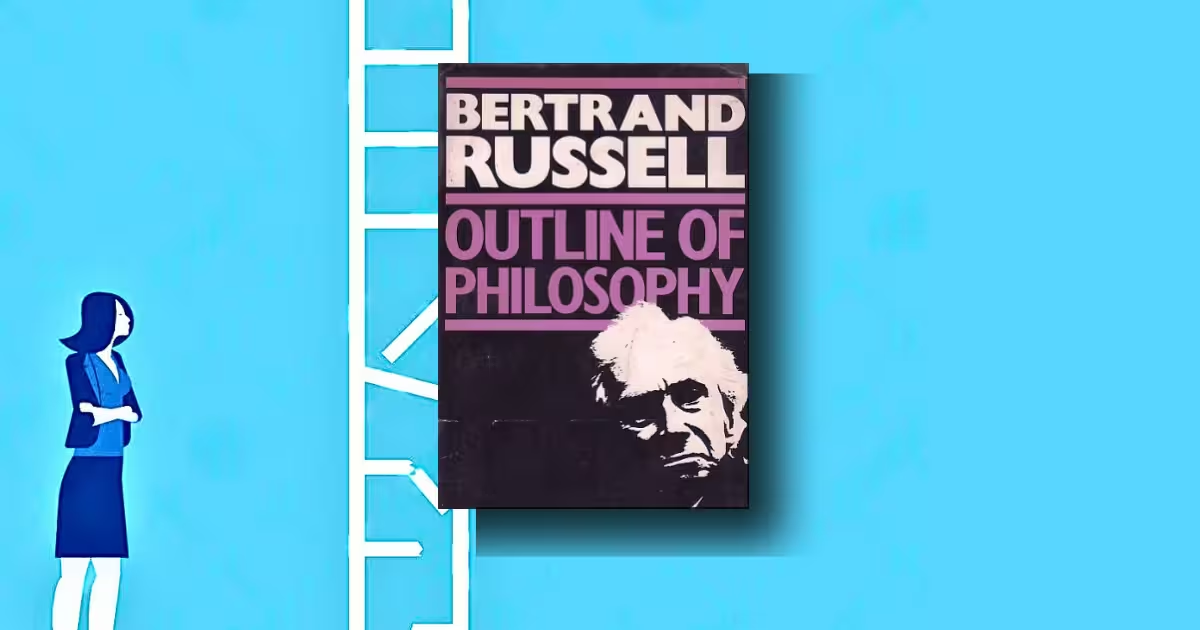
Do you ever feel like the world you see isn’t the world that actually exists? What if the table in front of you, the chair you’re sitting on, and even your own thoughts are not what they appear to be? Bertrand Russell’s An Outline of Philosophy doesn’t just ask these questions—it systematically dismantles everything you thought you knew about reality, knowledge, and your own mind.
Overview
An Outline of Philosophy is Bertrand Russell’s ambitious 1927 attempt to bridge the gap between modern science and philosophy.
Russell argues that our common-sense view of the world is fundamentally flawed—tables aren’t solid, time isn’t universal, and even our own thoughts are less certain than we imagine. He walks readers through perception, memory, physics (from atoms to relativity), and the nature of knowledge itself.
Written with Russell’s trademark clarity and wit, this book is less a traditional philosophical treatise and more a guided tour through the revolutionary scientific discoveries that were reshaping human understanding in the early 20th century.
Reader suggestion
An Outline of Philosophy is suggested for curious general readers who want to understand how modern science (especially physics) transformed philosophy; students seeking a clear introduction to epistemology, the philosophy of science, and the mind-body problem; anyone who’s ever questioned whether what they see is “really there.”
Not suggested to readers looking for easy answers or spiritual comfort—Russell is merciless in his skepticism; those who prefer philosophy as abstract theorizing without engagement with actual science; anyone who believes common sense is a reliable guide to truth.
Table of Contents
An Outline of Philosophy Introduction
- Title: An Outline of Philosophy
- Author: Bertrand Russell (1872–1970)
- First Published: 1927 (George Allen & Unwin)
- Later Editions: Reissued in Unwin Paperbacks, 1979; reprinted 1983, 1986
- Pages: Approximately 247
- Genre: Philosophy / Epistemology / Philosophy of Science
- Author’s Credentials: Russell was one of the most influential philosophers of the 20th century. Co-author of Principia Mathematica (1910–1913) with Alfred North Whitehead, winner of the Nobel Prize in Literature (1950), and a lifelong advocate for reason, pacifism, and social reform. His work spans logic, mathematics, epistemology, ethics, and political philosophy.
What This Book Is About
According to the book’s description, Russell’s central argument is straightforward yet radical: Philosophy is concerned with the universe as a whole, and Man demands consideration solely as the instrument by which we acquire knowledge of the universe.
An Outline of Philosophy attempts to reveal “the sort of world in which, according to modern science, we really live, and just how it differs from the world in which we seem to live”. This tension between appearance and reality runs through every chapter.
Russell divides his investigation into four parts:
- Man from Without — studying human beings as objective, observable phenomena
- The Physical World — what modern physics (atoms, relativity) tells us about reality
- Man from Within — introspection, consciousness, and the inner life
- The Universe — what philosophy can legitimately conclude about existence
An Outline of Philosophy Summary
Part I: Man from Without — The Scientific Study of Knowledge
The Problem of Philosophical Doubt
Russell opens with a characteristically blunt observation: “What passes for knowledge in ordinary life suffers from three defects: it is cocksure, vague, and self-contradictory”. Philosophy, he argues, exists to correct these defects—not by abandoning knowledge altogether, but by substituting “an amended kind of knowledge which shall be tentative, precise, and self-consistent”.
This sets the tone for everything that follows. Russell isn’t interested in producing a final, dogmatic system. He writes:
“Philosophy should be piecemeal and provisional like science; final truth belongs to heaven, not to this world.”
This is a crucial point. Russell explicitly rejects the ambition of earlier philosophers like Hegel or Bradley who tried to produce complete, final systems. In his view, philosophy is a continuing activity, not a finished product.
The Illusion of Common Objects
Russell begins his demolition of common sense with something as ordinary as a table. Naive common sense assumes tables are exactly what they appear to be. But this is impossible, he argues, because “they do not appear exactly alike to any two simultaneous observers”.
Physics tells us that a table is “really” a system of electrons and protons in rapid motion. But here’s the catch: the physicist himself depends on his senses to know about these electrons and protons. When you ask a physicist “Is there a chair there?” he’ll say “Of course there is; can’t you see it?” Yet what he actually sees are patches of color, not electrons and protons.
Russell explains the logical trap:
“He thinks that the sensation you have when (as you think) you see a chair, has a series of causes, physical and psychological, but all of them, on his own showing, lie essentially and forever outside experience. Nevertheless, he pretends to base his science upon observation.”
This is the heart of Russell’s epistemological skepticism. We infer the existence of physical objects from our sensations, but this inference is never clearly justified. We believe in causation, substance, and permanence—but these are metaphysical assumptions, not empirical findings.
Memory and Testimony: The Fragile Foundations
Russell then turns to memory and testimony—two pillars of scientific knowledge. He raises a devastating possibility:
“Remembering, which occurs now, cannot possibly—he may say—prove that what is remembered occurred at some other time, because the world might have sprung into being five minutes ago, exactly as it then was, full of acts of remembering which were entirely misleading.”
This is the “five-minute hypothesis.” It’s logically possible that the universe was created five minutes ago with all our memories intact. We cannot refute it by logic alone. This doesn’t mean we should believe it, but it does mean our confidence in memory is not absolute.
Testimony raises even more problems. When you ask a policeman for directions and he answers, you’re making two inferences: first, that the sounds you hear come from a physical body; second, that this body has a mind like yours. Both inferences are questionable. As Russell wryly notes:
“I do not mean any special insult to policemen; I would say the same of politicians and even of philosophers.”
Man and His Environment: Knowledge as Behavior
Russell introduces a crucial methodological decision: For the moment, he will study knowledge as an external observer would. This means treating knowledge as a characteristic displayed in reactions to the environment, not as a private “state of mind”.
According to Russell, knowledge is not contemplation—it’s action. When you watch a race and say “They’re off,” four stages occur:
- Physical events in the outside world (light waves from runners to your eyes)
- Physiological events in your body (eye → optic nerve → brain)
- Events in your brain (processing the stimulus)
- Muscular events (speaking)
The third stage “embodies the results of experience and learning”.This is where the interesting philosophical questions lie.
Russell distinguishes between reflexes (innate, like sneezing) and learned reactions (acquired through experience, like speaking a language). Most knowledge depends on learned reactions—connections in the brain that aren’t congenital but result from events that have happened to the individual.
The Process of Learning: Rats, Apes, and Insight
Russell reviews contemporary research on animal learning, noting with amusement:
“One may say broadly that all the animals that have been carefully observed have behaved so as to confirm the philosophy in which the observer believed before his observations began. Nay, more, they have all displayed the national characteristics of the observer. Animals studied by Americans rush about frantically… Animals observed by Germans sit still and think.”
This is vintage Russell—skeptical, witty, and deflating of academic pretension.
He discusses Thorndike’s “Law of Effect” (animals repeat actions that bring satisfaction) and “Law of Exercise” (repetition strengthens connections). But he notes that these laws are phrased in subjective terms—”satisfaction” and “discomfort” can’t be observed directly.
More significantly, Russell contrasts American “trial and error” research with Köhler’s work on chimpanzees. Köhler’s apes demonstrated what he called “insight”—sudden solutions to problems that appeared as wholes, not as products of random movements. Russell writes:
“Genuine solutions of problems, Köhler says, do not improve by repetition; they are perfect on the first occasion.”
Russell concludes that there are two ways of learning: one by experience (conditioned reflexes) and another by insight. The latter is not yet explained by behaviorism.
Language: Words as Bodily Habits
Russell’s treatment of language is remarkably modern. He rejects the traditional view that words “express thoughts” and “mean things.” Instead:
“The only satisfactory way to treat language, to my mind, is to treat it in this way, as Dr. Watson does. Indeed, I should regard the theory of language as one of the strongest points in favour of behaviourism.”
**A spoken word, Russell explains, “consists of a series of movements in the larynx and the mouth, combined with breath”. ** A written word is “a series of pieces of matter, having an essential space-order”.
The meaning of a word, for Russell, is found in its associations. A child learns to understand “bottle” because the word produces similar effects to the actual bottle. Russell defines meaning through the law of conditioned reflexes:
“We shall say that, to a given person, the word A, when he hears it, ‘means’ C, if the associative effects of A are closely similar to those of C.”
This is a behaviorist theory of meaning that doesn’t require any mysterious “mental” entities. Words are learned like any other bodily habit.
Perception Objectively Regarded
Russell defines perception as a species of “sensitivity”—a characteristic reaction to a stimulus. Scientific instruments are also sensitive, but what distinguishes human perception is the law of association or conditioned reflexes.
Perception is not a direct revelation of reality. Russell argues:
“If modern physics is to be believed, the dreams we call waking perceptions have only a very little more resemblance to objective reality than the fantastic dreams of sleep.”
This is a recurring theme: our perceptions are useful, not necessarily true. They help us navigate the world, but they don’t show us the world as it actually is.
Memory Objectively Regarded
Russell examines behaviorism’s attempt to explain memory without invoking “mental” entities. Watson, the behaviorist, “never uses the term ‘memory'”. For Watson, memory is simply the retention of habit.
Russell finds this inadequate. He points out that the same “meaning” can be expressed in many different sentences. If memory were merely verbal habit, we couldn’t explain why we can describe a past event in words we’ve never used before.
Russell concludes that memory involves more than habit—it involves a reference to the past that behaviorism can’t fully explain.
Part II: The Physical World — What Physics Tells Us About Reality
The Structure of the Atom
Russell explains the revolutionary physics of his day, starting with the Rutherford-Bohr model of the atom. All matter consists of electrons and protons. A hydrogen atom has one proton and one electron; helium has a more complex structure.
The key philosophical insight comes from Planck’s constant ( h ), which introduces discontinuity into nature:
“No adage had seemed more respectable in philosophy than natura non facit saltum, Nature makes no jumps. But if there is one thing more than another that the experience of a long life has taught me, it is that Latin tags always express falsehoods.”
Nature does make jumps. Electrons can only occupy certain orbits; energy is emitted in discrete quanta. This destroys the continuous, deterministic picture of the world that had dominated physics since Newton.
Relativity: The End of Absolute Space and Time
Russell explains Einstein’s theory of relativity in remarkably accessible terms. There is no one cosmic time. Two events that are simultaneous for one observer may not be for another.
“The notion of a ‘place’ is also quite vague. Is London a ‘place’? But the earth is rotating. Is the earth a ‘place’? But it is going round the sun.”
The solution is to think in terms of events rather than bodies. An “event” is anything that has both a date and a place. The physical world becomes a four-dimensional continuum of events, not a series of three-dimensional states of matter.
Russell explains the concept of “interval” —an objective quantity that doesn’t depend on the observer’s frame of reference. This replaces the old notions of absolute distance and absolute time.
Causal Laws in Physics
Russell attacks the traditional notion of causation. “Necessary” sequence is anthropomorphic. There’s no “compulsion” in nature—things just happen according to rules.
“To say that A is ‘necessarily’ followed by B is thus to say no more than that there is some general rule, exemplified in a very large number of observed instances, and falsified in none.”
Scientific laws are expressed in differential equations. They describe tendencies, not certainties. You can’t predict what will happen after a finite time, but you can say that as the time interval approaches zero, the behavior becomes more predictable.
Physics and Perception: The Subjectivity of Observation
This is perhaps the most important chapter for understanding Russell’s overall philosophy.
Russell argues that when we perceive an object, what we actually experience is an event in our own brain. The light from a star travels for years before reaching our eyes; what we see is not the star itself but the effect of light on our nervous system.
“A table does not look like a vast number of electrons and protons, nor like trains of waves meeting and clashing. Yet that is the sort of thing a table is said to be by modern physicists.”
The consequence is devastating for naive realism: Our perceptions are subjective, and we can only infer the existence of an external world. The physiologist observing a brain is actually seeing events in his own brain, not in the brain he’s observing.
Physical and Perceptual Space
Russell draws a crucial distinction between physical space (the space of physics, which is public and objective) and perceptual space (the space of experience, which is private and subjective).
“My percept of a table is outside my percept of my head, in my perceptual space; but it does not follow that it is outside my head as a physical object in physical space.”
From the standpoint of physical space, all your percepts are in your head. Even the most distant star you see is an event happening in your brain. This doesn’t mean the star isn’t real—it means your perception of it is not the star itself.
Part III: Man from Within — The Inner Life
Self-Observation and Introspection
Russell defends the reality of introspection against behaviorism. He argues that we know things about ourselves that others cannot know directly. Toothache, thirst, dreams—these are private experiences.
The behaviorist position breaks down, Russell argues, because physics itself tells us that all our knowledge of the external world is inferential. If physics is true, then our perceptions are subjective, and we can’t escape relying on private data.
“Our knowledge of the physical world, therefore, must be contained in our reaction to the stimulus which reaches us across the intervening medium.”
Descartes was right in a sense: the most certain knowledge we have is of our own experiences. But he was wrong to introduce the “I” and “thinking” as primitive certainties.
Images: The Stuff of Imagination
Russell defines images as occurrences that have the quality of sensations but aren’t caused by stimulation of sense organs. Images are “centrally excited” rather than peripherally excited.
He rejects the behaviorist claim that images are merely words or incipient movements. When he visualizes his childhood home, he can “look” at the image to answer questions about the furniture. This is a genuine visual experience, not just verbal behavior.
Images play a crucial role in memory and imagination. They’re the raw material of dreams, daydreams, and creative thought.
Memory and Imagination
Russell distinguishes between habit-memory (repeating a poem) and recollection (remembering a past incident). The essential feature of recollection is reference to the past.
“The difference which we can directly observe is not, of course, between our present recollection and the past conversation, but between our present recollection and present sensible facts.”
Imagination, by contrast, involves novelty: it combines known elements in new ways. It also involves absence of belief—you can imagine something without believing it’s real.
The Introspective Analysis of Perception
Russell argues that the datum in perception is not “I see a table” but “a visual triangle is occurring”. The “I” and “seeing” are inferences, not part of the immediate experience.
This leads to “neutral monism” —the view that the stuff of the world is neither mental nor physical, but neutral. Perception is a meeting point of physics and psychology. It’s neither one nor the other, but the raw material of both.
Consciousness and Emotion
Russell agrees with William James that “consciousness” is a function, not an entity. There’s no “inner duplicity” in experience—no separation between knower and known.
Emotions are caused by glandular secretions. But Russell notes that the cognitive element is crucial: when adrenaline was injected into him, he had the bodily symptoms of fear but didn’t actually feel fear because he knew there was nothing to fear.
Desire is not a mysterious attraction to a goal, but a blind tendency to certain activities. Explicit conscious desire is a later development.
Part IV: The Universe — What Philosophy Can Know
Some Great Philosophies of the Past
Russell provides a critical survey of major philosophers:
- Descartes: Right to doubt, wrong to think “I” is the starting point. The gulf between mind and matter is a mistake.
- Spinoza: Great ethically, but his monism is questionable.
- Leibniz: His theory of monads was ingenious, but his “pre-established harmony” was ad hoc. The distinction between physical and perceptual space was a genuine insight.
- Locke: Too psychological, but his attack on innate ideas was valuable. His influence on liberalism was enormous.
- Berkeley: Right that perceived objects are mental, wrong to deny non-mental events.
- Hume: Sceptical conclusions are hard to refute. He was right about the self and about the problem of induction.
- Kant: Obscure and ultimately unsuccessful. His a priori categories don’t solve the problems he identified.
Truth and Falsehood
Russell argues that truth is primarily a property of statements, not beliefs. A statement is true if a person who knows the language is led to that statement when in an environment that contains the meanings of the words.
This is a causal theory of truth. Words are caused by the environment; statements directly caused by the environment are “true.” Verification consists in putting yourself in a situation where previously used words result directly from the environment.
The Validity of Inference
Russell admits that induction cannot be logically justified. All inference is at best probable, not certain.
He discusses Keynes’s “principle of limitation of variety”—the assumption that the number of independent qualities in the universe is finite. This principle is necessary to justify induction, but it can’t itself be proven.
“At the very best, induction and analogy only give probability. Every inference worthy of the name is inductive, therefore all inferred knowledge is at best probable.”
Events, Matter, and Mind
Russell’s final position is neutral monism: “Everything in the world is composed of ‘events'”. An event occupies a small finite region of space-time.
Matter is constructed out of events. It’s not a substance but a convenient shorthand for describing causal laws. The same is true of mind.
“Both mind and matter are structures composed of a more primitive stuff which is neither mental nor material.”
This view is called “neutral monism” because the primitive stuff is neutral—neither mental nor physical.
Man’s Place in the Universe
Russell concludes with a call for intellectual humility and courage. Philosophy can’t prove the world is good or that we’re immortal. It can only help us see clearly.
“The conscious purpose of philosophy, therefore, ought to be solely to understand the world as well as possible, not to establish this or that proposition which is thought morally desirable.”
The good life, for Russell, is “one inspired by love and guided by knowledge”. Philosophy can help us achieve this by freeing us from prejudice and giving us a larger view of existence.
An Outline of Philosophy Analysis
Russell’s Unique Voice
Reading Russell is like having a conversation with the smartest, wittiest person you’ve ever met. He never talks down to you, but he never lets you off the hook either. His prose is crystalline—every sentence is designed to advance the argument, every paragraph builds on the last.
Consider this passage on the “five-minute hypothesis”:
“The world might have sprung into being five minutes ago, exactly as it then was, full of acts of remembering which were entirely misleading.
This is philosophy at its best: taking a seemingly absurd idea and showing that it’s logically possible. Russell doesn’t say we should believe it. He says we can’t disprove it. And that’s enough to shake our confidence.
The Marriage of Science and Philosophy
Russell was one of the last philosophers who could genuinely master both philosophy and science. He explains atomic theory, relativity, and quantum mechanics with the same clarity he brings to epistemology. This isn’t philosophy for philosophers—it’s philosophy for anyone who wants to understand the world.
An Outline of Philosophy was published in 1927, just as quantum mechanics was emerging. Russell discusses Heisenberg and Schrödinger, Planck’s constant and Bohr’s atom. He grasps the philosophical implications of these discoveries immediately:
“The theory that matter consists of ‘atoms’… was due to the Greeks, but with them it was only a speculation.”
He saw that physics was destroying the old materialist picture of the world—and that philosophy had to catch up.
The Honesty of Uncertainty
Russell never pretends to have all the answers. He admits that induction can’t be justified, that the mind-body problem remains unsolved, and that we may never know the intrinsic nature of matter.
This honesty is refreshing. Most philosophers want to give you a system—a set of beliefs you can hold onto. Russell wants to give you tools for thinking, not a set of conclusions.
What’s Missing?
An Outline of Philosophy is very much a product of its time. Russell’s discussions of race and gender reflect the prejudices of the 1920s. He doesn’t engage with non-Western philosophy. His treatment of ethics is somewhat thin compared to his treatment of epistemology.
The book also assumes a level of scientific literacy that may be challenging for modern readers. The physics is 100 years old—still philosophically relevant, but not up to date.
Strengths and Weaknesses
Strengths
Clarity of exposition. Russell’s prose is unmatched among philosophers. He makes complex ideas accessible without dumbing them down.
Integration of science and philosophy. Russell shows how physics, physiology, and psychology bear on traditional philosophical problems.
Intellectual honesty. He admits uncertainty and doesn’t pretend to have all the answers.
Skeptical rigor. Russell forces you to question assumptions you didn’t know you had.
Historical awareness. His survey of earlier philosophers provides context for his own views.
Weaknesses
Dated science. The physics is from 1927. While philosophically relevant, it’s not up to date.
Eurocentric. Russell doesn’t engage with non-Western philosophy.
Thin ethics. The chapter on ethics is brief and somewhat superficial compared to the rest of the book.
Behaviorism focus. Russell spends a lot of time engaging with Watson’s behaviorism, which was influential in the 1920s but is less relevant today.
No easy answers. If you’re looking for a comforting philosophy, this isn’t it.
Comparison with Similar Works
The Problems of Philosophy (1912)
Russell’s earlier book covers similar ground but is shorter and more accessible. An Outline of Philosophy is more comprehensive and engages more deeply with modern science.
The Analysis of Mind (1921)
Russell’s book on psychology overlaps significantly with Part I and Part III of An Outline of Philosophy. An Outline is broader, covering physics and the nature of the universe.
The Scientific Outlook (1931)
Published four years later, this book focuses more on the social implications of science. An Outline is more purely philosophical.
Karl Popper’s The Logic of Scientific Discovery (1934)
Popper addressed the problem of induction more rigorously than Russell. But Russell’s book is more accessible and covers a wider range of topics.
Stephen Hawking’s A Brief History of Time (1988)
Hawking’s book popularized modern physics for a general audience. Russell’s book does something similar for the philosophy of physics, but with more attention to the epistemological implications.
Conclusion
Who Should Read An Outline of Philosophy?
An Outline of Philosophy is for anyone who has ever questioned the reality of the world around them. It’s for students of philosophy who want a clear introduction to epistemology, philosophy of science, and the mind-body problem.
It’s for scientists who want to understand the philosophical implications of their work. It’s for anyone who’s ever looked at a table and wondered: “Is this really here?”
Russell doesn’t give you easy answers. He gives you something better: the tools to ask better questions. He shows you that philosophy is not a set of conclusions but a way of thinking—a way of examining your assumptions and testing your beliefs.
“Philosophy should make us know the ends of life, and the elements in life that have value on their own account… Philosophy cannot itself determine the ends of life, but it can free us from the tyranny of prejudice and from distortions due to a narrow view.”
In a world of certainty-mongers and dogma-sellers, Russell’s voice is a breath of fresh air. He reminds us that uncertainty is not a weakness but a strength—that the search for knowledge is more important than the possession of it.
If you’re ready to have your assumptions challenged and your mind expanded, read this book. You won’t agree with everything Russell says. But you’ll never think about the world the same way again.







