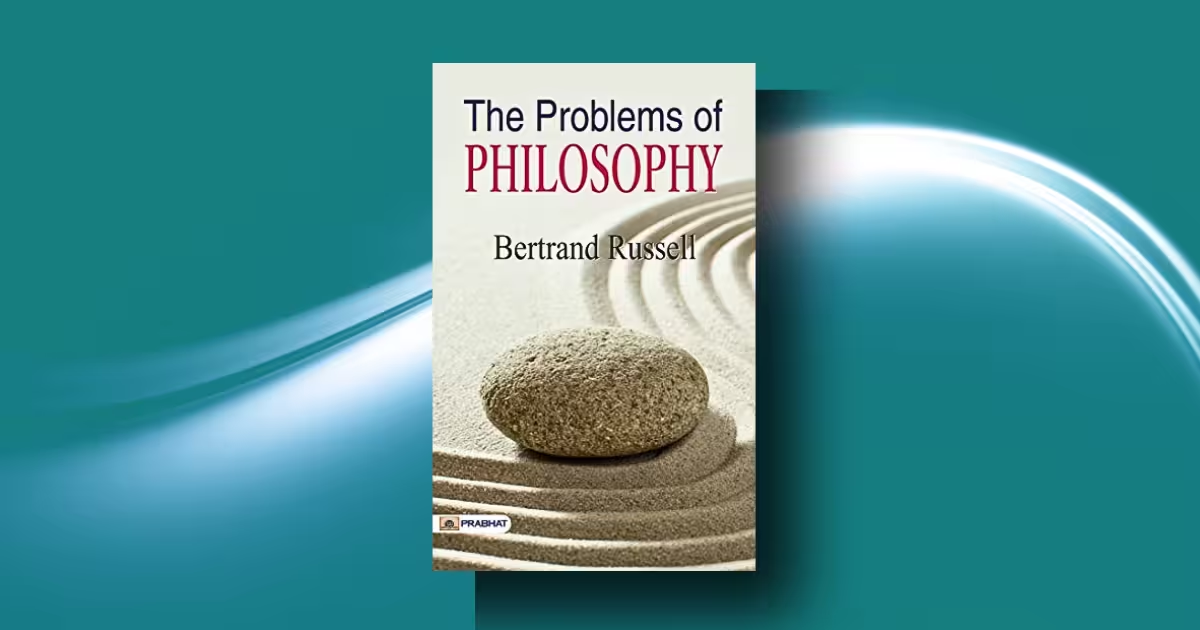

Why does a book Bertrand Russell wrote in about twelve weeks, for a shilling, for readers he described as ordinary “shop assistants,” still sit on more philosophy syllabuses than books published last year? I opened The Problems of Philosophy expecting a tidy set of answers about knowledge and reality.
I closed it with a longer list of open questions than I started with, and by the last chapter I understood that Russell had planned it that way from the first page.
The Problems of Philosophy (1912) is Bertrand Russell’s short, 15-chapter introduction to epistemology, built almost entirely around one question: what, if anything, can we actually know for certain? It is plain-spoken in the opening and closing chapters, genuinely difficult in the middle stretch on universals and a priori knowledge, and partly disowned by Russell himself twelve years after he wrote it.
It is still, in my opinion, the best hundred pages you can hand someone who has never read a page of philosophy and wants to see what the discipline actually does.
The Problems of Philosophy is best for:
- First-time philosophy readers who want the real primary text instead of a summary or a study guide
- Readers who want portable mental models, like the difference between a fact and your evidence for it, that work outside a classroom
- Students preparing for an introductory epistemology, philosophy of mind, or logic course
- Anyone who likes plain, exact prose and has no patience for jargon dressed up as depth
- Readers who enjoy watching one careful mind build an argument, take it apart, and start again
Not for:
- Anyone hoping for ethics, political philosophy, or aesthetics; none of that is here, this book is almost entirely about knowledge and reality
- Readers who want Russell’s final, settled opinions; he revised or dropped several of this book’s central claims within twelve years of writing it
- People who dislike one author’s voice narrating the whole history of philosophy through his own conclusions
- Anyone expecting a light or breezy read just because The Problems of Philosophy is short
- Readers who want to keep their certainties; Russell spends fifteen chapters quietly removing them
Table of Contents
1. Introduction
The Problems of Philosophy (January 1912) by Bertrand Russell (1872–1970). First published by Williams & Norgate in London and simultaneously by Henry Holt & Co. in New York, as the 35th volume in the Home University Library of Modern Knowledge, a series built for general adult readers rather than university specialists.
The edition I read and cite from throughout this review is the Oxford World’s Classics printing (ISBN 978-0-19-285423-0), which carries an introduction by John Skorupski, Professor of Moral Philosophy at the University of St Andrews.
Russell was, by any honest measure, one of the most consequential thinkers of the twentieth century: a philosopher, logician, and mathematician who co-wrote the three-volume Principia Mathematica with Alfred North Whitehead, a lifelong campaigner against war and nuclear weapons, and the winner of the 1950 Nobel Prize in Literature for his wide-ranging and humane writing.
He was also, briefly, a controversial one; Trinity College, Cambridge dismissed him from his lectureship in 1916 over his opposition to the First World War, and he served time in Brixton Prison in 1918 for his antiwar writing before being reinstated at Trinity years later.
None of that political history appears in The Problems of Philosophy. What you get instead is Russell at his most disciplined: a working logician trying to say, as plainly as he can, what a person is actually entitled to claim they know.
Context
The Problems of Philosophy is an introduction to epistemology, the branch of philosophy concerned with knowledge itself: what counts as knowing something, how belief differs from knowledge, and how much of what feels obvious is really just habit. Russell wrote it deliberately for readers with no philosophical training.
It is not a history of philosophy, though historical figures like Berkeley, Descartes, Hume, and Kant appear throughout as sparring partners. It is Russell working through the problems in his own order, using his own examples, and reaching his own conclusions.
Purpose
Russell states his aim directly in the Preface: he confined himself “to those problems of philosophy in regard to which” he thought “it possible to say something positive and constructive,” which is why theory of knowledge takes up more of the book than metaphysics does.
The book’s real thesis does not arrive until the final chapter, where Russell argues that philosophy’s value has almost nothing to do with settling questions and almost everything to do with the questions themselves, since they “enlarge our conception of what is possible” and loosen “the dogmatic assurance which closes the mind against speculation.”
2. Background
To understand why a Cambridge don wrote a beginner’s guide to philosophy, it helps to know what he had just finished. Russell completed Principia Mathematica with Whitehead in 1910, a decade-long, three-volume attempt to derive all of mathematics from a small set of logical axioms (I reviewed that book separately; if you want the full, exhausting story of how it took hundreds of pages to prove 1+1=2, that piece is here).
John Skorupski notes in his introduction to this edition that Russell said his “intellect never quite recovered from the strain” of that project.
On questions of general philosophy, though, he found a fresh burst of energy, and he wrote The Problems of Philosophy in roughly twelve weeks during the summer of 1911.
The Problems of Philosophy was one commission among many in the Home University Library of Modern Knowledge, a series that had already put out more than fifty affordable, shilling-priced volumes by the time Russell delivered his manuscript. G. E. Moore wrote the series’ volume on ethics that same year; Whitehead contributed one on mathematics.
Russell himself called his contribution his “shilling shocker,” a nickname that stuck. It was priced to be read by clerks and evening-school students, not just Cambridge undergraduates, which explains why it opens with a table and a question rather than a Greek term and a footnote.
Russell was honest enough to know the book would age. In a note added to the seventeenth impression in 1943, he felt obliged to explain that certain passages were “written in the early part of 1912,” back when China was still an empire and a particular former Prime Minister’s surname happened to start with the letter B, a dry joke aimed at readers puzzled by his examples.
He was right to worry about aging further. By 1924, in a new foreword written for the German translation, Russell publicly walked back several of the book’s foundational claims, a fact that most reviews of this book skip entirely and that I think is essential to reading it honestly.
I will come back to that foreword in the analysis section, because it changes how you should read Chapters 1 through 5.
3. The Problems of Philosophy Summary
Russell structures The Problems of Philosophy as one continuous argument across fifteen short chapters, so I am summarizing it in the order he built it, in enough detail that you should not need to go back to the source text to follow his reasoning.
Chapters 1 to 4: What is a table, really? Russell opens with what may be the most famous first line in twentieth-century philosophy: “Is there any knowledge in the world which is so certain that no reasonable man could doubt it?”
He answers it using the table in front of him. Its color changes with the light, its shape changes with your angle of view, and a microscope reveals a completely different surface than your naked eye does. Russell concludes that what you actually perceive, colors, sounds, textures, is not the table itself but “sense-data,” and the table as a persistent object is something you infer rather than see.
Chapter 2 asks whether we have any grounds for believing that inferred object really exists, independent of anyone perceiving it; Russell argues we do, on the basis of simplicity (a cat that gets hungry between sightings makes far more sense as a continuously existing animal than as a set of sense-data that blinks in and out of being) and instinctive belief, though he admits the argument falls short of strict proof.
Chapter 3 asks what that real table is made of, concluding that physical science can tell us about its structure and relations but never about how it intrinsically feels or looks, since color and sound are effects produced in us, not properties sitting out in the world.
Chapter 4 takes on Bishop Berkeley’s idealism directly, the claim that nothing exists except minds and their ideas, and Russell dismantles it by showing Berkeley quietly slides between two different meanings of the word “idea,” one where a thing is “in” the mind as an object of thought and one where it would have to literally be a mental item.
Chapter 5: Two ways of knowing. This is the chapter most philosophy courses still assign on its own. Russell distinguishes “knowledge by acquaintance,” direct, unmediated awareness of something (the color you’re seeing right now, your own thoughts), from “knowledge by description,” knowing about something only through a description that picks it out uniquely, like “the first Chancellor of the German Empire.”
You have never met Julius Caesar, so any thought you have about him is really a thought about whichever man in history uniquely fits certain descriptions you’ve absorbed. Russell’s blunt conclusion: “Every proposition which we can understand must be composed wholly of constituents with which we are acquainted.”
Chapters 6 to 8: Why does the sun rising tomorrow need a justification at all? Chapter 6 is where Russell tells his most famous story, the one you have probably encountered even if you’ve never opened this book.
A chicken is fed every single day of its life, and each feeding strengthens its confidence that this is simply how the world works, “showing that more refined views as to the uniformity of nature would have been useful to the chicken,” Russell writes, moments before its neck is wrung.
The point is that no number of past instances logically guarantees a future one; induction, the process of generalizing from repeated experience, cannot be proven by the very experience it depends on.
Chapter 7 widens this into the classic rationalist-versus-empiricist debate and concludes both sides were half right: logic and mathematics are known a priori, independent of any specific experience, but nothing about existence itself can be known that way.
Chapter 8 walks through Kant’s attempt to explain how a priori knowledge is possible, giving him credit for spotting the problem while rejecting his solution, since Kant’s answer would make arithmetic dependent on the accident of human psychology remaining constant, and Russell wants two plus two to equal four regardless of what our minds happen to be doing.
Chapters 9 to 10: Bringing Plato back. Russell revives Plato’s theory of Forms almost wholesale, renaming them “universals,” things like whiteness, justice, or the relation “north of,” which are shared across many particular objects but are not themselves located anywhere in space or time.
He argues you cannot escape universals even if you try, because the moment you appeal to “resemblance” between particular things to avoid abstract qualities, resemblance itself turns out to be a universal.
His most quoted description of this territory: “The world of being is unchangeable, rigid, exact, delightful to the mathematician, the logician, the builder of metaphysical systems, and all who love perfection more than life.” Chapter 10 explains how we come to know universals, concluding that all a priori knowledge, including arithmetic, ultimately concerns relations between universals rather than any particular fact about the world.
Chapters 11 to 13: What actually makes a belief true. Chapter 11 introduces “self-evidence” and shows it comes in degrees, using a genuinely disturbing real example: George IV reportedly came to believe he had fought at Waterloo simply because he had repeated the claim so often.
Chapter 12 is Russell’s answer to “what is truth,” and it is the book’s most technically demanding stretch. He rejects the coherence theory of truth (the idea that a belief is true if it fits neatly with your other beliefs) because more than one internally consistent story could describe the same facts, and settles instead on a correspondence theory: a belief is true when its parts, arranged in the order the believer holds them, actually match a fact in the world.
He illustrates this with Othello’s false belief that Desdemona loves Cassio, showing that judgment must be a relation joining four separate things (the believer, and each of the belief’s parts) rather than a single relation to one packaged “fact,” precisely so that false beliefs remain possible at all.
Chapter 13 then asks how we tell knowledge from error in practice, landing on the idea that most of what we call knowledge is really “probable opinion,” strengthened by how well it coheres with everything else we hold to be true.
Chapters 14 to 15: What philosophy is actually for. Chapter 14 takes aim at Hegel and any philosopher who claims pure logic can prove big metaphysical conclusions, like the unreality of space, time, or evil.
Russell argues these systems typically confuse a thing’s relations with its “nature,” and that thanks to Georg Cantor’s work on infinite sets, the supposed logical contradictions in infinite space and time turn out to be prejudice rather than proof.
His conclusion: philosophy’s job is criticism, examining the principles science and daily life already assume, not manufacturing new certainties from pure reason. Chapter 15, “The Value of Philosophy,” is the book’s genuine emotional turn.
Russell argues that philosophy is worth studying “not for the sake of any definite answers to its questions, since no definite answers can, as a rule, be known to be true, but rather for the sake of the questions themselves,” because they enlarge what you consider possible and free your mind “from the tyranny of custom.”
It closes on a note that is almost mystical for a man famous for cold logic, describing the philosophic life as citizenship of the universe rather than of “one walled city at war with all the rest.”
4. The Problems of Philosophy Analysis
Judged purely as an argument, the book is remarkably disciplined for something written in twelve weeks. Russell states a problem, tests the obvious answer, shows where it breaks, and only then offers his own position, usually while flagging exactly how confident he is in it.
That habit of grading his own certainty, rather than asserting everything with the same flat authority, is probably the single most useful thing a newcomer to philosophy can absorb from this book, and it is rarer in popular nonfiction than it should be.
But The Problems of Philosophy has to be read alongside its own author’s second thoughts, and almost no review mentions this. In the Appendix, a foreword Russell wrote for the 1924 German translation, he tells readers plainly that his views on several of this book’s central claims “have undergone a significant development.”
Influenced by Whitehead’s later work, he came to treat matter itself as a “logical construction” rather than an unknowable something-behind-the-sense-data, which means Chapters 1 and 2 need revising, in his own words, “though not quite to the extent that might appear.”
More strikingly, he abandoned the idea of a persistent subject or self standing behind acquaintance, treating the self too as a logical construction, and dropped the sensation-versus-sense-datum distinction that Chapter 1 leans on so heavily, aligning himself instead with William James.
He also says he would now be “much less inclined” to treat ethical statements as knowable a priori, a claim Chapter 7 states with more confidence than Russell later thought it deserved.
None of this makes the book worthless; if anything, it makes Russell more credible, not less, because he is showing you exactly how a rigorous mind is supposed to update.
But it does mean you should read Chapters 1 through 5 as an excellent snapshot of Russell’s thinking in 1911, not as his final word on sense-data, and it means the multiple-relation theory of judgment in Chapter 12, which John Skorupski’s introduction notes drew “technical objections” sharp enough from Wittgenstein to strain their friendship, should be read the same way.
Where The Problems of Philosophy holds up best is Chapters 6, 9, and 15: the problem of induction, the case for universals, and the closing argument for philosophy’s value have aged into something closer to permanent classics than period pieces, which is exactly why they are the three sections still quoted outside philosophy departments a century later.
5. Strengths and Weaknesses
Strengths
Clarity without dumbing down. Russell never hides behind jargon. When he needs a technical term like “sense-datum,” he defines it in one sentence and then uses it consistently for the rest of the book. That discipline is rarer in introductory philosophy writing than it should be.
It gives you tools, not trivia. The acquaintance-versus-description distinction, the problem of induction, and the correspondence theory of truth are not museum pieces.
They show up, often unnamed, in arguments about misinformation, forecasting, and evidence you will run into this week.
Honest about uncertainty. Russell grades his own confidence chapter by chapter rather than asserting everything with equal force. Few philosophers, and even fewer popular nonfiction writers, extend readers that kind of respect.
A genuinely moving final chapter. Chapter 15 earns its reputation. After fourteen chapters of careful, unshowy argument, the shift into a defense of philosophy as an expansion of the self rather than a search for facts lands with real force.
Weaknesses
The middle stretch is genuinely hard. Chapters 9 through 13, on universals, self-evidence, and the multiple-relation theory of truth, ask a lot of a reader with no prior training, despite The Problems of Philosophy‘s reputation as beginner-friendly. Several Goodreads reviewers I read while researching this piece made exactly this complaint, and I do not think it is unfair.
Russell later disowned parts of it. The Appendix admits that the treatment of matter, the self, and a priori ethics all needed revision within twelve years. A reader who only reads Chapters 1 through 8 and skips the Appendix comes away thinking Russell held these views for life; he did not.
No ethics, no politics, no aesthetics. Given how much of Russell’s later fame rests on his social and political writing, it is a little startling that this book, his most widely read, touches none of it. That is a deliberate choice stated in the Preface, not an oversight, but it does mean the title oversells the book’s scope.
The physics has dated. Russell describes matter as “a vast collection of electric charges in violent motion,” accurate pre-quantum, pre-general-relativity science for 1912, but a modern reader will notice the gap, and Russell says as much himself in the 1924 Appendix.
6. Comparison With Similar Works
Plato’s Republic (Books VI and VII)
Russell recommends this himself in the book’s own Bibliographical Note, and it is the direct ancestor of Chapter 9. If you want to see where the theory of universals actually started, before Russell’s modifications, this is the source text.
Descartes’ Meditations on First Philosophy (1641)
Also on Russell’s own recommended list. Descartes’ method of systematic doubt is the model Russell explicitly borrows in Chapter 2, right down to praising Descartes for showing that “subjective things are the most certain.”
Alfred North Whitehead and Bertrand Russell’s Principia Mathematica (1910–1913)
The book that exhausted Russell right before he wrote this one. Where The Problems of Philosophy is a hundred accessible pages built for general readers, Principia is roughly 2,500 pages of dense symbolic logic that almost nobody has read cover to cover.
I reviewed it separately, including the story of how it took hundreds of pages to prove that 1+1=2, in this companion piece. Reading both back to back is the fastest way to understand why Russell said his intellect never fully recovered from the first project.
Nassim Nicholas Taleb’s The Black Swan and Fooled by Randomness
This is the comparison almost no review of Russell’s book makes, and it is worth making. Taleb’s famous “turkey problem,” a bird fed every day of its life right up until the day before Thanksgiving, is a direct, openly credited descendant of Russell’s chicken in Chapter 6.
Taleb even keeps Russell’s original point intact: comfortable repetition is not evidence of safety. I have covered Taleb’s take on this idea in my reviews of Antifragile and Fooled by Randomness, and reading Russell’s original version first makes Taleb’s modern spin land harder, not softer.
A. J. Ayer’s Language, Truth and Logic (1936)
Ayer studied in the analytic tradition Russell helped found and pushed it further, toward logical positivism, arguing that most traditional metaphysics is not just unproven but literally meaningless.
If Russell’s Chapter 14 critique of Hegel whetted your appetite for watching a philosopher dismantle grand metaphysical systems, Ayer’s book takes that project much further and much more aggressively.
7. Conclusion
The Problems of Philosophy earns its reputation, but not for the reason most back-cover blurbs give it. It is not actually the gentlest possible entry point into philosophy; the stretch from Chapter 9 to Chapter 13 will slow down even a motivated first-time reader.
What makes it worth your time is something else: it is one of the few introductory books written by a thinker who was simultaneously working at the absolute frontier of the field, and it shows you his actual method, doubt carefully, argue honestly, grade your own confidence, and update in public when you’re wrong, rather than a simplified version built for a textbook.
Complete beginners should read it slowly, with the Appendix, not skip it, so they understand exactly which parts Russell later revised.
Philosophy and logic students will recognize Chapters 5, 6, and 9 as the direct ancestors of arguments they will meet again in far more technical form.
General readers who just want to know what philosophers actually do all day, rather than what they’re stereotyped as doing, will get a more honest answer here than from almost any modern popular-philosophy book I have read.
And if you have ever repeated a belief so often you stopped checking whether it was still true, Chapter 6 alone is worth the price of admission Russell originally set at one shilling.
8. Frequently Asked Questions
What is The Problems of Philosophy about?
It is Bertrand Russell’s 1912 introduction to epistemology, the study of knowledge. Across fifteen short chapters, Russell asks what we can actually know for certain, starting with a simple table in front of him and working up to the nature of truth, induction, and universal ideas like “whiteness” or “justice.”
Is The Problems of Philosophy hard to read?
The opening chapters and the final chapter are genuinely accessible to a first-time reader. Chapters 9 through 13, covering universals, self-evidence, and Russell’s theory of truth, are noticeably harder and reward a second read.
What is the chicken example in The Problems of Philosophy?
In Chapter 6, Russell describes a chicken fed every day of its life, growing more confident each day that feeding is simply how the world works, right up until the day its neck is wrung.
He uses it to argue that repeated past experience can never logically guarantee a future outcome. Nassim Taleb later adapted the same idea as the “turkey problem” in The Black Swan, explicitly crediting Russell.
Did Bertrand Russell still believe everything in this book later in life?
No. In a foreword written for the 1924 German translation, Russell explained that his views on matter, the self, and a priori ethical knowledge had changed significantly since 1912, partly under the influence of Alfred North Whitehead’s later work.
How long is The Problems of Philosophy?
The original 1912 edition ran about 255 pages; most modern paperback editions, including the Oxford World’s Classics printing, run closer to 100 to 116 pages, since the type is smaller and the introduction and index are formatted differently.
Is The Problems of Philosophy in the public domain?
Yes, the original 1912 text by Bertrand Russell is in the public domain in the United States and most other countries and is freely available through sources like Project Gutenberg and the Internet Archive.
Later editions that add a new introduction or foreword by a different author, such as John Skorupski’s introduction to the Oxford World’s Classics edition, remain separately copyrighted.