
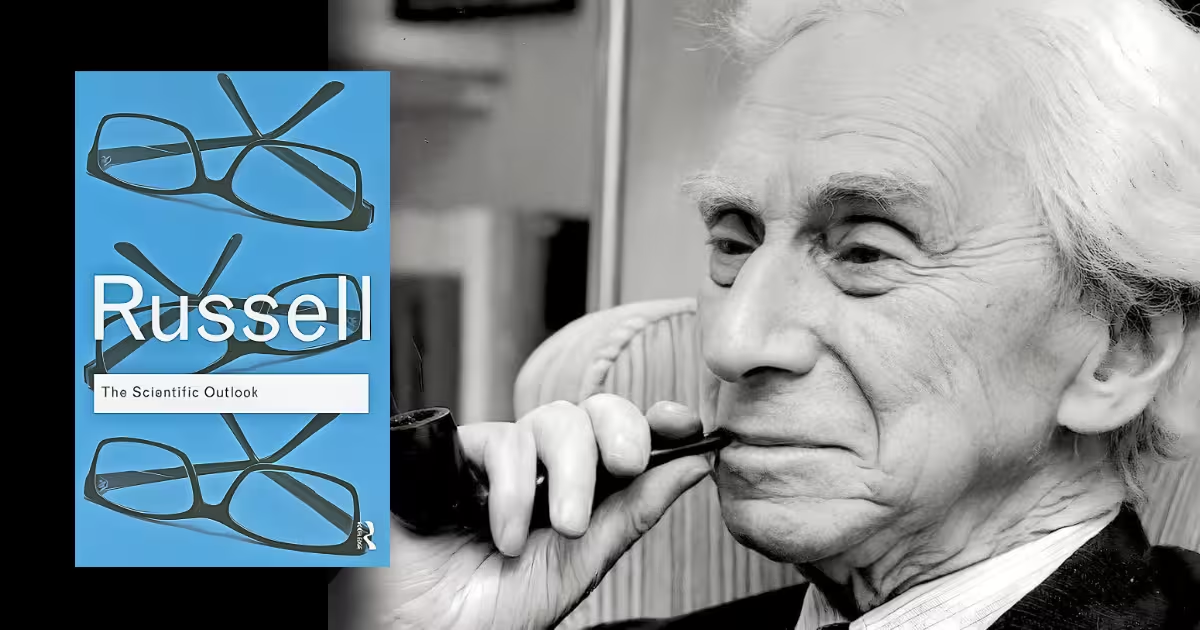

Do you ever lie awake at night wondering if the machines we built to serve us are slowly turning us into machines ourselves? You’re not alone. Nearly a century ago, one of the greatest minds of the twentieth century sat down and wrote The Scientific Outlook that asked the same question—and his answers will send chills down your spine.
Bertrand Russell’s The Scientific Outlook (1931) is not merely a dusty philosophical treatise. It is a chillingly prescient prophecy about the rise of scientific totalitarianism. Russell argues that science is shifting from a “contemplative” pursuit of truth to a “manipulative” tool for power.
He predicts a future where scientific experts form a ruling oligarchy, controlling everything from education to reproduction.
The book is a masterclass in critical thinking, but its dystopian final section—which directly inspired Aldous Huxley’s Brave New World—will leave you questioning the very nature of progress.
Preferred readers
The Scientific Outlook is a wonderful read for philosophy buffs, history of science enthusiasts, dystopian fiction fans, and anyone who has ever felt uneasy about the relentless march of technology.
Not for readers looking for light reading or those who prefer their science fiction to stay firmly in the realm of fantasy. If you are a techno-optimist who believes that science will solve all our problems without creating new ones, this book will challenge your worldview.
Table of Contents
Introduction
Title: The Scientific Outlook
Author: Bertrand Russell
Publication Date: 1931 (First Edition)
Publisher: George Allen & Unwin (London) / W.W. Norton (New York)
Edition: The republished version is the second edition of 1949, which includes a new preface by Russell himself.
Bertrand Russell (1872-1970) needs no introduction. He was a philosopher, logician, mathematician, historian, and social critic—a towering intellectual figure of the twentieth century.
He won the Nobel Prize in Literature in 1950, not for his fiction, but for his championing of humanitarian ideals and freedom of thought.
By 1931, Russell was already a public intellectual of immense stature, having been imprisoned for his pacifist stance during World War I and having written popular works on science like The ABC of Atoms (1923) and The ABC of Relativity (1925).
The Scientific Outlook is one of Russell’s most important works. It is a product of the interwar period, a time of immense scientific upheaval—the birth of quantum mechanics, the theory of relativity, and the dark shadow of eugenics. Russell, with his characteristic wit and clarity, set out to examine the nature of scientific knowledge and, more importantly, its implications for human society.
The central thesis of the book is deceptively simple yet profoundly disturbing: science, as a technique for manipulating the world, is in danger of eclipsing science as a pursuit of truth. Russell warns that this shift from “contemplation to manipulation” will lead to a new form of tyranny—a scientific society ruled by an oligarchy of experts who use their power not to liberate humanity, but to control it.
The Scientific Outlook Background
To truly understand The Scientific Outlook, we must first step back into the world of 1931. The Great Depression was ravaging the global economy. The Soviet Union was in the midst of Stalin’s brutal collectivization. The Nazi party was rising in Germany.
The optimism of the Enlightenment, which had promised that reason and science would lead to human perfection, was crumbling.
Russell, however, was not merely reacting to current events. He was responding to a deeper intellectual crisis. The Newtonian universe—a neat, orderly clockwork governed by absolute laws—had been shattered by Einstein’s relativity and, more recently, by the quantum mechanics of Heisenberg and Schrödinger. Physicists like Sir Arthur Eddington and Sir James Jeans were using these new discoveries to argue that science had proven the existence of God and free will.
Russell saw this as intellectual cowardice, a retreat from the hard truths of a chaotic universe.
He wrote The Scientific Outlook to cut through the fog. He wanted to explain what science really is, what it can and cannot do, and to warn against the dangerous tendency to turn science into a new religion.
The Scientific Outlook Summary
Reading The Scientific Outlook is like watching a brilliant chess player predict the moves of an opponent decades in advance. The book is divided into three distinct parts, each building upon the last to form a devastating argument.
Part I: Scientific Knowledge — The Foundation of Reason
Russell begins by demystifying the scientific method. He argues that, in essence, it is simple. It consists of observing facts, inferring general laws, and then testing those laws through prediction. He illustrates this with four iconic figures, each representing a different facet of scientific progress.
Galileo: The father of modern science, who challenged the authority of Aristotle and the Church. Russell recounts the famous (and possibly apocryphal) story of Galileo dropping weights from the Leaning Tower of Pisa to prove that all bodies fall at the same rate, much to the chagrin of his Aristotelian colleagues.
Galileo’s conflict with the Inquisition is presented not just as a battle between science and religion, but as a battle between the inductive method and the deductive method—between testing ideas against reality and relying on sacred texts.
The Inquisition’s sentence against Galileo is quoted at length, a stark reminder of the danger of dogmatic thinking. This section powerfully illustrates that “a scientific opinion is one which there is some reason to believe true; an unscientific opinion is one which is held for some reason other than its probable truth”.
Newton: The architect of the clockwork universe.
Russell shows how Newton’s law of gravitation unified the work of Galileo and Kepler, creating a magnificent, statuesque system. However, Russell is careful to point out that Newton’s laws were not the final word. They were later superseded by Einstein’s theory of relativity, which is itself a “stage on the road towards the exact truth”. This is a crucial point: science is not about absolute certainty, but about successive approximations.
Darwin: The giant of biology.
Russell acknowledges Darwin’s immense importance in forcing the world to accept evolution. However, he also notes that Darwin’s specific mechanism, natural selection, was already “less in favour amongst biologists than it used to be” .
More interestingly, Russell points out that Darwin’s work was flawed because he did not understand the laws of heredity, which were later revolutionized by Mendel. This shows Russell’s intellectual honesty: he celebrates the scientific method, not any particular scientific theory.
Pavlov: The pioneer of behaviorism. Russell devotes a significant portion of the book to Pavlov’s experiments on conditioned reflexes in dogs. He explains how Pavlov subjected what was once considered “voluntary behaviour” to scientific law.
This is a crucial step in Russell’s argument, as it establishes that even human psychology is subject to scientific analysis.
In fact, Russell notes that Pavlov’s work “has reduced it to the investigation of the conditions under which new reflex systems are brought into being”.
Part II: Scientific Technique — The Rise of the Machine
Having established the power of scientific knowledge, Russell moves on to its application. He traces the history of scientific technique from prehistoric times to the industrial revolution. He marvels at the explosive power of science, noting that “one hundred and fifty years of science have proved more explosive than five thousand years of prescientific culture”.
Russell explores the techniques used to master inanimate nature (machines, electricity, the control of climate), biology (agriculture, pest control, synthetic food), physiology (medicine, birth control), and psychology (advertising, propaganda).
He notes with a mixture of awe and concern that “the tendency of scientific technique is to cause everything to be regarded as not just a brute datum, but raw material for the carrying out of some human purpose”.
A key insight here is Russell’s analysis of advertising and propaganda. He argues that advertisers have discovered that “in the great majority of mankind any proposition will win acceptance if it is reiterated in such a way as to remain in the memory”.
He connects this to the rise of mass media—the press, the cinema, and the radio—which he identifies as powerful agents of uniformity. “The producers of Hollywood are the high-priests of a new religion,” he writes, a statement that feels almost too accurate today.
Part III: The Scientific Society — The Dystopian Vision
This is the section that makes The Scientific Outlook a truly remarkable and terrifying book. It is here that Russell paints his dystopian vision, one that would directly inspire Aldous Huxley’s Brave New World.
Russell argues that scientific technique will inevitably lead to the creation of artificially created societies run by a scientific oligarchy. He writes: “The scientific society, as I conceive it, is one which employs the best scientific technique in production, in education, and in propaganda”.
The key features of this society are:
✓: Scientific Government: Power will shift to a small group of experts who control the economy, education, and propaganda. Russell defines a scientific government as one that “can produce intended results: the greater the number of results that it can both intend and produce, the more scientific it is”.
✓: Eugenics and Scientific Reproduction: The state will regulate both the quantity and quality of the population. Russell predicts that “some 25 per cent. of women and some 5 per cent. of men will be selected to be the parents of the next generation, while the remainder of the population will be sterilized”. Artificial impregnation will replace natural means. As he chillingly notes, “Men will acquire power to alter themselves, and will inevitably use this power”.
✓: Education and Social Stratification: Education will be segregated.
The masses will be trained to be “docile, industrious, punctual, thoughtless, and contented”. The elite, on the other hand, will be bred for intelligence and trained in command. Russell warns that “initiative will be discouraged in these children, and insubordination, without being punished, will be scientifically trained out of them”.
✓: The Abdication of Love: Perhaps the most profound insight of the book is Russell’s argument that the scientific society will require the renunciation of love.
He writes: “the power conferred by science as a technique is only obtainable by something analogous to the worship of Satan, that is to say, by the renunciation of love”. In such a world, personal affections are seen as obstacles to the smooth functioning of the state. “The man drunk with power is destitute of wisdom,” Russell concludes, “and so long as he rules the world, the world will be a place devoid of beauty and of joy”.
The Scientific Outlook Analysis
Reading The Scientific Outlook in the 21st century is a profoundly unsettling experience. Russell’s predictions about scientific totalitarianism have not come to pass in the exact form he envisioned—we do not have a single world government that forbids Hamlet, for example.
However, the spirit of his prophecy is everywhere.
We live in a world where algorithms decide what we see, where governments use mass surveillance techniques, where our data is the raw material for corporate profit, and where the line between human and machine is becoming increasingly blurred. Russell’s warning about the shift from “contemplation to manipulation” is the defining story of our age.
As David Papineau notes in his preface to the Routledge Classics edition, Russell’s fears were not “merely an individual phantasy”.
They were shared by others, most notably Aldous Huxley. The parallels between The Scientific Outlook and Brave New World are striking, from the division of the population into castes to the removal of sexual restrictions. It is a testament to Russell’s foresight that his book remains so relevant.
Strengths and Weaknesses
What I Found Compelling
Clarity and Wit: Russell’s prose is a joy to read. He has a rare gift for making complex ideas accessible without dumbing them down. Even when he is discussing quantum mechanics or Pavlovian reflexes, his arguments are crystal clear.
Intellectual Honesty: Russell is not a blind advocate for science. He is willing to admit its limitations and dangers. He acknowledges that science is “not enough to guarantee a satisfactory existence”.
Prescience: The book’s dystopian vision is genuinely chilling. Russell understood the political implications of scientific power long before most people.
The Love vs. Power Dichotomy: Russell’s central argument—that science is shifting from a love of truth to a lust for power—is a profound and enduring insight.
What I Found Lacking
Naivety about Darwin: As Papineau points out, Russell shared the early 20th-century skepticism about Darwin’s theory of natural selection. He did not foresee the “new synthesis” of Mendelian genetics and Darwinian evolution that would revolutionize biology.
Pessimism: Russell’s predictions are undeniably pessimistic. While many of his specific prophecies have not come true, the underlying trend he identified is real.
Lack of a Solution: While Russell brilliantly diagnoses the problem, he offers only a vague hope that wisdom will prevail. He doesn’t provide a clear roadmap for how to prevent the scientific society he fears.
Comparison with Similar Works
The Scientific Outlook sits at the intersection of philosophy, science, and dystopian fiction. It is most often compared to:
Brave New World (1932) by Aldous Huxley: As mentioned, Huxley’s novel is a direct fictionalization of Russell’s ideas. While Russell’s book is non-fiction, Huxley’s is a novel, but both explore the same terrifying themes of scientific control and the loss of humanity.
1984 (1949) by George Orwell: Orwell’s novel is another dystopian classic that explores totalitarianism, but his focus is more on political repression and the manipulation of truth through language. Russell’s focus is specifically on the use of science as a tool of control.
The Managerial Revolution (1941) by James Burnham: Russell himself notes the parallels between his work and Burnham’s, which argued that the world would be run by a self-selecting oligarchy of managers.
Conclusion: A Warning We Ignore at Our Peril
The Scientific Outlook is not a comfortable read. It is a book that forces you to confront the dark side of progress. Russell’s genius was to see that the very thing that gives science its power—its ability to manipulate the world—is also its greatest danger.
He concludes with a plea that we must not lose sight of the human element. “Science in its essence is nothing but the systematic pursuit of knowledge,” he writes, “and knowledge, whatever ill-uses bad men may make of it, is in its essence good”.
The problem is not science itself, but the use to which it is put. “Man has been disciplined hitherto by his subjection to nature,” Russell writes in his concluding chapter. “Having emancipated himself from this subjection, he is showing something of the defects of slave-turned-master”.
This book is essential reading for anyone who wants to understand the world we are building. It is a warning that the greatest threat to our humanity may not come from a lack of knowledge, but from an excess of power.
If we are to navigate the challenges of the 21st century, we would do well to listen to the ghost of Bertrand Russell, whispering his warnings from 1931. It is a book that deserves a spot on every thinking person’s bookshelf.