
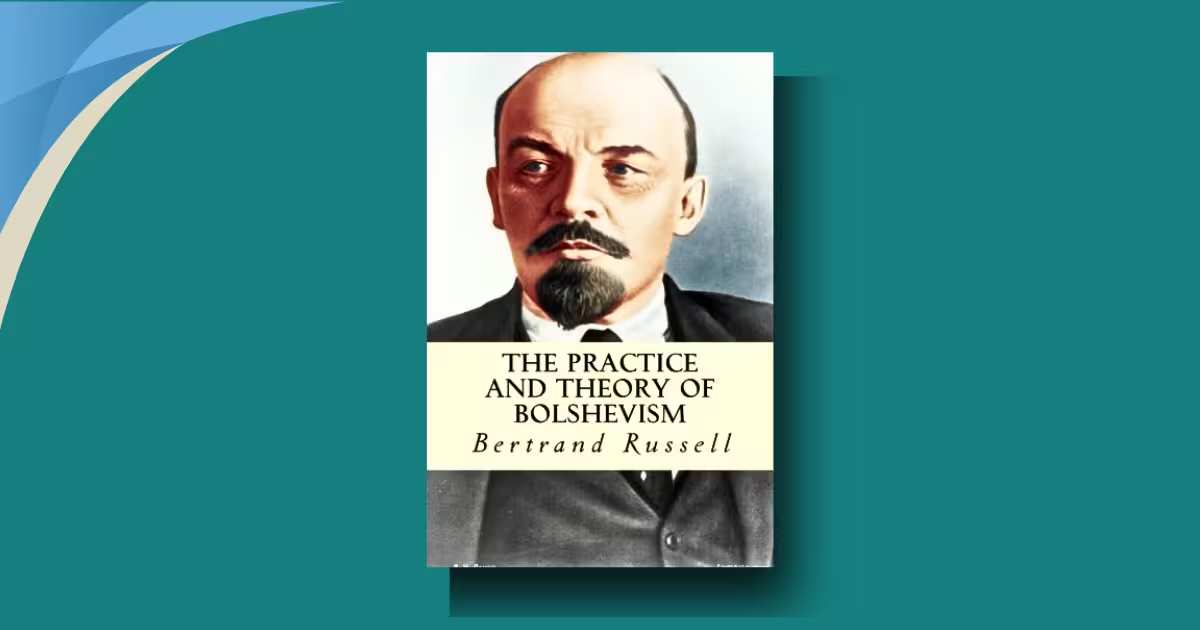
In 1920, the celebrated philosopher Bertrand Russell visited the newly formed Soviet Union and returned with a sobering diagnosis. While he affirmed the necessity of socialism, he concluded that the Bolshevik method—a minority dictatorship ruling through terror and dogma—was a catastrophic path that would lead not to liberation, but to a new form of tyranny.
The Practice and Theory of Bolshevism is a powerful, prescient critique of revolutionary fanaticism, blending sharp-eyed journalism with profound political philosophy.
Table of Contents
Introduction
The Practice and Theory of Bolshevism is a political and philosophical analysis written by the renowned British philosopher, logician, and social critic Bertrand Russell (1872–1970).
First published in 1920 by George Allen & Unwin in London and Harcourt, Brace & Howe in New York, the book was born from a specific, high-stakes moment: Russell’s visit to Soviet Russia in May and June of 1920 as a member of the British Labour Delegation.
Russell, already a prominent public intellectual and the author of works like Principles of Social Reconstruction (1916) and Roads to Freedom (1918), brought to this task a unique combination of analytical rigor, a commitment to scientific thinking, and a deep, humane skepticism.
Context
The Practice and Theory of Bolshevism is a first-hand account and critical examination of Bolshevism in its infancy. At the time, the Russian Revolution was just three years old, and the Soviet state was embroiled in a brutal civil war, facing an international blockade, and suffering from immense economic hardship.
Russell traveled through Petrograd (now St. Petersburg), Moscow, and the Volga region, observing daily life and meeting key figures, including Lenin, Trotsky, and Gorky.
The book is structured in two parts: the first offers a descriptive account of the “Present Condition of Russia,” while the second provides a “sympathetic but adverse criticism of Bolshevik theory”.
Purpose
Russell’s central thesis is both nuanced and damning. He begins by acknowledging the profound heroism and necessity of the Russian Revolution, stating, “The Russian Revolution is one of the great heroic events of the world’s history”. He also firmly believes that “Communism is necessary to the world”.
However, he argues that the Bolshevik method of achieving it—through a violent minority seizure of power, a dictatorship, and the suppression of all dissent—is fundamentally flawed.
As he writes in the preface, he does not believe that “by this method a stable or desirable form of Communism can be established”.
The Practice and Theory of Bolshevism is a warning: the Bolsheviks, he contends, have created a new religion of dogmatic certainty that is as dangerous as the medieval Church, and their path will lead not to freedom, but to a new, oppressive imperialism.
Background
Russell’s journey to Russia was not that of a detached tourist but of a committed socialist seeking to understand the world’s first attempt at a workers’ state.
He had previously outlined his hopes for a more just society in Roads to Freedom, expressing concerns that Marxism could lead to an over-powerful state. His visit was an opportunity to see if those fears were warranted.
The Russia he encountered in 1920 was a country in ruins. The First World War, followed by the October Revolution and a devastating civil war, had brought the economy to its knees.
The Communist Party, led by Lenin, had seized power in the name of the proletariat but ruled as a minority, suppressing all opposition parties like the Mensheviks and Social Revolutionaries. The country was also under a tight blockade by the Western Entente powers, which severely hampered its ability to trade and rebuild.
Russell’s account is unique because he was one of the few Western intellectuals of the time to approach Bolshevism with both a willingness to understand its principles and a critical, skeptical eye.
He was not a knee-jerk anti-communist; his critique came from within the socialist tradition, making his conclusions all the more powerful and troubling.
The Practice and Theory of Bolshevism Summary
Russell’s The Practice and Theory of Bolshevism is a remarkably concise yet comprehensive work. It is divided into two main parts, each containing several chapters that build a devastating case against the Bolsheviks’ methods while acknowledging the nobility of their initial aims.
Part I: The Present Condition of Russia
This section is Russell’s travelogue and reportage, grounded in his direct observations.
What is Hoped from Bolshevism: Russell begins by acknowledging the immense hope that Bolshevism has inspired. He compares it to a new religion, a response to the disillusionment and despair left by the Great War. He states that the Bolsheviks have created a powerful hope for a world without injustice, economic slavery, or war.
However, he is immediately wary, drawing a historical parallel: “The principles of the Sermon on the Mount are admirable, but their effect upon average human nature was very different from what was intended… These were the inevitable results, not of the teaching, but of fanatical belief in the teaching”.
He argues that the hopes of Communism are as admirable as those of Christ’s teachings, but they are held just as fanatically and are likely to cause as much harm.
General Characteristics: Russell paints a vivid picture of his journey, contrasting the official “royal progress” organized by the Bolsheviks with his private conversations with ordinary people.
He observes a profound disconnect between the theory of the “dictatorship of the proletariat” and its practice. He notes that for a Russian Communist, “dictatorship” means exactly what it says, but “proletariat” means something very different—essentially, the Communist Party itself.
He famously describes Bolshevism as “internally aristocratic and externally militant,” drawing a parallel to Plato’s Republic and the rule of Oliver Cromwell. He argues that the Communist Party has become a new ruling class, enjoying privileges and power.
Lenin, Trotsky and Gorky: This chapter contains Russell’s famous personal portraits of the three leaders. He describes Lenin as “an embodied theory,” “too opinionated and narrowly orthodox,” and a man whose strength comes from his “honesty, courage, and unwavering faith—religious faith in the Marxian gospel”.
He notes that Lenin believes nothing of value can be achieved except through world revolution. In contrast, he found Trotsky more impressive from an intellectual and personal standpoint, describing him as having “bright eyes, military bearing, lightning intelligence and magnetic personality”. He saw in Trotsky a “vein of gay good humour” and a vanity that he compared to an artist’s or actor’s.
Gorky, whom he met in Petrograd, is presented as a tragic figure, “heartbroken” by the suffering of Russia, supporting the government not because he thinks it faultless, “but because the possible alternatives are worse”.
Art and Education (written by Russell’s secretary, D.W. Black): This chapter explores the Bolsheviks’ impact on culture. While they initially protected artists and the old artistic community, Russell argues that the revolutionary atmosphere is stifling creativity.
He observes a growing pressure for art to serve propaganda, stating that “propaganda art alone can flourish in such an atmosphere”. In education, he notes the creation of excellent, modern schools but worries about the closing of many older ones and the heavy indoctrination of children with Communist doctrine.
He fears that the needs of industrialization will ultimately crush the humane and artistic development that the new system initially promised.
Communism and the Soviet Constitution: Russell delivers a scathing analysis of the Soviet system’s claim to be democratic. He states bluntly, “I did see an interesting experiment, but not in representative government”. He explains that the Soviet system was “moribund” because no free election would give a majority to the Communists.
Therefore, voting was by show of hands, candidates were denied printing and meeting halls, and opposition was crushed. Real power, he concludes, is entirely in the hands of the Communist Party, a group of about 600,000 in a population of 120 million.
The Failure of Russian Industry: Russell identifies the collapse of industry as the root cause of Russia’s suffering. He quotes the Ninth Congress of the Communist Party, which spoke of “the incredible catastrophes of public economy”.
The reasons he cites include Russia’s pre-war dependence on foreign machinery and expertise, the loss of key industrial regions like Poland and the Donets Basin, the lack of fuel, and, most importantly, the hostility of the peasants.
He argues that the government’s policy of forced requisition of food in return for worthless paper money had alienated the peasantry, who produced the bulk of the nation’s food.
This created a vicious circle: the towns were hungry because industry couldn’t produce goods to trade with the peasants, and industry couldn’t recover because the workers were hungry.
Daily Life in Moscow: Russell describes a life of “virtuous, well-ordered activity” but also one of immense hardship.
People worked long hours, faced constant food shortages, and were subjected to the terror of the “Extraordinary Commission” (the Cheka), a secret police force that could imprison anyone without trial.
He notes that “everybody breaks the law almost daily, and no one knows which among his acquaintances is a spy”. The average working man, he observed, “feels himself the slave of the Government, and has no sense whatever of having been liberated from a tyranny”.
Town and Country: Russell elaborates on the conflict between the urban, industrial centers and the vast, peasant countryside. The government, representing the towns, was essentially “encamped amid a peasant nation”.
The peasants were hostile because the state took their food and gave them nothing but useless paper in return. He concludes that the only solutions are peace and trade with the outside world, which would allow the government to supply the peasants with the goods they need.
Part II: Theory
This section is Russell’s philosophical critique of the intellectual foundations of Bolshevism.
The Materialistic Theory of History: Russell dissects the Marxist theory that all history is determined by economic motives. He distinguishes this from “philosophic materialism,” arguing that there is no logical connection between the two.
He acknowledges that economic factors are of “fundamental importance” but argues that Marxists overstate their case, neglecting other powerful human motives like nationalism, vanity, rivalry, and the love of power.
He argues that men are not solely driven by the desire for economic self-advancement, as Marxian theory assumes.
Deciding Forces in Politics: Russell outlines his own political psychology. He identifies four passions that are the “prime movers of almost all that happens in politics”: acquisitiveness, vanity, rivalry, and love of power.
He argues that Marxian theory fails to recognize the importance of the last three, which are social rather than economic. This, he believes, is the source of its errors. He notes that the love of power is “quite as strong a motive, and quite as great a source of injustice, as love of money”.
Bolshevik Criticism of Democracy: Russell presents the Bolshevik argument against parliamentary democracy—that it is a sham, controlled by capitalist propaganda. He then offers his counter-arguments.
He contends that a violent revolution by a minority is unlikely to succeed in a politically educated country and that it would, in any case, lead to a new tyranny. He argues that the Bolsheviks’ own philosophy of violence could be used by any other minority group.
Revolution and Dictatorship: Russell outlines the Bolshevik program for achieving Communism: a minority seizes power, establishes a dictatorship, and then “introduces Communism into every department of economic life as quickly as possible”. He raises three crucial questions: Is the ultimate state desirable? Is the cost of the conflict worth it?
And is this method likely to succeed? He answers the first question in the affirmative, agreeing that Communism is desirable. However, he argues that the price—a worldwide war and the creation of a brutal ruling class—is too high.
More importantly, he questions whether the method can lead to the desired goal, arguing that power is sweet and that the new rulers, having “absorbed the capitalist mentality,” are unlikely to relinquish it.
He concludes that “the price mankind must pay to achieve Communism by Bolshevik methods is too terrible,” and that “even after paying the price, I do not believe the result would be what the Bolsheviks profess to desire”.
Mechanism and the Individual: Russell argues that the concentration of power, not just inequality of wealth, is the greatest political evil. He believes that equalizing wealth without equalizing power is an unstable achievement. True freedom requires a diffusion of power, which can only be achieved through “a long period of gradual improvement,” not through violent revolution.
Why Russian Communism Has Failed: Russell provides a summary of his argument. He attributes the failure to the collapse of industry, which was caused by the Bolsheviks’ policies and their provocation of the outside world.
He argues that by provoking hostility, they were forced to provoke the hostility of the peasants and the urban population, leading to material disaster and spiritual collapse.
The ultimate source of the failure, he contends, is “the Bolshevik outlook on life: in its dogmatism of hatred and its belief that human nature can be completely transformed by force”.
Conditions for the Success of Communism: In his final chapter, Russell outlines a more realistic path to a socialist future. He argues that a successful Communist revolution must not paralyze industry.
He points out that a revolution in a country like England would be immediately crushed by an American blockade. Therefore, he argues, the transition must be more gradual. He advocates for “self-government in industry” as a key stepping stone, where workers run their own industries, thereby gaining the skills and experience needed to manage a socialist economy.
He concludes that the new world must be built “by slower and less showy methods… by industrial efforts after self-government, by proletarian training in technique and business administration”.
The Practice and Theory of Bolshevism Analysis
Russell’s The Practice and Theory of Bolshevism is a work of remarkable prescience. Written just three years after the October Revolution, it identified the core contradictions and likely outcomes of the Bolshevik experiment with startling clarity.
To put it frankly, reading this book is like watching a prophetic documentary unfold. Russell’s central critique—that a revolution fueled by hate and dogmatic certainty, led by a minority, would inevitably create a new, oppressive class—would be echoed by countless historians and dissidents in the decades to come.
Evaluation of Content
Russell effectively supports his arguments with a powerful blend of evidence. His first-hand observations of daily life in Moscow and the countryside give his theoretical critiques a grounding in grim reality.
When he describes the terror of the Cheka, the hunger in the cities, or the sullen resentment of the peasants, he is not just speculating; he is reporting what he saw. His conversations with Lenin, Trotsky, and Gorky provide invaluable, intimate portraits of the regime’s leadership.
His philosophical arguments are equally compelling. His critique of the “materialistic conception of history” is a masterclass in clear thinking. He brilliantly points out the logical fallacy of assuming that because economic factors are important, they are the only factors. By highlighting the role of nationalism, vanity, and the love of power, he exposes a significant blind spot in Marxist theory.
His comparison of Bolshevism to a religion is one of the book’s most enduring and insightful points. He writes, “Bolshevism as a social phenomenon is to be reckoned as a religion, not as an ordinary political movement”.
He saw that the Bolsheviks’ faith in Marx, their dogmatic certainty, and their intolerance of dissent mirrored the worst aspects of organized religion. This, he argued, was antithetical to the scientific temper and a threat to intellectual freedom.
Fulfillment of Purpose
Russell’s stated purpose was to define his own attitude towards Bolshevism and to help others do the same. In this, he succeeds admirably. He presents a balanced and nuanced view: he is a socialist who believes in the necessity of fundamental economic change, but he is also a humanist and a rationalist who recoils from the violent, authoritarian methods of the Bolsheviks.
He does not shy away from the uncomfortable truth that the Bolsheviks’ heroic attempt was also a tragic failure.
His predictions about the future of the Soviet Union were extraordinarily accurate. He foresaw that “Kremlinmania would evolve from ‘mere self-preservation, into a policy of imperialism'”.
He anticipated the rise of a new bureaucratic class that would value power above all else. He also predicted that a Communist revolution in the West would face an economic blockade from America, making success impossible in the short term.
These were not lucky guesses; they were the logical conclusions of a sharp and penetrating analysis.
A Unique Perspective
What makes Russell’s critique so powerful is that it comes from a place of sympathy.
He was not a conservative defender of the old order. He genuinely believed that “the existing capitalist system is doomed”. He had hoped for a more just world. It was precisely this hope that made his disappointment so profound.
He saw that the Bolsheviks were creating a system even worse than the one they had overthrown. As he famously wrote, “I went to Russia a Communist; but contact with those who have no doubts has intensified a thousandfold my own doubts, not as to Communism in itself, but as to the wisdom of holding a creed so firmly that for its sake men are willing to inflict widespread misery”.
This confession, coming from a man of his intellectual stature, adds an immense weight to his critique.
Strengths and Weaknesses
Strengths
First-Hand Authority: Russell’s observations as an eyewitness to the early Soviet state give the book an undeniable authenticity. His descriptions of daily life, the food queues, the terror, and the sullen mood of the population are far more powerful than any abstract theoretical critique.
Philosophical Rigor: The book is not mere journalism. Russell applies the full force of his analytical mind to dissect the philosophical and ideological underpinnings of Bolshevism. His critique of the materialistic conception of history is particularly strong.
Prescience and Clarity: Russell’s ability to see the future trajectory of the Soviet state is remarkable. His warnings about the rise of a new ruling class, the dangers of dogmatic belief, and the potential for imperialist expansion were all borne out by history.
Balanced Perspective: Despite his harsh criticism, Russell never loses sight of the nobility of the revolutionary ideal. He consistently acknowledges the heroism and good intentions of many Bolsheviks, making his critique all the more credible.
Prophetic Comparisons: His comparisons of Bolshevism to a religion and to the rule of Oliver Cromwell provide powerful and lasting analytical frameworks.
Weaknesses
Limited Time Frame: Russell’s visit to Russia lasted only about five weeks. He himself acknowledges this limitation, stating that he was “conscious that I was too short a time in Russia to be able to form really reliable judgments”. While his observations are sharp, a longer stay might have given him an even deeper understanding.
Potential for Bias: Some critics have argued that Russell’s analysis was colored by his own liberal, Western sensibilities and that he failed to fully grasp the desperate circumstances that necessitated the Bolsheviks’ harsh methods.
Intellectual Distance: As an academic, Russell sometimes views the revolution from a philosophical height that can feel a little detached from the brutal, visceral reality on the ground.
Underestimation of Resilience: While his critique of the system was accurate, he may have underestimated the Soviet Union’s capacity to survive and even industrialize under its brutal regime, as it later did under Stalin. Nonetheless, his core argument about the human cost remains unassailable.
Comparison with Similar Works
To truly appreciate Russell’s contribution, it is helpful to compare his book with other contemporary and similar works.
John Reed’s Ten Days That Shook the World (1919): Reed’s book is an eyewitness account of the October Revolution itself, written from an enthusiastic, pro-Bolshevik perspective.
It is a passionate, journalistic chronicle of the events that brought the Bolsheviks to power. In contrast, Russell’s book is a cooler, more analytical assessment of the regime after it had taken power.
Where Reed was a participant-observer cheering on the revolution, Russell was a critical observer assessing its consequences. Russell’s book is the necessary, sobering antidote to Reed’s romanticism.
Alexander Berkman’s The Bolshevik Myth (1925): Berkman, a prominent anarchist, visited Russia around the same time as Russell and initially arrived as a supporter of the revolution. His diary, published as The Bolshevik Myth, documents his growing disillusionment as he witnessed the reality of Bolshevik rule. Like Russell, Berkman criticizes the Bolsheviks’ authoritarianism and suppression of liberty.
However, Berkman’s critique comes from an anarchist perspective, making him even more hostile to the state and its power.
While Russell was a socialist who believed in the necessity of some form of state, Berkman was fundamentally opposed to all forms of government. Both books serve as powerful testimonies to the failure of the Bolshevik experiment from within the left.
George Orwell’s Animal Farm (1945) and 1984 (1949): While these are works of fiction, they are the literary heirs to Russell’s analysis.
Orwell, like Russell, was a democratic socialist who was deeply critical of totalitarianism.
Animal Farm is a direct allegory for the Russian Revolution, showing how a noble ideal can be corrupted by power-hungry leaders. 1984 depicts a dystopian future that embodies many of the features Russell warned about: a totalitarian state, the suppression of truth, and the worship of a mythical leader.
Russell’s book provides the intellectual framework that Orwell would later dramatize in his novels.
Conclusion
The Practice and Theory of Bolshevism is an outstanding work of political philosophy and a crucial historical document. It is a testament to the power of clear thinking and moral courage in the face of a powerful and alluring ideology.
Russell’s ability to separate the noble ideal of Communism from the brutal reality of its Bolshevik implementation is a lesson in intellectual honesty that remains profoundly relevant today.
For a book written over a century ago, its central insights have a chilling, contemporary resonance. In an age of political polarization, echo chambers, and dogmatic certainty, Russell’s plea for skepticism, tolerance, and a scientific, piecemeal approach to social problems is more vital than ever.
Recommendation
This book is an absolute must-read for anyone interested in political philosophy, the history of the 20th century, or the nature of revolutionary movements.
It is essential reading for students of political science, history, and philosophy. It is also a powerful and accessible work for general readers who want to understand not just what Bolshevism was, but why it ultimately failed.
If you have ever wondered how a revolution for freedom can become a tyranny, or how good intentions can pave the road to hell, Russell’s book offers one of the clearest and most compelling explanations ever written.
While its interest is “largely historical”, its warnings about the dangers of fanaticism, the corruption of power, and the need for a free intellect are timeless.







