
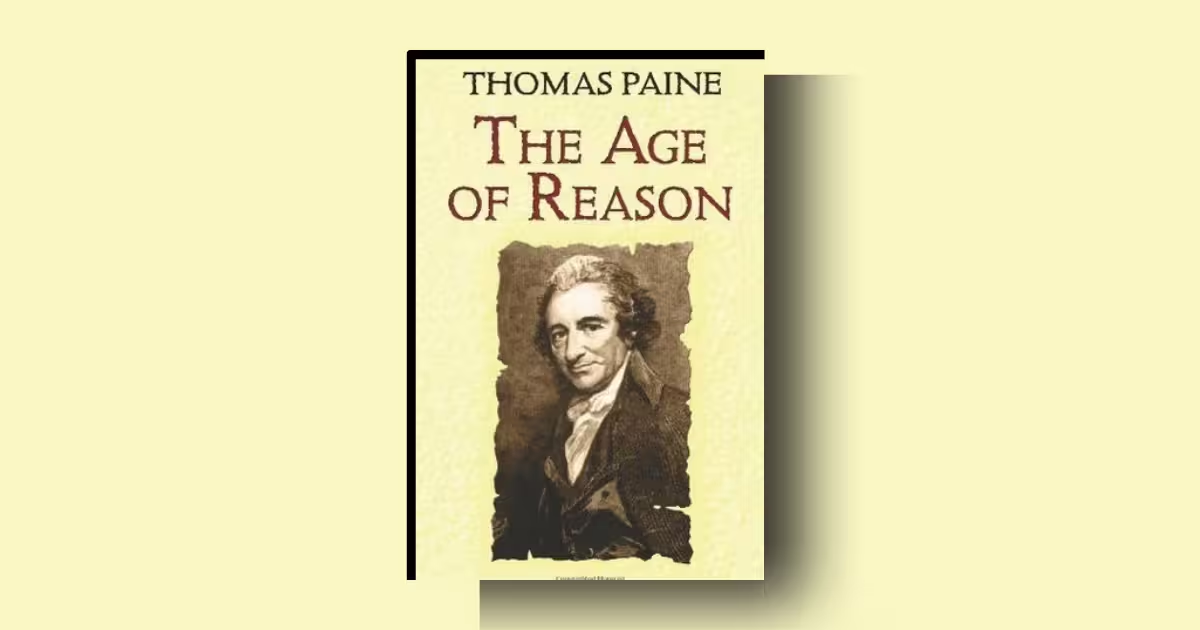
Can a book written in a French prison cell change how you see God, the Bible, and everything you thought you knew about religion? Thomas Paine reveals a whole dimension of God, the Bible and religion as a whole in The Age of Reason.
Table of Contents
Overview
Thomas Paine’s The Age of Reason is one of the most controversial religious critiques ever published. Written while Paine awaited execution during the French Revolution, this two-part work systematically dismantles organized Christianity, the divine authority of the Bible, and the concept of special revelation.
Paine argues that true religion requires no priests, no scriptures, and no miracles, only the belief in one God and the moral duty to treat others with justice and mercy. He presents the created universe, not any book, as the only genuine “word of God.”
The work sparked fierce backlash, led to Paine’s imprisonment, and remains a cornerstone of deist and freethought literature over two centuries later.
Reader recommendation of The Age of Reason
The Age of Reason is recommended to The Age of Reason:
- Skeptics and freethinkers questioning organized religion
- Students of philosophy, history, and religious studies
- Readers interested in Enlightenment-era critiques of Christianity
- Anyone struggling with contradictions in biblical texts
- Those seeking a rational, nature-based approach to spirituality
The Age of Reason is not recommended to:
- Readers seeking a gentle, non-confrontational religious discussion
- Those deeply committed to biblical inerrancy or literal interpretation
- People who prefer academic, scholarly theological works
- Anyone easily offended by blunt, sometimes harsh criticism of sacred texts
Introduction
Title: The Age of Reason
Author: Thomas Paine
Publication: Part I written in late 1793, published in 1794; Part II written in 1795, published in 1795
Editor (this edition): Moncure Daniel Conway
Original Context: Written while Paine was imprisoned in the Luxembourg prison in Paris, facing potential execution during the Reign of Terror
Thomas Paine (1737–1809) was an English-born American political activist, philosopher, and revolutionary. His earlier works, Common Sense (1776) and The Rights of Man (1791), had made him one of the most influential voices of the American and French Revolutions.
According to the editor’s introduction, Paine received an honorary Master of Arts degree from the University of Pennsylvania and collaborated with figures like Benjamin Franklin, David Rittenhouse, and George Clymer.
Context of The Age of Reason
The Age of Reason is a work of religious philosophy and critique, falling squarely within the deist tradition. Deism, as Paine practiced it, holds that reason and observation of the natural world are sufficient to determine the existence of a Creator, without the need for revealed religion, scripture, or institutional authority.
The book emerged from a specific historical moment. As the editor notes, “In the opening year, 1793, when revolutionary France had beheaded its king, the wrath turned next upon the King of kings, by whose grace every tyrant claimed to reign.” Paine found himself caught between revolutionary excess and religious reaction.
He later wrote in his preface to Part II: “The intolerant spirit of church persecution had transferred itself into politics; the tribunals, stiled Revolutionary, supplied the place of an Inquisition; and the Guillotine of the Stake.”
Purpose of The Age of Reason
Paine’s central thesis is unmistakable: the Bible and the New Testament are not divinely inspired; organized Christianity is a human invention designed to terrify and control people; and true religion consists simply of belief in one God and the practice of moral virtue.
He states his purpose directly in Chapter I: “All national institutions of churches, whether Jewish, Christian, or Turkish, appear to me no other than human inventions set up to terrify and enslave mankind, and monopolize power and profit.”
Paine also explains his motivation for publishing when he did: “The circumstance that has now taken place in France, of the total abolition of the whole national order of priesthood… has not only precipitated my intention, but rendered a work of this kind exceedingly necessary, lest, in the general wreck of superstition, of false systems of government, and false theology, we lose sight of morality, of humanity, and of the theology that is true.”
Background
The publication of The Age of Reason came at a perilous time for Paine. According to his own account, he had intended to publish his religious thoughts later in life, but events in France forced his hand.
He wrote Part I “near the close of the year 1793.” On December 28, 1793, just six hours after completing the manuscript, a guard arrived at his residence with an order for his arrest.
Paine was imprisoned in the Luxembourg prison, where he remained until November 1794. His release came through the efforts of James Monroe, who had replaced Paine’s enemy Gouverneur Morris as American Minister to France. Monroe found Paine “more dead than alive from semi-starvation, cold, and an abscess contracted in prison.”
Part II was written while Paine was still a prisoner, “with death still hovering over him.” He completed it after his release and it was published in London on October 25, 1795.
The book’s reception was explosive. According to the editor, “A hundred years ago England was suppressing Paine’s works, and many an honest Englishman has gone to prison for printing and circulating his ‘Age of Reason’.”
Thomas Williams was convicted in 1797 for selling a copy, though he received only a year in prison rather than the intended three years. Daniel Isaacs Eaton, another publisher, was pilloried at Charing Cross for publishing Paine’s works.
The Age of Reason Summary
Part I: The Author’s Profession of Faith
Paine opens with a clear statement of his beliefs: “I believe in one God, and no more; and I hope for happiness beyond this life. I believe the equality of man, and I believe that religious duties consist in doing justice, loving mercy, and endeavoring to make our fellow-creatures happy.”
He makes a crucial distinction that defines his entire project: “Infidelity does not consist in believing, or in disbelieving; it consists in professing to believe what he does not believe.”
This is not merely a semantic point, it’s the foundation of his critique of organized religion, which he sees as built on the systematic dishonesty of priests who claim to believe what they cannot possibly accept.
Of Missions and Revelations
Paine offers a devastating critique of the concept of revelation. He argues that even if God directly revealed something to one person, it ceases to be revelation for everyone else: “When he tells it to a second person, a second to a third, a third to a fourth, and so on, it ceases to be a revelation to all those persons. It is revelation to the first person only, and hearsay to every other.”
He applies this logic to all religious traditions: “Each of those churches shows certain books, which they call revelation, or the Word of God.
The Jews say that their Word of God was given by God to Moses face to face; the Christians say, that their Word of God came by divine inspiration; and the Turks say, that their Word of God (the Koran) was brought by an angel from heaven. Each of those churches accuses the other of unbelief; and, for my own part, I disbelieve them all.”
Paine also observes how Christianity adapted pagan ideas: “The trinity of gods that then followed was no other than a reduction of the former plurality, which was about twenty or thirty thousand. The statue of Mary succeeded the statue of Diana of Ephesus.
The deification of heroes changed into the canonization of saints.” He concludes that “The Christian theory is little else than the idolatry of the ancient mythologists, accommodated to the purposes of power and revenue.”
Concerning the Character of Jesus Christ
Perhaps surprisingly, Paine speaks with genuine respect about Jesus as a historical figure: “He was a virtuous and an amiable man. The morality that he preached and practiced was of the most benevolent kind.”
However, he maintains that “Jesus Christ wrote no account of himself, of his birth, parentage, or anything else. Not a line of what is called the New Testament is of his writing.”
Regarding the resurrection, Paine applies his signature skepticism: “The resurrection and ascension, supposing them to have taken place, admitted of public and ocular demonstration… A thing which everybody is required to believe, requires that the proof and evidence of it should be equal to all, and universal.”
Since this universal evidence was never provided, he concludes the story is unreliable.
He also notes a curious inconsistency: “It has long appeared to me a strange inconsistency to cite the Jews as a proof of the truth of the story. It is just the same as if a man were to say, I will prove the truth of what I have told you, by producing the people who say it is false.”
Of the Bases of Christianity
Paine compares Christian mythology to ancient pagan myths, finding them equally absurd. He observes that “The Christian mythologists tell that their Satan made war against the Almighty, who defeated him, and confined him afterwards, not under a mountain, but in a pit. It is here easy to see that the first fable suggested the idea of the second; for the fable of Jupiter and the Giants was told many hundred years before that of Satan.”
He then delivers a crushing summary: “They represent this virtuous and amiable man, Jesus Christ, to be at once both God and man, and also the Son of God, celestially begotten, on purpose to be sacrificed, because they say that Eve in her longing had eaten an apple.”
Examination of the Old Testament
Paine’s critique of the Old Testament is among the book’s most controversial sections. He writes: “Whenever we read the obscene stories, the voluptuous debaucheries, the cruel and torturous executions, the unrelenting vindictiveness, with which more than half the Bible is filled, it would be more consistent that we called it the word of a demon, than the Word of God.”
He doesn’t stop at moral condemnation. He argues that the Bible’s own internal evidence proves it wasn’t written by its supposed authors. For example, he points to Genesis 14:14, which mentions the city of Dan. According to the Book of Judges, the city wasn’t called Dan until after the tribe of Dan conquered it, which happened centuries after Moses’s death.
Similarly, Genesis 36:31 says, “These are the kings that reigned in Edom, before there reigned any king over the children of Israel.” Paine argues this could only have been written after Israel had kings, long after Moses.
The True Revelation
Paine’s positive theology emerges in Chapter IX. He writes: “THE WORD OF GOD IS THE CREATION WE BEHOLD: And it is in this word, which no human invention can counterfeit or alter, that God speaketh universally to man.”
He contrasts this with human language: “Human language is local and changeable, and is therefore incapable of being used as the means of unchangeable and universal information.”
But the creation “speaketh an universal language, independently of human speech… It is an ever existing original, which every man can read. It cannot be forged; it cannot be counterfeited; it cannot be lost; it cannot be altered; it cannot be suppressed.”
The Effects of Christianity on Education
Paine makes a striking historical argument: “It is owing to this long interregnum of science, and to no other cause, that we have now to look back through a vast chasm of many hundred years to the respectable characters we call the Ancients.”
He blames Christianity for suppressing scientific inquiry and replacing the study of nature with the study of dead languages.
He notes that Galileo was sentenced to renounce his discoveries “as a damnable heresy” in 1610, and that Virgilius was condemned for asserting the earth was a globe. “Later times,” Paine observes, “have laid all the blame upon the Goths and Vandals, but… it is nevertheless true, that the age of ignorance commenced with the Christian system.”
Mystery, Miracle, and Prophecy
Paine identifies three tools used to deceive people: “Those three means are Mystery, Miracle, and Prophecy. The first two are incompatible with true religion, and the third ought always to be suspected.”
Regarding miracles, he poses a question that remains powerful: “Is it more probable that nature should go out of her course, or that a man should tell a lie? We have never seen, in our time, nature go out of her course; but we have good reason to believe that millions of lies have been told in the same time.”
Part II: The Old Testament
The Case Against Mosaic Authorship
Paine’s examination of the Pentateuch is methodical. He notes that throughout Exodus, Leviticus, and Numbers, “the whole… of these books is in the third person; it is always, the Lord said unto Moses, or Moses said unto the Lord; or Moses said unto the people, or the people said unto Moses.”
This is the style of a historian writing about someone else, not an autobiography.
He highlights a particularly damaging passage: “Now the man Moses was very MEEK, above all the men which were on the face of the earth” (Numbers 12:3). Paine comments: “If Moses said this of himself, instead of being the meekest of men, he was one of the most vain and arrogant coxcombs.”
Deuteronomy’s Internal Evidence
Paine demonstrates that Deuteronomy is written in a dramatic style, with the author introducing Moses as a character speaking, then returning to his own voice. He shows how the final chapter describes Moses’s death and burial, something Moses couldn’t possibly have written.
He also points to the “giant’s bed” of Og, King of Bashan, described in Deuteronomy 3:11. The writer says the bed is “in Rabbath of the children of Ammon.” But Rabbath wasn’t taken until David’s time, some 400 years after Moses.
The Book of Joshua
Paine finds similar problems in Joshua. The book’s final verse says, “Israel served the Lord all the days of Joshua, and all the days of the elders that over-lived Joshua”, clearly written after Joshua’s death.
The Book of Judges and Samuel
The Book of Judges is “anonymous on the face of it… altogether fatherless.” The Book of Samuel contains a crucial anachronism: the author explains that “he that is now called a prophet, was before-time called a seer” (1 Samuel 9:9). This explanation only makes sense if the author lived long after the time of Samuel.
The Book of Ezra
Paine points out that the first three verses of Ezra are identical to the last two verses of 2 Chronicles, suggesting the compilers didn’t even know which book they were working with.
He also notes that Ezra’s list of returning exiles doesn’t add up, the total is 12,542 people off from the sum of the individual numbers.
The Book of Job
Paine treats Job with unusual respect. He calls it “a highly wrought composition, between willing submission and involuntary discontent.”
However, he notes that “from all the evidence that can be collected, the book of Job does not belong to the Bible.” He cites Hebrew commentators Abenezra and Spinoza, who argued it was originally a Gentile book translated into Hebrew.
Part II: The New Testament
Contradictions in the Gospels
Paine identifies numerous contradictions among the four Gospels. The genealogies of Jesus in Matthew and Luke “contradict each other in every particular.” Matthew gives 28 generations from David to Jesus; Luke gives 43, and the two lists share only the names of David and Joseph.
He also notes that Matthew says an angel appeared to Joseph, while Luke says the angel appeared to Mary. Mark and John don’t mention the annunciation at all. Similarly, the inscription on the cross is reported differently in all four Gospels.
The Resurrection Accounts
The resurrection narratives are particularly contradictory. Matthew says Mary Magdalene and “the other Mary” came to the tomb at dawn. Mark says it was “sun-rising.” John says it was “dark.” Luke says the women included Joanna and Mary the mother of James, while John says Mary Magdalene came alone.
The angelic appearances also differ. Matthew describes an angel sitting on the stone outside the tomb. Mark says “a young man” was inside, sitting on the right side. Luke says there were “two men” standing up. John says there were two angels sitting down, one at the head and one at the feet.
The Ascension
Paine notes that Matthew says nothing about the ascension, nor does John. Mark mentions it “in a careless, slovenly manner, with a single dash of the pen.” Luke says it happened at Bethany, while Mark implies it happened in Jerusalem.
Paine concludes: “The story of the appearance of Jesus Christ is told with that strange mixture of the natural and impossible, that distinguishes legendary tale from fact.”
The Age of Reason Analysis
What Makes This Book Revolutionary
Reading The Age of Reason in the 21st century, it’s easy to underestimate how radical it was in 1794. This wasn’t just another deist pamphlet—it was a systematic, evidence-based demolition of biblical authority written by one of the most famous revolutionaries in the world, from a prison cell where he expected to die.
Paine’s method was unprecedented. He didn’t just assert that the Bible was false; he used the Bible’s own internal evidence to prove it couldn’t be what it claimed to be. As he writes, “I will not go out of the Bible for proof against the supposed authenticity of the Bible. False testimony is always good against itself.”
This approach, treating scripture as a document to be examined like any other, anticipates modern biblical criticism by decades. As the editor notes, Paine “renounced the ‘a priori’ method, refused to pronounce anything impossible outside pure mathematics, rested everything on evidence, and really founded the Huxleyan school.”
The Moral Critique
What makes Paine’s argument particularly powerful is its moral dimension. He repeatedly asks how a just God could command the atrocities described in the Old Testament. “When we read in the books ascribed to Moses, Joshua, etc., that they (the Israelites) came by stealth upon whole nations… that they put all those nations to the sword; that they spared neither age nor infancy… are we sure these things are facts? are we sure that the Creator of man commissioned those things to be done?”
He points to a particularly horrifying passage in Numbers 31, where Moses orders the killing of all male children and all women who had known a man, but orders the soldiers to “keep alive for yourselves” all the virgin girls. Paine comments: “Among the detestable villains that in any period of the world have disgraced the name of man, it is impossible to find a greater than Moses, if this account be true.”
The Positive Vision
Despite its reputation as a negative, destructive work, The Age of Reason offers a genuine positive alternative. Paine’s deism isn’t just skepticism, it’s a vision of religion based on reason, nature, and morality.
He writes: “Do we want to contemplate his power? We see it in the immensity of the creation. Do we want to contemplate his wisdom? We see it in the unchangeable order by which the incomprehensible Whole is governed. Do we want to contemplate his munificence? We see it in the abundance with which he fills the earth.”
This is a religion that requires no priests, no scriptures, no rituals, only observation and gratitude. It’s also a religion that supports human freedom and equality, because it recognizes no special chosen people and no divine right of kings.
Lasting Influence
The impact of The Age of Reason was profound and long-lasting. According to the editor, “it became a signal for the commencement of those concessions, on the part of theology, which have continued to our time; and indeed the so-called ‘Broad Church’ is to some extent an outcome of ‘The Age of Reason’.”
The book’s influence extended beyond theology. As the editor notes, the first American edition of Part I was copyrighted by John Fellows, who was “afterwards Paine’s intimate friend in New York.”
The Theophilanthropist Church was founded in Paris and New York partly as a result of Paine’s ideas, and “the great rationalist wing of Quakerism in America” traces its origins to Paine’s influence.
Strengths and Weaknesses
Strengths
1. Methodological Rigor
Paine’s approach of using internal biblical evidence to challenge biblical authority is genuinely impressive. He doesn’t rely on external sources that believers could dismiss; he uses the text itself. This makes his arguments much harder to refute.
2. Moral Clarity
Paine never loses sight of the human cost of religious belief. He repeatedly asks how a just God could command mass murder, and he refuses to accept the standard answers. This moral seriousness gives his critique moral weight.
3. Accessible Style
Unlike many philosophical works, The Age of Reason is written in clear, direct English. Paine knew he was writing for ordinary people, not just scholars. This is why the book was so widely read, and so widely suppressed.
4. Positive Alternative
Paine doesn’t just tear down; he builds up. His vision of deism, belief in one God based on reason and nature, is genuinely appealing, especially to readers who have been alienated by organized religion.
5. Historical Insight
Paine’s observations about the relationship between Christianity and the suppression of science have been largely confirmed by later historians. He was right that the church often opposed scientific progress.
Weaknesses
1. Overconfidence
Paine sometimes claims more certainty than the evidence warrants. He presents some arguments as decisive when they’re merely suggestive. His case against Mosaic authorship is strong, but not as airtight as he implies.
2. Selective Reading
Paine focuses on the Bible’s most problematic passages and ignores its more uplifting sections. This is understandable given his polemical purpose, but it does mean he presents a one-sided picture.
3. Historical Errors
As the editor notes, Paine made some factual errors. He mentions only six planets, twelve years after Uranus was discovered. His statement that the Jews didn’t know astronomy has been challenged. These errors don’t undermine his main arguments, but they do provide ammunition for critics.
4. Lack of Nuance
Paine tends to treat all forms of Christianity as equally corrupt. This ignores the genuine differences between, say, Quakers (whom he respects) and the Catholic Church. His critique would be stronger if it acknowledged more complexity.
5. Limited Engagement
Paine doesn’t engage seriously with the best theological arguments of his day. He mostly attacks straw men and ignores sophisticated defenses of Christianity. This makes his critique less compelling to educated believers.
Comparison with Similar Works
Dialogues Concerning Natural Religion (1779) by David Hume’
Hume’s work is more philosophically sophisticated than Paine’s, exploring the limits of reason in matters of religion rather than making polemical arguments. Hume’s characters debate deism, theism, and atheism with nuance that Paine lacks. However, Hume’s work is also much less accessible and less politically engaged.
The System of Nature (1770) by Baron d’Holbach
D’Holbach was a more thoroughgoing materialist than Paine, arguing for atheism rather than deism. His work is more systematic and philosophically rigorous, but also more dry and less readable. Paine’s deism was actually a compromise position compared to d’Holbach’s atheism.
The Reasonableness of Christianity (1695) by John Locke
Locke attempted to show that Christianity is reasonable, while Paine argued it isn’t. Both men shared a commitment to reason, but they reached opposite conclusions. Locke’s work is more scholarly and less polemical, but also less passionate.
The God Delusion (2006) by Richard Dawkins
Dawkins’s work is the closest modern equivalent to “The Age of Reason.” Both books are polemical, accessible, and aimed at a general audience.
However, Dawkins is an atheist while Paine was a deist. Dawkins also has the advantage of modern science and biblical scholarship, which Paine lacked.
Conclusion
The Age of Reason is a remarkable book: flawed, passionate, sometimes wrong, but always worth reading. It represents one of the first serious attempts to apply historical criticism to the Bible, and it did so in a way that ordinary people could understand.
The book’s central argument, that religion should be based on reason and nature, not on ancient texts and priestly authority, remains relevant today. In an age of religious extremism and political manipulation of faith, Paine’s insistence on moral clarity and intellectual honesty is more important than ever.
Paine himself understood the risks he was taking. He wrote in his preface to Part II: “I have mentioned in the former part of The Age of Reason that it had long been my intention to publish my thoughts upon Religion; but that I had originally reserved it to a later period in life, intending it to be the last work I should undertake.” He knew the book might cost him his life.
It didn’t, but it cost him plenty. He was vilified, imprisoned, and largely abandoned by his former allies. Yet he never wavered. As he wrote, “It is not because right principles have been violated, that they are to be abandoned.”
Who Should Read This Book
I would recommend The Age of Reason to:
- Students of philosophy and history who want to understand Enlightenment-era religious thought
- Skeptics and freethinkers looking for a powerful articulation of their doubts
- Believers who want to understand the strongest arguments against their faith
- Anyone who has ever wondered why the Bible contains such troubling passages
I would not recommend it to:
- Those easily offended by blunt criticism of sacred texts
- Readers seeking a gentle introduction to religious questioning
- Anyone looking for a balanced treatment of the subject, this is a polemic, not a scholarly survey
Final Thoughts
What strikes me most about The Age of Reason is its honesty. Paine doesn’t pretend to have all the answers. He admits his uncertainty about the afterlife, writing: “I trouble not myself about the manner of future existence. I content myself with believing, even to positive conviction, that the power that gave me existence is able to continue it, in any form and manner he pleases.”
This is the humility of genuine faith, not certainty, but trust. It’s a lesson that believers and skeptics alike could learn from. Paine didn’t know everything, but he knew what he believed, and he wasn’t afraid to say it.
In the end, The Age of Reason is a book about freedom, freedom from priestly authority, freedom from superstition, freedom to think for oneself. That message is as powerful today as it was in 1794.







