
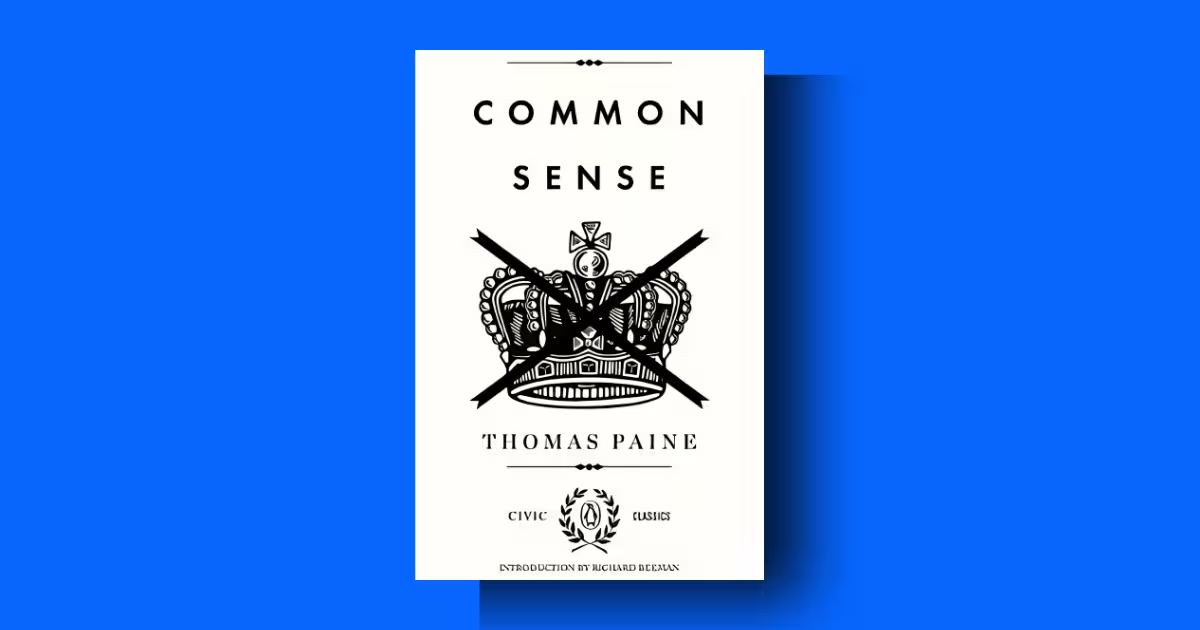
Do you ever wonder why a simple 47-page pamphlet written over 250 years ago still holds the power to make people question everything they’ve been taught about government, power, and their own freedom? Common Sense by Thomas Paine doesn’t just tell you what to think; it shows you how to think for yourself, and that’s precisely what made it the most dangerous and revolutionary document of its time.
Table of Contents
Overview
Common Sense (published January 10, 1776) is a political pamphlet that did what no army could do at the time: it convinced ordinary American colonists that breaking away from Britain wasn’t just possible, but inevitable and morally necessary.
Written by Thomas Paine, an English immigrant who had only arrived in America sixteen months earlier, this slim volume became the spark that turned colonial grumbling into revolutionary fire.
According to the BBC, the pamphlet sold an estimated 150,000 copies within its first few months. The Smithsonian reports that “Common Sense was so popular that 25 print editions appeared within a year; 120,000 copies were sold in its first three months and 500,000 copies by the end of the Revolution”; an estimated 20 percent of the colonial population owned a copy.
To put that in perspective, that would be like selling 65 million copies in today’s United States within twelve months. As Paine himself boasted, it was “the greatest sale that any Performance ever had since the use of Letters”.
Paine’s central argument is devastatingly simple: government exists only to secure the safety and freedom of the people. When it fails to do that, it becomes not just useless but dangerous.
The British monarchy, he argued, was not a benevolent father figure but a system of “hereditary succession” that amounted to “an insult and an imposition on posterity”. The time for reconciliation with Britain had passed. As Paine put it, “The blood of the slain, the weeping voice of nature cries, ‘TIS TIME TO PART”.
Historian Gordon S. Wood described Common Sense as “the most brilliant pamphlet written during the American Revolution, and one of the most brilliant pamphlets ever written in the English language”.
Author Scott Liell goes further, arguing in his book 46 Pages that “Common Sense accomplished what even the bloodshed of Lexington and Concord could not, a wholesale annihilation of the emotional and intellectual ties that bound the American colonies to the British crown and country”.
Reader recommendation of Common Sense
Common Sense is recommended to:
- Anyone interested in American history, the Revolutionary War, or the Founding Fathers
- Political science students who want to understand the philosophical foundations of democracy
- Citizens of any country who are questioning their own government’s legitimacy or authority
- People who want to understand how a single piece of writing can change the course of human events
- Those who enjoy primary source documents from pivotal historical moments
Common Sense is not for:
- Readers looking for a balanced, neutral historical account (this is propaganda, not history)
- People who prefer modern, easy-reading prose (the 18th-century language takes adjustment)
- Anyone who wants to learn about both sides of the argument (this is unapologetically one-sided)
- Readers who dislike religious references in political arguments (Paine uses the Bible extensively)
- Those who prefer academic detachment over passionate polemic
Background
Thomas Paine arrived in Philadelphia in November 1774, carrying a letter of introduction from Benjamin Franklin. He was forty years old, had failed as a corset-maker, a teacher, and a tax collector in England, and had been divorced twice. By all conventional measures, he was a nobody.
But that was precisely his strength.
Paine wasn’t a wealthy merchant, a plantation owner, or a Harvard-educated lawyer like many of the colonial elite. He was an artisan’s son who wrote for a living.
When he began writing for the Pennsylvania Magazine, he tackled controversial subjects, including a denunciation of the slave trade. He found ideological community with radical colonial leaders who, following the April 1775 battles at Lexington and Concord, were increasingly open to the proposition of independence.
Paine later described the colonial mindset at the time of his arrival:
“I found the disposition of the people such, that they might have been led by a thread and governed by a reed. Their suspicion was quick and penetrating, but their attachment to Britain was obstinate, and it was at that time a kind of treason to speak against it. They disliked the ministry, but they esteemed the nation. Their idea of grievance operated without resentment, and their single object was reconciliation.”
This was the environment that Common Sense was written to transform.
The pamphlet was published anonymously in January 1776, the public would not know Paine was the author until much later. Initially printed in an edition of 1,000 copies, it spread like wildfire. Within three months, 120,000 copies had been sold.
By the end of the Revolution, total copies, including pirated editions, reached an estimated 500,000. With a colonial population of only 2.5 million free inhabitants, this made it proportionally the best-selling book in American history.
As of 2006, it still holds that title.
Common Sense Summary: What I Learned
Part I: Of the Origin and Design of Government in General
Paine opens with a distinction that seems obvious once you hear it but was revolutionary at the time: society and government are not the same thing.
“Society is produced by our wants, and government by our wickedness; the former promotes our happiness POSITIVELY by uniting our affections, the latter NEGATIVELY by restraining our vices. The one encourages intercourse, the other creates distinctions. The first is a patron, the last a punisher.”
This is a crucial insight. Society is natural, organic, and beneficial. Government is artificial, coercive, and at best a necessary evil. Paine argues that “government, even in its best state, is but a necessary evil; in its worst state an intolerable one”.
He then imagines a small group of people settling in a new land—a thought experiment that any American colonist could easily visualize. These settlers would naturally form a society based on mutual need. Four or five people together could build a dwelling; one person alone would accomplish nothing. As the group grows, they would eventually need some form of government to “supply the defect of moral virtue”.
But here’s the key: this government should be simple, representative, and accountable to the people. Paine argues that the best government is the simplest one, and that the English constitution, with its king, lords, and commons, is “exceedingly complex”.
He dismantles the English system piece by piece, showing that the monarchy and aristocracy contribute nothing to freedom and that the House of Commons, the only democratic element, has been corrupted by the crown’s power to distribute offices and pensions.
Part II: Of Monarchy and Hereditary Succession
This section is where Paine really lets loose. He begins with a simple premise: “Mankind being originally equals in the order of creation”. If all men are created equal, then how can one man be born to rule over others?
Paine argues that there is no “truly natural or religious reason” for the division of humanity into kings and subjects. He points to the Bible, a text his audience would have known intimately, to show that God explicitly disapproved of monarchy. When the Israelites asked for a king, the prophet Samuel warned them:
“He will take your fields and your olive yards, even the best of them, and give them to his servants… and ye shall cry out in that day because of your king which ye shall have chosen, and the Lord will not hear you in that day.”
Paine concludes: “For monarchy in every instance is the Popery of government”. This was a devastating comparison for an audience that had fled religious persecution.
Hereditary succession, Paine argues, is even worse than monarchy itself:
“To the evil of monarchy we have added that of hereditary succession; and as the first is a degradation and lessening of ourselves, so the second, claimed as a matter of right, is an insult and an imposition on posterity. For all men being originally equals, no one by birth could have a right to set up his own family in perpetual preference to all others for ever”.
He points out that hereditary succession has been a disaster for England, listing “eight civil wars and nineteen rebellions” since the Norman Conquest. He famously declares:
“In short, monarchy and succession have laid (not this or that kingdom only) but the world in blood and ashes. ‘Tis a form of government which the word of God bears testimony against, and blood will attend it.”
Part III: Thoughts on the Present State of American Affairs
This is the heart of the pamphlet and where Paine makes his most urgent arguments. He begins by stating his intentions plainly:
“In the following pages I offer nothing more than simple facts, plain arguments, and common sense”.
He argues that the time for debate is over. Britain has chosen war, and America has accepted the challenge. The old arguments about reconciliation are now “like the almanacs of the last year; which, though proper then are superseded and useless now”.
Paine systematically dismantles the case for reconciliation:
First, the “child” argument. Some had argued that because America had flourished under British rule, it should continue that relationship. Paine responds:
“We may as well assert that because a child has thrived upon milk that it is never to have meat, or that the first twenty years of our lives is to become a precedent for the next twenty”.
Second, the “protection” argument. Britain had protected America, but only for its own interests. Paine writes:
“We have boasted the protection of Great Britain, without considering, that her motive was INTEREST not ATTACHMENT; that she did not protect us from OUR ENEMIES on OUR ACCOUNT, but from HER ENEMIES on HER OWN ACCOUNT”.
Third, the “parent country” argument. Many colonists still thought of England as the “mother country.” Paine responds with fury:
“Europe, and not England, is the parent country of America. This new world hath been the asylum for the persecuted lovers of civil and religious liberty from EVERY PART of Europe”.
He points out that not even one-third of the colonists were of English descent. To call England the “mother country” is “false, selfish, narrow and ungenerous”.
Paine then makes his most famous and devastating argument: a continent should not be governed by an island. “There is something very absurd,” he writes, “in supposing a continent to be perpetually governed by an island”.
The distance alone, three thousand miles of ocean, makes British rule impractical and unjust.
He appeals directly to the emotions of his readers:
“The blood of the slain, the weeping voice of nature cries, ‘TIS TIME TO PART”.
And he challenges those who still advocate for reconciliation:
“If you can say you can still pass the violations over, then I ask, Hath your house been burnt? Hath your property been destroyed before your face? Are your wife and children destitute of a bed to lie on, or bread to live on? Have you lost a parent or a child by their hands, and yourself the ruined and wretched survivor? If you have not, then are you not a judge of those who have”.
Part IV: Of the Present Ability of America
In the final section, Paine addresses practical concerns. Can America actually win independence? He argues that the time is right for several reasons:
First, military experience. The colonists had just fought in the French and Indian War, giving them military experience that would fade within a generation.
Second, natural resources. America has everything needed to build a navy: “Tar, timber, iron, and cordage are her natural produce. We need go abroad for nothing”.
Third, favorable conditions. America is young enough to form a new government without the entrenched interests that make reform impossible in older nations.
Paine proposes a continental government with annual assemblies, equal representation, and a president chosen by rotation among the colonies. He emphasizes that “the LAW IS KING” in America, not any man.
He closes with a stirring call to action:
“We have it in our power to begin the world over again. A situation, similar to the present, hath not happened since the days of Noah until now. The birthday of a new world is at hand”.
Key Arguments and Highlights
Society vs. Government
Paine’s distinction between society and government is foundational:
- Society is natural, voluntary, and produces happiness through mutual affection
- Government is artificial, coercive, and restrains vice through punishment
- Government should be minimal and only exist where “moral virtue fails”
The Corruption of Monarchy
Paine attacks monarchy from multiple angles:
- Biblical: The Bible shows that God disapproves of kingship
- Historical: Monarchy has caused countless wars and rebellions
- Practical: Kings are isolated from the people they rule
- Moral: Hereditary succession is “an insult and imposition on posterity”
The Case for Independence
Paine’s arguments for immediate independence include:
- Timing: The current moment is uniquely favorable due to military experience and national unity
- Resources: America has all the natural resources needed for self-defense
- Protection: Britain’s “protection” is actually a form of control
- Commerce: America’s trade will thrive regardless of British connection
- Global significance: “The cause of America is in a great measure the cause of all mankind”
The Plan for Government
Paine proposes:
- Annual assemblies with equal representation
- A Continental Congress with delegates from each colony
- A rotating presidency to prevent any one colony from dominating
- A Continental Charter guaranteeing freedom, property, and religious liberty
- No king—”the LAW IS KING”
Common Sense Quotes
On Government and Society
Perhaps the most quoted lines in the pamphlet are those where Paine lays out his foundational philosophy on the purpose of government.
“Society in every state is a blessing, but government even in its best state is but a necessary evil; in its worst state an intolerable one…”
“Society is produced by our wants, and government by our wickedness; the former promotes our happiness positively by uniting our affections, the latter negatively by restraining our vices. The one encourages intercourse, the other creates distinctions. The first is a patron, the last a punisher.”
“Government, like dress, is the badge of lost innocence; the palaces of kings are built on the ruins of the bowers of paradise.”
On Monarchy and Hereditary Succession
Paine’s fierce attack on the very concept of a king provides many of the pamphlet’s most memorable lines.
“For all men being originally equals, no one by birth could have the right to set up his own family in perpetual preference to all others forever…”
“One of the strongest natural proofs of the folly of hereditary right in kings, is, that nature disapproves it, otherwise, she would not so frequently turn it into ridicule by giving mankind an ass for a lion.”
“In short, monarchy and succession have laid (not this or that kingdom only) but the world in blood and ashes.”
“In England a king hath little more to do than to make war and give away places.”
🇺🇸 On America and the Cause of Independence
These lines capture the pamphlet’s urgent call to action and its vision of a continental destiny.
“The sun never shined on a cause of greater worth. ‘Tis not the affair of a city, a county, a province, or a kingdom, but of a continent—of at least one eighth part of the habitable globe.”
“The cause of America is in a great measure the cause of all mankind.”
“There is something absurd, in supposing a continent to be perpetually governed by an island.”
“We have it in our power to begin the world over again.”
On Reason, Change, and Freedom
“A long habit of not thinking a thing wrong, gives it a superficial appearance of being right…”
“Time makes more converts than reason.”
Common Sense Analysis
Let me be honest with you, reading Common Sense for the first time felt like being hit by a lightning bolt. Not because the arguments are complex- they’re not- but because they’re so ruthlessly simple and devastatingly effective.
Paine doesn’t try to impress you with learning or overwhelm you with evidence. He just asks you to think, and once you do, you can’t unsee what he’s shown you.
The New Oxford Review recently noted that “Thomas Paine’s prose adopted the cadence of pulpit exhortation and public address”, and that’s exactly right. Reading Common Sense feels like listening to a sermon from a prophet who’s just figured out that everything he was taught about God and king is a lie.
Historian Gordon S. Wood calls Paine “America’s First Public Intellectual”. That’s accurate, but I think it undersells him. Paine wasn’t just a public intellectual, he was a political evangelist. He didn’t just explain ideas; he converted people to them.
Before Common Sense, American colonists wanted better treatment from Britain.
After Common Sense, they wanted independence. That’s not persuasion; that’s transformation.
But I should also acknowledge the criticisms. John Adams, who supported independence but distrusted Paine’s radicalism, called Common Sense a “disastrous meteor”. Adams worried that Paine’s pamphlet would inflame popular passions and lead to mob rule.
There’s something to that criticism. Common Sense is not a balanced, nuanced analysis. It’s a polemic. It oversimplifies complex issues, uses emotional manipulation, and occasionally stretches logic to fit its conclusions.
One reviewer put it bluntly: “Common Sense is lacking in close rigor of argumentation. Again and again Paine’s logic can be seen to be grossly deficient”. This is true. Paine doesn’t always prove his points—he asserts them. He relies on rhetorical force rather than logical demonstration.
But here’s the thing: that’s exactly what made it work.
Common Sense wasn’t written for philosophers. It was written for farmers, shopkeepers, and artisans who didn’t have time for nuanced debates about constitutional theory. It was written for people who needed to be convinced, in language they could understand, that everything they’d been taught about kings and authority was wrong. And it succeeded spectacularly.
The BBC notes that the pamphlet “bolstered support for American independence”. That’s an understatement. The Smithsonian points out that Paine’s pamphlet “helped to animate the existing patriot movement”.
Without Common Sense, the Declaration of Independence might never have been written, or might have come too late to unite the colonies.
According to the US House of Representatives history, “By the spring of 1776, the Delegates recognized full well the effect it had among the American people. In the middle colonies, Samuel Ward noted, Paine’s pamphlet ‘has done immense Service’ in the cause for independence”.
As one modern reviewer put it, “Common Sense hits different because it’s not a founding document—it’s the sales pitch. It’s the argument that convinced ordinary colonists to pick up muskets”.
Strengths and Weaknesses
Strengths
1. Clarity and Accessibility
Paine wrote for ordinary people, not scholars. His language is direct, his arguments are simple, and his examples are drawn from everyday life. The title itself, Common Sense, tells you everything you need to know about his approach.
2. Rhetorical Power
Paine was a master of persuasion. He knew how to build an argument, how to appeal to emotion, and how to make his opponents look foolish. The section on hereditary succession is a masterpiece of ridicule and moral indignation.
3. Timeliness
Paine published Common Sense at exactly the right moment. The battles of Lexington and Concord had already been fought, but the colonists were still debating their goals. Paine gave them a clear, compelling answer.
4. Practical Proposals
Unlike many political pamphlets of the time, Common Sense doesn’t just criticize—it offers solutions. Paine’s proposals for a continental government, annual assemblies, and a rotating presidency show that he thought seriously about governance.
5. Moral Vision
Paine frames the American struggle as a cause of universal significance. “The cause of America,” he writes, “is in a great measure the cause of all mankind”. This elevates the conflict beyond local grievance to a fight for human freedom everywhere.
Weaknesses
1. Logical Gaps
Paine often asserts what he should prove. His biblical arguments, for example, depend on a very selective reading of scripture. His historical claims are sometimes exaggerated or oversimplified.
2. Emotional Manipulation
Paine uses emotional appeals, particularly in his descriptions of British atrocities, that sometimes border on propaganda. His goal was to inflame passions, not to inform dispassionately.
3. Religious Dependence
Paine’s arguments rely heavily on the Bible, which made sense for his 18th-century audience but may alienate modern secular readers. His interpretation of scripture is also highly selective.
4. Lack of Nuance
Common Sense presents a black-and-white view of the world: monarchy bad, republic good; Britain evil, America virtuous. The reality was, of course, much more complicated.
5. Limited Scope
The pamphlet doesn’t address many practical questions about how an independent America would actually function. It’s a call to action, not a detailed blueprint.
Comparison with Similar Works
Plain Truth by James Chalmers (1776)
Plain Truth was the most famous Loyalist response to Common Sense. Written under the pseudonym “Candidus,” it argued that independence was “ruinous, delusive, and impracticable”. While Common Sense sold hundreds of thousands of copies, Plain Truth had limited impact.
One contemporary newspaper noted that “If Common Sense in some places wanted polish, Plain Truth was covered over from head to foot with a detestable and stinking varnish”.
The American Crisis by Thomas Paine (1776–1783)
Paine’s follow-up series of pamphlets was written during the darkest days of the Revolutionary War.
The opening line, “These are the times that try Men’s souls”, is as famous as anything in Common Sense. While Common Sense convinced Americans to fight, The American Crisis convinced them to keep fighting when victory seemed impossible.
The Declaration of Independence by Thomas Jefferson (1776)
Jefferson’s Declaration shares many ideas with Common Sense: the equality of all men, the right to revolution, the condemnation of tyranny.
Indeed, historians agree that “Common Sense anticipated the Declaration in its attack on monarchy and its elevation of the colonists’ grievances from a dispute over English freedoms to a struggle of universal dimensions”.
Rights of Man by Thomas Paine (1791)
Paine’s later work defends the French Revolution and attacks Edmund Burke’s conservative philosophy. It expands on many themes from Common Sense: the natural rights of man, the corruption of monarchy, and the possibility of democratic government.
While Common Sense is focused on American independence, Rights of Man is a universal statement of democratic principles.
Leviathan by Thomas Hobbes (1651)
Hobbes’s defense of absolute sovereignty stands in sharp contrast to Paine’s democratic radicalism. Hobbes argues that government is necessary to prevent a “war of all against all”; Paine argues that government is at best a necessary evil. The difference between them is the difference between fear of anarchy and hope for freedom.
The Social Contract by Jean-Jacques Rousseau (1762)
Rousseau’s argument that legitimate government must be based on the general will of the people influenced Paine’s thinking. But where Rousseau is abstract and philosophical, Paine is concrete and practical. Rousseau wrote for philosophers; Paine wrote for everyone.
Conclusion
Who Should Read This Book?
Common Sense is essential reading for anyone who wants to understand how revolutions happen, how ideas spread, and how one person with a pen can change the course of history. It’s a masterclass in political persuasion, a foundational document of American democracy, and a powerful reminder that ordinary people can think for themselves.
I recommend it for:
- History students who want to understand the intellectual origins of the American Revolution
- Political science students studying democratic theory, revolution, or political communication
- Citizens of any country who are questioning their government’s legitimacy
- Writers who want to learn how to persuade with clarity and force
- Anyone who wants to understand why 500,000 copies of a 47-page pamphlet were sold in an era when most people couldn’t read
Final Thoughts
What strikes me most about Common Sense isn’t just its historical importance—it’s its immediacy. Reading it today, you can still feel the urgency, the anger, the hope that Paine poured into every sentence. You can understand why people who read it in 1776 felt like they were waking up from a long sleep.
Paine’s legacy is complicated. He died in poverty, largely forgotten, his radicalism too extreme even for the revolution he helped create. But his ideas didn’t die with him. The principles he articulated—that government exists to serve the people, that kings have no divine right to rule, that ordinary people can govern themselves—have spread around the world.
As the BBC noted, Paine’s influence was felt not only in the United States but also in France, “where his writings echoed through the French Revolution”. Nora Slonimsky, director of the Institute for Thomas Paine Studies, calls him “effectively, the social media influencer of his time”.
Common Sense is more than a historical document. It’s a reminder that ideas matter, that ordinary people can think for themselves, and that sometimes the most radical thing you can do is to speak the truth plainly.
As Paine himself wrote: “We have it in our power to begin the world over again”.







