
The Odyssey Film vs Poem: Homer’s Odyssey, roughly 3,000 years old yet still vital, stands as an essential classic. In an era marked by anxiety and upheaval, the storytelling impulse remains strong. Christopher Nolan has long harbored ambitions for a screen version of the epic.
After about two decades of planning, that project has finally reached audiences. To depict Odysseus’s journey, Nolan spent months filming on a vessel in open seas, approaching the work almost like a documentary.
He has described the process as demanding. Nolan emphasizes using sound and images to create an immediate impact on viewers and notes his appreciation for horror as a purely cinematic form.
The Odyssey Film vs Poem
Beyond any single genre, the Odyssey has always been a gripping tale filled with startling moments of shock and terror. Its lasting power, however, stems from something more human: the story of one man adrift and searching. It blends the spectacular with the ordinary in ways that have drawn the interest of major thinkers across classical antiquity.
Nolan is far from the first to grapple with this material. Roughly four centuries after the Odyssey began circulating in Greek learning, Aristotle offered a concise outline in the Poetics. The plot is not extended, he observed. A man has spent many years away and finds himself isolated.
After a harrowing sea voyage he returns home, confronts his enemies, survives, and sees them destroyed. Aristotle largely set aside elements of sexuality, pathos, or comedy, concluding that everything else amounts to episodes.
Nolan has long excelled at handling such episodes. Whatever views one holds of the director—currently a frequent subject of debate—he is drawn to ambitious scales and difficult undertakings. That approach has defined much of his career. Since the turn of the millennium, when a Homer project was still a distant goal, he has repeatedly explored unusual quests and the complexities of the human mind.
Inception (2010) was a intricate science-fiction heist story centered on dreams. Interstellar (2014), set in the year 2067, followed humanity’s search for a new place to live. Dunkirk (2017) dramatized the tense evacuation of Allied forces from France in 1940 across air, sea, and land. Oppenheimer (2023) presented a sweeping biographical portrait of the Manhattan Project and the development of a weapon capable of ending civilization.
Nolan has established himself as a major cinematic voice for the present day. Whether that sensibility fully aligns with the ancient world is another question.
Encountering the Iliad and the Odyssey still produces a sense of surprise. These works, dense with desire, violence, and fear, arise from a distant yet strikingly original imagination that predates and continues to shape our own era. Alexander Pope, one of Homer’s most celebrated translators, called him the greatest of poets, pointing to an exceptional range of intelligence, humanity, insight, and intuition. Almost nothing is known with certainty about the poet’s life.
Theories place his origins in the eighth century BC, with tradition claiming he died on the island of Ios. An enigmatic figure associated with myth—sometimes said to have been blind and possibly part of a collective of storytellers—Homer stands as a foundational influence. His successors include Virgil (The Aeneid), Dante (The Divine Comedy), Boccaccio (The Decameron), and Cervantes (Don Quixote).
In modern literature and cinema, Homer’s presence is widespread, appearing in works ranging from The Wizard of Oz and The Count of Monte Cristo to Alice in Wonderland. The influence reaches both children and adults. Stories such as the Harry Potter series and Game of Thrones would be difficult to imagine without Homeric foundations.
Film enthusiasts routinely connect Star Trek, O Brother, Where Art Thou?, Cold Mountain, and The Warriors to Odysseus’s tale.
The difficulty Homer poses lies in his fusion of physical heroes, monstrous beings, and brutal violence, all presented with a dense and lasting ambiguity. The legendary blind poet continues to shape daily culture in many registers. Within Homer we meet the wooden horse, fleeting references to Helen of Troy (wife of Paris), and scenes in which gods and mortals interact as patrons or opponents. The Olympian figures—especially Zeus, Athena, and Poseidon—exert a strong pull on the imagination and drive the plot of the Odyssey.
Alongside the epic journey appear Odysseus’s cunning exploits: his encounters with Circe (whose magic turns men into swine), the nymph Calypso (who offers immortality), and the deceitful singing women known as Sirens. There is also his steadfast, long-enduring wife Penelope, their son Telemachus, and, after a narrow escape from Scylla and Charybdis, the aging, homeward-bound survivor himself, that resourceful “king of sea-girt Ithaca.”
These figures and their absorbing adventures (the “episodes”) bring the literary masterpiece to life. Designed from the outset to captivate an audience and stir the Aristotelian responses of pity and fear (eleos and phobos), the Odyssey is fundamentally a work of the imagination, as much inward as outward.
The challenge Homer presents—the combination of flesh-and-blood heroes, savage giants, and vicious slaughter—remains as formidable as its opaque and profound ambiguity. Is it fact or fiction? Real or invented?
This is the territory in which Homer, as literature, takes flight, while Nolan, as a master of film, enters more contested ground. The Iliad portrays an actual nine-year war. Nolan’s sequel, a film script rather than a poem, aims for the condition of history.
Today more than ever, for instance, the Ithaca of Homeric legend would function as a tourist destination. Long before any footage was shot, Nolan’s Odyssey became entangled in controversies that created a distracting association between the film and its historical setting.
Across three millennia Homer has served as a lightning rod for cultural and political conflicts. With Nolan there were also disputes over sexual politics, though these did not reach the intensity of the debate surrounding Eliot Page’s casting as Demodocus in a walk-on role. Questions arose about whether a “white-armed Helen” should appear, and another cameo was played by Lupita Nyong’o from Kenya.
Quasi-historical arguments inevitably surfaced regarding Odysseus’s ship, trireme or Viking vessel?
A translation debate also existed: the long-serving Robert Fagles versus the voice of the present day, Emily Wilson, a brilliant classicist who has reshaped Homer studies through contemporary renderings of both poems. Whatever one’s reservations about Nolan’s staging, the choice of Wilson’s version may have helped ground, even free, every line of the script.
In the end this sublime poem is at once epic and intimate. In the text those two qualities coexist and sustain each other. That interplay is what makes it a masterpiece. In the film the challenge of the “episodes” is met through spectacular locations and striking camera work. In Homer we find the interplay of character and emotions; in Nolan, special effects.
Hollywood’s large screens and Imax cameras tend to privilege the image over the idea. One might argue that this reflects a tension already present in the relationship between the Iliad and the Odyssey. The former is set within the framework of an historical event, while the latter becomes a work of imagination that situates a fictional character in Hellenic landscapes. So is Odysseus or his voyage the central subject?
Homer himself appears to resolve the question. Odysseus is tested by the adventures of his homecoming, yet his motivation as a hero—to recover his former life in Ithaca—has already been established in the opening books. Of the Odyssey’s twenty-four books, only four (IX–XII) focus on the “adventures” of the voyage itself. The title supplies the key: the work is fundamentally about him.
Nolan’s decision to remain within Hollywood conventions while confronting Odysseus with thrilling episodes has been supported by many reviews. One publication described it as a massive, fearless adaptation and Nolan’s strongest film so far. Another called the Odyssey a masterpiece—disturbingly savage and an artwork in its own right. In the same coverage Mary Beard noted the relative absence of sex and humor.
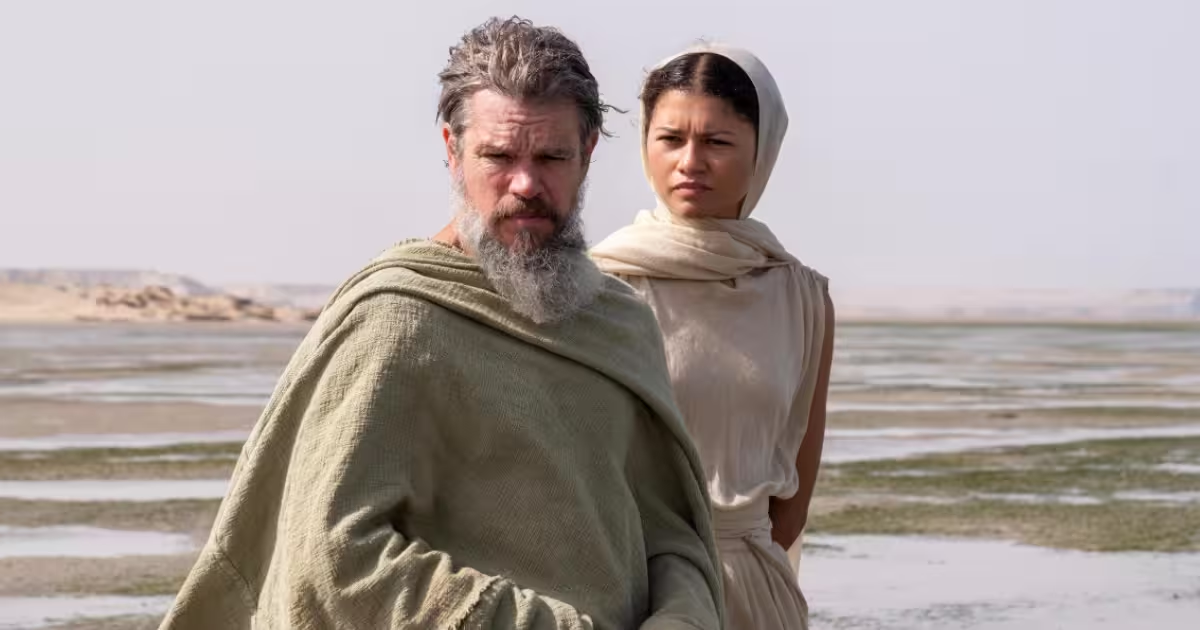
Elsewhere The New Yorker expressed disappointment in a modern, relatable treatment, yet the British press largely endorsed Nolan’s pursuit of a challenge, labeling it film of the year, a colossal piece of cinema, and a grand, gutsy vision. The emerging consensus treats it as a notable twenty-first-century movie featuring Matt Damon as an everyman Odysseus and Anne Hathaway as a contemporary woman. Viewers will form their own judgments.
Homer remains open to continual reinterpretation. The Return (2024), starring Ralph Fiennes and Juliette Binoche and directed by Uberto Pasolini, offers a stark, focused miniature centered on revenge in Ithaca. From the instant Odysseus emerges from the waves onto the beach, he is a man driven by purpose; it is his inward journey that turns the work into an unsettling piece of art.
That is the nature of stories. What matters is how they are told.