

Have you ever wondered why a 14th-century Italian poem about heaven, hell, and purgatory still sits on bestseller lists and university syllabi seven centuries after it was written? The answer might surprise you. Dante’s Divine Comedy isn’t just a relic of medieval theology—it’s a mirror held up to your own life, your choices, and the universal human longing for meaning.
T.S. Eliot once declared, “Dante and Shakespeare divide the world between them. There is no third”. Having taught this poem to hundreds of students, I’ve watched that initial hesitation melt into genuine fascination—and I’ve seen how Dante’s journey becomes, unexpectedly, their own.
Overview
The Divine Comedy is the second-most translated book in the world, after the Bible. It’s a 14,233-line epic written in Italian between 1308 and 1321 that traces Dante’s journey through Hell, Purgatory, and Heaven.
But it’s more than medieval theology—it’s a timeless guide to understanding sin, redemption, and what it means to be human. Whether you’re religious or not, Dante’s vision offers a framework for navigating modern life’s moral complexities.
Table of Contents
Why This 700-Year-Old Poem Still Matters
Here’s something that might stop you: Dante’s Divine Comedy is the most translated book in history after the Bible. That’s not an accident. It has been translated into over 40 languages, with English versions alone numbering in the dozens.
People don’t keep translating a poem for seven centuries unless it speaks to something deep and enduring.
So what keeps us coming back? Divine Comedy‘s power lies in its raw humanity. “It’s a poem that seeks to encompass everything, with artistic beauty and mathematical precision,” explains Jay Rubenstein, a history professor at USC Dornsife. “The world, all the universe and everyone who ever lived is potentially a part of Dante’s story”.
The Divine Comedy is divided into three canticles—Inferno, Purgatorio, and Paradiso—each containing 33 cantos, plus an introductory canto that makes 100 in total. The number three is everywhere: three parts, three-line stanzas, and a rhyme scheme called terza rima (ABA BCB CDC) that creates a walking rhythm throughout all 14,233 lines.
Dante invented this form, and it subtly underpins the entire journey.
But here’s the thing: most people only read Inferno. They stop at the gates of Hell and never make it to Purgatory or Paradise. Victor Hugo famously complained, “The human eye was not made to look upon so much light, and when the poem becomes happy, it becomes boring”.
That’s a mistake. Some of the most breathtaking moments in all of literature happen after Dante leaves Hell behind.
The Man Behind the Masterpiece
Dante Alighieri wasn’t writing from a place of comfort. He was a political exile, thrown out of his beloved Florence in 1302 and condemned to be burned at the stake if he ever returned. He spent the rest of his life wandering Italy, never seeing his home again. The pain of exile runs through every line of the Divine Comedy.
But here’s what’s remarkable: Dante turned his personal catastrophe into a universal story. He wrote not in Latin, the language of scholars, but in the Tuscan dialect—the language ordinary people spoke.
This was a radical choice. It helped establish Italian as a literary language and made the poem accessible to everyone, not just the elite.
Dante set the poem, Divine Comedy, in the spring of 1300, when he was 35 years old—“halfway along our life’s path,” as the opening line puts it. He’s lost in a dark wood, unable to find the right path, and terrified.
Three beasts—a leopard, a lion, and a she-wolf—block his way. These represent the three categories of sin that structure the entire poem: fraudulence, violence, and lust.
A Guide Through the Darkness
Enter Virgil, the Roman poet, who represents human reason. Virgil explains that Dante suffers from moral cowardice and that to escape the forest, he must journey through Hell and see sin for what it truly is. Virgil guides him through Hell and most of Purgatory.
But Virgil isn’t the only guide. Beatrice, Dante’s childhood love who died at 25, appears to Virgil in Limbo and sends him to help Dante. She represents divine revelation, theology, grace, and faith. And at the very end, Saint Bernard of Clairvaux takes over, representing contemplative mysticism and devotion to Mary.
The structure of each realm follows a pattern of 9 plus 1. Hell has nine circles plus Lucifer at the bottom. Purgatory has seven terraces for the seven deadly sins, plus two special zones at the base, making nine, with the Garden of Eden at the summit making ten. Paradise has nine celestial spheres plus the Empyrean, where God dwells.
Inferno (Hell): The Moral Train Wreck
Inferno is what I call a “moral train wreck”—and that’s exactly why it’s the most-read part. Everyone in Hell chose to be there. No one is there by accident or mistake. In Paradiso (Canto 5, lines 19ff), Beatrice explains that free will is God’s greatest gift to us, the gift most like Himself.
The tragedy of Hell is that its inhabitants either ignored this gift or misused it.
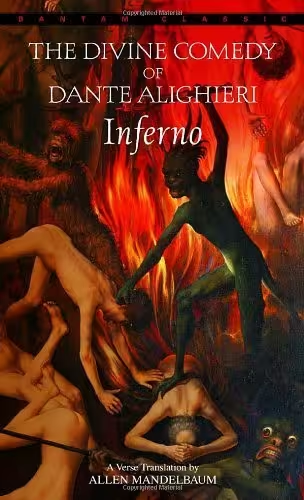
Each punishment in Hell is a contrappasso—a symbolic reflection of the sin itself. Fortune-tellers and soothsayers walk with their heads on backwards because they tried to see the future. As Dante writes:
“they had their faces twisted toward their haunches and found it necessary to walk backward, because they could not see ahead of them… and since he wanted so to see ahead, he looks behind and walks a backward path”.
The Inferno is filled with figures from history, mythology, and Dante’s own time—including political enemies and even Pope Boniface VIII. It’s a deeply personal document, a settling of scores wrapped in a cosmic vision.
Purgatorio (Purgatory): Hope and Mercy
Unlike Hell and Heaven, Purgatory is temporary. It will disappear at the end of time. But this doesn’t make it less important. The souls in Purgatory suffer punishments that are just as severe as those in Hell—but they repented, even at the last moment of their lives.
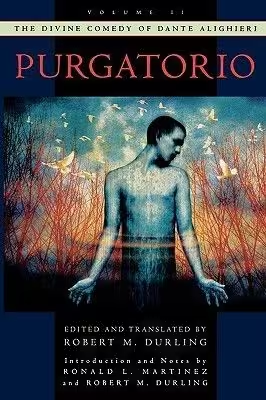
The Mountain of Purgatory is on the opposite side of the globe from Jerusalem, created by the rock displaced when Satan fell from Heaven. It’s a place of light where you can see the sun and stars. Unlike Hell’s shrieks and curses, the souls in Purgatory sing the Word of God in unison.
Love is the key concept here. Humans can sin by using love toward improper ends (Wrath, Envy, Pride), or by loving proper ends but with love that’s not strong enough (Sloth) or too strong (Lust, Gluttony, Greed). The seven terraces cleanse each of these sins.
Paradiso (Paradise): Seeing the Stars
The Paradiso is the most difficult part of the poem—and the most rewarding. Dante rises through nine celestial spheres based on Aristotelian and Ptolemaic cosmology. He meets saints, theologians, and angels, and learns that in Heaven, earthly values don’t work the way he expects. Two solids can occupy the same space.
Higher and lower don’t mean better or worse.
Beatrice grows more beautiful the higher they go, and Dante undergoes what he calls transumanar—“transhumanization”—a word he invented to describe how he could experience Heaven’s glory.
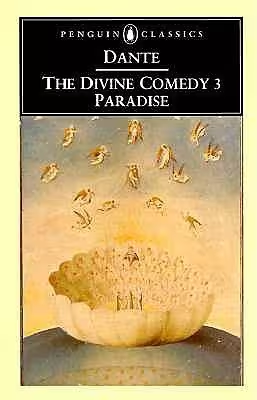
At the very end, Dante sees God. Not as a distant ruler, but as three circles of different colors, inhabiting the same space—the Trinity. Imprinted on these circles is a human face: the face of Christ. But Dante compares himself to a geometer trying to square the circle. He can’t fully comprehend or express what he saw.
Except for this:
“But already my desire and my will were being turned like a wheel, all at one speed, by the Love which moves the sun and the other stars”.
That final word—stelle, “stars”—is the last word in each of the three canticles. The poem begins in darkness and ends in light.
The “Comedy” of It All
Why did Dante call it a “comedy”? In the ancient world, poems were classified as high (tragedy) or low (comedy). Comedies had happy endings and were written in everyday language.
Dante took a serious subject—the redemption of humanity—and wrote about it in the “low” Italian vernacular rather than Latin. It was a bold, almost heretical move.
The title “Divine” wasn’t Dante’s. It was added by Giovanni Boccaccio, the author of The Decameron, who called it Divina Commedia in the 1350s. Boccaccio recognized what Dante had done: he had written a sacred poem, a poema sacro, that could stand alongside Scripture.
In fact, Dante himself comes close to claiming divine inspiration. In Paradiso Canto 25, he refers to “this sacred poem to which both Heaven and Earth have set their hand”. This is as close as he dares come to calling his work Scripture.
Why You Should Read It
The Divine Comedy is a Catholic poem written by a devout believer, but you don’t have to be Christian to appreciate it. As the USC scholars point out, the poem endures in secular times partly because of how thoroughly and imaginatively it organizes the cosmos. It takes the chaos and uncertainty of the afterlife and turns it into a precisely structured map.
In 1588, a young Galileo Galilei tried to map out the dimensions of Hell as Dante described them. The exercise convinced him that Dante’s vision could never be structurally achieved—and took an important first step toward theoretical physics. That’s the power of Dante’s imagination: it doesn’t just describe a world; it makes you want to measure it.
The poem also offers something more personal.
As Joseph Luzzi writes, Dante’s vision “can help us define our spiritual beliefs, better understand ourselves, and navigate the complexities of modern life”. In an age of distraction, when our attention spans are fragmented by screens and notifications, Dante demands something different: sustained attention, patient reading, and the willingness to sit with difficult questions.
C.S. Lewis remarked that reading Dante made Shakespeare seem artificial. Dorothy Sayers admitted that “fourteen thousand lines are fourteen thousand lines, especially if they are full of Guelfs and Ghibellines and Thomas Aquinas”.
But she also knew that the effort was worth it.
How to Approach It
If you’re new to Dante, here’s my advice: don’t try to understand everything on the first pass. Start with a good prose translation—Mark Musa’s is excellent—and read it like a story.
Treat the characters as real people, because Dante did. Let the images work on you. Don’t get bogged down in the theology or the politics.
And don’t stop at Hell. The real treasures are in Purgatory and Paradise. As the American Scholar notes, “some of the most sublime moments in The Divine Comedy, indeed in all of literature, occur after Dante makes his way out of the Inferno’s desolation”.
Each canto acts like a stained-glass window in a Gothic cathedral. You see through it to the location of the story, and the light shines through onto you. The purpose of the poem is to move you from misery to blessedness—to illumine you from within.
The Final Word
Dante finished the Divine Comedy in 1321, the year he died. He never saw Florence again. He’s buried in a modest tomb in Ravenna, not in the grand monument in Santa Croce that tourists mistake for his grave. But his poem has outlived every political enemy, every exile, every Pope who condemned him.
Seven hundred years later, the Divine Comedy remains one of the most consequential religious books ever written. It’s a poem that asks the biggest questions: Why are we here? How should we live? What happens when we die? And what does it mean to love?
Dante doesn’t give easy answers. But he gives something better: a journey. And like all great journeys, it changes you. You don’t return to your life the same person who left. That’s what makes it a comedy—not because it’s funny, but because it ends in joy.
As Dante writes at the very end of the poem, his will and desire were turned, “like a wheel in perfect motion, by the love that moves the sun and the other stars”. That’s where the poem leaves us: not in darkness, but in light. Not in confusion, but in love.