
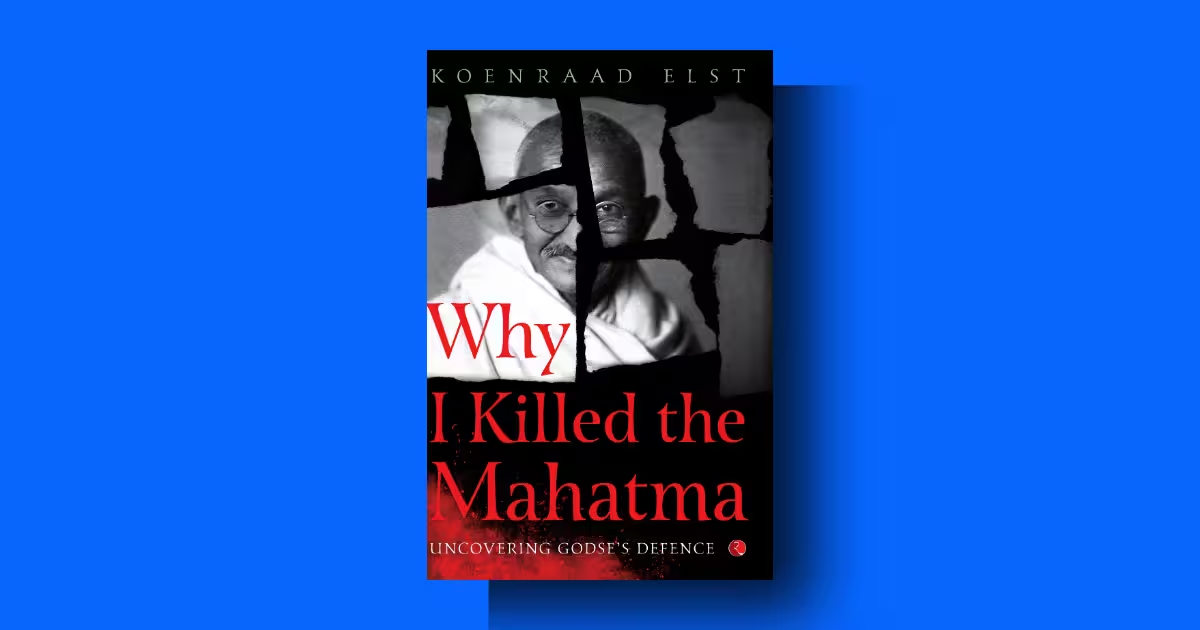

Koenraad Elst’s Why I Killed the Mahatma: Uncovering Godse’s Defence forces you to confront a truth that mainstream Indian history has spent decades burying. Nathuram Godse’s defence was not the ranting of a lunatic. It was a calculated, coherent, and meticulously argued political statement.
And that, more than the bullets he fired on 30 January 1948, is what makes him dangerous.
I read this book expecting to find a polemic. What I found instead was a forensic dissection of a trial that has been reduced to a one-line moral verdict: Gandhi was a saint, Godse was a fanatic. Elst, a Belgian Indologist with a doctorate in Oriental Studies, takes a different route.
He examines the 150-paragraph statement Godse read in Delhi’s Red Fort on 8 November 1948. He cross-references it with historical records. He asks a question that few Indian historians dare to ask: what if Godse was not entirely wrong about Gandhi’s policies, even if his solution was monstrous?
This review is not an endorsement of murder. It is an examination of a historical document that Elst argues has been tabooed, censored, and misrepresented. By the time you finish reading this, you will know exactly what Godse said, why he said it, and why his arguments continue to resonate with a section of Indian society today.
You will also understand why Elst’s book, first published in Dutch in 1998 and released in English by Rupa Publications in 2018, remains one of the most controversial works on the Mahatma’s assassination.
Table of Contents
Summary
- The Book: Why I Killed the Mahatma: Uncovering Godse’s Defence by Koenraad Elst, published by Rupa Publications in 2018 (251 pages).
- The Core Thesis: Godse’s courtroom defence was a coherent political critique of Gandhi’s policies, not the ravings of a madman. His criticism of Gandhi’s Muslim appeasement, his handling of the Khilafat movement, the Moplah rebellion, and the Partition was shared by many Hindus, including prominent leaders like Dr B.R. Ambedkar and Sri Aurobindo.
- The Method: Elst quotes Godse’s statement at length, paragraph by paragraph, and provides historical context, corrections, and commentary.
- The Controversy: Elst argues that Godse’s act was extremist, but his critique was not. He also argues that the murder backfired for the Hindutva movement, turning Gandhi into a martyr and destroying the Hindu Mahasabha politically.
- Who Should Read It: Anyone interested in the Partition, the Hindu-Muslim conflict, the history of the RSS and Hindu Mahasabha, or the political philosophy of Nathuram Godse. Not for those seeking a simple hagiography of Gandhi or a simple condemnation of Godse.
Reader Recommendation for Why I Killed the Mahatma
Who will love this book: Readers who are tired of the sanitized, one-sided narrative of Indian independence. If you have ever wondered why a Hindu nationalist would assassinate the man who led India to freedom, this book gives you the answer in Godse’s own words. It is for history buffs, students of political science, and anyone who believes that understanding a motive is not the same as condoning an act.
Who will benefit: Researchers working on Partition, communalism, and Hindu nationalism. The book is a primary source commentary. It fills a gap that B.R. Nanda’s Gandhi and His Critics and other mainstream works have left untouched.
As Elst notes, “Until now, no publication has dealt with this question, except for the naked text of Godse’s own defence speech during his trial” (Elst, Preface).
Who will bounce: Hardcore Gandhians who believe any discussion of Godse’s motives is a form of blasphemy. Also, readers who are looking for a neutral, academic tone. Elst is sympathetic to some of Godse’s arguments, and he does not hide it.
As the Business Standard review noted in 2018, “the author suffers from Islamophobia, which encourages him to assess Godse’s defence with more sympathy than objectivity.” If that description bothers you, this book will frustrate you.
1. Introduction
Title and Author Information: Why I Killed the Mahatma: Uncovering Godse’s Defence is written by Dr Koenraad Elst, a Belgian Indologist, Sinologist, and author. He holds a doctorate in Oriental Studies with a dissertation on Hindu Nationalism.
The book was published by Rupa Publications India in 2018. The foreword is written by Dr Gautam Sen, former Lecturer in the Politics of the World Economy at the London School of Economics.
Context: The book is a work of historical and political analysis. It belongs to the genre of revisionist history, though Elst would likely reject that label. It is not a biography of Gandhi or Godse.
It is a commentary on a single document: the defence statement Nathuram Godse delivered in court on 8 November 1948. Godse was tried for the murder of Mahatma Gandhi, which took place on 30 January 1948 at Birla House in Delhi.
He was sentenced to death and hanged on 15 November 1949. His statement was banned from publication after it was read. For decades, it existed only in fragments and in translations. Gopal Godse, Nathuram’s brother, published the English original in 1977 under the title May It Please Your Honour.
A new edition was published in 1993 as Why I Assassinated Mahatma Gandhi.
Purpose: Elst’s central argument is that Godse’s defence has been ignored, censored, or dismissed as the work of a fanatic. He aims to change that.
He writes: “The fact that he murdered the Mahatma has eclipsed every other fact in his fairly long and detailed statement. We hope that this study will enable the readers to see Godse with their own eyes rather than through the eyes of those who have thus far monopolised the discourse on the Mahatma murder” (Elst, Preface). Elst does not justify the murder.
He explicitly calls it “extremist.” But he argues that Godse’s critique of Gandhi was shared by many, and that this fact has been systematically suppressed.
2. Background: The Murder, The Trial, and The Taboo
Between 5:00 and 5:30 p.m. on 30 January 1948, Mohandas Karamchand Gandhi was shot three times at point-blank range while walking to his daily prayer meeting in the garden of Birla House, Delhi. He was 78 years old.
The assassin, Nathuram Vinayak Godse, was 37. Godse was the editor of a Marathi daily called Hindu Rashtra. He made no attempt to escape. He was arrested on the spot and likely saved from being lynched by the crowd.
The murder trial took place in Delhi’s Red Fort. Godse and his accomplice Narayan Apte were sentenced to death. Vinayak Damodar Savarkar, the ideological leader of the Hindu Mahasabha, was acquitted due to lack of evidence.
The others received prison sentences. Godse appealed the verdict, not because he denied the murder, but because he denied that there had been a conspiracy. He wanted to take sole responsibility to save his friends. The appeal failed.
What remains of Godse is his statement. It was read in court on 8 November 1948. The publication was immediately prohibited. But the ban was never formally lifted. It became a dead letter. Translations began appearing in the 1960s. In 1977, Gopal Godse published the English original. Elst’s book is the first serious commentary on this document.
Elst is careful to point out that Godse’s act had immediate and devastating consequences for the Hindu nationalist movement. The Hindu Mahasabha was knocked out as a political force.
The RSS was banned and forced to write a constitution. The Jana Sangh, later the BJP, was founded partly as a response to the political isolation that followed the murder. In other words, Godse’s act was a strategic disaster for his own cause. Elst makes this point repeatedly.
3. Why I Killed the Mahatma Summary
This is the heart of the book. Elst quotes Godse’s statement at length and comments on it. I will summarize Godse’s arguments and Elst’s commentary in a way that gives you the full picture without needing to read the original 150 paragraphs yourself.
3.1 The Murder Plot and the Conspiracy
Godse begins his statement by denying that there was a conspiracy. He claims sole responsibility. He says the first attempt on Gandhi’s life, on 20 January 1948, was unrelated to the second. He denies that his friends supplied him with weapons. He says he bought the revolver from an unknown merchant.
Elst points out that the court was right to ignore this plea. There was a conspiracy. Madanlal Pahwa, who was arrested after the first attempt, confessed under torture. Digamber Badge, an arms merchant, turned approver.
Gopal Godse, Nathuram’s brother, later admitted to Elst in an interview: “Of course I was involved, but I had a right to deny it. Nathuram was bound to be hanged, but for the rest of us it made a big difference, so we all—Nathuram included—pleaded against the conspiracy thesis” (Elst, Chapter 1).
The only person who could not be saved by this defence was Narayan Apte, the manager of Hindu Rashtra. He was the only real accomplice in the actual murder. Godse preferred to act alone on 30 January because the first attempt had failed due to too many participants.
3.2 Godse’s Background: The Chitpavan Brahmin and the RSS
Godse was a Chitpavan Brahmin from coastal Maharashtra. Elst provides a detailed history of this community. The Chitpavans were the power behind the Maratha Empire. They produced the Peshwas. They were prominent in the freedom movement. The British considered them the most dangerous caste in India.
They were also targets of anti-Brahmin violence after the murder. Elst documents this violence in detail. He cites Maureen Patterson’s study, which found that the worst violence took place in the Desh region, including Satara, Belgaum, and Kolhapur. One thousand Chitpavan houses were burned down in Satara alone.
At least eight people were killed, according to official figures. The New York Times reported fifteen deaths in Bombay on the first day. Elst estimates the total death toll may have been several hundred.
Godse joined the RSS in the early 1930s. He worked for the RSS for several years. He then joined the Hindu Mahasabha. He became a devoted follower of Savarkar. Elst notes that Godse began his political career as a volunteer in Gandhi’s Civil Disobedience campaign of 1930-31.
He was also active in the campaign against untouchability. He organized inter-caste meals. He saved the life of a Mahar child as a youngster. Elst makes the point that Godse was not an orthodox Hindu. He was a social reformer. He was a Gandhian in some respects.
3.3 Critique of Gandhi’s Policies: The Khilafat to Partition
This is the longest and most important section of the book. Godse’s critique of Gandhi is chronological. Elst comments on each point.
The Khilafat Movement (1919-1922): Gandhi supported the Khilafat movement, which aimed to restore the Ottoman Caliphate. Godse argues that this was a catastrophic mistake. It introduced a theological element into Indian politics. It was an anti-nationalist movement. The Caliphate was a transnational Islamic institution.
It had nothing to do with Indian freedom. When the movement failed, Muslims turned their anger on Hindus. There were riots across India. Godse says: “The Hindu-Muslim unity of the Mahatma became a mirage” (Godse, para 70a). Elst agrees that the Khilafat movement was a disaster.
He quotes Rabindranath Tagore, who said that Muslims cannot confine their patriotism to any one country. He also quotes Dr Ambedkar, who said that the Khilafat movement was the main cause of the growth of Muslim separatism.
The Moplah Rebellion (1921): The Moplah Muslims of Kerala declared a Khilafat kingdom. They conducted pogroms against Hindus. There were murders, rapes, and forced conversions.
Godse says Gandhi “kept mum” and never uttered a word of reproach. He even started a relief fund for the Moplahs instead of their victims. Elst corrects Godse on one point: Gandhi did condemn the Kohat pogrom.
But he admits that Gandhi’s response to the Moplah rebellion was inadequate. He quotes Shrikant Talageri, who said that Congress suppressed reports of the atrocities and that Gandhi called the Moplah murderers “my brave Moplahs.”
The Afghan Invasion Intrigue: During the Khilafat movement, the Ali Brothers invited the Amir of Afghanistan to invade India. Gandhi supported them.
He said: “If they had sent a message to the Amir, I also would send one to inform the Amir that if he came, no Indian so long as I can help it, would help the Government to drive him back” (Godse, para 70c). Elst calls this “the height of folly” and says it shows serious confusion in Gandhi’s mind.
The Attack on the Arya Samaj: In 1924, Gandhi attacked the Arya Samaj, a Hindu reform movement that was reconverting Muslims to Hinduism. Godse says this attack provoked a Muslim youth to murder Swami Shraddhananda, the leader of the Shuddhi movement, in 1926.
Elst notes that the time gap was more than two and a half years, so the causal link is weak. But he agrees that Gandhi was not even-handed. He quotes Ambedkar, who criticized Gandhi for never condemning the murders of Hindu leaders like Shraddhananda and Rajpal.
The Separation of Sindh (1931): Gandhi supported the separation of Sindh from the Bombay Presidency. This created a Muslim-majority province that later became part of Pakistan. Godse says Gandhi “threw the Hindus of Sind to the communal wolves.” Elst agrees that this was a concession to the Muslim League that yielded no reciprocal benefit.
The Round Table Conference (1930-32): Godse says Gandhi was the biggest factor in the failure of the conference. He says Gandhi invited Ramsay MacDonald to give the Communal Award, which strengthened communalism. Elst admits that Gandhi and the Congress played their cards badly. He quotes R.C. Majumdar, who said that Gandhi’s Christian meekness fell flat on the British.
Congress Greed for Office (1937): The Congress formed provincial governments in 1937 but excluded the Muslim League. Godse says this was a blunder. Elst agrees. He says the Congress should have shared power with the League. By excluding them, the Congress gave Jinnah a tactical advantage.
The Cripps Mission (1942): The Cripps Mission proposed a plan that would allow provinces to form separate dominions. Godse says the Congress accepted the principle of Partition. Elst agrees. He quotes Gandhi, who wrote in Harijan: “If the vast majority of Muslims regard themselves as a separate nation… they must have the partition” (Elst, Chapter 4).
Quit India (1942): Godse says the Quit India movement was a failure. It was suppressed in three months. Jinnah raised the counter-slogan “Divide and Quit.” Elst agrees that it was a strategic disaster. He says it left the political field to the Muslim League. He also notes that Gandhi approved a proposal to hand over all power to the Muslim League in August 1942, just before launching Quit India.
This is a shocking fact that few people know.
Gandhi’s Hindustani: Godse says Gandhi’s support for Hindustani, a mix of Hindi and Urdu, was “a fraud and a crime.” He says it was Urdu under another name. Elst agrees that Hindi had a better claim to be the national language. He says the script of Devanagari is more scientific than the Arabic script.
National Symbols: Godse says Gandhi stopped the singing of Vande Mataram because some Muslims objected. He banned the Shiva Bavani. He even removed the tricolour flag from his hut in Noakhali (in Bangladesh) when a Muslim objected. Elst comments that Gandhi was “harsh on the polemical but non-violent Swami Shraddhananda, and kind to the Swami’s murderer.”
Cow Slaughter: Godse says Gandhi made no effort to ban cow slaughter. He quotes Gandhi: “How can I impose my will upon a person who does not wish voluntarily to abandon cow-slaughter? India does not belong exclusively to the Hindus.” Elst disagrees with Gandhi.
He says democratic governments take decisions by majority. If a majority wants to ban cow slaughter, there is nothing undemocratic about it.
Friendship with Suhrawardy: Godse was outraged by Gandhi’s friendship with H.S. Suhrawardy, the Muslim League leader who was responsible for the Great Calcutta Killing of August 1946, in which 6,000 people died. Gandhi called Suhrawardy a “martyr.” Elst says this was a case of a middle-class intellectual infatuated with an unscrupulous muscle-man.
The Partition: Godse says Gandhi conceded Partition. He says Gandhi “uttered not one word of sympathy or comfort for millions of displaced Hindus.” Elst says this is not entirely true, but he admits that Gandhi’s focus was on Muslims. He quotes B.R. Nanda, who admits that Gandhi’s policy was “a continual retreat in the face of Muslim pressure.”
3.4 Godse’s Verdict on Gandhi: The Character Assassination
Godse does not just criticize Gandhi’s policies. He attacks his character. He calls Gandhi a “hypocrite.” He says Gandhi was “a violent pacifist who brought untold calamities on the country.”
He accuses Gandhi of being autocratic. He says Gandhi was the “master brain” who alone knew when to start and stop a movement. He says Gandhi’s “inner voice” was a cover for his own whims.
Elst does not fully endorse this character assassination. He says Godse exaggerates. He points out that Gandhi had some victories. The Salt March was a success. The Poona Pact was a success. But Elst agrees that Gandhi was autocratic. He quotes Paul Johnson, who called Gandhi “a political exotic.” He quotes Alain Daniélou, who said Gandhi was “sly and acetic, ambitious and devout.”
He quotes M.M. Kothari, who said Gandhi “wanted India to have a monkish economy, a monkish politics, a monkish foreign policy and a monkish defence policy.”
3.5 Other Hindu Voices on Gandhi
Elst does not rely solely on Godse. He brings in other critics. He quotes Sri Aurobindo, who said Gandhi was “a little cracked” for thinking that Hindus should surrender to Muslim demands. He quotes Dr Ambedkar, who said that Hindu-Muslim unity was a “mirage.”
He quotes Sita Ram Goel, who said that Gandhi’s failure was the failure of Hindu society. He also quotes Ram Gopal, who said that Gandhi himself killed Gandhism by choosing Nehru over Patel as his successor.
Elst notes that Gandhi called Nehru “the only Englishman in my camp.” This is a devastating observation. Gandhi, the champion of swadeshi, chose the most Anglicized leader to succeed him.
4. Analysis: My Opinion on the Book
This is a difficult book to review without sounding like you are defending murder. Let me be clear: Nathuram Godse was a murderer. He shot an unarmed old man in the chest three times. Nothing in this book changes that fact. Elst does not try to change it. He calls the act “extremist” on the first page of his preface.
What Elst does is force you to separate the act from the argument. That is an uncomfortable exercise. But it is a necessary one. Because if you dismiss Godse as a madman, you do not have to engage with his arguments. And if you do not engage with his arguments, you do not have to ask whether Gandhi’s policies were as wise as they are made out to be.
Elst’s book is not a defense of Godse. It is a defense of historical accuracy. He wants you to see Godse as he was: a secular nationalist, a social reformer, a man who was willing to compromise on separate electorates if it kept India united. He was not a religious fanatic. He was not a casteist. He was not a lunatic. He was a political actor who believed that Gandhi had betrayed India. And he was not alone in that belief.
The most valuable part of the book is the section on the consequences of the murder. Elst shows that Godse’s act was a catastrophe for the Hindu nationalist movement.
The Hindu Mahasabha was destroyed. The RSS was banned. Gandhi became a saint. The very policies Godse wanted to reverse were entrenched. As Elst writes, “From the viewpoint of Hindutva strategy, the murder was the worst possible blunder.” This is a point that many contemporary Hindutva activists conveniently forget.
5. Strengths and Weaknesses
Strengths:
Primary source commentary: No other book does what this book does. It takes Godse’s statement and explains it line by line. It provides historical context. It corrects errors. It is a valuable resource for researchers.
Historical detail: Elst brings in a wide range of sources, from R.C. Majumdar to Dr Ambedkar to Sri Aurobindo. He does not rely solely on Godse.
Balanced verdict: Elst is sympathetic to Godse’s critique, but he is not blind to Godse’s faults. He admits that Godse exaggerated. He admits that Godse’s act was a disaster for his own cause.
The foreword by Gautam Sen: Sen’s foreword is a superb summary of the book’s importance. He writes: “A refusal to understand its political rationale lends unsustainable credence to the idea that his assassin was motivated by religious fanaticism and little else besides.”
Weaknesses:
Sympathy for Godse: Elst is sometimes too sympathetic. He tends to accept Godse’s version of events without sufficient skepticism. For example, he relies on Gopal Godse’s testimony for the claim that Ambedkar praised Godse. As the reviewer Jatin Desai pointed out, “There is no other evidence to prove this.”
Islamophobia: The Business Standard review accused Elst of Islamophobia. This is a fair criticism. Elst often attributes Muslim separatism to the intrinsic nature of Islam, rather than to specific historical and political circumstances. He does not give enough weight to the role of British colonial policy in exacerbating communal divisions.
Lack of nuance on Gandhi: Elst is harsh on Gandhi. He does not give enough credit to Gandhi’s achievements. He does not acknowledge the immense moral authority Gandhi commanded, or the courage it took to stand up to the British. He also does not acknowledge that Gandhi’s non-violence was a strategic choice, not just a moral one.
Repetitive: The book is sometimes repetitive. Elst quotes Godse at length, and then repeats the same points in his commentary.
6. Comparison with Similar Works
There are several books that deal with the Gandhi assassination. The most famous is The Men Who Killed Gandhi by Manohar Malgonkar. Malgonkar’s book is more of a narrative history. It tells the story of the conspiracy and the trial. It does not engage with Godse’s arguments in detail. Elst’s book is different. It is a commentary on the text of Godse’s statement.
Another important book is Freedom at Midnight by Larry Collins and Dominique Lapierre. This book is a popular history of Indian independence and Partition. It contains a chapter on the assassination. It repeats the rumor that Godse had a homosexual relationship with Savarkar. Elst debunks this rumor. He shows that it is based on a claim by Gopal Godse that he denies ever making.
B.R. Nanda’s Gandhi and His Critics is a more scholarly work. Nanda is a Gandhian. He defends Gandhi against his critics.
But even Nanda admits that Gandhi made mistakes. He admits that Gandhi’s policy of appeasement was a failure. However, Nanda does not mention Godse at all. This is a glaring omission. Elst’s book fills that gap.
Dr Ambedkar’s Pakistan is another important comparison. Ambedkar is even more radical than Godse in his critique of Gandhi. He argues that Hindu-Muslim unity is impossible.
He argues for a partition with an exchange of population. Elst quotes Ambedkar extensively. He uses Ambedkar to support his argument that Godse’s critique was shared by many.
7. Conclusion
So, who should read this book? If you are a student of Indian history, you should read it. If you want to understand the roots of the Hindu-Muslim conflict, you should read it. If you are interested in the psychology of political violence, you should read it. But you should read it with your eyes open.
Elst is not a neutral observer. He has a point of view. He believes that Godse’s critique of Gandhi has been unfairly suppressed. He believes that Gandhi’s policies were disastrous. He believes that the mainstream narrative of the assassination is a lie.
You do not have to agree with him. But you should engage with him. Because the questions he raises are important. Was Gandhi’s non-violence a strategy or a dogma?
Was his appeasement of the Muslim League a mistake? Did he betray the Hindus of Pakistan? Did he pave the way for Partition? These are not easy questions. But they are questions that need to be asked. And Elst’s book is a powerful reminder that the answers are not as simple as we would like them to be.
The Godse equation is not simple. It is a complex mix of ideology, grievance, and violence. Elst’s book does not solve the equation. But it gives you the variables. And that is more than most books on the subject do.





