
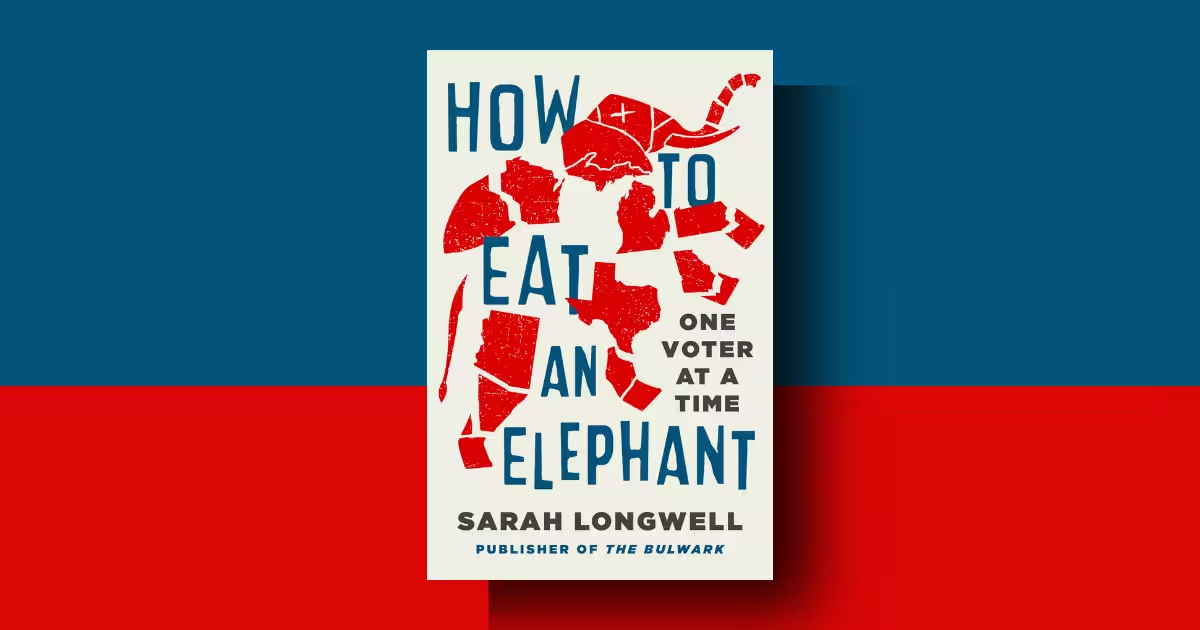

How to Eat an Elephant: One Voter at a Time is not a book about elephants. It is Sarah Longwell’s unflinching account of eight years spent listening to Trump voters in focus groups, and it might be the most important political book of 2026. Longwell, the publisher of The Bulwark, conducted over 400 of these sessions between 2018 and 2026, sitting behind one-way glass while voters explained why they still supported Donald Trump after January 6, after the Access Hollywood tape, after the lies about stolen elections.
She did not write this book to shame them. She wrote it to understand them, because she believes that defeating MAGA requires persuading a small slice of Trump’s coalition to abandon it.
That argument, laid out in 336 pages published by St. Martin’s Press on September 8, 2026, is both a diagnosis of what went wrong for Democrats and a playbook for how to fix it.\
Table of Contents
Snapshot
What is How to Eat an Elephant: One Voter at a Time about? It’s a political strategy book by Sarah Longwell, publisher of The Bulwark, published by St. Martin’s Press on September 8, 2026. The book draws on over 400 focus groups she conducted with thousands of voters between 2018 and 2026.
Her central argument is that defeating MAGA requires persuading a small percentage of Trump voters, not just turning out the Democratic base. She identifies six types of swing voters, explains the “Republican Triangle of Doom” that traps voters in a misinformation loop, and argues that Democrats must learn to communicate in the new media environment or keep losing.
Who will actually love How to Eat an Elephant?
Never Trump conservatives and former Republicans who need a framework for understanding how their party became unrecognizable.
Democratic strategists and campaign operatives who are tired of losing and want practical, evidence-based advice.
Anyone who has tried to talk politics with a Trump-voting family member and ended up screaming into the void.
Political junkies who listen to The Focus Group podcast and want the deeper analysis.
Who will bounce off How to Eat an Elephant?
Hardcore MAGA voters who will dismiss it as liberal propaganda (Longwell quotes them directly, and they don’t come off well).
Democrats who want pure moral condemnation of Trump voters without any attempt to understand them.
Readers looking for a quick, light read. This is dense, data-heavy, and emotionally taxing in places.
Introduction
How to Eat an Elephant: One Voter at a Time is Sarah Longwell’s first book, published by St. Martin’s Press on September 8, 2026. It runs 336 pages, and the audiobook version is narrated by Longwell herself at 8 hours and 29 minutes.
Before this book, Longwell was known as the publisher of The Bulwark, the co-host of The Secret Podcast with Jonathan V. Last, and the host of The Focus Group Podcast, where she plays raw audio from her focus groups with voters across the political spectrum.
What makes Longwell uniquely qualified to write this book is her background. She spent fifteen years as a Republican communications operative. She worked at the Intercollegiate Studies Institute, at Berman and Company (Rick Berman’s PR firm), and served on the national board of the Log Cabin Republicans. She is a lesbian who came out while working in conservative politics, which she describes as a complicated experience. She voted for John McCain in the 2000 primary and describes herself as a “John McCain Republican.”
In other words, she is not a lifelong Democrat who discovered Trump voters in 2016. She was one of them, culturally and professionally, for most of her adult life.
The book’s central thesis is stated clearly in the introduction: “I say all of this because I want you to understand my priors. I am not a disinterested observer when it comes to Sarah Longwell. I would run through walls for her. I would take a bullet for her.
And by the end of this book, you are likely to feel the same way.” That’s from the foreword by Jonathan V. Last. The actual thesis Longwell argues is simpler: You cannot save democracy with one election.
You save it by persuading a small percentage of Trump voters to abandon MAGA, election after election, until the movement collapses under its own contradictions.
Background and Context
Sarah Longwell’s political journey is the backbone of this book’s credibility. She grew up in Perry County, Pennsylvania, a rural county that voted 74 percent for Donald Trump in 2024. She describes her childhood as “culturally conservative” in the best sense: church on Sundays, hunter safety classes in school, the pledge of allegiance every morning.
She went to Kenyon College, came out as a lesbian in 2005, and spent the next decade working in Republican politics while trying to reconcile her personal identity with her party’s positions on gay rights.
The turning point was the 2016 election. She had been arguing since 2015 that Trump would lose the Republican primary. She was wrong.
She watched the Access Hollywood tape, the “grab them by the pussy” moment, and assumed Republican voters would finally abandon him. They didn’t. She resigned from the Log Cabin Republicans board in protest when the organization moved to endorse Trump retroactively.
What followed was a decade of focus groups. Over 400 of them, with thousands of voters. She tested messaging for Republican Voters Against Trump, a $50 million campaign in 2020. She built The Bulwark out of the ashes of The Weekly Standard. And she listened. That listening is the engine of this book.
How to Eat an Elephant Summary
Part I: The Communications Crisis
Longwell opens with a scene from the DealBook Summit in December 2024, one month after Trump’s reelection. She is on a panel with Kevin McCarthy, Jason Miller, Kellyanne Conway, and Anita Dunn. McCarthy is preening about Trump’s turnout numbers.
Miller is lecturing about the weaponization of the Justice Department. Conway arrives late and gasps performatively when Longwell says something impolite. Longwell describes the moment she “lost her shit” and told McCarthy, “You’re the one who went down and resurrected him.”
That scene sets up her central diagnosis: The Republican Triangle of Doom. It works like this. Trump says something false. Right-wing media amplifies it. GOP politicians validate it. Voters believe it.
And then politicians point to voters’ beliefs as proof they were right all along. Longwell writes: “They manufactured a narrow margin of consensus and could point to that consensus as evidence that they were correct. This sort of logical human centipede is usually called circular reasoning. I call it the Republican Triangle of Doom.”
She traces this through January 6. In the immediate aftermath, even two-time Trump voters were shaken. Jamie from Pennsylvania said she was “appalled” and “shocked.” Audra from Arizona said Trump should be impeached so he couldn’t run again.
Lindsey Graham said “count me out, enough is enough.” Mitch McConnell said Trump was “practically and morally responsible.” But within six months, the cement had hardened. By July 2021, Annette from Arizona was saying January 6 was “100 percent orchestrated from Antifa.”
Robert from Alaska said it was “all set up by the Democrat Party to make those people look bad.” Longwell writes: “Without trusted messengers to help them make sense of what’s happening, voters are vulnerable to whoever gets there first with a compelling story.”
Part II: The Six Types of Swing Voters
This is the section that makes the book genuinely useful. Longwell breaks down persuadable voters into six categories, each with its own motivations and openings for persuasion.
1. The Red-Pilled. These are voters who underwent a political conversion driven by cultural grievance. They didn’t leave the Democratic Party over taxes. They left because they came to see Democrats as the party of “woke” and elite condescension. Taylor from Arizona explained why he started listening to Joe Rogan and Matt Walsh: “They speak with intelligence, so I like these people.”
Oksana from Georgia said Democrats have become “a party of rich, like, celebrities.” Longwell notes: “The COVID pandemic was a major inflection point for many of them.” Arif from New York claimed the pandemic was “basically a lie.” Many are not social conservatives in the traditional sense.
They’re not trying to roll back gay marriage. But they believe Democrats are more focused on cultural issues than on the economic pressures dominating their daily lives.
2. The Realigners. These voters didn’t change. The parties did. There are two streams. The first is college-educated suburbanites who used to vote Republican but swung to Democrats because of Trump. Susan from Florida, a 2020 Trump voter who voted for Kamala Harris in 2024, said: “After seeing January 6 and how Trump didn’t do anything, I didn’t want to be a Republican anymore.”
The second stream is working-class voters who used to be Democrats and have moved toward Republicans. Jeni from Alabama said being a Democrat used to mean “you are working-class,” but now: “They remind me of my family. They just want to run everybody over.”
3. The Double Haters. These voters think both parties are corrupt and both candidates are terrible. Janiece from Florida called the parties “one snake and two heads.”
Tandra from North Carolina called both parties “trash.” Longwell notes: “The double haters are among the most gettable of all the swing voters. The bad news is that getting them requires a candidate with tremendous political talent.”
4. Hispanic Voters. Trump won 46 percent of the Hispanic vote in 2024, the highest for any Republican in history. But Longwell argues they’re moving back.
Evelin, a Biden-to-Trump voter from California, said: “I’m all for the ICE. I’m all for get the criminals out, but the way they’re approaching and separating families and the killings… I’m against that.” Longwell writes: “Hispanic voters moved to Trump on economics. They’re moving back because the deportation machine is in their communities.”
5. Low-Information Voters. These voters don’t follow politics. They’re news receivers, not news seekers. Drew from New York City said: “I don’t really watch the news at all. Just from scrolling on social media because at this point, every account ever is saying what’s happening.”
Longwell explains: “You don’t seek out news intentionally. News comes to you through your algorithms.” This is the hardest category to reach, but also potentially the most important.
6. Young Voters. Trump’s approval with young voters collapsed from -7 in March 2025 to -31.8 less than a year later. Kim from Virginia said: “There are things that are very disappointing and very rough right now.” Joseph from Michigan said: “Basic families are spending so much on just the cost of living that they don’t have a cost to save. There’s just no financial way out.” Longwell writes: “Trump didn’t own the votes of the young people who supported him in 2024; he rented them.”
Part III: The Issues That Decide Elections
The Economy. This is the number one issue, full stop. Longwell quotes Pierre, a black swing voter from Nevada: “The number-one thing for everyone who votes is whether they have enough food to eat and can put clothes on their children’s backs.”
She breaks down Trump’s five-act economic story: the golden memory of pre-COVID prosperity, the idea that Trump “can’t be bought” because he’s already rich, the perception that Trump takes action while Democrats talk, and the scapegoating of immigrants. She argues Democrats can flip this script by hammering on Trump’s broken promises. Sylvia from Michigan said: “It cost me $10 more [for an oil change], so I’m not seeing it.
And why I voted for Trump was for the prices to come down at the grocery store. Nothing’s come down.”
Immigration. Longwell argues that Trump won the narrative war on immigration by creating a “threat cluster” that collapsed immigration, crime, drugs, and terrorism into one emotional bundle.
She writes: “Democrats addressed Trump’s message at the level of motive (he’s appealing to racism) rather than the level of model (he’s offering a story about order and safety).
Calling out bigotry might be morally correct, but it doesn’t compete with a narrative that tells voters: I see what you see, I know you feel unsafe, and I will restore control.” Her recommendation: “Order without cruelty.” Democrats should lead with control, clarity, and protection, then offer compassion.
Trans Issues. This is the most uncomfortable chapter in the book, and Longwell knows it. She argues that Republicans have moved the debate to sports, puberty blockers, and surgery for minors, and Democrats have walked into the trap.
She quotes Lynn from Georgia, an “out gay woman” in Atlanta: “I thought the Democrats really led with the transgender issue. I have a difficult time with that topic.”
Longwell’s advice: “It’s okay to say that this is an issue we’re still working to understand as a country.” She argues Democrats should stop letting activists push them into unpopular positions and instead do the persuasion work first.
Part IV: The Path Forward
RIP GOP. The Republican Party is not coming back. Longwell writes: “The problem isn’t that Republican voters forgot what their party once stood for. They simply changed their minds.” She describes the GOP as now defined by its enemies rather than its ideology.
She predicts a schism between the MAGA Establishment (transactional, power-focused) and the America Firsters (ideologically committed to isolationism and populism) once Trump leaves the scene.
Wartime Generals. Democratic voters don’t want moderate or progressive. They want fighters. Brandon from Georgia said Democrats need to “fight fire with fire.” Ronald from North Carolina said the party needs someone “a little gangster.” Longwell writes: “They don’t want their own Donald Trump. They want their own apex predator.”
Offense. The final section is a playbook. Talk about the economy constantly. Frame every issue as an economic issue. Don’t be scared of immigration. Use “satisfy and steer” when cultural issues come up. Build media infrastructure. Make people laugh. Feed the good wolf.
How to Eat an Elephant Critical Analysis
How to Eat an Elephant is an outstanding and important book. It is not a comfortable read. Longwell quotes voters saying things that made me want to throw the book across the room.
But that discomfort is the point. She is asking readers to do something genuinely hard: listen to people you disagree with, not to change your mind, but to understand how they think. And she makes a convincing case that this understanding is the only path to defeating MAGA.
Longwell’s evidence is her strongest asset.
She has conducted over 400 focus groups. She quotes voters directly, extensively, and without condescension. She does not tell you what to think about the voters. She lets them speak. The result is a book that feels less like an argument and more like a window into a country most politically engaged people never see.
The book’s logical structure holds up. She moves from diagnosis (the communications crisis, the Triangle of Doom) to categorization (the six voter types) to prescription (the playbook). Each section builds on the last. The personal narrative, her journey from Republican operative to anti-MAGA strategist, is woven throughout, which keeps the book from becoming dry. The foreword by Jonathan V. Last is also a smart addition. Last’s voice, self-deprecating and blunt, provides a counterpoint to Longwell’s more optimistic tone.
Strengths and Weaknesses
What worked for me:
The focus group quotes are devastating and illuminating in equal measure. Longwell’s willingness to let voters say things that are factually wrong without correcting them in the moment is the book’s greatest strength.
The “Triangle of Doom” framework is genuinely useful. I’ve been thinking about politics for years, and I had never seen the circular reasoning of the right-wing media ecosystem explained so clearly.
The chapter on character is the best in the book. Longwell traces how “character” went from a conservative value to something Trump voters actively reject. The line “What you see is what you get. Trump is predictably, genuinely transgressive. He’s an honest bullshit artist” will stay with me.
The practical advice is specific. “Satisfy and steer” on trans issues. Talk about the economy constantly. Build media infrastructure. This is not vague hand-wringing.
What didn’t work:
The book is dense. There are moments, especially in Part II, where the voter quotes start to blur together. I found myself wishing for more synthesis and fewer transcripts.
Longwell’s optimism sometimes feels strained. She argues that voters are persuadable, but the evidence she presents also suggests that many are not. The book could have acknowledged this tension more directly.
The title is a metaphor that doesn’t quite land. How to Eat an Elephant is a cliché about big tasks, and the book’s engagement with it is minimal.
Comparison with Similar Works
If you’ve read Hillbilly Elegy by J.D. Vance, you’ll notice the contrast immediately. Vance’s book was a memoir about a specific community. Longwell’s is a data-driven analysis of a national phenomenon. Vance tried to explain Trump voters to elites. Longwell tries to explain how to beat them.
The Death of Truth by Michiko Kakutani covers similar ground on the collapse of shared reality, but Kakutani is a cultural critic, not a political strategist. Her book is a lament. Longwell’s is a playbook.
Democracy in Chains by Nancy MacLean traces the intellectual roots of the right’s assault on democracy. Longwell is less interested in intellectual history and more interested in what voters actually say in a conference room in Ohio.
The closest comparison is probably What Happened by Hillary Clinton, but that book was written from a place of defeat and explanation. Longwell’s book is written from a place of strategy. She is not asking why she lost. She is asking how to win.
Conclusion and Recommendation
“How to Eat an Elephant: One Voter at a Time” is a necessary book for anyone who cares about American democracy. It is not an easy read, and it is not a comforting one.
But it is a useful one. Longwell has done the work that most of us are too lazy or too angry to do. She has sat in rooms with Trump voters and listened. And she has come back with a message that is equal parts warning and hope.
Who should read this book: Democratic strategists, Never Trump conservatives, politically engaged citizens who are tired of losing, and anyone who has ever tried to argue with a family member about politics and failed. If you are a MAGA voter, this book will make you angry. That might be the point.
Who should skip it: Readers looking for a quick, light, or purely entertaining read. This is a dense, data-heavy book that requires attention and emotional stamina. If you are not ready to listen to voters you disagree with, you are not ready for this book.
I finished How to Eat an Elephant feeling something I had not felt in years: genuinely hopeful about the possibility of persuasion. Longwell’s argument is not that everyone can be reached. It is that enough people can be reached to make a difference. And she makes you believe it, one voter at a time.




