
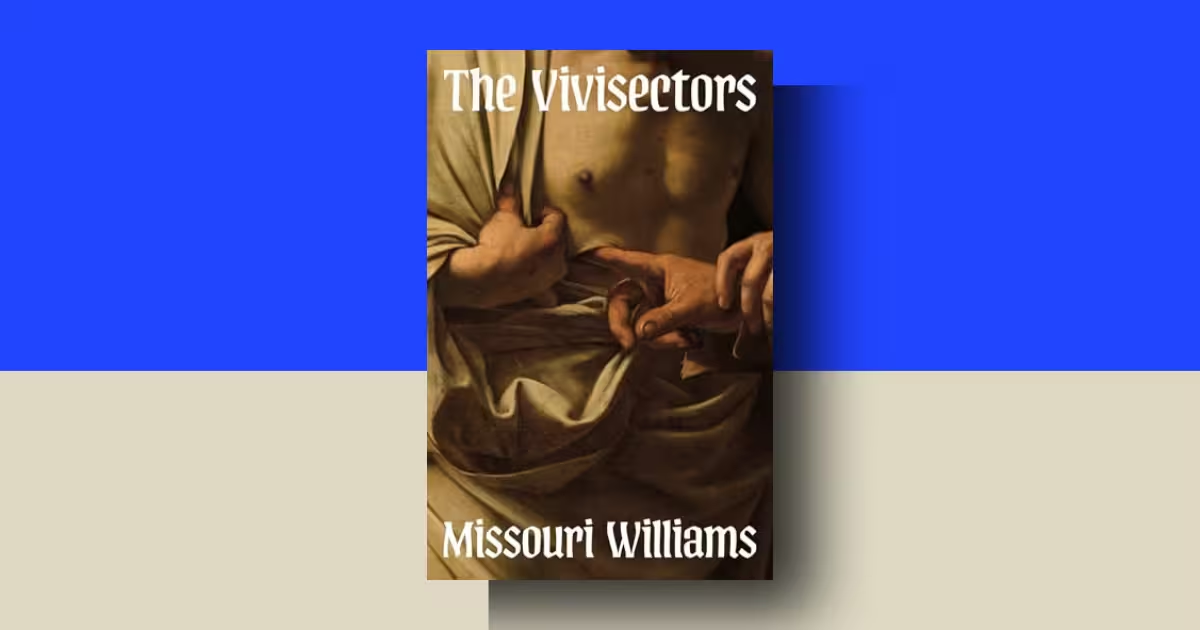

The Vivisectors by Missouri Williams is a dark, unsettling novel that turns a decaying university city into a disturbing examination of power, cruelty, isolation and love. At its centre is Agathe, an emotionally detached young woman who ghostwrites for a fraudulent academic before being drawn into the troubled world of Adam, a charismatic student whose presence exposes the fractures surrounding them.
What begins as a strange campus story gradually becomes something much larger: a psychological and philosophical novel about people who dissect one another in search of truth while failing to understand themselves. Williams makes that tension especially powerful by surrounding her characters with a city being reclaimed by nature and institutions quietly collapsing from within.
Missouri Williams’s The Vivisectors is not a book you read so much as a book that reads you back, slowly, with a scalpel. Longlisted for the 2026 Booker Prize, this second novel from the author of The Doloriad takes the familiar furniture of the campus novel (ambitious students, scheming professors, crumbling institutions) and douses it in petrol.
What emerges is a story about a young woman named Agathe who works as a ghostwriter for a fraudulent academic, gets sent to spy on a charismatic student named Adam, and finds herself, against every instinct she has, beginning to feel something.
I finished it three weeks ago and I still cannot decide whether it is a love story or an autopsy report. Perhaps it is both.
Table of Contents
1. Summary
The Vivisectors by Missouri Williams is a psychologically intense literary novel about Agathe, a detached young woman who works as a ghostwriter for a wealthy academic and becomes involved with Adam, a charismatic student caught in a university controversy. Set in an unnamed city slowly being overtaken by vegetation, the novel explores power, institutional decay, alienation, cruelty, identity and love.
What is The Vivisectors about?
It follows Agathe as she moves between her dysfunctional family, her fraudulent academic employer and the university world surrounding Adam. When Adam becomes embroiled in a conflict with a professor, Agathe is sent to observe him. Their relationship gradually becomes more complicated as observation turns into emotional involvement.
Who is Agathe?
Agathe is the novel’s detached and unreliable narrator. She repeatedly claims to feel little or nothing, describing herself as having a “big dead rock” at the centre of her soul, yet her actions reveal emotions that she struggles to acknowledge.
What are the main themes of The Vivisectors?
The major themes include power, institutional decline, nature versus human control, loneliness, cruelty, identity, interpretation and love. The title becomes particularly significant when characters describe people as “vivisectors”—those who dissect every action, motive and mistake until human relationships become objects of analysis rather than genuine encounters.
Is The Vivisectors a love story?
Yes, but it is an unconventional and deeply unsettling one. Agathe and Adam are both emotionally complicated characters who struggle to distinguish genuine connection from observation, performance and manipulation. The novel ultimately asks whether love requires believing in another person even when the available evidence gives us reasons to doubt.
Why is nature important in The Vivisectors?
The city is being overtaken by vegetation, while gardeners attempt to control the advancing wilderness. The natural world becomes a powerful metaphor for forces that human institutions cannot permanently suppress. The narrator observes that nature can be cut down and controlled temporarily, only to return again.
Reader recommendation for The Vivisectors: Who will actually love this, and who will bounce? If you are the kind of reader who needs to like the people you are reading about, this is not your book. Agathe is cold, cruel, and frequently repulsive. She sits in her paralysed mother’s lap to operate a wheelchair. She confesses, “I’ve always wanted to break people”.
But if you loved Ottessa Moshfegh’s My Year of Rest and Relaxation, or Julia Armfield’s Private Rites, or anything where the prose itself is the point, you will find something extraordinary here. This is a novel for people who have grown tired of being told what to feel.
2. Introduction
The Vivisectors by Missouri Williams. Published by 4th Estate (HarperCollins) in the UK on 21 May 2026, and by Farrar, Straus and Giroux in the US on 26 May 2026. 304 pages.
Longlisted for the 2026 Booker Prize. Williams’s debut, The Doloriad, won the 2023 Republic of Consciousness Prize. She lives in London.
Publication context: The book arrived with considerable fanfare. Vulture named it one of the most anticipated books of 2026. 4th Estate acquired it in an eight-publisher auction, a detail that tells you something about the industry’s confidence in Williams’s trajectory.
3. Background
The novel is set in an unnamed university city that resembles Oxford or Cambridge but is deliberately stripped of that specificity. The city is being overtaken by vegetation. The gardeners, a mysterious workforce who keep the growth at bay, have entered into a bitter dispute with the university. The academics want them to maintain the college lawns but leave the rest of the city to rot.
The gardeners want to impose order everywhere. The result is a stalemate that mirrors the larger decay of the city itself.
This backdrop matters because The Vivisectors is not really about campus politics. It is about a world where the systems that are supposed to hold things together (universities, families, cities) have all quietly stopped working, and the people inside them have learned to live with the failure.
4. The Vivisectors Plot Summary
The novel opens with a suicide attempt. Agathe’s mother has tried to drown herself in the bath. She has succeeded in damaging her brain but not in dying.
She is left mute, paralysed, and vacant, a “vegetable in a chair.” Agathe’s uncle, with whom she lives in a decaying house on the edge of the park, tells her the news over breakfast. Agathe feels nothing, or rather she feels something that she refuses to call feeling. She goes to her boss’s house, does her job, and carries on.
Agathe works for a woman she calls “my boss,” a wealthy foreign academic who teaches city planning at the university but whose lectures, emails, and research are all actually written by Agathe. The boss is a “mountainous woman with huge, rolling hips” who eats tapioca pudding from a silver tureen and talks endlessly about her own suffering.
She is in love with Adam, a student in her department, a charismatic and manipulative young man from her own city. When Adam gets into a fight with another professor named Jacob, the boss asks Agathe to befriend Adam and report back.
Agathe does. She goes to the university library every afternoon and finds Adam in the theology section. She introduces herself, invents a research project about mercy and forgiveness, and begins a strange, slow dance of mutual observation. Adam is handsome, charming, and damaged. He is also, as Agathe quickly realises, performing. She tells him stories about her boss, disguising the boss as her mother. She shares nothing real.
In the meantime, Agathe’s father demands that she visit her mother. The mother sits in an electric wheelchair on the lawn, wrapped in blankets and wearing black wraparound sunglasses. Agathe cannot push the chair across the grass.
So she climbs into her mother’s lap and operates the chair from there, her legs hooked over the armrest, her body pressed against the warm, blank mass of her mother’s torso. It is one of the most disturbing scenes I have read in years. Agathe feels nothing, she says, except maybe a distant sorrow she cannot name.
Adam and Agathe grow closer. He tells her about his childhood, about his parents, about his desire to be an architect. He takes her hand. He kisses her. He shows up at her uncle’s house one night and they have sex. Agathe cries. Adam licks her tears.
But then Adam finds out that Agathe was sent by her boss to spy on him. He does not seem to care. What he cares about is that Agathe does not seem to care about his fate. He is going to be expelled. His future is collapsing. And Agathe has not once asked him what he is going to do. She has been treating him as an object of study, not a person.
The novel’s climax involves the university administration, the gardeners, a fete in the great court, and a series of revelations about Agathe’s family. Her father tells her that she was responsible for some unspecified accident on the stairs when she was a child, an accident that left her mother traumatised and that her parents have spent her whole life writing around. The final image is of Agathe pushing her mother into a pond in the gardeners’ hall and leaving her there.
The novel ends with Agathe telling Adam the story of an albino whale. The villagers loved the whale, the whale disappeared, a dead whale washed ashore, and the villagers refused to believe it was theirs. It is a story about faith, about refusing to accept what is in front of you, about the things we refuse to see because seeing them would require us to change.
Agathe tells Adam this story as if it is the greatest love story of all time. And then, for the first time in the novel, she extends her hand. He takes it.
5. The Vivisectors Analysis
5.1. Characters
Agathe is the novel’s narrator and its central problem. She is a misanthropist who cannot admit that she has feelings. She tells us repeatedly that she feels nothing, that she has a “big dead rock” at the centre of her soul, that she is a “ghost.” But the novel is full of evidence to the contrary. She cries in the library. She feels sick when Adam touches her.
She envies her mother’s vegetable state because it represents a kind of freedom from thought. Agathe’s unreliability as a narrator is the engine of the book. We cannot trust her when she says she feels nothing. We can only watch what she does.
Adam is the object of Agathe’s study and the engine of the novel’s plot.
He is charming, manipulative, and genuinely wounded. He has been treated unfairly by the university, but he has also treated others unfairly. He is “an active star,” as Agathe puts it, a person who creates problems wherever he goes. He is also, in his own way, trying to reach Agathe. He tells her, “I like you,” and means it. He is the first person who has ever really looked at her.
My boss is a grotesque comic figure who becomes something more than that by the end. She is a wealthy woman who has bought her way into academia, a woman who talks endlessly about her suffering while doing nothing to alleviate it. She is also, in her own way, lonely. Her final confrontation with Agathe is one of the novel’s most moving scenes, precisely because it refuses to sentimentalise her.
5.2. The Vivisectors Themes
The novel’s central theme is power. Who has it, who wants it, and what they are willing to do to keep it. The university is a machine for preserving power.
The gardeners, who are treated as servants, actually hold the city together. The academics, who are supposed to be the guardians of knowledge, are hollow. Adam and Jacob’s fight is not about justice; it is about power. Everyone is using language to get what they want, and nobody is telling the truth.
The second theme is decay. The city is rotting. The vegetation is winning. The university is collapsing. The family is broken. Agathe’s body is described as “a great big lump of stone.” The novel is obsessed with the material reality of decay, with the way things fall apart.
The third theme is love, and this is where the novel gets interesting. Because The Vivisectors is, as the Booker judges put it, “a new kind of love story.” It is a love story about two people who cannot express love, who have been taught that love is weakness, and who nonetheless find themselves drawn to each other. The albino whale story is the key.
The villagers love the whale. The whale disappears. A dead whale washes ashore. The villagers refuse to believe it is theirs. That is what love is, the novel suggests: the refusal to accept the evidence, the insistence on believing in something that might not be there.
6. Evaluation
This is a brilliant, infuriating, and unforgettable novel. It is not a pleasant read. It is not meant to be.
Strengths: The prose is extraordinary. Williams writes with a precision that is almost surgical. Every sentence feels calibrated. The dialogue is sharp and strange. The characters are monstrous but compelling. The novel’s central idea (that a woman who feels nothing might be the only person capable of telling the truth about a world that has stopped feeling) is executed with real rigour.
Weaknesses: The pace flags in the middle. There are sections where the philosophical discussions between Agathe and Adam become repetitive. The ending is ambiguous to the point of frustration. Some readers will finish the book and wonder what, exactly, they were supposed to take away from it.
Impact: The Vivisectors stayed with me for weeks. I found myself thinking about Agathe’s mother in the wheelchair, about the albino whale, about the gardeners’ silent rebellion. The novel is not just a story; it is an argument about what fiction can do. It is a book that trusts its readers to sit with discomfort, to resist easy conclusions, to keep reading even when the characters are unlikable.
Comparison: The obvious comparison is Ottessa Moshfegh, but Williams is doing something different. Moshfegh’s narrators are passive; Agathe is active. She chooses her cruelty.
She chooses her silence. She chooses, in the end, to reach out her hand. The novel also recalls Rachel Cusk’s Outline trilogy, in the way it uses a passive narrator to refract the stories of others, and Clarice Lispector’s The Passion According to G.H., in its obsession with the materiality of the self.
Adaptation: There is no adaptation as of this writing. The novel’s interiority would make it very difficult to film. But a stage adaptation, or a radio play, might work. The dialogue is strong enough to carry it.
7. Personal Insight with Contemporary Educational Relevance
The most important theme in The Vivisectors, for me, is the idea that the institutions we build to protect us can also become the things that trap us. The university in the novel is a place of decay.
It is not educating anyone. It is not producing knowledge. It is a machine for preserving the power of a small group of people who have no idea what they are doing. The international students are cash cows. The gardeners are servants. The academics are frauds.
This resonates with contemporary debates about higher education. In the UK, tuition fees have risen to £9,535 per year for 2025/26, and many students are graduating with debt they will never repay. Universities are increasingly run like businesses, with vice-chancellors earning six-figure salaries while staff are on insecure contracts.
The novel’s vision of a university that has become a “transparent citadel” where “human axolotls masquerading as professors and students are bent on drawing and quartering each other with no mercy” is exaggerated, but it is not entirely fictional.
The novel also speaks to the climate crisis. The vegetation that is overtaking the city is a metaphor for the natural world reclaiming what we have taken from it.
The gardeners, who are trying to hold back the growth, are fighting a losing battle. The academics, who have given up, are the ones who are right. “Nature doesn’t care about us at all,” Agathe says. “We can beat it down and tear it to pieces, but it just lies there mutely, saying nothing, before it comes back again.” That is the truth of the Anthropocene. We can build all the walls we want.
The water is still rising.
8. The Vivisectors Quotes
On self-knowledge: “When I think about myself, I see that black stone. When I think about the world around me, I see an arrangement of walls, each enclosing and excluding different planes of emptiness, fields where nothing grows and villages devoid of inhabitants.”
On cruelty: “I’ve always wanted to break people. I love fixing things for people, but I need to humble them at the same time. I give help, but only on my terms.”
On love: “It is the same old problem. I couldn’t run away but I couldn’t go towards him either. I had no idea what I wanted. I hadn’t thought that I’d wanted anything.”
On the city: “This city had a dream. It dreamt of this tower. And if in building this tower we had willingly lost touch with one kind of truth, we had lost it to gain another.”
On the whale: “What are the chances of two albino whales occupying the same waters at the same time? And when one disappears that the other washes ashore? It takes great strength of character to go on living when everything seems to add up. It takes great strength of character to insist on coincidences, to believe that in the infinite churn of anonymous events something so readable can emerge without being true. This is what faith is.”
9. Conclusion
The Vivisectors is not a book for everyone. It is cold, difficult, and frequently unpleasant. But it is also one of the most original and intelligent novels I have read in years. It is a book about a woman who cannot feel, written by an author who understands exactly what feeling costs. It is a book about a city that is dying, written with a precision that makes every sentence feel inevitable.
I recommend it to readers who loved The Doloriad, to fans of Ottessa Moshfegh and Julia Armfield, and to anyone who is tired of novels that tell them what to think.
This is a book that trusts you to sit with discomfort. It rewards patience. And its final image, of Agathe reaching out her hand, is one that I will be thinking about for a long time.





