
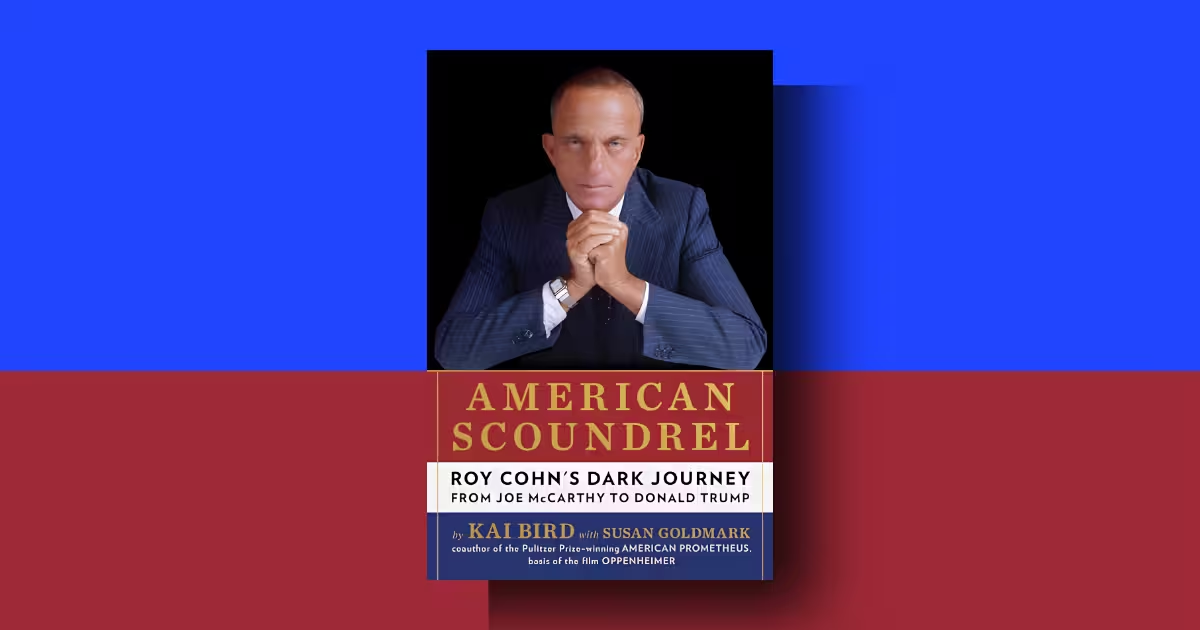

I finished American Scoundrel: Roy Cohn’s Dark Journey from Joe McCarthy to Donald Trump by Kai Bird and Susan Goldmark in four sittings, and I kept doing something I rarely do with a 528-page biography. I kept reading passages out loud to whoever was in the room. Not because the writing is flashy. Because Roy Cohn keeps talking, and every time he opens his mouth in this book, he makes the case against himself better than any prosecutor ever could.
That is the review in one sentence: American Scoundrel does not need to editorialize Roy Cohn into a villain. It just quotes him.
Table of Contents
Summary
American Scoundrel: Roy Cohn’s Dark Journey from Joe McCarthy to Donald Trump is a 528-page biography by Pulitzer Prize winner Kai Bird and his wife and lead researcher, Susan Goldmark, published by Scribner on September 1, 2026 (ISBN 9781668031575, $32.00 hardcover).
It traces Roy Cohn (1927–1986) from his role as prosecutor in the 1951 Rosenberg espionage trial, through his years as Senator Joseph McCarthy’s chief counsel during the Army-McCarthy hearings, into his decades as a mob-connected New York fixer, and finally into his most consequential act: mentoring a young Donald Trump starting in 1973. Cohn was disbarred in June 1986 and died of AIDS-related complications on August 2, 1986, weeks after his disbarment.
The book’s central argument is that Trump’s political style, the counterpunching, the denial of wrongdoing, the exploitation of the media, and the loyalty-over-ethics worldview, was learned directly from Cohn. If you want to understand where Trumpism’s playbook actually came from, this book gives you the answer in granular, well-sourced detail, and it does it mostly through Cohn’s own recorded words.
Who Should Read This (And Who Should Bounce)
You’ll love this book if:
- You want to understand the direct, personal line between McCarthyism and Trumpism, told through one man who lived both eras
- You enjoy political biography that reads like narrative nonfiction, not an academic monograph
- You want primary-source quotes, not secondhand summary. Cohn gave dozens of on-the-record interviews before he died, and Bird and Goldmark use them heavily
- You already liked Bird’s Pulitzer-winning American Prometheus (the basis for Christopher Nolan’s Oppenheimer) and want his same style applied to a much sleazier subject
You’ll probably bounce if:
- You’re looking for a balanced or sympathetic account. This book is not interested in redeeming Cohn, and it says so from the first page
- You want deep legal or constitutional analysis of McCarthyism rather than a character study built around one man
- You find extended cataloging of fraud, sexual hypocrisy, and mob ties exhausting rather than illuminating. This book has a lot of that, chapter after chapter
- You already know the broad Cohn story from Tony Kushner’s play Angels in America or the documentary Where’s My Roy Cohn? and want new territory rather than a fuller, footnoted version of what you already know
Introduction
American Scoundrel: Roy Cohn’s Dark Journey from Joe McCarthy to Donald Trump was written by Kai Bird, with Susan Goldmark credited as coauthor and, in Bird’s own description in his acknowledgments, his “chief researcher” for the project. Scribner published the hardcover on September 1, 2026, running 528 pages under ISBN 9781668031575, at a list price of $32.00. An eBook (ISBN 9781668031599) and an unabridged audiobook read by Ari Fliakos are also available.
Kai Bird is not a neutral first-time biographer picking up an interesting subject. He won the Pulitzer Prize for Biography, jointly with Martin J. Sherwin, for American Prometheus: The Triumph and Tragedy of J. Robert Oppenheimer (2005), the book that Christopher Nolan adapted into the 2023 Best Picture winner Oppenheimer.
I have written before about that film and the McCarthy-era security hearing that destroyed Oppenheimer‘s career, so watching Bird return to the same decade from Roy Cohn’s side of the table felt like closing a loop. Bird also wrote The Chairman (a biography of John J. McCloy), The Color of Truth (about the Bundy brothers), and The Outlier, a study of Jimmy Carter’s presidency.
He runs the Leon Levy Center for Biography at the CUNY Graduate Center and is an elected member of the Society of American Historians. Susan Goldmark, his wife, has a graduate degree in development economics from Princeton and spent decades working in more than seventy-five countries for the World Bank.
She is not a professional writer by trade, but Bird credits her as having led the research for this book, which likely explains its density of court records, FBI files, and interview transcripts.
Genre-wise, this sits squarely in political biography and twentieth-century American history, with a heavy dose of true crime given how much of Cohn’s life involved mob clients, indictments, and financial fraud.
The book’s thesis is stated plainly in the preface and repeated in the acknowledgments: Roy Cohn is not a footnote to McCarthyism who happened to know Donald Trump later in life. He is the connective tissue between two of the ugliest chapters in modern American politics, and understanding Trump requires understanding the specific man who trained him.
Bird writes that after finishing his 2021 Carter biography, he had what he calls an epiphany, realizing that he had “somehow underestimated the significance of Roy Cohn” across four decades of writing about the American establishment, because Cohn kept appearing as a minor, obstructive character in the lives of McCloy, the Bundys, Oppenheimer, and Carter.
Background
You do not need a history degree to follow this book, but a little context helps. Roy Cohn came of age during the Second Red Scare, the period from the late 1940s through the 1950s when fear of Soviet espionage and domestic communism dominated American politics.
The Soviet Union’s surprise 1949 atomic test, the conviction of Alger Hiss for perjury in January 1950, and the arrests of Klaus Fuchs, Harry Gold, and David Greenglass on espionage charges all fed directly into the case that made Cohn’s early career: the prosecution of Julius and Ethel Rosenberg.
From there, Cohn became chief counsel to Senator Joseph McCarthy of Wisconsin during the height of McCarthyism, then spent three decades as a New York lawyer whose client list ran from Studio 54’s owners to reputed Mafia figures to, starting in 1973, a young real estate developer named Donald Trump. Cohn died of AIDS-related complications in 1986 while publicly denying he had the disease.
He resurfaced culturally in 1991 and 1992 as a character in Tony Kushner’s Pulitzer Prize-winning play Angels in America, and more recently as a supporting figure in the 2024 film The Apprentice, for which actor Jeremy Strong received an Academy Award nomination.
Bird published this book in 2026, during Trump’s second presidential term, and he is candid about the timing. In the acknowledgments, he recounts telling Trump he was writing a Cohn biography, to which Trump reportedly replied, “That’s exciting,” before asking whether Bird would have written it “if I wasn’t his client.”
Bird says he began the project back in 2022, before Trump’s reelection, which suggests the book was not conceived as a campaign-season hit job, even though it will almost certainly be read as one by Cohn and Trump’s remaining defenders.
American Scoundrel Summary
I am going to walk through this in enough detail that you will not need to go back to the book to know the shape of Cohn’s life. If you want the granular court-case-by-court-case detail, the book has twenty-eight chapters and you should still read it. But here is everything that matters.
The making of a fixer (Chapters 1–3). Cohn was born in the Bronx in 1927 to Albert Cohn, a state supreme court judge, and Dora Marcus Cohn, whose banking family arranged the marriage as what the authors call a “calculated transaction,” trading Dora for a judgeship for Albert.
Roy’s uncle, Bernard “Bernie” Marcus, ran a bank empire that collapsed in 1929, sending him briefly to Sing Sing prison, a formative early lesson for young Roy in how quickly power and respectability can turn on a person.
Cohn grew up with connections, not talent alone. He was initially rejected by Columbia Law School and got in anyway through his family’s influence, which the book frames as the first proof of Cohn’s guiding principle: bend the rules if you have the right connections.
The Rosenberg case (Chapters 4–5). This is where the book earns its narrative tension. At twenty-four years old, Cohn was already maneuvering behind the scenes of “the trial of the century,” as J. Edgar Hoover called it.
Bird and Goldmark document, using Cohn’s own later confessions to journalists Sidney Zion and Sam Roberts, that Cohn engaged in improper ex parte communications with the trial judge, Irving Kaufman, whom Cohn had personally helped get assigned to the case.
Cohn told Zion decades later, “Saypol and I were in constant communication with Judge Kaufman,” directly contradicting his earlier public denials. The book also details how Cohn pressured witness David Greenglass into implicating his own sister, Ethel Rosenberg, by threatening to prosecute Greenglass’s wife otherwise. Julius and Ethel Rosenberg were executed on June 19, 1953. Cohn never expressed regret. His quoted line, used as an epigraph in the book, is chilling in its flatness: “I would have pulled the switch myself.”
McCarthyism and the book-burner years (Chapters 6–10). Cohn became chief counsel to Senator Joseph McCarthy and, in 1953, forced U.S. Information Agency libraries across Europe to purge roughly thirty thousand books, including works by W. H. Auden and John Dewey, on the grounds that the authors were supposedly communist sympathizers.
This section covers the Army-McCarthy hearings, Cohn’s infamous efforts to secure preferential treatment for his friend and rumored lover, David Schine, after Schine was drafted, and McCarthy’s eventual Senate censure in December 1954. McCarthy’s career and health collapsed afterward; he died in 1957 from complications related to alcoholism. Cohn, by contrast, simply moved to New York and reinvented himself.
The New York fixer years (Chapters 11–19). This is the longest stretch of the book, and it is genuinely astonishing how much sleaze it fits in. Cohn built a legal practice representing Mafia figures, corrupt judges, and New York political machines across party lines.
He was indicted three times on federal charges including bribery, extortion, and perjury, and acquitted all three times, each time prosecuted by U.S. Attorney Robert Morgenthau, whom Cohn accused of running a personal vendetta on behalf of Robert Kennedy. Slate critic Laura Miller’s assessment of this stretch of the book is accurate: it reads like “a bounteous cornucopia of midcentury sleaze,” complete with forgery, insurance scams, tax evasion, and even alleged mob-ordered killings connected to Cohn’s circle.
Throughout, Cohn was living a closeted gay life while publicly opposing gay rights legislation in the New York City Council, a hypocrisy the book documents through firsthand accounts from people like Manhattan borough president Andy Stein, who describes Cohn personally lobbying him against a gay rights bill.
Donald Trump and Studio 54 (Chapters 20–22). Cohn met Trump at Le Club, a private Manhattan dinner venue, in late October 1973, when Trump was a twenty-seven-year-old, largely unknown aspiring developer trying to expand his father Fred Trump’s outer-borough real estate business into Manhattan.
Trump needed a lawyer because the Justice Department had just sued the Trump family’s company for racial discrimination in housing, alleging that thirty-nine Trump-owned buildings in Queens, Brooklyn, and Staten Island systematically marked rental applications from Black applicants with a large “C.” Cohn’s advice, quoted directly in the book, was blunt: “Tell them to go to hell and fight the thing in court and let them prove you discriminated.”
That single piece of advice, the book argues convincingly, became the template for essentially every controversy of Trump’s subsequent career: deny everything, counterattack immediately, never settle, never apologize. Cohn later called Trump his “best friend” and claimed Trump phoned him a dozen times a day.
The two men were also fixtures together at Studio 54, the disco club Cohn represented as legal counsel, where Trump later admitted to Bird, in an interview conducted for this book, that he witnessed group sex happening openly in the club’s VIP areas.
Decline and death (Chapters 23–28). The final third of the book covers Cohn’s later legal troubles, his increasingly reckless business dealings, his diagnosis with AIDS (which he publicly and repeatedly denied even as he privately sought experimental treatment, reportedly with help arranged through Reagan administration contacts), and his formal disbarment by New York State in June 1986 on charges of perjury and fraud.
Cohn responded to the seven-member Disciplinary Committee by calling them “a bunch of yo-yos.” He died on August 2, 1986, roughly two months after his disbarment, with his last partner, Peter Fraser, holding his hand. He chose the epitaph “Lawyer and Patriot” for his crypt.
The book closes by tracing Cohn’s cultural afterlife through Tony Kushner’s Angels in America, where Cohn appears as a character confronted by the ghost of Ethel Rosenberg, and through the AIDS Memorial Quilt, which by the time of a 1996 Capitol Mall display carried roughly 39,000 panels commemorating AIDS deaths, Cohn’s own contested legacy folded permanently into that larger epidemic and its politics.
American Scoundrel Analysis
Here is where I will give you my honest opinion rather than another summary. American Scoundrel is, in a word, gripping. Bird and Goldmark do not just assert the McCarthy-to-Trump throughline, they build it out of documented behavior repeated across five decades: the denial-and-countersue instinct, the cultivation of tabloid gossip columnists as personal weapons, the transactional friendships that dissolve the moment they stop being useful, the closeted contradiction between private conduct and public moralizing.
When you read the Rosenberg chapters and then the Trump discrimination-lawsuit chapters back to back, you see the same man giving the same advice twenty years apart, and it lands harder than any thesis statement could.
Where the book is most effective is its sourcing. Cohn gave extensive on-the-record interviews across his life, to Sidney Zion for a 1988 posthumous “autobiography,” to journalist Sam Roberts, and to writer Peter Manso, and Bird and Goldmark quote him constantly rather than paraphrasing him into a safer, more distant portrait.
Publishers Weekly, in its starred review, called the result “an extraordinary portrait of a singular American figure,” and I agree that the specificity is what makes it work. This is not a book arguing from vibes. It is a book built from depositions, disbarment hearing transcripts, and Cohn’s own contradictory public statements laid side by side.
Does the book fulfill its stated purpose? Mostly, yes. Kirkus, in its own starred review, called it “a thorough, deeply reported life story of the gleefully villainous lawyer who molded a U.S. president,” and that word “molded” is doing real work.
American Scoundrel does not claim Cohn invented Trump’s character from nothing. It claims Cohn gave an already ambitious, image-obsessed young man a specific operating manual, and then it shows you the manual, page by page, decade by decade.
Strengths and Weaknesses: My Honest Reading Experience
What I found compelling:
The book never slows down to lecture you about why any of this matters politically today. It trusts you to draw the line from 1953 to 2026 yourself, and because the parallels are so specific (the counterpunching, the denial, the use of loyal media contacts), the line draws itself.
I also appreciated that Bird does not let Trump off the hook as a passive student. The book makes clear Trump embellished his own account of meeting Cohn in his 1987 book The Art of the Deal, and Bird flags the discrepancy directly rather than quietly accepting Trump’s version.
The reporting on Cohn’s closeted sexuality and his active opposition to gay rights legislation, while he was privately living a gay life, is handled with real nuance.
It is not played for shock value. It is presented as the central psychological engine of the man, the gap between Cohn’s public performance and private reality that the book argues explains almost everything else about him, including his relentless need for control.
Where the book falls short:
At times the sheer accumulation of fraud cases, indictments, and business scams in the middle third of the book becomes numbing rather than illuminating. Chapters 23 through 26 in particular cover so many overlapping legal and financial schemes that I found myself losing track of which specific fraud was under discussion, even though each individual episode is well documented.
A tighter edit here, trimming maybe forty or fifty pages, would have kept the momentum from the Trump chapters going instead of letting it dissipate into an undifferentiated parade of sleaze.
I also wanted more direct engagement with the counterargument some of Cohn’s own contemporaries made, that his aggressive tactics were simply a more extreme version of what every ambitious New York lawyer of his era did, and that singling him out as uniquely evil lets the broader establishment that tolerated and profited from him off too easily.
The book gestures at this (the New York Daily News quote about Cohn as “the city’s preeminent manipulator” reaching “into City Hall, the mob, the press, the Archdiocese”) but does not fully interrogate why so many respectable people, judges, cardinals, senators, kept inviting him to dinner.
How the Critics Reacted
I want to be straight with you here rather than just cherry-picking blurbs.
The reception has been remarkably consistent for a book about such a divisive subject. Publishers Weekly also starred it. Booklist starred it as well, describing it as “deeply researched, admirably balanced, and propulsively paced.”
In the New York Times, critic Jennifer Szalai called it “a thorough and readable account of Cohn’s astonishing life and career.” The Atlantic praised how the book reframes McCarthyism itself as being “about ambition and careerism, rather than ideology.”
Jack Shafer at Bloomberg wrote that “if Lucifer had practiced law, his career might have resembled Cohn’s.” The Guardian‘s Martin Pengelly called it “a book Trumpworld doesn’t want you to read.” Not every outlet loved it unconditionally.
Some reader reviews on Goodreads note that the book’s exhaustive cataloging of Cohn’s misdeeds can feel repetitive by the halfway point, which tracks with my own reaction to the middle chapters.
But I found no major outlet disputing the book’s factual reporting or its central argument. The disagreement, where it exists, is about pacing and length, not accuracy.
Comparable Books and Media Worth Knowing About
If American Scoundrel interests you, a few other works sit naturally alongside it. Tony Kushner’s play Angels in America: A Gay Fantasia on National Themes remains the definitive cultural portrait of Cohn as a symbol, and reading Bird’s factual account after (or before) watching a production of the play gives both works more weight.
Sam Roberts’s earlier biography, originally published in the 1980s and later updated, covers similar ground with less access to the Trump-era material Bird had available.
Ivy Meeropol’s documentary Bully. Coward. Victim.: The Story of Roy Cohn is a strong visual companion, built partly from the same interview archive Bird draws on.
If you want Kai Bird’s writing on a completely different subject handled with the same investigative patience, I covered his Pulitzer-winning American Prometheus and its connection to the McCarthy-era security hearings that broke Oppenheimer’s career in my review of the 2023 Oppenheimer film, and the overlap between the two books, one man targeted by the McCarthy-era security state, another who ran it, is genuinely eerie once you have read both.
For readers more interested in how Cohn’s legacy plays out in Trump’s current family and administration, my reviews of Eric Trump’s Under Siege and Ben Rhodes’s All We Say, which closes on Trump’s second inaugural address, both make good next reads. Robert D. Kaplan’s Waste Land is also worth pairing with this one if you want a wider lens on how Trump fits into a global pattern of strongman politics rather than just the New York-specific origin story Bird tells.
Conclusion and My Recommendation
American Scoundrel earns its place as, in Kirkus’s words, close to definitive on its subject. I would recommend it without hesitation to anyone who wants to understand the specific personal mechanics behind Trump’s political style rather than another book arguing about Trump’s policies in the abstract.
It is also simply a well-told story of American ambition and rot, useful reading even for someone who has no particular interest in current politics and just wants a well-researched account of McCarthyism’s human cost and the mob-connected New York legal world of the 1960s and 70s.
I would hesitate to recommend it to a reader looking for a short, breezy read. At 528 pages, with a genuinely overstuffed middle section, this is a commitment. And if you are a reader who needs your nonfiction subjects to have at least a little redeeming complexity, be warned that Bird and Goldmark are not interested in giving Cohn any.
This book is not neutral, and it does not pretend to be. But given how much of its case rests on Cohn’s own recorded words rather than the authors’ editorializing, I think that lack of neutrality is earned rather than imposed.
If you read one political biography this year, and you want it to actually explain something rather than just relitigate an election cycle, this is the one.





