
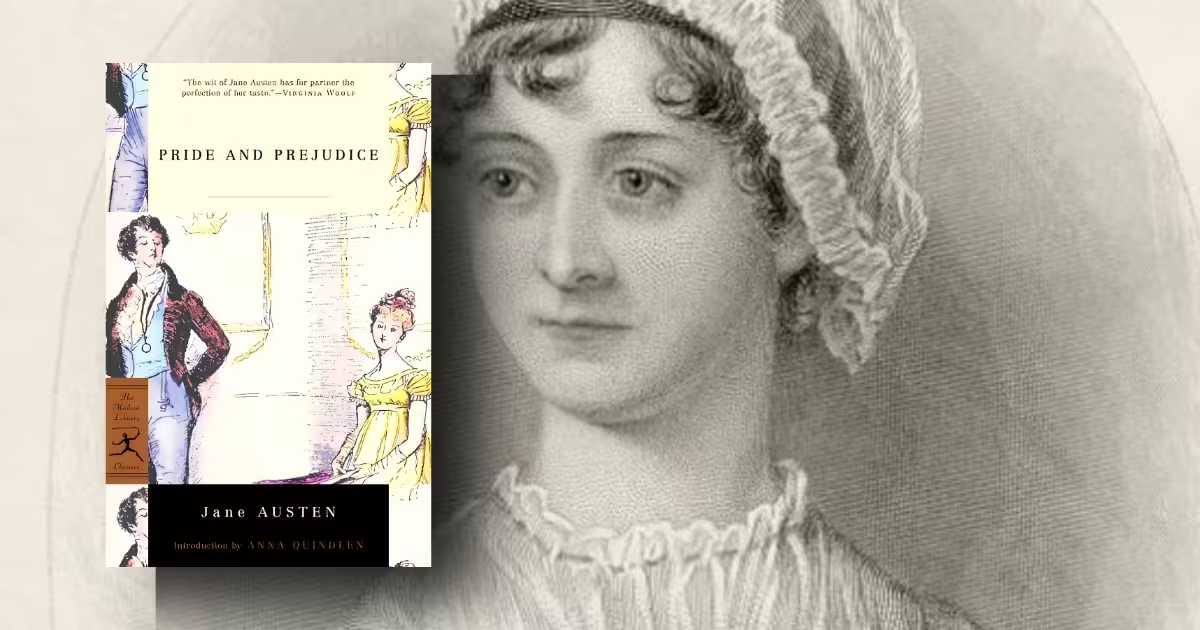

Pride and Prejudice is usually taught as a story about love, class, and first impressions. Underneath that, Jane Austen built the novel out of things we rarely name out loud: exact income figures, a piece of inheritance law called an entail, a plot that runs almost entirely on letters, and a narrator who is quietly laughing at everyone in the room, including us.
This piece walks through ten of those less obvious themes, then looks at the best Pride and Prejudice adaptations (including the new 2026 Netflix version with Emma Corrin and Jack Lowden) and a handful of books worth reading next if this one left a mark on you.
Pride and Prejudice is not really a love story. That is the sentence that changed how I read the book on my third pass through it, and it is the reason this list exists.
I had spent two readings falling for Elizabeth Bennet’s wit and Mr. Darcy’s slow, grudging honesty, and it took a third reading, done slowly and with a notebook next to me, to notice how much of the novel is built out of numbers, legal technicalities, and letters. Once I saw it, I could not unsee it.
Jane Austen wrote a romance that people have been rereading for more than 210 years, but she wired the whole thing together with financial arithmetic and property law, and most articles about this book skip straight past that scaffolding to get to the ballroom scenes. I want to spend some time on the scaffolding.
Table of Contents
Why Pride and Prejudice Still Has Secrets After 210 Years
Pride and Prejudice was published on 28 January 1813, and Jane Austen received her own copies from London the next day.
She wrote to her sister Cassandra that she had “got my own darling Child from London,” a line that gets quoted so often it has become a kind of shorthand for how proud she was of this particular book, according to Jane Austen’s House, which holds the original letter.
She had actually started the story seventeen years earlier, in 1796, at age twenty, under the working title First Impressions. By the time it reached print, she was thirty-seven.
That gap matters. A twenty-year-old wrote the bones of the plot, and a thirty-seven-year-old revised it into the book we know, and somewhere in that revision, Austen layered in an amount of financial and legal detail that a lot of readers skim past because the romance is more fun to focus on.
I think that is exactly why the themes below stay hidden. They are not hidden because they are subtle. They are hidden because the love story is louder.
There is also a reason to look at this book again right now. Netflix is releasing a new six-part adaptation in autumn 2026, written by Dolly Alderton and directed by Euros Lyn, with Emma Corrin as Elizabeth Bennet and Jack Lowden as Mr. Darcy, according to Netflix’s own Tudum press materials.
Every time a new adaptation lands, the same five themes get recycled in every recap: love, pride, prejudice, class, reputation. I wanted to write the version that goes past that list.
10 Hidden Themes in Pride and Prejudice
1. The Marriage Market Runs on Exact Numbers, Not Vibes
Austen does not let a single major character enter the story without a price tag attached, and that is the first thing a close reader notices.
Mr. Darcy is worth £10,000 a year. Mr. Bingley has “four or five thousand a year,” a figure Mrs. Bennet repeats before she has even met him. Mr. Bennet’s entire estate produces £2,000 a year, and because it is entailed away from his daughters, Elizabeth stands to inherit only about £40 a year of her own after her mother dies, according to figures drawn directly from the novel’s text and cross-checked against literary economic analysis published by Gale’s Critical Essays series.
Using a rough historical multiplier of around 80 times today’s dollar value, often cited by Austen scholars, Mr. Bennet’s income sits somewhere near $160,000 a year in modern terms, and Darcy’s near $800,000. Those are not romantic numbers.
They are budget lines, and Austen wants you to do the math along with her characters, because everyone in the novel is doing exactly that math in their heads at every dance.
2. An Inheritance Law Called Entail Controls Almost Every Decision
An entail is a legal restriction that ties an estate to a single line of male heirs, and it is the reason Mr. Collins, a cousin the Bennets barely know, stands to inherit Longbourn instead of any of the five Bennet daughters.
Because Mr. and Mrs. Bennet had no sons, the property was set to pass outside the family entirely once Mr. Bennet died, according to legal analysis of the novel published in the University of Georgia’s Journal of Intellectual Property Law. That single piece of property law is the real engine behind Mrs.
Bennet’s constant panic about marrying off her daughters. It is not simple nerves. It is a woman doing risk management for five children who could legally lose their home the day their father dies.
Once you read the entail as the actual plot mechanism it is, instead of background noise, Mrs. Bennet stops being comic relief and starts looking like the only adult in the house who is being honest about the stakes.
3. Letters Quietly Run the Entire Plot
As many as 42 separate letters are mentioned across Pride and Prejudice, according to research published by Jane Austen’s House, and several of them do more narrative work than most scenes of dialogue.
Mr. Darcy’s letter to Elizabeth after his failed proposal is the hinge the entire second half of the book turns on. Mr. Collins’s letters announce his arrival before he does. Jane’s letters from London carry half the emotional weight of the Bingley storyline.
Austen originally drafted the story as an epistolary novel, meaning it was told entirely through letters, before reworking it into the third-person narration we now read. Even after that rewrite, the letters never left. They just moved from the structure of the book into its bloodstream.
4. The Narrator Is In On the Joke, and So Is Austen
Pride and Prejudice opens with one of the most quoted lines in English literature, the one about a single man in possession of a good fortune needing a wife, and that sentence is a joke before it is a statement of fact.
It sounds like a universal truth and it is actually Mrs. Bennet’s opinion dressed up as one, which is the whole trick of Austen’s narrative voice. She writes in what scholars call free indirect discourse, a technique that slides between an outside narrator and a character’s private thoughts without ever announcing the switch.
That means Austen can mock a character’s snobbery while appearing to simply describe it, and readers who are not paying close attention absorb the mockery without ever catching her doing it.
This is arguably Austen’s biggest technical contribution to the English novel, and it rarely makes anyone’s top ten list of “themes,” even though it shapes every single page.
5. A War Is Happening in the Background the Whole Time
The militia stationed at Meryton, the regiment that brings Wickham into the Bennet sisters’ orbit and later helps him seduce Lydia, exists because Britain was at war with Napoleonic France for most of Austen’s adult life.
Soldiers were a normal, visible part of small-town English life in this period, moved around the country and billeted wherever they were needed.
Austen never describes a single battle, and two of her own brothers served in the Royal Navy during these same years, yet the war is the reason there are young officers in red coats loitering around Meryton for the Bennet girls to flirt with in the first place.
Readers who treat the militia as set dressing are missing that Lydia’s disaster only becomes possible because a national war economy put an unsupervised regiment of young men within walking distance of an under-chaperoned teenager.
6. Walking Is Elizabeth’s Version of Rebellion
When Elizabeth walks three miles through mud to see her sick sister Jane at Netherfield, arriving with a dirty hem, Caroline Bingley treats it as scandalous rather than sensible.
That reaction tells you everything about how tightly a Regency woman’s body and movements were policed. A woman walking alone, exerting herself, arriving looking anything less than pristine, was read as a mild social violation, not an act of practical sibling loyalty.
Elizabeth does it anyway, repeatedly, throughout the book. Her long solo walks are one of the only forms of physical independence available to her, and Austen keeps returning to them precisely because they say something about Elizabeth’s character that no line of dialogue could say as efficiently.
7. Female “Accomplishment” Was a Performance, Not an Education
What did it actually take to be considered an accomplished woman in 1813? Caroline Bingley answers this directly in one of the novel’s sharper satirical scenes, listing music, singing, drawing, dancing, modern languages, and “a certain something in her air and manner of walking” as the minimum requirement, on top of extensive reading.
Darcy adds that a truly accomplished woman must also improve her mind through reading, at which point Elizabeth dryly says she no longer wonders that he knows only six accomplished women.
Austen is not praising this list. She is exposing it as an impossible standard designed to keep women performing rather than thinking, and Elizabeth’s refusal to play along is one of the quieter forms of rebellion running through the whole book.
8. Illness and “Nerves” Double as Social Strategy
Mrs. Bennet’s nerves are treated as a running joke, and Jane’s convenient cold at Netherfield gets her a longer visit under the same roof as Mr. Bingley. Both moments use physical fragility as a tool.
In a world where women had almost no direct way to control their own circumstances, a headache, a case of nerves, or a timely cold could function as a socially acceptable lever, a way to extend a visit, avoid an unwanted conversation, or draw sympathy without ever making a direct request.
Austen treats this with more compassion than mockery when it comes to Jane, and with pure comedy when it comes to Mrs. Bennet, but both characters are working the same system.
9. Sisterhood Is Full of Quiet Competition, Not Just Loyalty
Elizabeth and Jane are close, but Austen surrounds them with sisters and friends who make very different, harder choices.
Charlotte Lucas, Elizabeth’s closest friend outside her family, marries the ridiculous Mr. Collins with her eyes fully open, telling Elizabeth plainly that she is not romantic and only wants “a comfortable home.”
That is not weakness. It is a twenty-seven-year-old woman with no fortune making a clear-eyed calculation about her own survival, and Austen never punishes her for it.
At the same time, Lydia’s recklessness embarrasses her sisters in ways that could have ruined all of their marriage prospects at once, a reminder that in this world, one sister’s choices were never just her own.
10. Old Land Money Looks Down on New Trade Money
Mr. Darcy’s wealth comes from land his family has held for generations. Mr. Bingley’s £100,000 fortune, by contrast, came from his father, who made his money in trade and never lived long enough to buy the landed estate he wanted, according to the text of the novel itself, in Chapter 4.
That distinction, land versus trade, old money versus new, sits underneath almost every snobbish comment Caroline Bingley and Mr. Darcy’s aunt make, and it is worth noticing that Bingley’s own money is, structurally, closer to “new” than “old.”
Elizabeth’s aunt and uncle, the Gardiners, are explicitly “in trade” and live near Cheapside in London, which Caroline Bingley sneers at, yet the Gardiners turn out to be some of the most decent, sensible adults in the entire novel.
Austen sets up the class snobbery just to quietly dismantle it through the people who actually earn her narrator’s respect.
The Best Pride and Prejudice Adaptations, and What Each One Gets Right
Which Pride and Prejudice adaptation is the most faithful to the book? Most Austen fans and critics point to the 1995 BBC miniseries, starring Jennifer Ehle and Colin Firth, as the version that sticks closest to the novel’s pacing, dialogue, and Regency detail.
A public poll run by British Period Dramas gave that version a decisive win, with over 62 percent of the vote against several rival adaptations. Its six-hour runtime lets Austen’s slower plot beats breathe in a way that a two-hour film simply cannot.
The 2005 film, directed by Joe Wright and starring Keira Knightley and Matthew Macfadyen, took the opposite approach. It compressed the story, leaned hard into cinematography and mood, and picked up four Oscar nominations along the way, including a Best Actress nod for Knightley.
Purists sometimes argue it takes liberties with the Bennets’ financial situation and social standing, giving the family a scrappier, more rustic look than the novel supports, but it remains the version that introduced an entire generation to this story.
Bride and Prejudice, the 2004 Bollywood-influenced musical retelling directed by Gurinder Chadha, moves the story to modern India and turns Mr. Darcy into an American hotel executive.
It is by far the most purely entertaining adaptation on this list, and it makes the class and cultural tension of the original text feel fresh by transplanting it somewhere new.
Then there is the one everyone is about to be talking about. Netflix’s new six-episode Pride and Prejudice arrives in autumn 2026, written by Dolly Alderton, directed by Euros Lyn, and led by Emma Corrin as Elizabeth and Jack Lowden as Mr. Darcy, with Olivia Colman as Mrs. Bennet and Rufus Sewell as Mr. Bennet, according to Netflix’s official Tudum announcement.
The production has described it as a faithful, classic take on the 1813 text rather than a modern reimagining, which puts it closer to the 1995 miniseries in spirit than to Bride and Prejudice or the loose modern retelling Bridget Jones’s Diary, which borrowed the enemies-to-lovers shape of the story without naming its debt outright.
If you enjoy thinking about how a story survives translation from page to screen, it is worth reading how differently a much older classic handles the same problem in our look at how no film has ever fully captured Homer’s Odyssey, which runs into a version of the same fidelity debate that follows every new Pride and Prejudice release.
Books Like Pride and Prejudice, If You Want More of This Feeling
What should you read after finishing Pride and Prejudice? Start with Austen’s own Sense and Sensibility, her earlier novel, which shares the same interest in marriage, money, and two sisters navigating both with very different temperaments.
For something outside Austen’s own catalog, The House of Mirth by Edith Wharton follows Lily Bart, a clever, charming woman without fortune trying to survive the same brutal marriage market almost a century later, in Gilded Age New York rather than Regency England.
Recommendation lists from Penguin Macmillan and several literary sites point to it repeatedly as the closest thing to Pride and Prejudice‘s social bite, just with a much harder ending.
If you want a direct modern retelling, Eligible by Curtis Sittenfeld, published in 2016 as part of HarperCollins’s Austen Project, moves the Bennets to present-day Cincinnati, turns Darcy into a neurosurgeon, and became a New York Times bestseller. It keeps Austen’s social satire intact while updating every specific detail around it.
For a genuinely different angle on the same story, Longbourn by Jo Baker retells the events of Pride and Prejudice from the perspective of the Bennet family’s servants, the people doing the actual physical labor that keeps Longbourn running while the Bennet sisters worry about balls and suitors.
It is one of the few retellings that takes the class themes discussed above and turns them completely inside out.
And if you specifically want the enemies-to-lovers, Muslim community, contemporary Toronto version, Ayesha at Last by Uzma Jalaluddin has been described by several outlets as a modern Pride and Prejudice with its own cultural texture, and it was named one of Publishers Weekly’s best romance books of 2019.
What I Take From Rereading This Book
Every time I come back to Pride and Prejudice, I find fewer new plot twists and more new arithmetic. That sounds like an odd thing to say about a book people mainly remember for a wet shirt scene that is not even in the original text, but it is true.
Austen built a love story on top of an inheritance crisis, and she was clever enough to make the inheritance crisis so entertaining that generations of readers barely noticed it was there. I think that is the real reason this book has survived 210 years, two world wars, a dozen film and television adaptations, and at least one Bollywood musical remake.
It works as pure romance for readers who want that, and it works as a sharp piece of social and economic observation for readers who go looking for it. Not many novels manage both at once, and even fewer manage it while also making you laugh on nearly every page.
FAQs
What is the most overlooked theme in Pride and Prejudice?
The precise financial detail behind almost every character’s introduction is easy to skim past, but it is one of the clearest examples: Austen gives Mr. Darcy, Mr. Bingley, Mr. Bennet, and even Elizabeth’s own inheritance exact figures, turning the marriage plot into something closer to a budget spreadsheet than a fairy tale.
How many letters appear in Pride and Prejudice?
As many as 42 letters are mentioned across the novel, according to research from Jane Austen’s House, and several of them, including Mr. Darcy’s letter to Elizabeth, carry major plot turns that dialogue alone does not handle.
Is the new 2026 Netflix Pride and Prejudice faithful to the book?
Netflix has described its six-episode series, written by Dolly Alderton and starring Emma Corrin and Jack Lowden, as a faithful, classic adaptation rather than a modern reimagining, positioning it closer in spirit to the 1995 BBC miniseries than to looser retellings.
Why was Pride and Prejudice originally called First Impressions?
Jane Austen began the novel under that title in 1796, when she was twenty years old, according to Jane Austen’s House. She revised it substantially over the following seventeen years before it was published in 1813 as Pride and Prejudice, likely to avoid confusion with another novel that had already used the original title.
What should I read if I loved Pride and Prejudice?
Sense and Sensibility for more Austen, The House of Mirth for a harder-edged take on the same marriage market, Eligible for a full modern retelling, Longbourn for the servants’ perspective, and Ayesha at Last for a contemporary, culturally specific version of the same enemies-to-lovers shape.





