
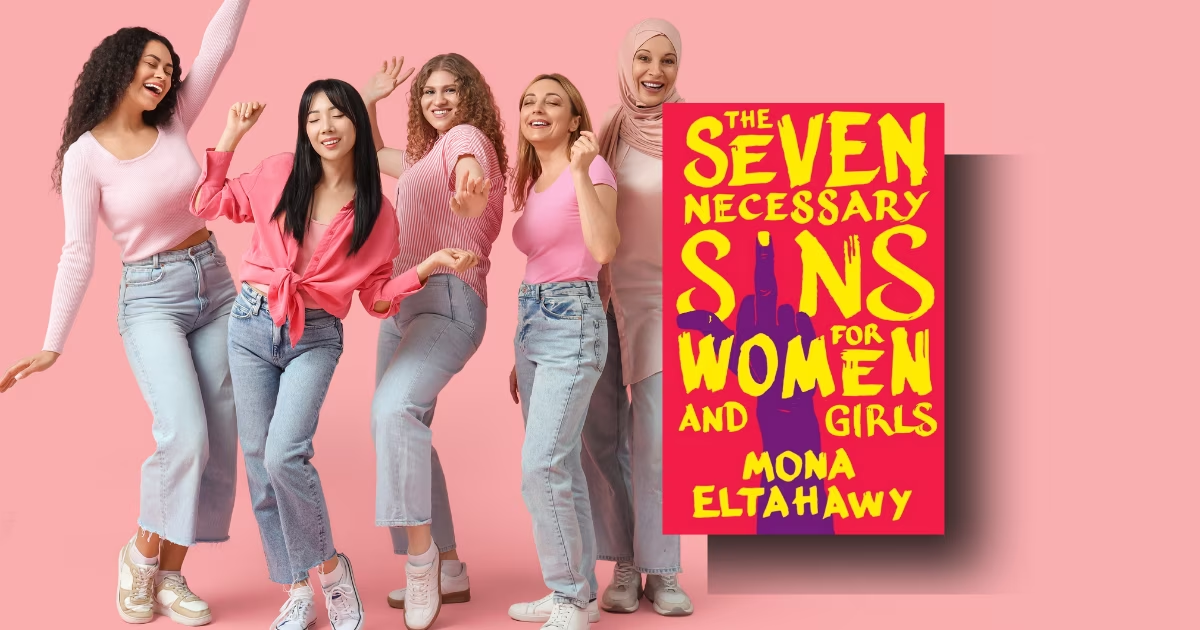

The Seven Necessary Sins for Women and Girls is Mona Eltahawy’s 2019 feminist manifesto that tells women to stop apologizing and start sinning: to be angry, to seek attention, to swear, to want more, to take power, to fight back, and to desire freely. It is loud, funny, furious, and at times frightening.
I finished it convinced that her core argument is right, and equally convinced that a few of her numbers are wrong. This Seven Necessary Sins for Women and Girls review covers both, so you can decide whether the book belongs on your shelf, your syllabus, or nowhere near your reading list.
Table of Contents
Brief Summary
The Seven Necessary Sins for Women and Girls (Beacon Press, September 17, 2019, 208 pages) argues that patriarchy is universal, so feminism must be just as universal and far more aggressive.
Mona Eltahawy, an Egyptian-American journalist who was sexually assaulted at Mecca at fifteen and beaten by Egyptian riot police in 2011, flips the Christian idea of the Seven Deadly Sins. She names seven “sins” that women and girls are punished for: anger, attention, profanity, ambition, power, violence, and lust. Her claim is that these are not sins at all. They are tools.
- Author: Mona Eltahawy, born August 1, 1967, in Port Said, Egypt; former Reuters correspondent; author of Headscarves and Hymens (2015).
- Genre: Nonfiction, feminist manifesto, memoir-infused political essay.
- Core idea: Women should “defy, disobey, and disrupt” patriarchy rather than negotiate with it.
- Key concept: The “Trifecta of Misogyny,” meaning the state, the street, and the home working together to oppress women.
- Most controversial chapter: Violence, where she asks how many men would have to die before patriarchy “comes to the table.”
- My verdict: Brave, readable, globally minded, and worth your time. It is also repetitive, and it contains at least two factual slips I found while checking its figures.
- Rating: 4 out of 5.
Who will love The Seven Necessary Sins for Women and Girls, and who will bounce?
You will probably love it if:
You are tired of “lean in” feminism that asks women to fix themselves instead of the system.
You want a feminist book that centers women from Egypt, Uganda, India, Brazil, Pakistan, and Saudi Arabia, not only the United States.
You liked Audre Lorde’s Sister Outsider, Rebecca Traister’s Good and Mad, or Soraya Chemaly’s Rage Becomes Her.
You are a young woman who has been told to lower her voice one too many times.
You will probably bounce if:
Profanity bothers you. The phrase “Fuck the patriarchy” is her self-described “declaration of faith,” and she uses it constantly.
You want a data-heavy academic study. This is a manifesto, and it reads like one.
You believe men need to be persuaded into feminism. She says plainly that this is not the book for that argument.
You are uncomfortable with any discussion of violence as political resistance, even a deliberately provocative thought experiment.
Introduction
Mona Eltahawy wrote The Seven Necessary Sins for Women and Girls, published in hardcover by Beacon Press in Boston on September 17, 2019, with a paperback following on September 15, 2020 (216 pages, according to Penguin Random House). It was her second book after Headscarves and Hymens: Why the Middle East Needs a Sexual Revolution (Farrar, Straus and Giroux, 2015).
Context: What kind of book is it?
The book is a feminist manifesto built from memoir, reportage, and political argument. Eltahawy is not an academic. She is a journalist who reported for Reuters from Cairo and Jerusalem in the 1990s, wrote opinion columns for outlets including The Guardian, The Washington Post, and The New York Times, and became internationally known in November 2011 when Egyptian riot police broke her left arm and right hand, sexually assaulted her, and detained her for twelve hours near Tahrir Square.
Her credentials here are lived experience and three decades of writing about women in the Middle East and beyond. Since September 2020, she has also written the Feminist Giant newsletter.
Purpose: What is the main argument of The Seven Necessary Sins for Women and Girls?
The central thesis is simple and she states it on the first pages: patriarchy lives everywhere, so feminism must stop handing women survival tips and start giving them weapons. In her words, “Feminism should terrify the patriarchy.”
She closes the introduction by asking for “more manifestos on how to destroy it,” meaning patriarchy, instead of road maps toward a peace treaty, and then names this book as hers.
Background
Eltahawy says she wrote the book “with enough rage to fuel a rocket,” and the introduction explains where that rage came from. In 1982, at fifteen, she was sexually assaulted twice while performing hajj in Mecca.
She stayed silent for years.
In February 2018, she shared that story on Twitter under a new hashtag, #MosqueMeToo, to support a Pakistani woman named Sabica Khan who had described her own assault in Mecca. The thread spread in Indonesian, Arabic, Turkish, French, German, Spanish, and Farsi.
Five days later, at fifty, she went dancing in a Montreal club to recover. A man groped her. This time she chased him, knocked him down, and punched him repeatedly, yelling that he should never touch a woman like that again. Then a club manager asked her why she had not let her husband handle it. She launched a second hashtag, #IBeatMyAssaulter, and women around the world replied with their own stories.
Those two moments, thirty-five years apart, frame everything. As she puts it: “I don’t want to be protected. I want to be free.”
The Seven Necessary Sins for Women and Girls Summary
I have written this summary so that you come away with every major argument, story, and statistic in the book. If you only read this section, you will know what Eltahawy argues and how she backs it up.
Introduction: Why does Eltahawy call them “sins”?
She calls them sins because patriarchy treats them as sins. “I call them ‘sins,’ but of course they are not,” she writes. They are “what women and girls are not supposed to be or do or want.” She calls her framework “The Gospel of Mona.”
The introduction also sets out her political scope. Eltahawy was born in Egypt, moved to the UK at seven, to Saudi Arabia at fifteen, worked in Jerusalem, and moved to the United States in 2000. Patriarchy, she says, lived in every one of those places. She wants a feminism led by “the nonwhite and the queer,” one that fights racism, homophobia, transphobia, classism, ableism, and ageism at the same time.
She also refuses a trap she calls the “rock and a hard place” for Muslim women. On one side, Islamophobes use her assault story to demonize Muslim men. On the other, her own community tells her to keep quiet so Muslims do not “look bad.” Her answer is that the misogyny of Mecca, of Donald Trump, and of American churches exposed by #ChurchToo is “one and the same.”
Chapter 1, Anger: What happens to the anger girls are born with?
Eltahawy argues that girls are born angry and patriarchy trains the anger out of them. She opens with herself at four years old, on a balcony in Cairo, when a man stopped his car and exposed himself to her and a friend. She waved her slipper at him. She believed her rage could chase him away. By fifteen, at hajj, that rage had turned into tears and shame.
The evidence she uses:
■ The Global Early Adolescent Study, led by Robert Blum of Johns Hopkins University, gathered data on ten- to fourteen-year-olds in fifteen countries, including Belgium, China, Egypt, India, Kenya, Scotland, and the US. Its finding, as Eltahawy reports it: by about age ten, children everywhere have absorbed the myth that girls are vulnerable and boys are strong.
■ A 2017 Georgetown Law Center on Poverty and Inequality study found Black girls in the US are seen as less childlike than white girls from as early as age five.
■ During the Larry Nassar case, more than 150 women and girls accused the former USA Gymnastics doctor of abuse. Kyle Stephens told her parents at twelve that Nassar had abused her since she was six; they made her apologize to him. Nassar was sentenced to 40 to 175 years.
Her proposal is a “Rage for Girls” curriculum. It would include June Jordan’s “Poem About My Rights,” Ursula K. Le Guin’s 1986 Bryn Mawr commencement speech (“We are volcanoes”), Audre Lorde’s essay “Uses of Anger,” Poly Styrene’s punk song “Oh Bondage! Up Yours!”, and a Halsey concert where teenage girls chanted “I’m a fucking hurricane.”
This chapter also introduces her most useful idea, the Trifecta of Misogyny: the state, the street, and the home all oppress women together, so you cannot fight one while ignoring the other two.
Her sharpest line here is about where anger goes when it is suppressed. Girls turn it inward, as sadness and shame. And “Sadness does not terrify patriarchy.” The chapter ends: “angry women are free women.”
She also takes on white American women, arguing that many only discovered their anger after Trump’s 2016 election, while Black women from Anita Hill in 1991 to Tarana Burke, who started “Me Too” in 2006, had been warning the country for decades.
Chapter 2, Attention: Why is “attention seeking” used against women?
The quickest way to discredit a woman, Eltahawy argues, is to accuse her of wanting attention. So she claims it openly. “Attention is power,” she writes, and “Attention is both reward and punishment. It is how patriarchy regulates us.”
Her strongest example is her own survival. When riot police beat and detained her in Cairo in November 2011, a stranger lent her a phone. She tweeted “beaten, arrested, interior ministry” to about five thousand followers. Within fifteen minutes, #FreeMona was trending globally, and the US State Department responded. “My fame saved me,” she writes. A feminist group later told her at least twelve other women were assaulted the same way at that protest, and none spoke out.
Her second example is her September 2012 arrest in the New York City subway for spray-painting pink paint over an ad that read “In any war between the civilized man and the savage, support the civilized man.” Each ad cost $6,000. She was jailed for twenty-two hours; charges were later dropped.
The numbers she cites on who gets attention:
■ Women’s Media Center, 2017: men delivered 74.8 percent of US broadcast news; women 25.2 percent. In print, men had 61.9 percent.
■ USC Annenberg study of 1,100 top films, 2007 to 2017: only 30.6 percent of speaking characters were female, and only 4.3 percent of 1,223 directors were women.
■ Ireland’s 2018 abortion referendum: in an RTÉ exit poll, 43 percent of voters said women’s personal stories in the media had the biggest impact on their vote.
She then turns to women who were killed for commanding attention: the Pakistani social media star Qandeel Baloch, strangled by her brother in 2016, and four prominent Iraqi women, including Instagram star Tara Fares, who died within six weeks in 2018. The chapter closes with a defiant reclaiming of the insult itself: “We must all become attention whores.”
Chapter 3, Profanity: Why does Eltahawy say “Fuck the patriarchy”?
Every lecture she gives starts the same way: “this is my declaration of faith: Fuck the patriarchy.” She uses it deliberately because she is “a woman, a woman of color, a Muslim woman,” and she is not supposed to say it.
Her argument is that civility is a tool of power. Those who demand civility are usually the ones least hurt by incivility. Profanity, she writes, “is the verbal equivalent of civil disobedience.”
Her main case study is Stella Nyanzi, a Ugandan academic who called President Yoweri Museveni, in power since 1986, “a pair of buttocks” after he broke a promise to provide sanitary pads to schoolgirls.
Eltahawy cites figures that about 30 percent of Ugandan girls miss school when their periods begin (Build Africa), and UNICEF estimates around 60 percent miss school because of a lack of separate toilets.
Nyanzi’s crowdfunding campaign, Pads4GirlsUG, raised enough for one million girls in two weeks. She was jailed for five weeks in 2017, then arrested again in 2018 over a poem about Museveni’s late mother.
Other examples in the chapter:
■ Michelle Wolf at the April 2018 White House Correspondents’ Dinner.
■ Lisa Brown, a Michigan state representative banned from speaking in June 2012 after she said “vagina” during an abortion debate.
■ Pussy Riot, whose forty-second “punk prayer” in Moscow’s Cathedral of Christ the Saviour in February 2012 led to two-year sentences.
Cardi B, the first female rapper since Lauryn Hill in 1998 to top the Billboard Hot 100 as a solo artist, with “Bodak Yellow.”
She also cites Gloria Anzaldúa’s 1981 essay: “a woman who writes has power. And a woman with power is feared.” Her conclusion is personal: “I own my body, and I own my language.”
Chapter 4, Ambition: Why is ambition treated as a sin for women?
Ambition is a sin, she writes, because patriarchy wants women to be “less than,” while “having ambition means being more than.” The chapter opens with a piece of speculative fiction Eltahawy wrote for the 2015 PEN World Voices Festival, set on January 20, 2050, when three women are inaugurated on the same day: Egypt’s first woman president, Saudi Arabia’s first woman mufti, and a third consecutive woman president of the United States.
She traces her own “Map of Ambition” through her maternal line. Her grandmother was pregnant fourteen times. Her mother went to medical school in Cairo and earned a PhD in London.
Yet Eltahawy’s teachers in the UK kept asking what her father did, unable to imagine her mother as anything but a wife following her husband.
The evidence here is some of the strongest in the book:
- Tokyo Medical University admitted in 2018 that it had lowered female applicants’ scores to keep women at about 30 percent of students. Juntendo University wrongly rejected 121 women between 2016 and 2018; its president said the goal was “to rescue those boys.”
- A Boston Consulting Group survey of 200,000 employees, including 141,000 women across 189 countries, found women start their careers just as ambitious as men. At companies with poor gender diversity, only 66 percent of women sought promotion versus 83 percent of men. At firms improving on diversity, the numbers were 85 and 87 percent.
- A 2017 study by Seth Gershenson and Nicholas Papageorge found teachers expected 58 percent of white students but only 37 percent of Black students to earn a four-year degree.
Her line on this is one of the best in the book: “It is the system that fails women, not women who fail themselves.”
She is also honest about what ambition means to her. In an April 2018 notebook entry she wrote that she had $300 in the bank, and she refuses to measure ambition by wealth. “I do not want to be liked; I want to be free.” The chapter ends with her eight-year-old niece asking why police broke her arms, hearing that her aunt did not go home, and replying, “Good.” Eltahawy’s closing: “Let us always tell girls they can be more than.”
Chapter 5, Power: What is a powerful woman?
Eltahawy’s answer is that power held by a woman is not automatically feminist. The question is whether she uses it to dismantle patriarchy or to serve it.
She opens at a Cairo café during the 2014 men’s World Cup final, when a boy saw Brazilian president Dilma Rousseff on television and asked his father, “A woman can be president?” It is a lovely moment.
Then she complicates it. Brazil later impeached Rousseff and elected Jair Bolsonaro, who told congresswoman Maria do Rosário he would not rape her because she did not deserve it. In Brazil in 2017, she notes, there were 606 registered domestic violence cases and 164 rapes per day.
Her key concept here is “crumbs.” Patriarchy throws a few women limited power in exchange for loyalty. Her examples include Gina Haspel, whom Trump named the first woman to head the CIA despite her role in the torture program, and AfD co-leader Alice Weidel in Germany. Her reply: “I don’t want crumbs; I want the whole cake,” and patriarchy’s cake will not do, so “we must bake our own.”
She contrasts them with women who take power without asking: Rashida Tlaib and Ilhan Omar, elected to Congress in 2018; Amina Wadud, who on March 18, 2005, led the first recorded mixed-gender Friday prayer in New York, with Eltahawy praying behind her (without a headscarf, and on her period); and Indian women who forced their way into the Sabarimala temple in Kerala after India’s Supreme Court overturned the ban on menstruating-age women in September 2018. On January 1, 2019, an estimated five million women formed a 385-mile “Women’s Wall” across Kerala.
The next day, Bindu Ammini and Kanakadurga entered the temple.
She also includes Elaine Brown, the only woman to lead the Black Panther Party, and the Combahee River Collective’s 1977 statement. The chapter’s sharpest line: “Women who do not ask for permission are powerful.”
Chapter 6, Violence: Does Eltahawy really advocate violence against men?
She opens with a thought experiment, not a plan: “Imagine if we declared war.” An underground group called Fuck the Patriarchy kills five men a week, then fifty, then five hundred, until patriarchy sends someone to negotiate. She admits it is “intentionally disturbing.” Her point is the asymmetry. Many millions of men have died in wars men started, yet the daily war on women has no name. “There is no War on Women news bulletin.”
The statistics she uses:
- UNICEF: 74 percent of Egyptian girls aged fifteen to seventeen have undergone some form of genital cutting.
- UN survey, 2013: 99.3 percent of women and girls in Cairo have experienced street sexual harassment.
- Femicide Census (UK, 2017): of 139 women killed by men, 76 percent knew their killer and 46 percent were killed by a current or former partner.
- US: about three women a day are killed by a current or former partner.
- Bosnia: between 12,000 and 50,000 women raped during the 1992 to 1995 war. Rwanda, 1994: an estimated 250,000 women raped.
Her main intellectual support is University of Miami law professor Mary Anne Franks, whose 2016 article “Men, Women, and Optimal Violence” argues that society would be better off if women’s justified violence against men were “encouraged, protected, and publicized.” Franks even called Eltahawy’s Montreal punches an example of “optimal violence.”
She also covers the criminal justice gap: women who kill abusive partners receive far longer sentences on average than men who kill their partners, and as many as 90 percent of women imprisoned for killing a man had been battered by him, according to figures she attributes to the ACLU.
The most painful pages describe her 2016 visit to Vilina Vlas, a spa hotel in Višegrad, Bosnia, which the war crimes tribunal confirmed had been used as a rape camp. Guests now swim in the same pool where women were mass raped. Srebrenica has a memorial for its 8,000 murdered men and boys. Vilina Vlas has spa brochures. I had to put the book down after that section.
She ends with the 2018 Brett Kavanaugh confirmation, watching women cry in Senate elevators to no effect. “I am done crying,” she writes. “We must make patriarchy fear us.”
Chapter 7, Lust: What does “I own my body” mean in this book?
It means no one else has a claim: “not the state, not the street, and not the home,” and not any house of worship either. This chapter is the most personal.
Eltahawy writes that she waited until twenty-nine to have sex because of her upbringing, then worked through the guilt. She identifies as queer and polyamorous, and she describes both as part of her refusal of patriarchal rules.
She builds the chapter on June Jordan’s 1991 essay on bisexuality, bell hooks’s line that “Desire disrupts rules,” and stories from her 2015 book tour across twelve countries, where women told her about virginity, guilt, coming out, and hymen surgery.
Her global examples include Egypt’s 2017 crackdown on LGBTQ people after rainbow flags appeared at a Mashrou’ Leila concert (more than sixty-five arrested); China’s Feminist Five, detained for thirty-seven days in 2015 for planning to hand out anti-harassment stickers; Nigeria’s 2014 Same Sex Marriage Prohibition Act and the anthology She Called Me Woman; Kenya’s ban on the lesbian film Rafiki; India’s 2018 decriminalization of homosexuality; and Argentina’s Ni Una Menos movement.
She ends with the line she now uses to close every talk, borrowed from Ni Una Menos: “this time the fire is ours.”
Conclusion: How does the book end?
It ends with Rahaf Mohammed, the eighteen-year-old Saudi woman who in January 2019 barricaded herself in a Bangkok airport hotel room, tweeted for help, and was granted refuge in Canada. Eltahawy translated her tweets. In return, Saudi media ran headlines calling her a “porn activist.” She also salutes Greta Thunberg and Belgian student Anuna De Wever. Her final line asks us to “celebrate women and girls who sin.”
Seven Necessary Sins for Women and Girls Analysis
Yes. The Seven Necessary Sins for Women and Girls is a furious, generous, and often thrilling manifesto, and I think it is one of the more useful feminist books of the last decade for readers outside the Anglo-American bubble. It is also a book that needs a fact-checker, and I say that as someone who agrees with most of it.
Does Eltahawy support her arguments with evidence?
Mostly, yes. Chapters 2 and 4 are the strongest because the data does the work: the Tokyo Medical University scandal, the BCG ambition survey, the teacher-expectation study, and the Annenberg film numbers are specific, sourced in her endnotes, and hard to argue with. Her personal stories are not decoration either. They are the argument. When she writes that her fame saved her life in Cairo, the chapter on attention stops being theory.
The weaker parts are where rhetoric outruns evidence. The violence chapter leans heavily on a single law review article. And as I checked her numbers, I found problems I cannot ignore.
Does the book fulfill its purpose?
It fulfills the purpose it sets for itself. She promised a manifesto, not a policy paper, and she delivered one. Kirkus called it “a striking anti-patriarchal manifesto” and flagged the violence argument as its “most controversial” point.
Deena ElGenaidi in The Brooklyn Rail (February 2020) praised it as “an excellent introduction to feminist thought” but found it hard to say what the book had “added to the cultural consciousness.” I land between them. The ideas are not new, but the global cast of characters is.
Strengths and Weaknesses of The Seven Necessary Sins for Women and Girls
What I found compelling
The global lens. Stella Nyanzi, Qandeel Baloch, Amina Wadud, Trupti Desai, Nthabiseng Nooe, Zheng Churan, Bisi Alimi, Rahaf Mohammed. Most feminist bestsellers in English never leave the US. This one barely stays there.
The Trifecta of Misogyny. State, street, and home is a genuinely handy framework. It explains why electing a woman president does not stop a woman being harassed on the bus or beaten at home.
The “crumbs” argument. Her refusal to celebrate Gina Haspel as a feminist win is the clearest statement I have read of why representation alone is not liberation.
Honesty about her own contradictions. She admits she finds it hard not to hate men after two days of survivor testimony in Dublin. She admits she has $300 in the bank. That candor makes her easier to trust.
Humor. “Fuck off, kitten,” her gender-neutral insult for trolls, made me laugh out loud.
What frustrated me
Two factual errors I could verify. In Chapter 6 she writes that 139 women were “killed each day by men in the United Kingdom” in 2017. The Femicide Census published by Women’s Aid in December 2018 counts 139 women killed by men in the whole of 2017, not per day. It is almost certainly a slip, but in a chapter about violence statistics it matters.
In Chapter 7 she dates Argentina’s Senate abortion vote to August 2019. The Senate actually rejected that bill on August 8 to 9, 2018, as CBC and The Washington Post reported at the time.
A statistic that has since been debunked. She twice states that trans women of color in the US have an average lifespan of thirty-five years. In August 2022, Kate Sosin at The 19th traced this figure to an anecdotal line about Latin America in a 2015 Inter-American Commission on Human Rights report and concluded it is false for the US. The violence against trans women she describes is real; that number is not supported.
An overstated study. She says studies show swearers are “more intelligent.” The best-known research, Kristin and Timothy Jay’s 2015 paper in Language Sciences, found that people fluent in taboo words also tend to have strong general verbal fluency. That is about vocabulary, not IQ.
Repetition. The Montreal punch, the Cairo beating, and the “foot soldiers of the patriarchy” label appear again and again. The Brooklyn Rail made the same complaint. At 208 pages, it should feel tighter than it does.
The violence chapter will lose readers. I understand it as a provocation meant to expose a double standard. But she also writes, sincerely, “We should declare war if we must.” Some readers who agree with every other chapter will close the book here, and I am not sure she weighed that cost.
Tone toward women who disagree. Labeling women who vote conservative “foot soldiers of the patriarchy” is satisfying as rhetoric and weak as persuasion. It explains them away rather than listening to them.
What happened after the book was published?
Several stories she left open have since moved on, which is useful context if you read it today:
Stella Nyanzi was convicted of cyber harassment in August 2019 and sentenced to eighteen months, according to Al Jazeera. PEN International reported that her conviction was quashed on appeal in February 2020.
Argentina legalized elective abortion up to fourteen weeks on December 30, 2020, when the Senate passed the bill Ni Una Menos had fought for, according to NPR.
The book’s paperback appeared on September 15, 2020.
Books Like The Seven Necessary Sins for Women and Girls
Mona Eltahawy, Headscarves and Hymens (2015). Her first book followed her 2012 Foreign Policy essay Why Do They Hate Us?, which drew heavy criticism at the time for its framing of Arab men. Seven Necessary Sins is broader and angrier, and it deliberately points the same critique at the West.
Simone de Beauvoir, The Second Sex (1949). The philosophical foundation. Beauvoir diagnoses; Eltahawy prescribes.
Chimamanda Ngozi Adichie, We Should All Be Feminists (2014). Warm, short, and persuasive where Eltahawy is confrontational.
Roxane Gay, Bad Feminist (2014). Gay makes room for contradiction; Eltahawy has little patience for it.
Laura Bates, The New Age of Sexism. A more data-driven take on how misogyny adapts.
Rebecca Traister, Good and Mad (2018), and Soraya Chemaly, Rage Becomes Her (2018). Both make the case for women’s anger with more reporting and less memoir, but mostly within the US.
Audre Lorde, Sister Outsider (1984). Eltahawy quotes Lorde repeatedly. “Uses of Anger” is the seed of Chapter 1.
For a wider reading list, see our 15 Best Books on Feminism.
FAQ About The Seven Necessary Sins for Women and Girls
What are the seven necessary sins in Mona Eltahawy’s book?
Anger, attention, profanity, ambition, power, violence, and lust. Each gets its own chapter.
Is The Seven Necessary Sins for Women and Girls suitable for teenagers?
For older teens, yes, with a heads-up. It contains frequent profanity and frank descriptions of sexual assault, genital cutting, and wartime rape. The book is explicitly addressed to girls, and the anger and ambition chapters are its most useful parts for young readers.
Does Mona Eltahawy hate men?
She admits it is “difficult for me not to hate men” after hearing survivor testimony, but her stated target is patriarchy as a system. She writes that “feminism is not about ‘hating men'” and that some women uphold patriarchy too.
What is the Trifecta of Misogyny?
Her term for the way the state, the street (society), and the home (family) work together to oppress women and girls.
How long is the book?
208 pages in the 2019 Beacon Press hardcover and 216 pages in the 2020 paperback.
Conclusion
Should you read The Seven Necessary Sins for Women and Girls?
Yes, if you want a feminist book that is global, personal, and unwilling to be polite. The Seven Necessary Sins for Women and Girls works best as a spark rather than a textbook. It will make you angry at the right things, and it introduces you to dozens of women worth reading about on your own, from Stella Nyanzi to Amina Wadud to Rahaf Mohammed.
Read it with a pencil. Check the numbers in Chapters 2 and 6 before you repeat them. Treat the violence chapter as a thought experiment that asks why women’s self-defense is judged so much more harshly than men’s aggression, and decide for yourself where you stand.
Best for: general readers new to feminism, students of gender studies and Middle East politics, activists, and young women who have been told they are “too much.”
Not ideal for: readers looking for academic rigor, anyone put off by constant profanity, or readers hoping for a book that tries to win over skeptical men.
As a reader, I came away agreeing with her closing plea more than I expected to. Girls should be told they can be more than. I just wish her editor had caught the “each day” in her femicide figure, because her argument never needed the exaggeration.
References
- Eltahawy, Mona. The Seven Necessary Sins for Women and Girls. Boston: Beacon Press, 2019. (Primary source for all quotations and in-book statistics.)
- Penguin Random House, book page and paperback details
- Kirkus Reviews, “The Seven Necessary Sins for Women and Girls”
- Deena ElGenaidi, The Brooklyn Rail, February 2020
- Mona Eltahawy, Wikipedia
- Women’s Aid, The Femicide Census 2017 Annual Report
- CBC News, Argentina’s Senate rejects bill to legalize abortion (August 2018)
- NPR, Argentina Legalizes Abortion In Historic Senate Vote (December 30, 2020)
- Kate Sosin, The 19th, on the 35-year life expectancy claim (August 2022)
- Jay & Jay, “Taboo word fluency and knowledge of slurs and general pejoratives,” Language Sciences, 2015
- Al Jazeera, Ugandan academic Stella Nyanzi jailed (August 2019)
- PEN International, Stella Nyanzi released, conviction quashed
- Mona Eltahawy, “Why Do They Hate Us?”, Foreign Policy, April 2012





