
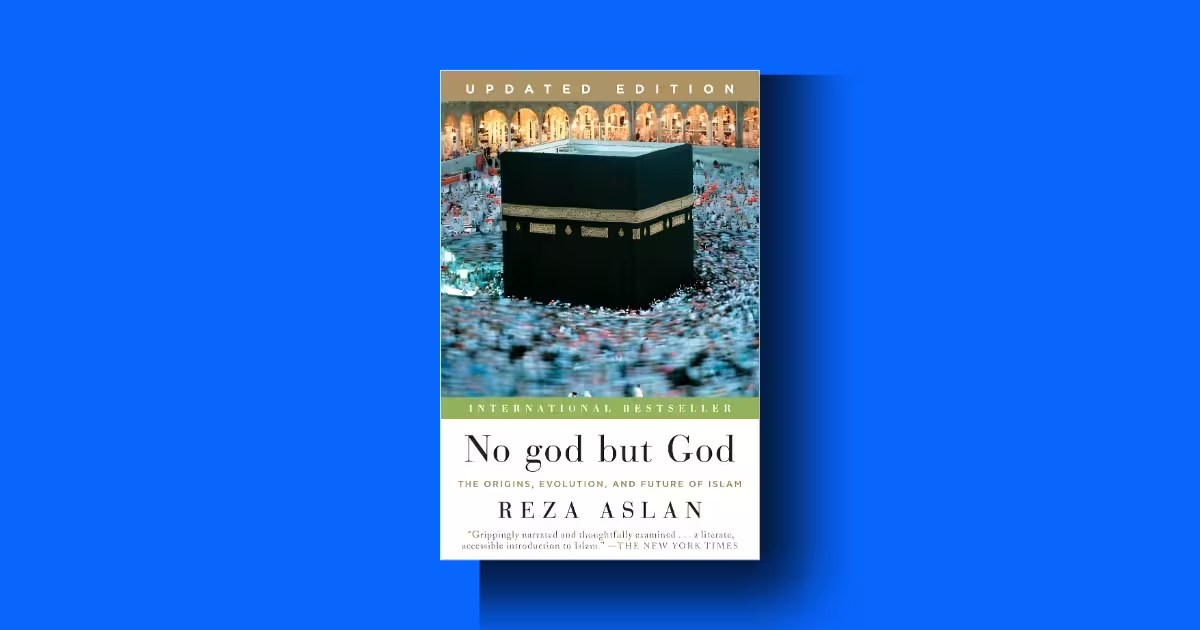

No God but God: The Origins, Evolution, and Future of Islam is Reza Aslan‘s retelling of fourteen centuries of Islamic history, and it is also something the cover does not quite admit: a courtroom speech.
From the pagan Ka’ba to the Tahrir Square protests, Aslan builds one case, that the Prophet Muhammad started a social revolution of “moral accountability and social egalitarianism,” and that later clerics, caliphs, and puritans spent centuries undoing it.
I finished the 2011 updated edition convinced of two things at once.
This is one of the most readable introductions to Islam I have held in my hands. And it is a book that sometimes wants its conclusion so badly that it bends the evidence to reach it. If you want to know whether No God but God deserves its reputation, what it actually says chapter by chapter, and where it goes wrong, this review gives you all of it.
Table of Contents
Brief summary
No God but God (Random House, 2005; updated edition 2011) is a narrative history of Islam by Iranian-American scholar Reza Aslan. It moves in eleven chapters from pre-Islamic Arabia, through Muhammad’s life in Mecca and Medina, the meaning of jihad, the four “Rightly Guided” caliphs, the making of Islamic law and theology, Shi’ism, Sufism, the colonial era, and the modern debate over Islamic democracy.
Its central thesis is that Islam’s founding message was a radical program of social justice, that much of what the world now calls “Islam” (veiling rules, harsh penal law, the “House of War” doctrine, clerical monopoly) was built by later men, and that the modern upheaval in the Muslim world is an “Islamic Reformation,” an internal fight over who speaks for the faith. The prose is vivid. The scholarship is solid in places, selective in others.
Read it as a smart argument, not a neutral textbook.
Reader Recommendation
You will probably love it if you are:
A general reader who wants one book that explains Sunni, Shi’a, and Sufi Islam without drowning you in footnotes.
A student of religion, history, or politics looking for a lively first map before tackling heavier academic work.
A Muslim reader, especially a younger one, curious about reformist readings of the Quran on women, war, and law.
Anyone who wants to understand why the Iranian Revolution of 1979 and the Arab uprisings of 2011 were argued in religious language.
You may bounce off it if you are:
A traditional believer who holds that the Quran is eternal and uncreated, or that the Shariah is divine law. Aslan calls the second view, flatly, “shirk.”
A skeptic who wants hard source criticism. Aslan leans on the early biographers when they help his story and calls them “topoi” when they do not.
A specialist. You will spot the simplifications quickly, and a few outright factual slips (I list them below).
Someone looking for a balanced political book. The final chapters are opinion, often sharp opinion, about US foreign policy, Saudi Arabia, and Iran.
Introduction
No God but God: The Origins, Evolution and Future of Islam was written by Reza Aslan and first published in hardcover by Random House in March 2005. A trade paperback followed in 2006 and the edition I read is the 2011 Random House Trade Paperback updated edition, which adds a new preface written ten years after 9/11 and a closing chapter titled “Welcome to the Islamic Reformation.”
Penguin’s UK listing says the book has been translated into thirteen languages and was named by Blackwell’s as one of the hundred most important books of its decade. A separate young readers’ adaptation also exists.
Context: genre, subject, and the author’s background
This is popular nonfiction, somewhere between narrative history and religious studies. According to his Wikipedia biography, Aslan was born in Tehran on May 3, 1972, and his family left Iran in 1979, during the revolution.
He holds a BA in religious studies from Santa Clara University, a Master of Theological Studies from Harvard Divinity School, an MFA in fiction from the Iowa Writers’ Workshop, and a PhD in sociology from UC Santa Barbara (2009). He is a professor of creative writing at UC Riverside. That mix matters for understanding the book.
The MFA shows in every opening scene. The religious-studies training shows in the framework. And the personal history shows in Chapter 10, where he describes landing at Tehran’s Mehrabad Airport and remembering how, as a child, he pushed through the crowd holding his little sister’s hand.
Aslan is also better known today for Zealot (2013), his book on the historical Jesus, and for the viral 2013 Fox News interview in which he was asked why a Muslim would write about Jesus. No God but God came first, and in my view it is the better book.
Purpose: what is the book’s main argument?
Aslan states his purpose plainly in the prologue: “This book is, above all else, an argument for reform.” He adds that some will call it apostasy and others apology, and he accepts the second label, because “an apology is a defense.”
His thesis has three parts:
Religions are born inside history. “It is not prophets who create religions,” he writes. Prophets are reformers who reinterpret what already exists.
Muhammad’s message was egalitarian, and his successors reversed much of it. The book repeatedly separates what the Quran says from what male jurists, caliphs, and hadith collectors later made it say.
The present conflict is internal. In his words, “What is taking place now in Islam is an internal conflict between Muslims, not an external battle between Islam and the West.”
Background: Why Was This Book Written in 2005?
Aslan wrote against the “clash of civilizations” thesis, the phrase Samuel Huntington made famous, which after September 11, 2001 became a common way of framing relations between the West and Muslim societies. Aslan’s twist is to say the real fear underneath it is a “clash of monotheisms.”
He quotes a former Southern Baptist Convention president calling Muhammad “a demon-possessed pedophile,” and Senator James Inhofe describing Middle East conflicts as “a contest over whether or not the word of God is true.”
The 2011 preface updates the mood with polling numbers. Aslan cites a 2010 poll in which nearly a quarter of Americans believed President Obama was a Muslim, a 10 percent jump from 2008, rising to nearly 40 percent among Republicans.
His point is that “Islam in the United States has become otherized.” Interestingly, he also concedes something few authors admit about their own genre: “greater knowledge about Islam is not enough to alter people’s perceptions of Muslims.” Personal relationships, he says, do more than data.
For scale: Pew Research Center reported in June 2025 that the global Muslim population grew by 347 million between 2010 and 2020, reaching 2.0 billion, or 25.6 percent of humanity. Aslan’s book uses the older figure of “nearly a billion and a half.” The audience for this argument has only grown.
No God but God Summary
I have tried to write this section so that you come away with the full arc of the book, including the specific claims, numbers, and stories Aslan uses. Page numbers vary between editions, so I cite chapters.
Prologue: The Clash of Monotheisms
The book opens on a night train to Marrakech. Aslan steps into a neighboring compartment where a Moroccan conductor is berating an American couple, Malcolm and Jennifer. The conductor’s final word, spat in English, is “Christian.” It turns out the couple are missionaries carrying Arabic New Testaments to the Western Sahara. The scene sets up the whole book: faith, suspicion, and history colliding in a small space.
Aslan then lays out his method. “Religion, it must be understood, is not faith. Religion is the story of faith.” Sacred history is not the same as ordinary history, and he says myths “are always true” in the sense that what matters is “What do these stories mean?” He names his main sources, the early biographers Ibn Ishaq (d. 768), Ibn Hisham (d. 833), al-Baladhuri (d. 892), and al-Tabari (d. 922), and he warns that the Quran tells us “very little about Muhammad’s life.”
Chapter 1, The Sanctuary in the Desert: What was religion like in pre-Islamic Arabia?
It was crowded, mixed, and far less “ignorant” than later Muslim tradition claims. Aslan describes the Ka’ba as a “squat, roofless edifice” holding, by tradition, 360 idols, including Hubal, al-Uzza, and even images of Jesus and Mary. Allah was already known as a distant High God, and his “daughters” Allat, al-Uzza, and Manat were the deities people actually prayed to.
Key points from this chapter:
⦿ Henotheism. Using Max Müller’s term, Aslan argues that sixth-century Arabs already believed in one supreme God while keeping lesser gods. The pilgrims’ chant, “Here I am, O Allah, here I am,” shows it.
⦿ Jews, Christians, and Zoroastrians were woven into Arabian life. The Christians of the region were largely Monophysite, not imperial Byzantine Trinitarians, a point Aslan returns to when discussing the Quran on the Trinity.
⦿ The Hanifs. Four Meccans (Waraqa ibn Nawfal, Uthman ibn Huwairith, Ubayd Allah ibn Jahsh, and Zayd ibn Amr) rejected idols for “the religion of Abraham.”
⦿ The boldest claim. Aslan cites a little-known tradition, catalogued in eleven versions by M. J. Kister, in which the Hanif Zayd scolds a teenage Muhammad for offering him meat sacrificed to an idol. Aslan uses Quran 93:7, which says God found Muhammad “erring,” to argue that the Prophet took part in Mecca’s pagan rites before his calling.
⦿ Birth date. The traditional year of 570 CE was chosen to match the “Year of the Elephant,” which modern scholarship places around 552 CE. Aslan concludes we only know Muhammad was born “sometime in the last half of the sixth century.”
The chapter’s thesis line: “It is not prophets who create religions. Prophets are, above all, reformers.”
Chapter 2, The Keeper of the Keys: Why did the Quraysh really oppose Muhammad?
Because his message threatened their money, not only their gods. This is the most original chapter in the book, and the one I found most persuasive.
Aslan explains how Qusayy, in the late fourth century, united the Quraysh, seized the Ka’ba, and gathered the region’s idols into it, so that pilgrims had to come to Mecca and pay. He calls it a “religio-economic system.”
He then engages Patricia Crone’s Meccan Trade and the Rise of Islam, which found no non-Arabic evidence for Mecca as an international trade hub, and he lands between Crone and Montgomery Watt: the trade was modest, but it depended wholly on the shrine.
Tribal ethics were collapsing. In the old Bedouin code, the tribe was only as strong as its weakest member, and blood money set a free man’s life at about 100 camels and a free woman’s at 50. In rich Mecca, orphans and widows fell into debt and then slavery.
Muhammad, an orphan himself, marries the wealthy forty-year-old widow Khadija and becomes a comfortable merchant. Then, in 610, on Mount Hira, comes the command “Recite!” and the first verses (96:1-5). Aslan makes several arguments here:
⦿ The epithet an-nabi al-ummi should mean “the Prophet for the unlettered” (the scriptureless), not “the illiterate Prophet.” A merchant, he argues, could surely read his own receipts.
⦿ Muhammad feared he was becoming a Kahin, a paid ecstatic poet, and contemplated suicide. Khadija comforted him, and her Christian cousin Waraqa declared, “He is a prophet of this people.”
⦿ The earliest revelations were about social justice, not monotheism. “Do not oppress the orphan, and do not drive away the beggar” (93:9-10).
⦿ Around 613, the shahadah appears. Aslan’s key sentence: “There is no god but God” was “a conscious and deliberate attack on both the Ka’ba” and the Quraysh’s right to manage it. If God needs no intermediaries, the idols are useless, and so is Mecca’s economy.
The result: a boycott of Muhammad’s clan, the deaths of Abu Talib and Khadija, abuse in the streets, an assassination plot (Ali sleeps in the Prophet’s bed as a decoy), a bounty of 100 she-camels, three days in a cave, and escape to Yathrib with a few dozen followers.
Chapter 3, The City of the Prophet: What made Muhammad’s Medina revolutionary?
He united every tribal office in one person and opened the community to anyone who took an oath. Aslan calls the Ummah a “neo-tribe,” borrowing Marshall Hodgson’s phrase.
The Hijra in 622 became Year 1 of the Islamic calendar. Aslan argues Muhammad first arrived as a mere Hakam (arbiter) between the feuding Aws and Khazraj, and that the famous Constitution of Medina, “often celebrated as the world’s first written constitution,” could not have been finished as preserved before the Battle of Badr in 624. He brought “fewer than a hundred men, women, and children.”
The reforms Aslan lists:
- Blood-money equalized for every believer. (He tells the story of the aristocrat Jabalah ibn al-Ayham, who left Islam when told his only redress for being slapped by a humble man was to slap him back.)
- Usury banned and a tax-free, interest-free market founded.
- Zakat, a mandatory tithe for the poor.
- Women allowed to inherit and to keep their dowries, and given a right to divorce (4:128).
- Polygyny limited to four wives “but only if you can treat them all equally” (4:3), paired with 4:129, “you will never be able to treat your wives equally,” which Aslan reads as favoring monogamy.
On the veil, Aslan’s claim is clear. The “verse of hijab” (33:53), revealed around 627, applied only to Muhammad’s wives, and “nowhere in the whole of the Quran is the term hijab applied to any woman other than the wives of Muhammad,” a point he credits to Leila Ahmed.
Then the turn. After Muhammad’s death, he argues, male scholars used hadith to claw back power. He notes that within two centuries some 700,000 hadith were circulating, most fabricated, and that nearly one sixth of the “reliable” hadith come from Aisha. He shows how Quran 4:34 can be translated as “leave them alone in bed” (Ahmed Ali) or “beat them” (Majid Fakhry), and says both are grammatically defensible. He blames Umar for stoning adulterers, “a punishment which has absolutely no foundation whatsoever in the Quran.”
On Aisha’s age, Aslan states she was nine when betrothed and consummated the marriage after puberty, and argues “Muhammad needs no defense on this point.” Readers will judge that paragraph differently. I found it the book’s least careful moment.
Chapter 4, Fight in the Way of God: What does jihad actually mean?
“A struggle,” “a striving,” or “a great effort,” says Aslan, and in the Quran it is never “holy war.” He argues the phrase “holy war” came from the Crusaders, and that jihad is best understood as “a primitive ‘just war theory.'”
The evidence he offers:
- Quran 2:190, “do not begin hostilities; God does not like the aggressor,” and 22:39, permitting fighting only to the oppressed.
- A ban on killing women, children, monks, rabbis, the elderly, and other noncombatants.
- The harsher verses (9:5, 9:29, 9:73) were aimed, he says, at the Quraysh and their allies during an active war.
- The “House of Islam versus House of War” doctrine came later, around the Crusades, and was challenged by Ibn Taymiyya (1263-1328) on the basis of 2:256, “there can be no compulsion in religion.”
The battles are told like a novel. At Badr (624), about 300 of Muhammad’s men faced 1,000 Qurayshi warriors, and he lost “only a dozen men.” At Uhud (625), the Quraysh came with 3,000 warriors and 200 cavalry, the archers broke ranks to grab loot, Muhammad was wounded, and Hind bit into the liver of his uncle Hamzah. At the Trench (627), Muhammad dug a ditch and the siege failed after nearly a month.
Then comes the hardest episode, the execution of the men of the Jewish clan Banu Qurayza, with estimates of 400 to 700 dead. Aslan argues they were executed for treason, not for being Jews; that the arbiter was Sa’d ibn Mu’adh, not Muhammad; and that the dead were “slightly more than one percent” of Medina’s Jewish population. He cites a West Point Combating Terrorism Center finding that Muslims accounted for 85 percent of al-Qaeda’s casualties between 2004 and 2006, and 98 percent between 2006 and 2008.
The chapter ends in 630, when Muhammad enters Mecca with 10,000 men, declares a general amnesty, executes only “six men and four women,” smashes the idols, and protects only the image of Jesus and Mary with his hands.
Chapter 5, The Rightly Guided Ones: How was Muhammad’s successor chosen?
Messily, says Aslan, and the mess shaped Islam for good. Muhammad died in 632 without naming a clear successor. A small gathering chose Abu Bakr while Ali was washing the Prophet’s body. Aslan openly sides with the view that Ali was excluded for political reasons, citing Wilferd Madelung’s The Succession to Muhammad.
The four caliphs in brief:
⦿ Abu Bakr (632-634): fought the Riddah Wars against tribes that stopped paying zakat, which Aslan says “permanently” fused apostasy with treason. He notes the Quran lists no earthly penalty for apostasy.
⦿ Umar (634-644): conquered Syria, Egypt, Jerusalem, and the Sasanian heartland; brilliant administrator, but Aslan calls him “fiery, rigid, misogynistic.”
⦿ Uthman (644-656): nepotism, the title Khalifat Allah (“Successor to God”), and the canonization of the Quran around 650, with rival copies burned. He was killed while reading the Quran.
⦿ Ali (656-661): fought Aisha at the Battle of the Camel, then Mu’awiyah at Siffin in 657, accepted arbitration, lost the Kharijites, and was assassinated by one of them in Kufa.
Aslan calls the Kharijites “the first Muslim ‘extremists'” and draws a straight line from them to modern Jihadists. After Ali, Mu’awiyah founded the Umayyad dynasty (661-750), turning the caliphate into a monarchy. The chapter ends with the abolition of the Ottoman caliphate in 1924 and a quick sketch of the modern debate among Ali Abd ar-Raziq, Sayyid Qutb, and Ayatollah Khomeini.
Chapter 6, This Religion Is a Science: Who wrote Islamic law?
Human scholars, over centuries, argues Aslan, and that is the most provocative claim in the book.
The chapter opens with the Abbasid mihna (inquisition), when Ahmad ibn Hanbal was flogged for insisting the Quran was uncreated. Aslan explains the two camps: the Rationalist Mu’tazilites, who put reason first, and the Traditionalist Ash’arites, whose answer to hard questions was bila kayfa, “Don’t ask why.” The Traditionalists won.
He then covers the Five Pillars (prayer, alms, fasting, Hajj, and the shahadah), the doctrine of tawhid (God’s absolute oneness), and the four Sunni law schools: Shafi’i, Maliki, Hanafi, and Hanbali, plus the Shi’a Ja’fari school. He points out the Quran has “some eighty or so verses” dealing directly with law and 114 chapters arranged roughly longest to shortest.
On hadith, he quotes Joseph Schacht’s maxim, “the more perfect the isnad, the later the tradition,” and Jonathan Berkey’s line that it was “not Muhammad himself who defined the Sunna, but rather a memory of him.”
His strongest paragraph, and the one most likely to anger traditional readers: “There is absolutely nothing divine about the Shariah.” He compares calling Shariah divine because the Quran is divine to saying water and wine are the same because wine contains water. He also notes that Sudanese reformer Mahmoud Mohamed Taha was executed and Cairo professor Nasr Hamid Abu Zayd was forced from Egypt for arguing the Quran must be read in historical context.
Chapter 7, In the Footsteps of Martyrs: How did Shi’ism become a separate faith?
Through ritual first, theology later. Aslan opens on October 10, 680, at Karbala, where Husayn, the Prophet’s grandson, dies with his small band against the Umayyad army (Aslan gives 72 companions and 30,000 soldiers). Four years later, in 684, the “Penitents” of Kufa gathered at Karbala to mourn, and Aslan, citing Heinz Halm, argues Shi’ism was born “through the process of performing the rituals.”
He explains the Imamate (Twelvers, Seveners/Ismailis, Zaydis), the occultation of the twelfth Imam, the doctrine of the Mahdi, the Safavid Shah Ismail’s declaration of Twelver Shi’ism as Iran’s state religion in 1501, and finally Khomeini’s Valayat-e Faqih, the rule of the jurist.
Aslan stresses that senior ayatollahs rejected Khomeini’s doctrine, and he quotes the late Grand Ayatollah Montazeri: “even the Prophet did not have absolute Valayat-e Faqih.” He also notes that 70 percent of Iranians are under thirty and have no memory of pre-revolution Iran.
The chapter closes with a surprise: young Khomeini wrote Sufi love poetry about a “cup of wine from the Beloved’s own hands.”
Chapter 8, Stain Your Prayer Rug with Wine: What is Sufism?
“A religious movement that can only be described; it cannot be defined,” Aslan says. He opens with a lush retelling of Layla and Majnun and then walks through Sufi basics:
⦿ Al-Hallaj cried “I am the Truth” in tenth-century Baghdad and was executed. Al-Ghazali criticized not what he felt but that he said it in public.
⦿ Attar’s The Conference of the Birds: thirty birds cross seven valleys to meet the Simurgh and discover that “Simurgh” means “thirty birds.” They were seeking themselves.
⦿ Key terms: nafs (ego), ruh (spirit), qalb (heart), fana (annihilation of the self), dhikr (remembrance).
⦿ Orders: the vocal dhikr of the Qadiri, the silent dhikr of the Naqshbandi, the whirling Mevlevi founded by Rumi, the music of the Chishti.
It ends with the Indian thinker Shah Wali Allah, whose legacy split two ways, toward Sayyid Ahmed Khan’s modernism and toward the Deobandi school, whose students, Aslan notes, were called “taliban.”
Chapter 9, An Awakening in the East: How did colonialism reshape Islam?
It made Western ideals look like weapons. The chapter opens with a harrowing dispatch about the killing of mutinous sepoys at Lahore in August 1857, in which 237 prisoners are shot and 45 more are found dead of suffocation. Aslan then traces the responses:
⦿ Modernists: Sayyid Ahmed Khan’s Aligarh school (1877) and Chiragh Ali.
⦿ Pan-Islamists: Jamal ad-Din al-Afghani, who Aslan says was actually Iranian-born, and Muhammad Abdu, who together founded the Salafiyya.
⦿ Pan-Arabists: Sati al-Husri and others.
⦿ Islamic socialists: Hasan al-Banna founded the Muslim Brothers in 1928; they had nearly half a million members by the 1950s.
⦿ Islamists: Sayyid Qutb’s Milestones (1964), which declared modern Muslims to be living in jahiliyyah. Qutb was hanged.
⦿ Wahhabis: the 18th-century pact between Muhammad ibn Saud and Muhammad ibn Abd al-Wahhab, the 1802 sack of Karbala (Aslan says 2,000 Shi’a were killed), and the Kingdom of Saudi Arabia, which with oil money founded the Muslim World League in 1962.
The chapter ends with the Afghan war against the Soviets, the birth of al-Qaeda, and 9/11. Aslan’s view: al-Qaeda is “severely crippled,” but US “democracy promotion” has been “disastrous.”
Chapter 10, Slouching Toward Medina: Can there be an Islamic democracy?
Yes, argues Aslan, and it is already happening. This chapter begins with his own return to Iran as an adult, then recounts Iran’s 1979 constitution (approved by “over 98 percent of the electorate”), the Tehran Spring of 1999, and the Green Movement of 2009.
His central distinction, borrowed from theologian Harvey Cox, is between secularism (an ideology that removes religion from public life) and secularization (a gradual process). His key sentence: “It is pluralism, not secularism, that defines democracy.”
He points to England’s established church and to Israel as democracies with religious foundations, notes that “nearly one-third of the world’s Muslims already live in democratic states,” and cites a 2006 Pew poll in which majorities or pluralities in every Muslim-majority country surveyed wanted democracy.
He also covers Pakistan’s turbulent history since the 1947 partition, when roughly 17 million people crossed the new borders, and argues that moderate Islamist parties must be allowed to compete, pointing to Turkey’s AKP as success and Algeria in the 1990s as failure.
Chapter 11, Welcome to the Islamic Reformation: What is the future of Islam?
A reformation that is already under way, driven by the loss of clerical monopoly. The chapter starts at al-Azhar in Cairo, founded in 972, and then introduces Amr Khaled, the Egyptian accountant-turned-televangelist whose Facebook page, Aslan writes, had over two million fans and whose YouTube channel had more than twenty-six million visits.
Aslan’s comparison is Martin Luther. Just as the printing press and sola scriptura broke the Church’s monopoly, the Internet and translated Qurans are breaking the Ulama’s. He describes IslamOnline, with nearly one million daily visitors and “tens of thousands” of fatwas, where a user can shop for the ruling they like.
His uncomfortable but interesting point: the tolerant Islam of Amr Khaled and the violent Islam of Osama bin Laden are “two competing and contradictory sides of the same reformation phenomenon.” Both reject clerical authority. Aslan notes Luther himself urged the slaughter of rebelling peasants in 1525. The book’s last lines: “The Islamic Reformation is already here. We are all living in it.”
No God but God Critique: My Analysis
No God but God is a luminous, impatient, and sometimes reckless book. It made me see the shahadah as an economic act for the first time, and it also made me reach for other sources more often than any popular history I have read this year.
Does Aslan support his arguments with evidence?
Partly. The chapters on Mecca’s economy, on the development of law, and on the hadith are well sourced; he engages Crone, Watt, Schacht, Goldziher, Madelung, and Lecker by name, and he usually tells you when scholars disagree. The weaker moments come when he picks between sources by how well they fit his thesis.
The early biographers are “topoi” when they describe miracles or anti-Jewish debates, yet trustworthy when they show Umar’s harshness or Ali’s claim. Historian Nikki Keddie, reviewing the book in the Washington Post, made a similar point: Aslan’s “good storytelling occasionally interferes with accuracy,” according to the summary of her review on Wikipedia. I agree.
Does the book fulfill its purpose?
As an introduction, yes. As an “argument for reform,” mostly yes, though the argument depends on a reading of Medina that is as idealized as the Wahhabi reading he attacks, just pointed the other way.
Tariq Ali, in his October 22, 2005 Guardian review, went further, calling it a book “designed for the west,” and R. Douglas Geivett of Talbot School of Theology, writing for the Christian Research Institute in 2009, argued it “offers little reason to believe” its hoped-for reforms will come. Both are critics with their own commitments, so weigh them as such.
Strengths: what I found compelling
The economic reading of Mecca. Chapter 2 is worth the price alone. Seeing “There is no god but God” as an attack on a shrine-based economy changed how I read the early Meccan surahs.
The prose. Uhud, Karbala, and the death of Uthman read like fiction. The Layla and Majnun retelling is gorgeous.
Clear definitions. Tawhid, shirk, ijtihad, taqlid, isnad, fana: I have never seen them introduced so painlessly.
Internal diversity. Aslan’s line “God may be One, but Islam most definitely is not” is the book’s best corrective to anyone who talks about “Islam” as a single bloc.
The Luther analogy in Chapter 11. It explains why reformers and militants can both be “anti-clerical” at the same time.
Weaknesses: where the book frustrated me
Selective sourcing, as described above.
The Banu Qurayza section. The “one percent” arithmetic is meant to shrink the event, and the claim that it set no precedent is fair, but 400 to 700 executed men remain a mass killing, and the percentage framing felt like advocacy.
Aisha’s age. Two sentences of reassurance are not enough for an issue this many readers care about.
Umar as villain. Umar is blamed for much of the rollback of women’s rights, with a single Umar standing in for a complicated legal history.
Dated politics. The 2011 chapters were written in the first months of the Arab uprisings, with real optimism. Readers in 2026 know that Egypt, Syria, Libya, and Yemen went in very different directions, and the book cannot account for that.
Factual slips I found in the 2011 edition
Because trust matters, here are three errors I checked against other sources:
- Muhammad Abdu’s dates are printed as “1845-1950.” Britannica and the Encyclopedia.com entry give 1849 to 1905.
- The book refers to “the 2002 U.S.-led war to depose Saddam Hussein.” The invasion began in 2003, which is the year Aslan’s own chronology at the front of the book gives.
- It says the remaining Jewish clans of Medina were expelled “under the leadership of Umar near the end of the seventh century.” Umar’s caliphate, per the book’s own chronology, ran 634 to 644, the middle of the century.
None of these topple the argument, but they are the kind of slips a copy editor should have caught in an “updated” edition.
Books Like No God but God
Karen Armstrong, Islam: A Short History (2000): shorter, calmer, less political. Aslan praises Armstrong’s biography of Muhammad in Chapter 4. Choose Armstrong for balance, Aslan for energy.
Patricia Crone, Meccan Trade and the Rise of Islam (1987): the scholarly work Aslan argues with in Chapter 2. Much harder, but it shows you how shaky the traditional account of Mecca is.
Tom Holland, In the Shadow of the Sword (2012): takes the revisionist, skeptical approach to Islamic origins that Aslan rejects. Read the two together for a real debate.
Lesley Hazleton, The First Muslim (2013): a narrative life of Muhammad with a similar novelist’s eye, focused only on the Prophet.
Reza Aslan, Zealot (2013): the same method, historical context over dogma, applied to Jesus. Readers who like one will like the other.
Henry Kissinger, World Order: for the geopolitical frame around Chapters 9 and 10.
If the question of how religious ideas shape politics interests you, you may also like our pieces on the most dangerous books ever written, Nietzsche’s God is dead, and C.S. Lewis’s Mere Christianity, which makes an opposite, apologetic case for a different faith.
No God but God FAQ
Is No God but God historically accurate?
Mostly, at the level of events and dates, with a few printing errors noted above. Its interpretations are contested, especially on the Qurayza, the succession, and Shariah.
Is Reza Aslan a Muslim?
The book is written from inside the faith. In the Prologue he says “there is no higher calling than to defend one’s faith,” and he closes it with the traditional blessing on the Prophet. In Chapter 10 he describes feeling like “a fugitive” and “an apostate” in the eyes of the young passport officer when he returned to Iran.
What is the main idea of No God but God?
That Islam’s founding message was social egalitarianism, that later institutions reversed much of it, and that today’s conflict is an internal “Islamic Reformation.”
Does the Quran require the veil, according to Aslan?
No. He argues the “verse of hijab” (33:53) applied only to Muhammad’s wives.
How long is the book?
The 2005 first edition runs about 310 pages; the 2011 edition adds an eleventh chapter and a new preface.
Conclusion
Should You Read No God but God?
Yes, with a pencil in hand. No God but God is the book I would give a curious friend who knows nothing about Islam and wants to finish a book, not abandon it at page forty. It is also the book I would warn a student about, because its confidence runs ahead of its evidence in several places.
Who benefits most: general readers, undergraduates, book clubs, journalists who need fast context, and Muslim readers interested in reformist thought. Who should look elsewhere first: specialists and readers who need neutral source criticism. Pair it with Crone or Holland for the skeptical side and with Armstrong for a gentler tone, and you will have a far richer picture than any single book can give.
For me, the sentence that stays is from the Prologue: “No one speaks for God.” Aslan adds that not even the prophets do; they speak about God. Aslan does not speak for God either. But he speaks clearly, and in a subject crowded with noise, that is worth a great deal.
Tags/Categories: Non-fiction, Religion, Islam, History, Middle East, Politics, Theology, Sufism, Book Review, Comparative Religion
References
- Aslan, Reza. No God but God: The Origins, Evolution and Future of Islam. Updated edition. Random House Trade Paperbacks, 2011.
- Wikipedia, “No God but God: The Origins, Evolution, and Future of Islam” (publication details; summaries of Keddie and Tariq Ali reviews)
- Wikipedia, “Reza Aslan” (biography, education, career)
- Penguin UK, No God But God (thirteen languages; Blackwell’s list)
- Tariq Ali, “Waiting for an Islamic Enlightenment,” Guardian review, October 22, 2005 (archived at tariqali.org)
- R. Douglas Geivett, Christian Research Institute, 2009
- Laila Lalami, review in the Sunday Oregonian, 2005
- Pew Research Center, “Islam was the world’s fastest-growing religion from 2010 to 2020,” June 10, 2025
- Britannica, “Muhammad Abduh” (dates 1849 to 1905)





