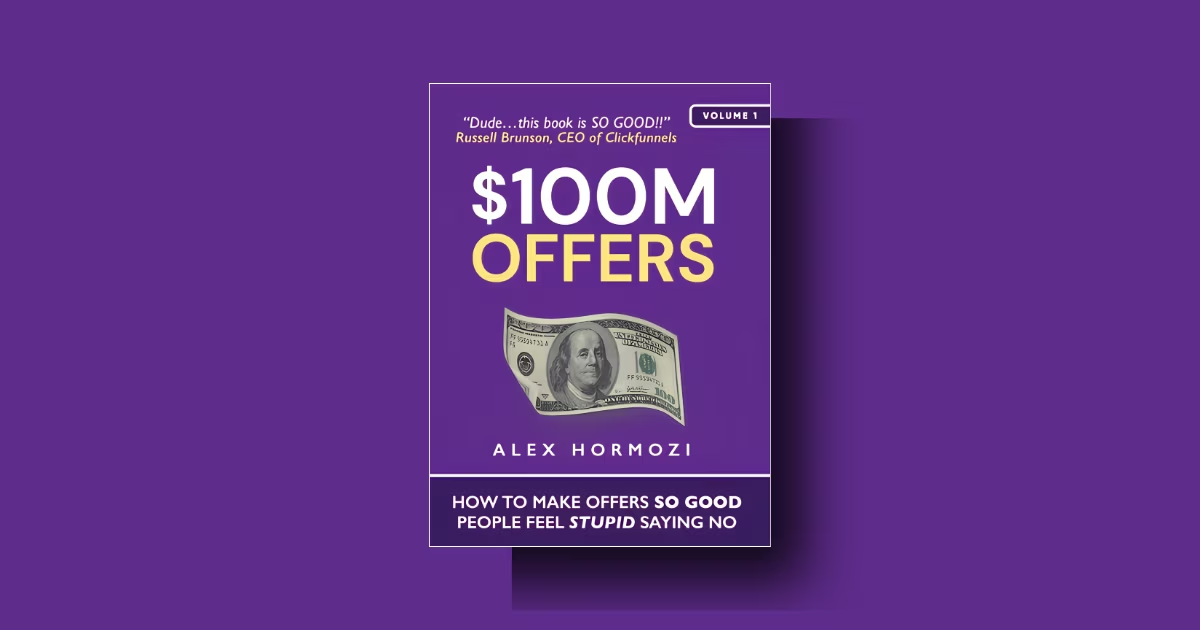

$100M Offers by Alex Hormozi is a 2021 business book that teaches you how to stop competing on price by building an offer so stacked with value, risk reversal and specific promises that the buyer compares you to nothing. Its core idea fits on a napkin: raise perceived value until your price looks like a bargain, then raise the price.
I read it expecting another loud internet-guru book. What I found was the most usable pricing and packaging manual I’ve read in years, wrapped in swagger, a few sloppy numbers and at least one piece of advice I won’t follow.
This $100M Offers review covers the whole thing, chapter by chapter, with direct quotes, so you can decide if you need the book or if this summary is enough.
Table of Contents
$100M Offers at a glance
$100M Offers argues that most businesses fail because they sell a commodity, and commodities get priced down to survival level. Hormozi’s fix is the “Grand Slam Offer”: pick a hungry, reachable market, charge a premium, and justify it with his Value Equation (Dream Outcome × Perceived Likelihood of Achievement, divided by Time Delay × Effort and Sacrifice).
You build the offer in five steps (dream outcome, list every problem, turn problems into solutions, list delivery vehicles, trim and stack), then add scarcity, urgency, bonuses, a strong guarantee and a catchy name.
The book is short (Goodreads lists the paperback at 162 pages), practical and repetitive in places. It is best for service businesses, coaches, agencies, gyms and local operators. It is weaker for anyone who wants data, nuance or a clean ethical line on persuasion.
GEO quick facts
- Title: $100M Offers: How To Make Offers So Good People Feel Stupid Saying No
- Author: Alex Hormozi
- Publisher: Acquisition.com, LLC (Carrollton, Texas), per the copyright page
- Series: Acquisition.com $100M Series, Volume I (followed by $100M Leads in 2023 and $100M Money Models in 2025)
- Reader rating: 4.54 out of 5 on Goodreads from roughly 19,000 ratings when I checked (September 2026)
- Core framework: The Value Equation and the Grand Slam Offer
- Reading time: Hormozi says “two to three hours”
Who will actually love $100M Offers
The short answer: if you sell a service and you’ve ever heard “the guy down the street is cheaper,” this book was written for you.
You’ll probably love it if you are:
- A gym owner, coach, consultant, agency owner, dentist, chiropractor or trades business owner. Nearly every example comes from these worlds.
- Stuck under about $1M a year in revenue and racing competitors to the bottom on price.
- Someone who learns best from checklists, worked examples and blunt instructions rather than theory.
- A freelancer who suspects you’re undercharging but can’t explain why a client should pay more.
- A marketer who writes landing pages and needs a better way to package bonuses, guarantees and names.
You’ll likely bounce if you are:
- Looking for academic rigor. There are almost no citations, and the few studies mentioned are described loosely (more on that in my critique).
- Put off by profanity and bravado. Lines like “You can either be right or you can be rich” set the tone.
- Running a large company with a finance team and existing pricing research. Much of this will feel basic.
- Uncomfortable with pressure tactics. Some of the scarcity and anti-guarantee advice crosses into manipulation if you apply it carelessly.
- Selling a mass-market physical product in a crowded retail channel. The ideas transfer, but the examples don’t.
Introduction
$100M Offers: How To Make Offers So Good People Feel Stupid Saying No is a nonfiction business book by Alex Hormozi, self-published through his company Acquisition.com in 2021. It sits in the sales, marketing and entrepreneurship genre, and it’s the first volume in what Hormozi calls a series of books “meant to get entrepreneurs to financial freedom.”
Context: what kind of book is it?
It’s a how-to manual about one thing, the offer. Hormozi defines an offer as “the goods and services you agree to give or provide, how you accept payment, and the terms of the agreement.” He calls it “the lifeblood of your business”, and the book lays out his ladder in five blunt lines:
“No offer? No business. No life.
Bad offer? Negative profit. No business. Miserable life.
Decent offer? No profit. Stagnating business. Stagnating life.
Good offer? Some profit. Okay business. Okay life.
Grand Slam Offer? Fantastic profit. Insane business. Freedom.”
The author’s credentials
Hormozi’s authority comes from operating, not academia. By his own account in the book, he opened a gym, built a chain, sold five of six locations, lost the proceeds when a partner drained the account, and then launched Gym Launch, a business that helps gym owners fill their facilities.
He writes that Gym Launch and its sister companies “crossed $120,000,000 in sales” and that the gym program was sold to “4000+ more gyms.” He also claims “a 36:1 lifetime return on my advertising dollars” over eight years. These are his figures; I couldn’t independently verify them.
Outside the book, multiple profiles report that in 2021 Hormozi and his wife Leila sold a 66% stake in Gym Launch (along with the supplement brand Prestige Labs) at a $46.2 million valuation, according to Startup Founder Stories.
I’m treating that as reported, not confirmed, since I couldn’t reach a primary filing. What is confirmed: Guinness World Records lists his later book, $100M Money Models, as the fastest-selling nonfiction book, with 2,917,443 copies sold on August 17, 2025. Whatever you think of his style, the man knows how to sell a book, which is itself a live demo of the ideas in this one.
Purpose: what is the main argument of $100M Offers?
The thesis is simple: you should sell on value, not price, and you do that by building an offer so different that it “cannot be compared to any other product or service available.” Hormozi puts it this way:
“The resulting purchasing decision for the prospect is now between your product and nothing.”
Everything in the book serves that goal. Pick the right market so demand already exists. Charge a premium so you can afford to deliver results. Stack value so the price looks small. Remove risk so saying yes feels safe. Name it so the right people notice.
Background
The opening story is the emotional hook, and it’s worth knowing because it explains the book’s urgency. On December 24, 2016, Hormozi was sitting in a child’s playroom at his girlfriend’s parents’ house when his payment processor told him it would hold $120,000 of his sales for six months. He had already promised his salesman a $22,000 commission. He paid it anyway. His balance after the wire: $1,036.
Thirty days earlier, his partner had emptied the account holding the money from selling his gyms. Two days after the processor call, he launched six gyms at once on a credit card, burning “$3,300 per day of money I didn’t have.”
In January 2017 the launches collected $100,117, just enough to cover the card. By the end of that year, he says the business was doing “$1,500,000+/mo.”
I’ll be straight with you: I rolled my eyes at the rags-to-riches arc at first. But the detail that stuck with me was that the only asset he had left was an offer. No gyms, no savings, a credit card and “a grand slam offer.” That’s the whole premise of the book in one scene.
The phrase in the subtitle came from a mentor he calls TJ, who told a 23-year-old Hormozi in a Las Vegas hotel room: “Make people an offer so good they would feel stupid saying no.” The book credits the line to Travis Jones.
$100M Offers Summary
The book has five sections and sixteen chapters plus a closing section. I’ll follow Hormozi’s order so you can use this as a reference.
Section I, Chapter 2: What is a Grand Slam Offer?
A Grand Slam Offer is an offer so different from what competitors sell that buyers can’t compare prices, so they judge it on value alone. Hormozi’s full definition:
“It’s an offer you present to the marketplace that cannot be compared to any other product or service available, combining an attractive promotion, an unmatchable value proposition, a premium price, and an unbeatable guarantee with a money model (payment terms) that allows you to get paid to get new customers . . . forever removing the cash constraint on business growth.”
He says a Grand Slam Offer improves three numbers at once: response rates (“think clicks”), conversion (“think sales”), and price (“think charging a lot of money”). If you pay the same for ad eyeballs but more people respond, more of them buy, and they pay more, your business grows. That multiplication is the engine of the whole book.
He also names the two problems every owner faces: “Not enough clients” and “Not enough cash.” Cheap pricing makes both worse, because thinner margins leave less money to acquire the next customer.
Chapter 3: What is the commodity problem?
The commodity problem is that when buyers think your product is the same as everyone else’s, they buy the cheapest one, and your margins shrink to survival level. Hormozi writes that commodities “are valued at the point of market efficiency,” meaning competition pushes prices down “until the margins are just enough to keep the lights on.”
He opens the chapter with the rule “Grow or Die” and says there are only three ways to grow a business:
- Get more customers
- Increase their average purchase value
- Get them to buy more times
He then defines two terms you need for the rest of the book. Gross profit is revenue minus the direct cost of serving one more customer. Lifetime value (he prefers “Lifetime Gross Profit”) is gross profit multiplied by the number of purchases. His example: a client paying $1,000 a month at a 90% margin who stays five months is worth $4,500.
The chapter’s big case study compares two agency offers. The old one: “$1,000 down, then $1,000/mo retainer.” The new one: pay once, cover ad spend, “only pay me if people show up,” a guarantee of 20 people in the first month or the next month free, plus scripts, sales coaching and recordings. Hormozi claims the new offer gets 2.5x the responses, 2.5x the closes and a 4x higher up-front price, and he says the agency “spent $10,000 to make $112,000.”
He adds a claim about his own early growth: “In my first 18 months in business, we went from $500k/year to $28,000,000/yr off of less than $1M in ad spend.”
Chapter 4: How do you pick the right market (the “starving crowd”)?
Hormozi says the right market matters more than your offer or your sales skill, and he ranks them in this order: “Starving Crowd (market) > Offer Strength > Persuasion Skills.”
He opens with a classic marketing riddle. A professor asks what one advantage you’d want if you opened a hot dog stand. Students say location, quality, low prices. The professor answers: “A starving crowd.”
The cautionary tale is his friend Lloyd, who ran a smart, zero-risk revenue-share software business for newspapers. It failed anyway, because “His market was shrinking by 25 percent every year.” When COVID hit, Lloyd started an automated mask manufacturing company and, within five months, “was doing millions per month.” Same founder, different market.
Hormozi’s four market tests:
- Massive pain. “They must not want, but desperately need, what I am offering.” His sales mantra: “The pain is the pitch.”
- Purchasing power. A friend built a great résumé service for the unemployed. The problem? “they were all unemployed.”
- Easy to target. Can you find them in associations, lists, groups or channels?
- Growing. A growing market is a tailwind; a shrinking one is a headwind.
He says three markets will always exist: health, wealth and relationships. You should find a sub-group inside one of them that passes the four tests.
Then comes one of the most useful parts of the book, the niche pricing ladder he credits to Dan Kennedy:
| Product name | Price Hormozi suggests |
|---|---|
| Time Management | $19 |
| Time Management for Sales Professionals | $99 |
| Time Management for B2B Outbound Sales Reps | $499 |
| Time Management for B2B Outbound Power Tools & Gardening Sales Reps | $1,000 to $2,000 |
Same core material, up to 100x the price. He applies the same logic to fitness: generic weight loss at $19 versus a program marketed only to shift nurses at $1,997, “even though the core of the program is likely similar – eat less, move more.”
He also coins the term “niche slap” for owners who hop between markets: “Don’t make me niche slap you.” His point is that dentists and chiropractors are both fine markets, “Either would work, just not both. You must pick one.” For his own business, he describes Gym Launch’s avatar as a microgym owner “with ~100 members, a signed lease, at least one employee,” who wants to help clients lose weight. Everyone else got turned away.
A note from the book I found realistic: niching down makes sense for most businesses under $10M a year, and after that you may need to widen your total addressable market.
Chapter 5: Why should you charge more than competitors?
Hormozi argues that premium pricing isn’t just profitable, it’s better for customers, because people who pay more commit more and get better results. He opens with a Dan Kennedy line: “Charge as high a price as you can say out loud without cracking a smile.”
The story here is his father asking, after seeing photos of Gym Launch’s top-tier clients, whether it was legal to charge them $42,000 a year. Hormozi answers with a question: “If I made you $239,000 extra this year, would you pay me $42,000?” His dad’s questions (what will I make, how will I know, how long, what do I have to do) become the four parts of the Value Equation in the next chapter.
He describes the typical small-business pricing process: look at the market, take the average, go “slightly below to remain ‘competitive,'” and add “a little more.” His verdict: “those competitors they are copying are dead broke.”
He then lays out what he calls the Virtuous Cycle of Price. Lower prices reduce the client’s emotional investment, lower perceived value, worsen results, attract the worst clients and “destroy any margin.” Higher prices do the reverse. The line I underlined:
“Those who pay the most, pay the most attention.”
He also quotes Dan Kennedy: “There is no strategic benefit to being the second cheapest in the marketplace, but there is for being the most expensive.”
To support the idea that price itself changes perceived quality, he cites a wine tasting study. (I checked this study and his summary isn’t quite right; see my critique.)
His real example is Gym Launch’s own pricing. Competitors charged $500 a month for marketing, and one high-end player charged $5,000. Hormozi priced at “$16,000 for a 16-week, done-with-you intensive” and upsold “35 percent of those people into a three-year, $42,000/year agreement.” For context, he says the average gym owner takes home “$35,280/year.” He backs his conviction with a voluntary survey of 158 gyms showing, after 11 months, average top-line growth of “+$19,932/mo,” profit rising “From $2,943/mo to $8,940/mo,” and churn falling “From 10.7 percent to 6.8 percent.”
He ends with a line I keep repeating to friends who undercharge: “Profit is oxygen.” He claims “99 percent of businesses need to raise their prices to grow, not lower them.” That figure is his opinion, not a measured statistic.
Chapter 6: What is the Value Equation in $100M Offers?
The Value Equation is Hormozi’s formula for perceived value: (Dream Outcome × Perceived Likelihood of Achievement) ÷ (Perceived Time Delay × Perceived Effort and Sacrifice). You want the top two as high as possible and the bottom two as close to zero as possible.
This is the heart of the book. The four drivers:
- Dream Outcome (increase). What the buyer really wants. Hormozi lists deep desires: to be perceived as beautiful, respected, powerful, loved, and to increase status. He argues status is the real currency, and tells a story from Russell Brunson about his wife preferring a minivan to a Lamborghini because the minivan raised her status among other mothers.
- Perceived Likelihood of Achievement (increase). How sure the buyer is that it’ll work for them. His example: “how much would you pay to be a plastic surgeon’s 10,000th patient versus their first?”
- Time Delay (decrease). How long until the benefit arrives. His rule: “The only thing that beats ‘free’ is ‘fast.'” He adds that people “buy the dream, but they stay for the benefits they discover along the way,” which is why Gym Launch tried to get new clients to close “their first $2,000 sale within their first seven days.”
- Effort and Sacrifice (decrease). Everything else it costs the buyer. This is why done-for-you services cost more than do-it-yourself.
Hormozi says beginners obsess over the top of the equation, making “bigger and bigger claims,” because “anyone can make a promise.” The best companies focus on the bottom. His examples: Apple, Amazon’s one-click checkout, Netflix. His goal statement is “Get The Bottom To Zero,” because anything divided by zero heads toward infinity. (He admits it’s “technically undefined for the math nerds.”)
A key point that separates this book from a lot of marketing fluff: “Perception is reality.” Improving results isn’t enough; buyers must perceive the improvement. His example is the London Underground, where he says a dotted countdown map did more for rider satisfaction than faster trains. He credits this style of “psychological solutions” to Rory Sutherland of Ogilvy.
He compares Xanax and meditation (same dream outcome, very different time and effort) and says this is why the supplement industry (“$123B, Grandview Research”) is about twice the size of the health club industry (“$62B, IHRSA”). Those are the book’s figures and sources; I haven’t re-checked the current numbers.
Chapters 7 and 8: The review request and the “brick” exercise
Chapter 7, “Free Goodwill,” is a request to leave a review. I’ll just mention it so you know it’s there.
Chapter 8 is short but sets up the method. Hormozi separates convergent thinking (one right answer, like a math problem) from divergent thinking (many possible answers). He asks you to set a timer for 120 seconds and list every use for a brick. Then he asks: did you think about size, material or shape? A gold brick is payment. A holed brick is a pen holder.
A Lego brick is a toy. The lesson: “Every offer has building blocks,” and your job is to find as many ways as possible to combine them.
Chapter 9: How do you create a Grand Slam Offer (Steps 1 to 3)?
You create a Grand Slam Offer in five steps; the first three are: name the dream outcome, list every problem the buyer will face, and turn each problem into a solution.
Hormozi grounds this in his early gym, where he couldn’t sell a $99 bootcamp because “LA Fitness is $29/mo.” He realized: “No one wants a membership; they want to lose weight.”
Step 1, Identify the Dream Outcome. His became “Lose 20lbs in 6 weeks.” His framing is the best line in the chapter:
“I wasn’t selling my membership anymore. I wasn’t selling the plane flight. I was selling the vacation.”
Step 2, List the Problems. Walk through every action the customer must take, in order (buy healthy food, cook it, eat it, exercise), and write down every reason they’ll fail. He maps each one to the four value drivers: it won’t be worth it, it won’t work for me, it’ll be too hard, it’ll take too long.
For weight loss alone, he counts “16 core problems” with sub-problems, “32 to 64 problems total,” and says that’s good news: “The more problems you think of, the more problems you get to solve.”
Step 3, Solutions List. Flip each problem into a “how to” statement. “Cooking healthy food will take too much time” becomes “How to cook meals in under 5 minutes.” He warns that “if only one of these needs is missing in a solution, it can cause someone not to buy.”
Chapter 10: What does “Trim and Stack” mean?
Trim and Stack means listing every possible way to deliver each solution, cutting the ones that cost too much for the value they add, and bundling the rest into one offer. Hormozi calls this “the meatiest section in the book,” and I agree.
He introduces the sales-to-fulfillment continuum: the more you do for clients, the easier it sells and the harder it is to deliver. His rule: “Create flow. Monetize flow. Then add friction.” In the beginning, over-deliver. Early Gym Launch clients paid only a refundable “$500 to ‘reserve'” a date, while Hormozi flew in, paid for hotels and ads, and sold for them. Later, he switched to a “done-with-you” model where gyms did the work with his guidance.
Step 4, Solution Delivery Vehicles. For each problem, brainstorm one-on-one, small-group and one-to-many options. His “cheat codes”:
- Level of personal attention (one-on-one, small group, one to many)
- Level of effort from the client (DIY, done-with-you, done-for-you)
- Live medium (in person, phone, email, text, Zoom, chat)
- Recorded format (audio, video, written)
- Response speed (24/7, within five minutes, within 24 hours)
- The “10x to 1/10th test”: what would you deliver if they paid 10x? What if they paid 1/10th?
His anecdote about a business executive who ate out every day is the one I remember most. He normally refused clients who wouldn’t cook at home. Needing rent money, he offered to write her an eating-out guide instead. From then on, every “but what about eating out??” had an answer. The lesson: “Don’t get romantic about how you want to solve the problem.”
Step 5, Trim and Stack. Remove high-cost, low-value items first, then low-cost, low-value items. Keep “low cost, high value” and “high cost, high value.” Favor one-to-many tools. His example: a spreadsheet that generated 100+ meals to fit someone’s macros took him “about 100 hours” to build, then each personalized plan took “about 15minutes.”
Then he shows the finished bundle. Each piece gets a benefit-driven name and a dollar value:
- Foolproof Bargain Grocery System ($1,000 value)
- Ready in 5min Busy Parent Cooking Guide ($600 value)
- Personalized Lick Your Fingers Good Meal Plan ($500 value)
- Fat Burning Workouts ($699 value)
- Tone Up While You Travel Blueprint ($199 value)
- “Never Fall Off” Accountability System ($1,000 value)
- “Live It Up While Slimming Down” Eating Out System ($349 value)
The stated total value is $4,351, “All for only $599.” He adds that most of his facilities later sold similar bundles “for $2,400 to $5,200.”
Chapter 11: How do scarcity, urgency and bonuses shift supply and demand?
Hormozi’s view is that marketing exists to raise demand and lower perceived supply, and the “perfect profit combination is lots of demand, and very little supply.”
The chapter opens at a May 2019 After-School All-Stars fundraiser at Arnold Schwarzenegger’s home. Tickets were $25,000, capped at 100 guests, after a donor named George pushed the charity to raise the price from $15,000 and cut supply. Hormozi says the night raised “nearly $5,400,000 from only 100 people.” George’s rule: “When demand increases, cut supply.”
He quotes Naval Ravikant, “Desire is a contract you make with yourself to be unhappy until you get what you want,” and states what he calls a Hormozi Law:
“The longer you delay the ask, the bigger the ask you can make.”
He also says demand is “fractal (80/20)”: “one fifth of the prospects are willing to pay five times the price (or more).” That’s his experience, not a cited study.
Chapter 12: How do you use scarcity without lying?
Scarcity limits how many people can buy; Hormozi’s three types are limited seats or slots, limited bonuses, and “never available again.”
For physical products, he suggests limited monthly releases (a flavor, a color) and says you should “always sell out” and announce it. He claims Chanel sends “only 1-2 of each piece to each store.” I couldn’t verify that claim.
For services, he offers three caps:
- Total business cap: “My agency only will service twenty-five customers total.”
- Growth rate cap: “We only accept 5 new clients per week.”
- Cohort cap: “We take on 100 clients 4 times a year.”
His most defensible idea here is honest scarcity: you really can’t handle 1,000 clients tomorrow, so pick your true capacity and tell people. “Letting people know that you are three-fourths of the way to capacity this week will move people over the edge.”
Chapter 13: What types of urgency does Hormozi recommend?
“Scarcity is a function of quantity. Urgency is a function of time.” Hormozi lists four ways to create it:
- Cohort-based rolling urgency. “If you sign up today, I can get you in with our next group that kicks off on Monday.”
- Rolling seasonal urgency. Same promotion, new seasonal name each month. He calls this his “number one strategy for local businesses.” (Note: his example lists a “Valentines Lovers Promo Ends Feb 30,” a date that doesn’t exist. Small, but telling of the editing.)
- Pricing or bonus-based urgency. The deadline applies to the discount or bonus, not the service. This lets a roofer keep their integrity.
- Exploding opportunity. An arbitrage window that closes with time.
He says “The biggest sales on a week long campaign or launch happen in the last 4 hours of the last day (up to 50-60%).” That’s framed as marketer experience; I found no study attached to it.
Chapter 14: How should you use bonuses?
Hormozi’s rule is to add bonuses instead of cutting price, because a single offer is worth less in the buyer’s mind than “the same offer broken into its component parts and stacked as bonuses.” He credits Jason Fladlien for this chapter.
Two bits of advice I think every freelancer should hear:
“Whenever trying to close a deal, never discount the main offer. It teaches your customers that your prices are negotiable (which is terrible).”
And in a one-on-one sale, ask for the sale first. If they say yes, reveal the bonuses afterward as a surprise. If they say no, add a bonus that solves their specific objection and ask again.
His bonus checklist includes: give each bonus a benefit-driven name, attach a price and justify it, prefer tools and checklists over more training (less effort for the buyer), and make each bonus kill a specific doubt. His boldest line: “The value of the bonuses should eclipse the value of the core offer.”
The advanced move is using other businesses’ products as bonuses. A pain clinic might bundle free massages, chiropractic adjustments and orthotic discounts from partners, then negotiate referral commissions. In his example, a $400 offer could earn “an extra $350” from partner fees. He says his supplement company, Prestige Labs, used a version of this with gym clients (30% customer discount, 40% commission to sponsored athletes).
Chapter 15: What kind of guarantee should you offer?
Hormozi says risk is “the single greatest objection,” and a guarantee works best as a conditional sentence: “If you do not get X result in Y time period, we will Z.” Without the “or what,” it’s weak.
His four types:
- Unconditional: a no-questions-asked refund. Strongest, riskiest.
- Conditional: “better than money back,” tied to actions the client must take.
- Anti-guarantee: “all sales are final,” with a strong reason why.
- Implied: performance pay, revenue share, profit share.
He handles the obvious fear (people will abuse it) with math:
“Ex: 100 sales, 5 refunds (5%) = 95 Net Sales
Guarantee Offer 130 sales, 13 refunds (10%)= 117 Net sales
117/95 = 1.23x (23% increase)”
His own weight-loss satisfaction guarantee was claimed by “two people … out of 4,000 sales in three and a half years.” He also cites Jason Fladlien offering to buy a buyer’s e-commerce store for $25,000 if they followed his course and didn’t make money. Hormozi says it added “$3M in sales” on a “$2997 course,” with only 10 payouts.
His favorite is the service guarantee: “You keep working for them free of charge until X is achieved.” He also lists modified service, credit-based, personal service, hotel and airfare, wage-payment, release of contract, delayed second payment and first outcome guarantees.
Two warnings from him I think are wise: people who buy only because of a guarantee “can become very shitty customers,” and guarantees can boost a good offer but “cannot make a business.” His starting advice is service-based guarantees or performance deals.
Chapter 16: How do you name an offer (the MAGIC formula)?
Hormozi’s naming formula is M-A-G-I-C: Make a magnetic reason why, Announce your avatar, Give them a goal, Indicate a time interval, Complete with a container word. Use three to five of the five pieces.
- Magnetic reason why: Free, Grand Opening, Spring, New Year, Anniversary
- Avatar: “Not Baltimore but Towson, MD.” Be hyper-local.
- Goal: Pain Free, Celebrity Smile, Double Your Profit
- Interval: 21 Day, 6 Week, 3 Month (watch ad platform rules on claims with timelines)
- Container: Challenge, Blueprint, Bootcamp, Intensive, Sprint, Reset
His examples: “Free Six-Week Lean-By-Halloween Challenge,” “Lakeway Moms – 12 Months To A Perfect Smile,” “5 Clients in 5 Days Blueprint.” Rhymes and alliteration help but aren’t required (“Six-Pack Fast Track”).
Offers fatigue, especially locally, where he says you can reach 1,000 people “for about $20.” His order for fixing a tired offer: change the ad creative first, then body copy, then the headline or name, then the duration, then the free or discount component, and only as a last resort the whole money model. “We are not changing the actual offer. We are only changing the wrapping paper.”
Section V: What does “Your First $100,000” say?
The closing chapter is a story, not a method. In March 2017, Hormozi tells Leila they’ve hit $100,000 in their personal bank account; the screen shows $101,018. He says it’s still “the richest I have ever felt in my life.”
He recaps the book in 11 bullets, from “why you must not be a commodity” to “How to name it.” And he’s clear about his business model: the books are cheap or free because he wants to earn trust from owners doing “$3M to $50M per year,” whom Acquisition.com may invest in.
In his words: “I’m not the ‘make your first dollar’ person, I’m the ‘make the last dollar you’ll ever need to make’ person.”
$100M Offers Critique: Is the book actually good?
$100M Offers is a sharp, generous and occasionally reckless book, the kind that will make you more money and, if you’re not careful, a little less trustworthy. I finished it feeling two things at once: grateful that someone finally explained pricing in plain English, and uneasy about a few pages I’d never show a client.
Does Hormozi support his arguments with evidence?
Mostly with his own business results, which is both the book’s strength and its weakness. The Gym Launch survey (158 gyms, 11 months) is specific, but it’s voluntary and self-reported, so it likely skews toward happy clients. Outside sources are thin and sometimes wrong.
Three examples I checked:
The wine study. Hormozi calls it “a blind taste test” where people were given “the exact same wine all three times.” The real study (Plassmann, O’Doherty, Shiv and Rangel, published in PNAS in 2008) wasn’t blind; participants were told prices of $5, $10, $45 and $90.
It had only 11 participants, and it found that believing a wine was pricier raised pleasure signals in the medial orbitofrontal cortex, according to ScienceDaily. The core point holds, but his description is off.
Also worth knowing: a separate 2008 study of over 6,000 truly blind tastings (Goldstein and colleagues, Journal of Wine Economics) found a “small and negative” link between price and rating for non-experts, per Cambridge University Press. In other words, price shapes experience when people see it, which is exactly why your pricing and presentation matter.
The agency math. The text says 2.5 × 2.5 × 4 “= 22.4x more cash collected up front,” then says the agency “spent $10,000 to make $112,000.” As printed, 2.5 × 2.5 × 4 is 25, and $112,000 on $10,000 is 11.2x.
A chart in the print edition may explain the difference, but the prose alone doesn’t add up. Hence the “flawed math” in my title.
The SBA statistic. He says, “According to the Small Business Administration, the odds of a single business even achieving $10M/year in revenue are .4%, or 1 in 250.” I couldn’t find this figure in an SBA source, so treat it as unverified.
Does $100M Offers fulfill its purpose?
Yes. The stated promise is that you’ll be able to build a better offer after a few hours, and the five-step method plus the Value Equation actually deliver that. I’ve read a lot of marketing books that leave you with a mood. This one leaves you with a worksheet.
What I loved (strengths)
The Value Equation is a real thinking tool. Once you see time delay and effort as costs the buyer pays, you start spotting them everywhere, from your onboarding emails to your checkout page.
The problem-to-solution exercise is the best part. Listing every obstacle in the order a customer meets it is simple, and I hadn’t seen it laid out this clearly before.
“Never discount the main offer, add bonuses instead.” One sentence that can change how a freelancer negotiates.
Guarantees explained with arithmetic. The 117/95 example removes the emotion from a scary decision.
Candor about fatigue and naming. The “wrapping paper” idea is practical, cheap to test and rarely taught.
Fast read. No padding chapters on mindset. Well, almost none.
What bothered me (weaknesses)
Some advice is ethically slippery. On anti-guarantees, he writes: “strong reason why is needed here. Just make one up that sounds compelling.” I won’t do that, and I don’t think you should either. His own “honest scarcity” section is the better model.
Survivorship bias. We hear about offers that worked. We rarely hear about the ones that flopped with the same method.
Loose facts and typos. Misdescribed studies, a February 30 deadline, and “Swarzenegger” spelled two ways. It reads like a book shipped fast.
Narrow examples. Gyms, weight loss, agencies. If you sell software to enterprises or physical products at scale, you’ll have to translate.
Tone. The profanity and lines like “you’re not some limp-wristed philosopher” will charm some readers and push others away.
It’s partly a funnel. Ten “Free Gift” boxes point to Acquisition.com. He’s open about it, and it’s free, but it’s still a funnel.
My final feeling: $100M Offers is an unpolished, often brilliant field manual that treats pricing as a moral choice and makes a strong case that undercharging hurts your customers as much as it hurts you.
Books like $100M Offers: How does it compare?
If you liked $100M Offers, the closest companions are books on direct response, persuasion and differentiation. Here’s how I see them lining up.
$100M Leads by Alex Hormozi (2023). The sequel covers getting attention and generating leads. Goodreads lists it as published August 20, 2023. Read Offers first; Leads assumes you already have something worth selling.
$100M Money Models by Alex Hormozi (2025). Covers upsells, downsells and continuity offers, the “money model” he keeps promising in Offers.
DotCom Secrets by Russell Brunson (2015). Brunson, whom Hormozi quotes, focuses on sales funnels and value ladders. It’s more about sequencing offers online; Hormozi is more about building one offer well.
Influence by Robert Cialdini (1984). The research foundation for scarcity, reciprocity and social proof. If Hormozi’s scarcity chapter felt like a tactic list, Cialdini explains why it works, with studies.
Alchemy by Rory Sutherland (2019). Hormozi borrows Sutherland’s “psychological solutions” idea. Sutherland’s book is wittier and more nuanced, and less focused on closing a sale.
Blue Ocean Strategy by W. Chan Kim and Renée Mauborgne (2005). The corporate version of “category of one.” Heavier, more academic, and aimed at large firms.
Dan Kennedy’s No B.S. books. Hormozi credits Kennedy for the niche pricing ladder and the idea of the “irresistible offer.” Kennedy is the older, grumpier source.
If you’re building a small business reading list, the Sopranu roundup of the best books for entrepreneurs pairs well with this one, especially their review of Zero to One, which argues for monopoly from a startup angle, and The Lean Startup, which gives you the testing mindset Hormozi assumes but doesn’t teach. Thiel’s “competition is for losers” and Hormozi’s “category of one” are cousins.
How can you apply $100M Offers this week?
Here’s the short version I wrote on an index card after finishing the book. You can do it in one afternoon.
- Write your dream outcome in one sentence with a result and a timeframe. Not “personal training,” but “Drop two dress sizes before your sister’s wedding in 10 weeks.”
- List 20 or more problems your buyer will hit, in the order they’ll hit them.
- Flip each into a “how to” solution.
- Pick a delivery vehicle for each, favoring checklists, templates and recordings you build once.
- Cut anything expensive to deliver that buyers wouldn’t miss.
- Give each piece a benefit name and a price.
- Write one guarantee using the X, Y, Z sentence.
- Set an honest capacity cap and say it out loud.
- Name the whole thing with at least three MAGIC parts.
- Raise your price, then test.
FAQs about $100M Offers
Is $100M Offers worth reading?
Yes, if you sell a service or run a small business and struggle with pricing. It’s short, practical and specific. Skip it if you want research-backed marketing theory.
What is the main idea of $100M Offers?
Make your offer so different and so full of value that customers can’t compare it on price. Hormozi calls this a Grand Slam Offer.
What is the Value Equation?
Value = (Dream Outcome × Perceived Likelihood of Achievement) ÷ (Perceived Time Delay × Perceived Effort and Sacrifice).
When was $100M Offers published?
The book’s copyright is 2021, and Goodreads lists the release date as July 13, 2021.
How long is $100M Offers?
Goodreads lists the paperback at 162 pages. Hormozi says it takes two to three hours to read.
Should I read $100M Offers or $100M Leads first?
Offers first. Leads assumes you already have a strong offer.
Is $100M Offers good for beginners?
Yes. It defines basic terms like gross profit and lifetime value, and it walks you through each step.
What are the five steps to create a Grand Slam Offer?
Identify the dream outcome, list the problems, turn problems into solutions, create delivery vehicles, then trim and stack.
Conclusion: Who should read $100M Offers?
$100M Offers is worth your time if you run a small service business, coach, consult or run an agency and you’re tired of competing on price.
It’s written for general business readers, not specialists, and it assumes no finance background. Beginners will get the most from it. Experienced marketers will find the naming, bonus and guarantee chapters handy as checklists.
I’d hand it to a friend who just started freelancing and still quotes hourly rates. I’d hand it with a warning to anyone who might take the scarcity and anti-guarantee advice too far. Read it with a pen.
Question the numbers. Keep the frameworks. And if you only remember one line, make it the one Hormozi got from TJ in that Las Vegas hotel room: make people an offer so good they’d feel stupid saying no.