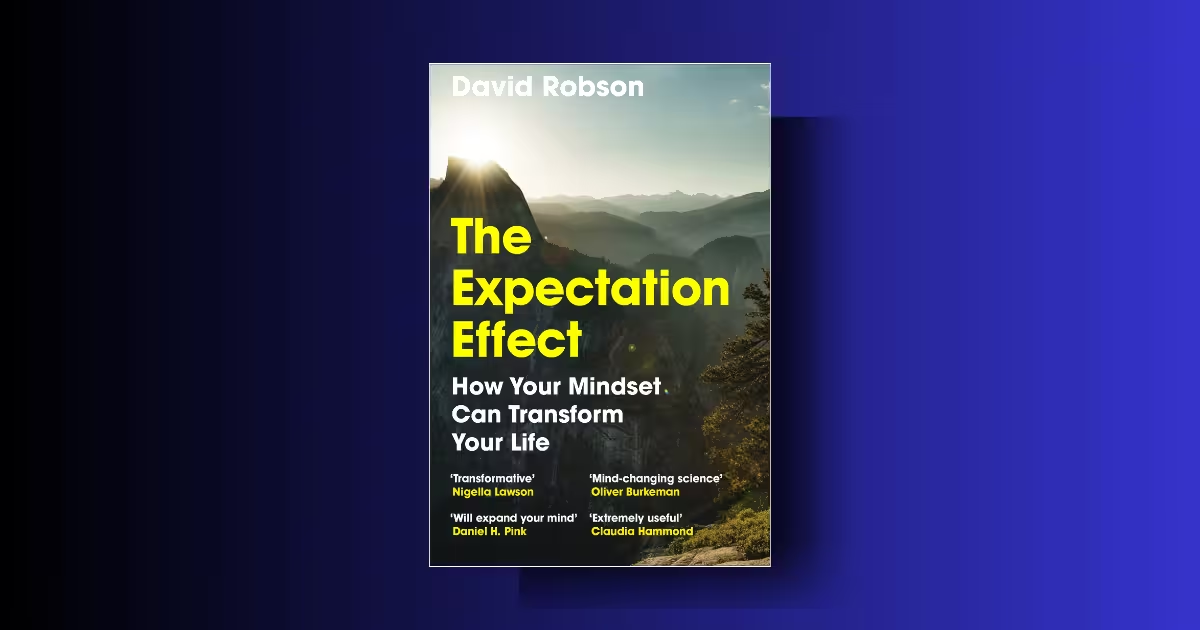

The Expectation Effect is David Robson’s 2022 science book arguing that what you expect from a pill, a workout, a meal, a stressful morning or your own 70th birthday partly decides what you actually get. It is not a “think positive” manual.
Robson, a former BBC Future editor, builds his case from placebo trials, hormone tests, brain scans and decades-long health surveys, and some of the numbers are hard to shake off: people with a positive view of ageing lived about 7.5 years longer in one Ohio study, and a single paragraph that took under a minute to read lifted students’ maths scores on a real graduate admissions exam.
I finished The Expectation Effect convinced, then went looking for the weak spots. Some of its most famous studies have since wobbled under replication. The core idea, I’d argue, still stands.
This The Expectation Effect review gives you the full summary, the practical tools, and an honest scorecard on the science.
Table of Contents
The Expectation Effect brief
The Expectation Effect: How Your Mindset Can Transform Your Life (Canongate, UK, January 2022; US subtitle How Your Mindset Can Change Your World, Henry Holt, February 15, 2022) argues that the brain is a “prediction machine” that builds your experience of pain, hunger, fatigue, stress and even ageing from expectations as much as from raw signals.
Placebos heal through that machine; nocebos (negative expectations) harm through it, and both can spread between people like a contagion. Robson’s ten chapters move from perception and medicine to exercise, diet, stress, sleep, willpower, intelligence and ageing, and each ends with a “How to think about…” toolkit.
The big lesson: change specific beliefs (not your general mood) through honest reframing, and your body often follows. The Expectation Effect won the British Psychological Society’s book award in 2022, according to its UK publisher. My verdict: a brilliantly told, mostly sound book whose willpower and classroom chapters lean on research that has since been seriously challenged.
Quick facts
| Detail | Answer |
|---|---|
| Author | David Robson, science journalist, former editor at BBC Future |
| Published | UK: Canongate, January 2022 (304 pp. paperback). US: Henry Holt, February 15, 2022 (336 pp.) |
| Genre | Popular science, psychology, health |
| Core claim | Specific beliefs shape physical and mental outcomes through the brain’s predictions |
| Chapters | 10, plus introduction and epilogue |
| Honours (per Canongate) | BPS Book Award 2022 winner; FT Best Books of 2022 (Health and Wellbeing); Waterstones Best Books of 2022 (Popular Science); Sunday Times Best Paperbacks of 2023; BBC Radio 4 Book of the Week |
| My rating | 4 out of 5 |
Reader recommendation for The Expectation Effect
You will probably love it if you:
live with chronic pain, migraines, anxiety or insomnia and want tools that sit alongside (not instead of) medical care;
liked Carol Dweck’s Mindset but wanted harder physiological evidence;
coach, teach, manage or parent, since the chapter on other people’s expectations will change how you talk to the people in your care;
are over 50, or worried about getting older. Chapter 10 alone is worth the cover price;
diet constantly and feel hungry on “healthy” food all the time.
You will probably bounce if you:
want a step-by-step programme. The advice is split into ten short toolkits;
already follow the replication crisis closely, since some flagship studies here (ego depletion, Pygmalion, the 1979 “time-warp” retreat) will make you wince;
hope for “manifesting” or law-of-attraction content. Robson explicitly calls that pseudoscience;
need a quick read. It is dense with study after study, around 300 pages.
Introduction
Title, author and publication details
The Expectation Effect: How Your Mindset Can Transform Your Life is the second book by British science writer David Robson, following The Intelligence Trap (2019). Canongate published it in Edinburgh in January 2022, and Henry Holt released the American edition, retitled How Your Mindset Can Change Your World, on February 15, 2022, at 306 pages according to Gooodreads.
Canongate lists the UK paperback at 304 pages and the audiobook at 8 hours 58 minutes. Robson wrote much of it, he tells us, during the Covid-19 lockdowns.
Context: what kind of book is The Expectation Effect?
The Expectation Effect is popular science sitting right on the border with self-help. Robson’s credentials are journalistic rather than clinical.
Canongate’s author page says he was an editor and senior journalist at BBC Future and now writes for The Times, The Telegraph, The Guardian, The Atlantic and The Washington Post, and that The Intelligence Trap has been translated into 15 languages. He has since published a third book, The Laws of Connection (Canongate, 2024). That background matters.
The Expectation Effect reads like long-form science reporting: a vivid case, the study behind it, an interview with the researcher, and then the practical lesson.
Purpose: what is the main argument of The Expectation Effect?
The central thesis is simple and bold. Your expectations, conscious or not, are “self-fulfilling prophecies” that change your physiology, not just your mood. Robson borrows Stanford psychologist Alia Crum’s line that “our minds aren’t passive observers simply perceiving reality as it is”.
He adds two guardrails that he repeats all the way through, and I think they are the most important sentences in the book. First, the effects come from specific beliefs (“my body is fit”, “stress gives me energy”), not general cheerfulness. Second, “your mind, alone, cannot perform miracles”.
You cannot imagine yourself rich or visualise away a terminal illness, and he names Rhonda Byrne’s The Secret (which, he notes, sold 35 million copies) as pure pseudoscience.
Background
The placebo effect has a strange history, and Robson uses it as his spine. Thomas Jefferson wrote in 1807 about a doctor who gave out more “bread pills” and coloured water than real drugs, calling the practice “a pious fraud”. By the mid-20th century, medical journals were dismissing placebo responders as neurotic or unintelligent.
Then came Henry Beecher, the Second World War anaesthetist whose observations led to the placebo-controlled trial, which the US Food and Drug Administration adopted as its gold standard by the 1970s.
Two newer ideas make The Expectation Effect possible. One is the “predictive processing” theory of the brain, traced back to Hermann von Helmholtz’s 19th-century notion of “unconscious inference” and championed today by neuroscientists such as Anil Seth and Moshe Bar. The other is a wave of mindset research from labs at Stanford, Yale and elsewhere since the 2000s.
The catch, which Robson only partly addresses, is that this same period produced psychology’s replication crisis. I’ll come back to that in the analysis, because it is where this book is most vulnerable.
The Expectation Effect summary
Below is a full, chapter-by-chapter summary of The Expectation Effect. I have kept the studies, the numbers and the practical advice, so you can use the ideas even if you never open the book. Page-level quotations are kept short and marked.
Introduction: can a belief really kill you, or make you fitter?
Robson opens with two stories that frame everything. In the first, a Harvard team told hotel cleaners that their daily work (hoovering, changing beds, moving furniture) already met recommended exercise levels. A month later, their weight and blood pressure had improved with no reported change in lifestyle.
The second story is darker. From the late 1970s, the US Centers for Disease Control received reports of young Hmong refugee men from Laos dying in their sleep. At its peak, “Sudden Unexpected Nocturnal Death Syndrome” killed more young Hmong men than the other top five causes of death combined. The medical anthropologist Shelley Adler traced it to the dab tsog, a night demon in Hmong folklore.
Cut off from the shamans and rituals that once protected them, the men experienced ordinary sleep paralysis (which affects around 8 per cent of people) as a deadly attack, and the terror may have triggered fatal heart arrhythmias.
Robson then tells his own story. Prescribed antidepressants, he suffered “ice-pick” headaches, until he learned while writing about placebos that many side effects arise from the nocebo response. Knowing that, the pain faded. It is a smart opening because it shows both directions of the effect: belief can heal and belief can hurt.
Chapter 1, The Prediction Machine: does your brain see the world, or guess it?
Your brain mostly guesses. This is the theoretical engine of the whole book. Robson argues, following neuroscientists like Moshe Bar and Anil Seth, that the brain builds a running simulation of the world from past experience and then checks it against the senses.
Bar’s summary, quoted in The Expectation Effect, is perfect: “We see what we predict, rather than what’s out there.”
The evidence comes thick and fast:
Gatwick, December 2018. Around 170 reported drone sightings shut Britain’s second-biggest airport for roughly 30 hours, disrupting 140,000 passengers and cancelling more than a thousand flights. Police never found a single photo. Robson argues fear primed officers to see drones in a grey winter sky.
Zürich Zoo. Shown the famous duck-rabbit illusion, about 90 per cent of visitors saw a bird in October. At Easter, that fell to 20 per cent, and nearly every child under ten saw a rabbit.
Hallucinated faces and songs. Primed participants “saw” faces in random grey static in 34 per cent of trials, and nearly a third of Dutch students heard Bing Crosby’s “White Christmas” in pure white noise.
Amundsen’s expedition, 13 December 1911. Fearing Scott had beaten them to the Pole, the Norwegian team “saw” people in the distance. It was a pile of their own dogs’ droppings.
The chapter then turns personal and clinical. A young woman Robson calls Sara went almost totally blind with no damage to her eyes, a “functional neurological disorder”. Robson notes FNDs are the second most common reason for referral to a neurologist, after headaches and migraines. Her Edinburgh neurologist, Jon Stone, treated her with encouragement plus magnetic brain stimulation that produced flashes of light, proving her visual system still worked. Eight months later her sight fully returned.
Expectation also bends everyday perception. People afraid of heights overestimated a 26-foot drop by about five feet. Arachnophobes see spiders as bigger and faster than they are. Lonely students watching playground videos noticed the unkind faces and missed the smiles.
Taste is just as pliable. At two MIT pubs, about 60 per cent of drinkers preferred “MIT Brew” (beer with a few drops of balsamic vinegar) when told about the vinegar afterwards, but only about 30 per cent when told beforehand. Participants wearing “Ray-Ban” sunglasses made about half as many reading errors as those told they had a mid-market brand, though the glasses were identical.
In Ellen Langer’s flight-simulator study, 40 per cent of cadets read smaller text than they could on a standard eye chart.
Robson’s toolkit for Chapter 1: question your own objectivity as a witness; remember that phobias physically exaggerate threats, which exposure therapy can shrink; try attention-retraining apps (he names Personal Zen) for anxiety; and use rich, sensory language when you serve food, because labels change taste.
Chapter 2, A Pious Fraud: how can a sugar pill heal a real illness?
A sugar pill heals by triggering the body’s own “inner pharmacy”. This chapter is the medical heart of the book, and the numbers are striking:
- In Second World War field hospitals, Beecher found about 32 per cent of badly wounded soldiers reported no pain and 44 per cent only slight or moderate pain. When morphine ran short, saline injections worked, by his estimate, about 90 per cent as well as the real drug.
- In analgesic trials overall, the placebo response can account for around 50 per cent of a painkiller’s relief. Block the brain’s opioid receptors with naloxone and placebo pain relief largely disappears, which proves the relief is chemical and not imaginary.
- Placebos improve Parkinson’s symptoms by roughly 20 to 30 per cent by raising the brain’s own dopamine. An empty asthma inhaler delivers about 30 per cent of the benefit of the drug salmeterol.
- In a UK trial of 230 angina patients reported in The Lancet, the benefit of an arterial stent over sham surgery was too small to be statistically significant.
- “Placebo adherers”, people who faithfully take their dummy pills, tend to live longer than people who take pills haphazardly, even after controlling for income, education, smoking and drinking.
Robson also lists what makes a placebo stronger. Bigger tablets beat smaller ones, capsules beat tablets, injections beat pills, and surgery beats injections. Price matters: labelling a Parkinson’s placebo “cheap” halved its benefit. Branding matters: placebo Nurofen matched the active painkiller in one study. A caring, competent clinician matters most of all. He adds that 12 per cent of UK GPs say they have given a placebo at least once.
Then comes the twist. Placebos are getting stronger. In painkiller trials, real drugs beat placebos by about 27 per cent in the 1990s but by just 9 per cent by 2013, and the change was concentrated in US trials. One explanation is direct-to-consumer drug advertising; another, from Gary Bennett at UC San Diego, is that public awareness of placebos has itself raised expectations.
That leads to “open-label” placebos, which patients know are fake. In Cláudia Carvalho’s 2016 Lisbon trial, chronic back pain patients taking openly labelled placebo capsules reported about a 30 per cent drop in pain after three weeks, and a 2020 follow-up found the gains lasted five years. Leon Morales-Quezada’s Harvard team paired opioids with an open-label placebo and the smell of cardamom oil; patients cut their opioid use by 66 per cent with no rise in pain. Robson places this against the CDC figure of 450,000 American opioid overdose deaths between 1999 and 2019.
You do not even need a pill. Marburg’s Psy-Heart trial gave heart bypass patients about three hours of expectation-focused conversations and a “recovery action plan”. They left hospital about 4.7 days earlier than standard-care patients and had lower levels of the inflammatory molecule IL-6 six months later.
In Stanford work led by Kari Leibowitz, a doctor simply saying a mild allergic rash would soon fade made it fade faster. Patients of more reassuring doctors recovered from colds about a day sooner. Robson’s conclusion is that the words a doctor speaks are themselves “biologically active”, and, more pointedly, that with mind and body, “knowledge really is power.”
Robson’s toolkit for Chapter 2: do not panic when a treatment is “partly placebo”, since the biology is still real; choose empathetic clinicians where you can; learn how your treatment works; visualise and plan your recovery; talk to patients who improved; and consider an open-label placebo only alongside, never instead of, prescribed medicine.
Chapter 3, Do No Harm: can negative expectations make you sick?
Yes, and sometimes severely. The nocebo (“I shall harm”) response is the placebo’s evil twin, and this chapter is where the book gets unsettling.
The examples:
- In the 1880s, Baltimore surgeon John Noland Mackenzie showed a severe hay-fever patient an artificial rose, wiped clean of any pollen. Within a minute her nose blocked and her throat swelled. On learning the truth, she was cured, burying her nose in real roses on her next visit.
- An analysis of more than 1,200 placebo-controlled trials found about half of placebo takers reported at least one adverse event, and about 5 per cent quit because of side effects.
- Telling men about sexual side effects of the prostate drug finasteride raised erectile dysfunction from about 10 per cent to up to 30 per cent. Patients warned about stomach irritation from aspirin were six times more likely to stop taking it.
- When GlaxoSmithKline changed the colour and binding ingredients of the thyroid drug Eltroxin in New Zealand in 2007, complaints jumped from 14 in 30 years to about 1,400 in 18 months, roughly a 2,000-fold increase. The active ingredient had not changed.
- Patients’ early beliefs predicted post-concussion syndrome in 80 per cent of cases, better than the severity of the injury itself.
- In Minnesota in 2007, “Mr A” swallowed 29 trial capsules in a suicide attempt and his blood pressure crashed. They were placebos. In Greifswald, Germany, in 2016, a woman in a sham acupuncture control group (only adhesive tape) suffered a heart rate of 23 beats a minute after being warned of possible cardiovascular collapse.
- In the Framingham study, women who believed in the 1960s that they were more likely than peers to get heart disease were about 3.7 times more likely to die of cardiac arrest over 20 years, even after controlling for BMI, cholesterol and smoking.
Robson also covers the strange timing of deaths. Thomas Jefferson and John Adams both died on 4 July 1826, the 50th anniversary of the Declaration of Independence, and James Monroe died on the same date five years later. In the death records of more than 30 million Americans, death was 4 per cent more likely on a birthday than in the two preceding days.
The fix is framing. In a University of New South Wales study, students told that “73 out of 100 people will not experience drowsiness” reported fewer side effects than those told 27 out of 100 would. Robson puts it sharply: “Worst-case thinking doesn’t prepare you,” he writes, it “promotes the worst case.” In Stanford’s peanut allergy trial, children told that mild symptoms were a sign the therapy was working (like sore muscles after training) felt less anxious, reported fewer symptoms, and produced more of the protective antibody IgG4.
For pain, he recommends a “pain-relief mindset” to counter catastrophising, the habit researchers Luana Colloca and Beth Darnall compare to pouring gasoline on a fire. Robson cites evidence that more than half of chronic pain patients get at least a 30 per cent reduction using reappraisal, with some reaching 70 per cent.
Robson’s toolkit for Chapter 3: check whether a drug’s side effects also appeared in the trial’s placebo group; reframe risk (a 10 per cent chance of a side effect means 90 per cent stay clear); read mild side effects as a sign the treatment is acting; measure your catastrophising and challenge it with evidence; and keep phrases handy like “My pain is in my brain” and “The sensations are real, but temporary.”
Chapter 4, The Origins of Mass Hysteria: can you catch a symptom from someone else?
You can, and it is not a sign of weakness. In May 2006, around 300 Portuguese teenagers developed dizziness, breathing problems and rashes. The cause turned out to be the teen soap Morangos com Açúcar (Strawberries with Sugar), whose characters had just caught a fictional virus with the same symptoms.
Robson explains the mechanism through the “mirror system”, first spotted in macaques at the University of Parma in the early 1990s by Giacomo Rizzolatti’s team. We simulate other people’s actions and feelings in our own brains and bodies. In the Framingham data, a happy friend raised your own odds of high life satisfaction by about 15 per cent, a friend of a friend by about 10 per cent, and a friend of a friend of a friend by about 6 per cent.
Symptoms spread the same way:
- Volunteers who watched an actor feign sickness after taking an inert pill reported 11 times as many symptoms.
- Blood donors were twice as likely to feel faint after seeing another donor nearly collapse.
- Fabrizio Benedetti’s Alpine study took 121 students to a lab 3,500 metres up. One “trigger” student was warned about altitude headaches and spread the word to 35 others. Of those, 86 per cent got headaches, against 53 per cent of the rest, with matching rises in prostaglandins. As Benedetti told Robson, “the stronger expectations are, the stronger the effects will be.”
From cases like a 1962 South Carolina mill “insect” outbreak (about 60 workers), Robson draws three laws of contagion: stress, social connection to a sufferer, and a plausible threat. He applies them to the Salem witch trials, a 1983 West Bank outbreak that affected nearly a thousand girls (traced to a smelly broken latrine), post-9/11 school rashes and “Havana syndrome”.
Media then turns local scares global. Robson discusses “electro-sensitivity” (1.5 per cent of Swedes, 4 per cent of Britons), where James Rubin’s 2006 King’s College London study of 60 sufferers found slightly more symptoms during sham exposure than real mobile signals.
He covers 46 Taiwanese students hospitalised after 2009 swine flu jabs, about 600 psychogenic cases after Colombia’s 2014 HPV vaccine rollout, and statin side effects, where the placebo-versus-drug difference in muscle pain was under 1 per cent according to an American Heart Association review. Reported statin muscle pain runs at 10 to 12 per cent in the US and UK, where negative coverage is common, and about 2 per cent in Sweden and Japan.
Gluten gets the same treatment. In a meta-analysis of ten blinded studies, 16 per cent of people with self-reported gluten sensitivity reacted to gluten but not placebo, while about 40 per cent reacted equally to both. UK reports of gluten sensitivity rose 250 per cent in three years in the mid-2010s.
The hopeful note: Keith Petrie and Fiona Crichton in Auckland found that explaining the nocebo effect could “immunise” people against “wind turbine syndrome”.
Robson’s toolkit for Chapter 4: notice how your body mirrors others; be wary in times of political anxiety and new technology; remember coincidence; look for studies comparing exposed and unexposed people; and drop stigmatising language about psychogenic illness.
Chapter 5, Faster, Stronger, Fitter: is fatigue in your muscles or in your head?
Mostly in your head, or more exactly, in your brain’s forecast of how much your body can safely spend. The chapter opens at the 1997 Tour de France. Before a time trial, Richard Virenque asked his physiotherapist Willy Voet for a mysterious new drug. Voet secretly injected glucose solution. Virenque finished 3 minutes 4 seconds behind Jan Ullrich in what Voet called “the time trial of his life”.
Robson revives the forgotten Italian physiologist Angelo Mosso, who argued in La Fatica that brain fatigue weakens muscles, and sides with Timothy Noakes’s “psychobiological” view of exhaustion.
The evidence: only 50 to 60 per cent of muscle fibres fire during intense exercise; Bangor University cyclists lost 15 per cent of their stamina after a 90-minute mental task (2009); and cyclists lasted 18 per cent longer when a rigged clock ran 10 per cent slow. He quotes Paavo Nurmi: “Mind is everything; muscles, pieces of rubber.”
Belief works like a drug:
- Weightlifters given decaf they thought was strong caffeine managed about 10 per cent more reps.
- Runners given saline they believed was similar to EPO ran 3 kilometres 1.5 per cent faster.
- After false feedback that they were fitter than others, participants’ VO2 max scores rose, opening a gap of about 7 per cent with the control group.
- In a 2019 study, being told you carried a “bad” version of the CREB1 exercise gene hurt lung function more than actually carrying it.
The “invisible exercise” section is my favourite. Jeremy Morris’s postwar study found London bus conductors, who climbed 500 to 750 steps a day, had roughly half the heart failure risk of drivers. Robson includes a table of everyday METs (vacuuming 3, mowing the lawn 6, dancing 7.8) and notes an Imperial College finding that about a third of English public transport users meet activity guidelines through commuting alone.
Then the hotel cleaners in full: told that 15 minutes of changing linen burns 40 calories, vacuuming 50 and cleaning bathrooms 60, they lost about a kilogram each and saw blood pressure drop from above-normal to normal in a month.
Alia Crum and Octavia Zahrt’s follow-up of more than 60,000 people over up to 21 years found that those who thought they were less active than peers were up to 71 per cent more likely to die, even after controlling for measured activity. Robson also cites evidence that just 15 minutes of exercise a day can add three years to life expectancy.
Two warnings follow. “Fitspiration” images left Adelaide students more tired and in a worse mood after a treadmill session (2020). And visualisation works: imagining lifting weights from a first-person view, 15 minutes a day, five days a week, raised arm strength by 11 per cent in six weeks, against about 5 per cent for an outside view.
Ohio University researchers found mental practice halved strength loss in limbs in plaster casts. Michael Phelps, with 28 Olympic medals (23 gold), credits his race visualisations.
His reframe for breathlessness and aching legs is three words long: “The exercise is working.”
Robson’s toolkit for Chapter 5: set an aim before each session; use any “mental crutch” (music, kit, a favourite drink), even knowing it works through belief; question your “I’m not sporty” story; reframe aches as progress; log invisible exercise for a week; avoid upward comparisons; and visualise your next workout during rest.
Chapter 6, The Food Paradox: why can a “healthy” meal leave you hungrier?
Because your body reacts to what you think you ate. Robson opens with a quiz: a “Super-Slimmer” menu (avocado toast, tuna niçoise, chicken braise, granola bar) against a “Bon Viveur” menu (croissant, hot chocolate, spaghetti puttanesca, fish pie, two doughnut bites). Without snacks, the slimmer plan is about 1,750 calories and the indulgent one about 1,632. The “sensible” granola bar alone has 279 calories against 110 for the doughnuts.
The science of “expected satiety” begins with Henry Molaison (H.M.), the amnesiac who rated his hunger at about 50 out of 100 before and after meals and ate a second full dinner a minute after the first. Then:
- Remembering lunch cut later cookie eating by about 45 per cent (Suzanne Higgs, Birmingham).
- In a 2012 Bristol study, a rigged soup bowl showed that hunger over the next three hours tracked how much soup people saw (300ml or 500ml), not how much they ate.
- A protein bar labelled “healthy” left people hungrier than eating nothing at all.
Crum’s milkshake study is the centrepiece. The same 380-calorie shake was labelled either “Indulgence” (620 calories) or “Sensi-Shake” (140 calories, “guilt-free”). After the indulgent label, the hunger hormone ghrelin dropped as it should after a big meal. After the “sensible” label, it barely moved.
Purdue researchers found people who believed a drink would solidify in the stomach digested it more slowly and ate about 400 fewer calories over the day. A 1970s study found Thai participants absorbed 70 per cent more iron from a recognisable curry than from the same food blended to mush.
Robson also cites Crum’s 2019 analysis of 26 US chain restaurants: indulgent dishes got words like “sinful” and “gooey”; healthy dishes got “lite” and “fat free”. Tastier names raised vegetable eating by 29 per cent in one of her studies. Feeling poor matters too: Singapore participants told they scored in the bottom 19 per cent showed higher ghrelin after a shake.
Among 131 dieters, those who linked cake with “celebration” did better over three months than those who linked it with “guilt”. He ends with France, where WHO figures put average BMI at 25.3, against 28.8 in the US.
Robson’s toolkit for Chapter 6: eat without screens; recall your last meal when cravings hit; choose foods described with indulgence; prioritise flavour and texture when dieting; avoid sweetened drinks; savour anticipation; and enjoy treats without guilt.
Chapter 7, De-stressing Stress: is stress bad for you, or is your belief about stress the problem?
Robson’s answer is that the belief does much of the damage. He traces the “war on worry” from an 1872 British Medical Journal warning, through Theodore Seward’s “Don’t Worry” clubs and William James’s “religion of healthy-mindedness”, to a 1983 Time cover story, the same year “stressed out” entered English.
Hans Selye, the father of stress research, was nominated for the Nobel Prize 17 times, yet his rat studies involved extreme panic rather than ordinary pressure.
Jeremy Jamieson at the University of Rochester changed the story. Before a practice GRE, half of 60 students read a short paragraph saying anxiety can help performance. Their maths scores averaged 770 on the real exam months later, against 706 for the control group. Under the Trier Social Stress Test, reappraisers’ hearts still raced, but their blood vessels dilated, the pattern you see in exercise, rather than constricting as if bracing for injury. Distraction did not help; reframing did.
Jamieson’s line, quoted in The Expectation Effect: “The stress response, instead of becoming this thing to be avoided, actually becomes a resource.”
The biggest number: in an eight-year study of more than 28,000 people, high stress raised the risk of dying by 43 per cent, but only for those who believed stress harmed their health. The authors estimated the belief alone equates to about 20,000 preventable US deaths a year.
Robson also warns against chasing happiness. Iris Mauss at Berkeley found people who valued happiness most were less happy on every measure, and that judging your own emotions as “bad” predicted depression and anxiety in a study of about a thousand people. Maya Tamir showed angry players performed about three times better in a game, provided they had been told anger was useful. Billie Jean King’s motto, “pressure is privilege”, gets a good page.
Sleep follows the same logic. Around 10 per cent of people are “complaining good sleepers” and 16 per cent are “non-complaining bad sleepers”, and it is the complainers who suffer the daytime fatigue, poor focus and low mood. One meta-analysis author concluded that “worry about poor sleep is a stronger pathogen than poor sleep”.
With about 8 per cent of US adults (around 17 million) on sleep medication, Robson suggests roughly 40 per cent of them may have no objective sleep problem. Selye himself came round late in life, coining “eustress” and writing that stress “is not what happens to you, but the way you take it”.
Robson’s toolkit for Chapter 7: accept unpleasant feelings rather than suppressing them; read a racing heart as fuel; relabel anxiety as excitement; keep reminders of these ideas at your desk; accept restlessness at night; and check your sleep objectively with an app or tracker before assuming the worst.
Chapter 8, Limitless Willpower: does self-control run out like fuel?
Only if you believe it does, Robson argues, though this is the chapter where I trust the evidence least (more on that below). He begins with Barack Obama’s identical blue and grey suits, meant to save decision-making energy, and Roy Baumeister’s “ego depletion” theory.
In Baumeister’s famous experiment, students who resisted cookies and ate radishes gave up on an impossible puzzle after about 8.5 minutes, against 19 minutes for the cookie eaters. His team linked willpower to glucose and found people spend about a quarter of their day resisting desires.
Then Veronika Job’s work turns the theory around. People who agreed with statements like “Your mental stamina fuels itself” showed no drop in Stroop test accuracy after a tedious task, while those with a “limited” view did. Primed with the non-limited belief, participants were about twice as accurate.
In diaries, non-limited people were more productive after a demanding day. Job and Krishna Savani found the non-limited view more common among Indian students, possibly linked to practices like trataka, a yogic exercise of focusing on a single point such as a candle flame.
Robson proposes a “unified theory”: the brain acts like an accountant, rationing fuel when it believes reserves are low. That would explain why just rinsing your mouth with sugar water improves performance. He points to Danielle Steel’s 179 books, 20-hour workdays and her office sign, “There are no miracles. There is only discipline.” In a nursery study, 74 per cent of children who heard a story about willpower getting “stronger and stronger” waited 13 minutes for a bigger treat, against 45 per cent of controls.
The chapter ends with rituals. Basketball players hit 83.8 per cent of free throws following their routine, against 71.4 per cent without it. A short salt-sprinkling ritual raised karaoke scores by 13 points out of 100, but only when it was called a “ritual”. About 64 per cent of ritual performers chose a fruit bar over a Snickers, against 48 per cent of controls.
Robson’s toolkit for Chapter 8: build autonomy into your routines; notice tasks that energise you; question whether “draining” tasks really are harder; and create a simple personal ritual or lucky charm for high-pressure moments.
Chapter 9, Untapped Genius: can other people’s expectations make you smarter?
They can move your performance, and the classic case is Spruce Elementary School in South San Francisco in 1964. Robert Rosenthal and principal Lenore Jacobson told teachers that certain children, actually chosen at random, were about to “bloom”. In Grade 1, those children gained about 15.4 IQ points more than classmates, and 9.5 more in Grade 2. One girl, Violet, gained 37 points.
Robson adds newer work:
- Cyrus Foroughi at George Mason University found students recruited with a “brain training” flyer gained 5 to 10 IQ points after one hour’s training; those recruited with a neutral flyer gained almost nothing.
- Nicole Sorhagen found first-grade teachers’ misjudgements still predicted maths and reading at age 15 in a sample of about a thousand children.
- Israeli soldiers whose instructors expected more scored three standard deviations higher, though Robson calls this size exceptional. The average workplace effect lifts a person about 16 percentiles.
- Christine Rubie-Davies’s trial with 90 teachers, who filmed themselves to catch “leaked” low expectations, produced a 28 per cent improvement in students’ maths performance.
He also covers bias: a study from the early 1990s found attractive MBA graduates earned about $10,000 a year more ten years on; in William Mayew’s analysis of 792 CEOs, the deepest voices earned about $187,000 more a year; and a 2018 US study of more than 8,500 pupils found teacher expectation effects stronger for girls and minority boys than for white boys. Stereotype threat explains part of it.
The remedy is self-affirmation: list ten personal values or qualities, pick the most important and write why it matters.
In studies Robson cites, it nearly closed the gender gap on spatial rotation tasks, shrank a physics exam gender gap from about 10 per cent to a couple of points, cut a UK class gap by 62 per cent, and reduced racial differences in US grades by 40 per cent. Nine years on, 92 per cent of Black students who did the exercises enrolled in college, against 78 per cent of controls. Robson’s summary of the confirmation bias behind it is the line I underlined twice: “we don’t like the objects of our expectations to go off script.”
Robson’s toolkit for Chapter 9: question “I’m bad at maths” stories; test yourself with small new challenges; treat frustration as a sign of learning; use self-affirmation against stereotype threat; and if you teach or manage, film yourself or ask an observer to check what you are “leaking”.
Chapter 10, The Super-Agers: are you really as young as you feel?
This is the chapter that stayed with me longest, and the answer the evidence gives is a qualified yes. It opens with Paddy Jones, listed by Guinness World Records as the world’s oldest acrobatic salsa dancer, in her mid-80s at the time of writing.
The evidence:
- Ellen Langer’s 1979 “time-warp” retreat. People in their 70s and 80s lived as if it were 1959 in a redecorated New Hampshire monastery. Sixty-three per cent improved on cognitive tests, against 44 per cent of a control group, and observers rated them as looking younger. Robson is honest that each group had just eight people.
- Becca Levy’s Ohio study (2002). Among more than 1,100 people aged 50 and over, those with positive views of ageing lived an average of 22.6 more years, against 15 years for the negative group, a gap of about 7.5 years that held after controlling for factors such as socioeconomic status and loneliness. Levy called the cause “societally sanctioned denigration of the aged.”
- The Baltimore study. Negative age beliefs held around age 36 predicted heart attacks and strokes up to 38 years later.
- Dementia. People with negative age beliefs showed more amyloid plaques, tau tangles and hippocampal shrinkage. Among carriers of the high-risk APOE ε4 gene, positive beliefs halved dementia risk.
- Whitehall civil servants. Those who thought old age starts at 60 or younger were about 40 per cent more likely to develop coronary heart disease than those who placed it at 70 or older.
Robson compares this with high cholesterol, which he says shortens life expectancy by up to four years. He explains Levy’s “stereotype embodiment theory” through three routes: psychological (losing confidence in memory), behavioural (moving less) and physiological (stress). Cortisol rose about 40 per cent from age 50 to 80 in people with negative beliefs, and fell about 10 per cent in those with positive ones. Negative beliefs were also linked to shorter telomeres and a faster “epigenetic clock”.
He sets the novelist Martin Amis, who in 2010 called for “euthanasia booths”, against role models: Hiromu Inada, who finished the Hawaii Ironman in 2018 just over a month short of his 86th birthday; Albert Stricker, who covered about 53km in a 12-hour ultra in Basel at 95; and Penelope Fitzgerald, who published her first novel at 60, won the Booker two years later, and the National Book
Critics Circle Award at 80. In Los Angeles, older adults taught about ageing stereotypes plus an hour’s exercise class raised their weekly steps from 24,749 to 30,707, a 24 per cent rise. In Sardinia’s Nuoro province, where elders are revered, Robson reports three times as many centenarians as the rest of Sardinia and ten times the US rate.
Robson’s toolkit for Chapter 10: focus on what age adds (experience, emotional regulation); remember much decline is controllable; stop blaming illness on age; find role models; watch your media diet; and make friends outside your age group.
Epilogue: what three habits make the expectation effect stick?
Robson returns to the Hmong. California’s Mercy Medical Center now works with shamans alongside doctors and has trained 140 of them. He then gives three closing strategies:
- Remember your brain is “a work in progress”. Neuroplasticity, and Carol Dweck’s growth mindset, make changing expectations realistic.
- Take an outside view. Ethan Kross’s “self-distancing” (imagine advising a friend, or looking back from the future) makes reappraisal easier in hard moments.
- Be kind to yourself. Robson warns against blaming yourself for the “wrong mindset”. Self-compassion makes change easier.
He closes with Hamlet: “There is nothing either good or bad but thinking makes it so.”
The Expectation Effect in 12 practical takeaways
If you only remember a dozen things from this summary of The Expectation Effect, make them these:
- Ask whether a side effect also showed up in the trial’s placebo group.
- Reframe risk numbers: “90 per cent won’t” instead of “10 per cent will”.
- Read mild treatment side effects as signs the treatment is working, when your doctor confirms that is plausible.
- Learn how your treatment works. Understanding strengthens it.
- Tell yourself before an exam or interview that a racing heart is fuel.
- Count your invisible exercise: stairs, housework, the walk to the station.
- Reframe workout aches with “the exercise is working”.
- Name food in indulgent terms and eat it without a screen.
- Recall your last meal before you snack.
- Stop rating your sleep as a disaster; check it objectively.
- Build one small, personal pre-performance ritual.
- Decide that old age starts later than you think, and act like it.
The Expectation Effect review
The Expectation Effect is one of the most useful popular psychology books I have read in years, a humane, carefully hedged and often startling book that changed how I read a drug leaflet, a food label and my own racing pulse. It is also a book of uneven foundations. Some chapters stand on bedrock; two stand on sand that has shifted since publication.
Does Robson support his arguments with evidence?
Mostly, yes. The medical chapters lean on randomised, placebo-controlled trials and measurable outcomes like naloxone reversal, IL-6 levels, IgG4 antibodies, ghrelin and blood vessel dilation. That is the book’s quiet strength: Robson keeps returning to biology, so “mind over body” never floats off into wishful thinking.
He also flags limits as he goes. He notes the 230-patient stent trial needs replication, admits Langer’s 1979 retreat had only eight people per group, concedes the hotel cleaners may have put more “oomph” into their work, and calls the Israeli soldiers’ effect exceptional.
But he is a storyteller first, and the stories pull harder than the caveats. Three problems stood out when I checked the research myself:
Ego depletion has largely collapsed. In 2016, a preregistered replication run by 23 labs with 2,141 participants (Hagger and colleagues, Perspectives on Psychological Science) found an effect size of d = 0.04, statistically indistinguishable from zero. Robson frames willpower around Veronika Job’s mindset studies instead, which is clever.
However, a 2023 preregistered replication of Job, Dweck and Walton’s original 2010 study by Carruth, Ramos and Miyake in PLOS ONE (187 participants) found neither a depletion effect nor any moderation by willpower mindset. Chapter 8’s central claim is therefore much less settled than the book suggests.
The Pygmalion study is more contested than it reads. Robert Thorndike attacked the original Spruce Elementary data in the late 1960s, partly because some baseline IQ scores were implausibly low.
Stephen Raudenbush’s 1984 meta-analysis found the expectation effect shrank to near zero once teachers had known pupils for a couple of weeks. Lee Jussim and Kent Harber’s 2005 review concluded classroom self-fulfilling prophecies are real but usually small and do not accumulate much over time. Robson mentions “legitimate reasons to question the results” and the small sample, then leads with Violet’s 37-point leap anyway.
Correlation does a lot of heavy lifting. Levy’s 7.5-year finding and Crum and Zahrt’s 71 per cent mortality figure come from observational cohorts. Robson rightly notes the controls used, and the Baltimore data (beliefs measured at around age 36) answers the “sick people feel old” objection well. Still, no cohort study can rule out every hidden confounder, and readers should treat these numbers as strong associations, not proven effect sizes.
The hotel cleaner study drew similar doubts on release. Speaking to NPR, Martin Binks of the Duke Diet and Fitness Center argued that because the 84 women’s eating and exercise were tracked only by questionnaire, behaviour changes could not be ruled out. Robson’s later reliance on the 60,000-person Crum and Zahrt data is the right answer to that critique.
One section has aged in Robson’s favour. He leaned towards a psychogenic explanation for Havana syndrome. In 2023, five US intelligence agencies judged it highly unlikely that a foreign adversary was responsible, and two NIH studies in JAMA in March 2024 (one comparing 86 affected people with 30 unaffected colleagues) found no evidence of brain injury, according to NPR and UPI.
Some members of Congress still dispute the intelligence verdict, so I would call it unresolved rather than closed, but the evidence has moved his way.
A small dating issue: Robson calls Eliud Kipchoge’s 2:01:39 the marathon world record. Kipchoge lowered it to 2:01:09 in Berlin in 2022, and Kelvin Kiptum ran 2:00:35 in Chicago in October 2023, a mark World Athletics ratified.
Does The Expectation Effect fulfil its purpose?
Largely, yes. Robson set out to show that specific expectations shape physical outcomes through known mechanisms, and to give readers honest tools to use that. On medicine, pain, nocebo, social contagion and stress, he succeeds convincingly. On willpower and intelligence, the claims outrun the current evidence.
The book’s real contribution to its field is synthesis: it is the clearest single account I know that ties placebo research, predictive processing, stress reappraisal and ageing beliefs into one framework.
Strengths: what I found compelling
The guardrails are real. Robson repeatedly rejects “manifesting”, insists on specific beliefs over general positivity, and closes with self-compassion rather than blame. Few mindset books do this.
Open-label placebos change the ethics. The idea that you can benefit from a placebo you know is fake felt, to me, like the book’s most practical gift.
The nocebo chapter is a public health tool. The Eltroxin, statin and framing examples should be required reading for anyone who writes patient leaflets.
Toolkits make it usable. Every chapter ends with concrete steps you can try today.
The writing is a pleasure. Gatwick drones, Amundsen’s dog droppings, Virenque’s glucose shot. You remember the science because you remember the story.
Weaknesses: what disappointed me
Replication blind spots, especially chapters 8 and 9, as set out above.
Story first, effect size second. Dramatic single cases (Violet’s 37 IQ points, the 3-standard-deviation soldiers) get more space than the averages.
The diet chapter is the thinnest. Fitness writer Tom Venuto, reviewing it on Burn the Fat Blog, felt it leaned less on the expectation theme, and cautioned that expectations do not override energy balance. I agree; Robson says as much, but a reader skimming could miss it.
Responsibility can still creep in. Despite the epilogue, a book telling you that beliefs shape illness can leave a chronically ill reader feeling quietly blamed. Robson warns against this; I wish he had done so earlier than the final pages.
Repetition. Around chapter 7, the “study, then number, then interview” rhythm starts to feel familiar.
Books like The Expectation Effect
If you liked The Expectation Effect, these are the closest neighbours, and here is how they differ.
Mindset by Carol Dweck (2006). Dweck’s growth-versus-fixed mindset is about ability and learning; Robson’s book is broader and far more physiological, and he even cites Dweck in his epilogue.
Cure: A Journey into the Science of Mind Over Body by Jo Marchant (2016). The nearest rival. Marchant, also a science journalist, covers placebos, hypnosis and stress with more reporting on clinical settings. Robson’s book is more practical and reaches further into diet, willpower and ageing.
Breaking the Age Code by Becca Levy (2022). The full-length version of Robson’s Chapter 10, written by the researcher behind the Ohio and Baltimore findings. Read it if the ageing chapter hits you as hard as it hit me.
The Secret by Rhonda Byrne (2006). The book Robson defines himself against. Where Byrne promises that visualising wealth attracts it, Robson insists the mind “cannot perform miracles”.
The Intelligence Trap by David Robson (2019). Robson’s first book, on why clever people make poor decisions. Same style, same habit of pairing a vivid case with a study, but focused on reasoning rather than health.
The Healing Power of Resilience by Tara Narula. A clinician’s view of the mind-body link in illness; see our review of The Healing Power of Resilience.
FAQs: The Expectation Effect
Is the expectation effect real?
Based on the available evidence, yes, in specific and measurable ways. Placebo pain relief is largely blocked by the opioid blocker naloxone, which shows it is chemical, and in the finasteride trial Robson cites, warnings raised erectile dysfunction from about 10 to up to 30 per cent. Some broader claims, like unlimited willpower, are much less certain.
What is the difference between placebo and nocebo?
Placebo (“I shall please”) is improvement caused by positive expectation; nocebo (“I shall harm”) is harm caused by negative expectation. Robson describes the nocebo as the placebo’s mirror image, switching off the same dopamine and opioid systems and releasing pain-amplifying chemicals such as cholecystokinin.
Do open-label placebos work if you know they are fake?
In several trials, yes. In Cláudia Carvalho’s 2016 Lisbon study, back pain patients taking openly labelled placebos reported about 30 per cent less pain after three weeks. Robson stresses they should never replace prescribed medicine.
Can your attitude to ageing really add years to your life?
Becca Levy’s 2002 Ohio study linked positive ageing beliefs to about 7.5 extra years of life. It is an observational finding, so it shows a strong association rather than definitive proof, but several later cohorts point the same way.
Is The Expectation Effect a self-help book?
Partly. It is mainly popular science, but each chapter ends with a “How to think about…” toolkit. Robson explicitly rejects the “law of attraction” style of self-help.
Is The Expectation Effect worth reading?
Yes, if you want a science-based way to rethink pain, stress, exercise, food and ageing. Read chapters 8 and 9 with a sceptical eye, because key studies behind them have failed to replicate or remain disputed.
Conclusion
The Expectation Effect is a general-audience book, and that is its strength. You need no science background; Robson explains predictive processing, ghrelin and telomeres in plain English. Specialists in psychology will find little new research but a superb synthesis, and they will spot the replication soft spots faster than most readers.
I would hand it first to three people: anyone with chronic pain or health anxiety (alongside, never instead of, their doctor), anyone who teaches or manages others, and anyone quietly dreading getting old. I would warn all three to treat the willpower and IQ chapters as hypotheses, not facts.
What stays with me is Robson’s restraint. He could have sold a miracle. Instead he sold something smaller and truer: your beliefs are one lever among many, and it is a lever you can actually reach. For a book about expectations, that is a refreshingly honest one to set.