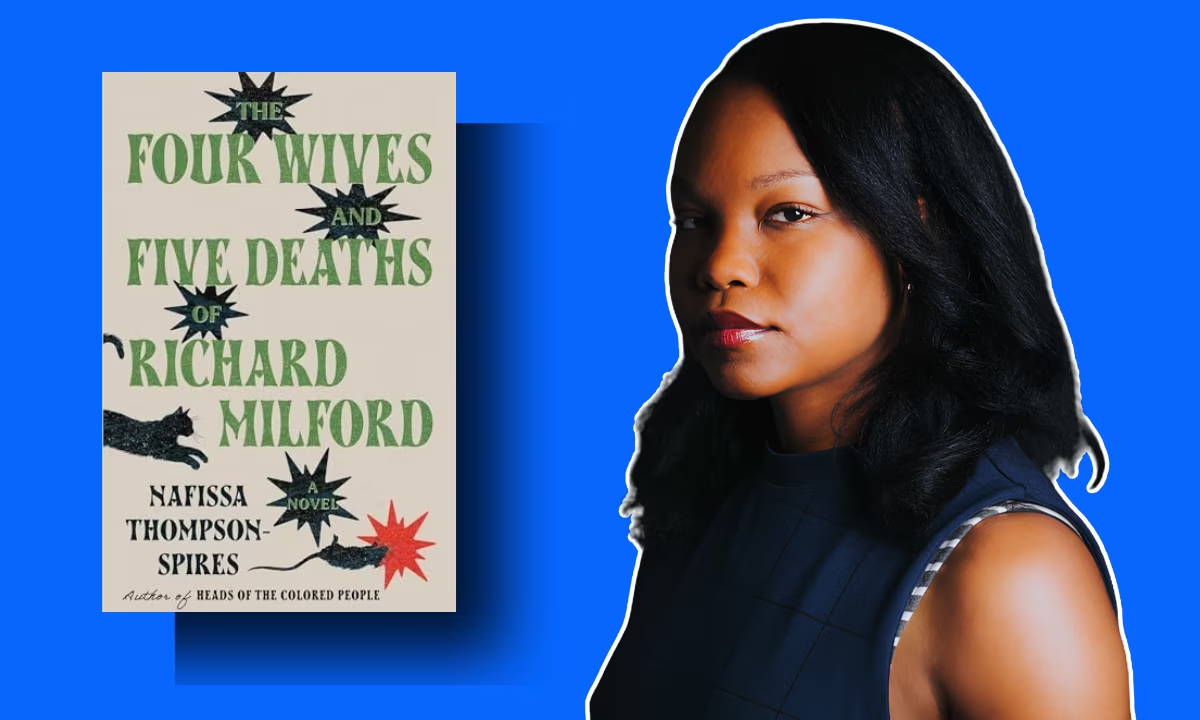

The Four Wives and Five Deaths of Richard Milford by Nafissa Thompson-Spires is a 176-page historical mystery set in Newville, a fictional all-Black town in 1920s Oklahoma. Richard Milford, a notorious moonshiner, bigamist, and oil magnate, is found dead after a flash flood.
The novel unfolds through the testimonies of his four “wives” (Lally, Sophronia, Georgette, and Vivianne) along with his longtime cook Alberta, and each of them believes she is responsible for his death.
The town itself acts as a gossipy Greek chorus, narrating the story in interludes that blur the line between truth and tall tale. Published by Scribner on October 6, 2026, the book is a darkly comic, structurally inventive debut from the author of Heads of the Colored People. It is on the shortlist for the Center for Fiction’s 2026 First Novel Prize, with the winner due on December 8, 2026.
The novel examines mythmaking, patriarchy, and the impossibility of a single truth.
Kirkus Reviews called it “shrewd, audacious, and funny.” If you love unreliable narrators, non-linear storytelling, and historical fiction with teeth, this one will stay with you.
Table of Contents
Reader recommendation
You’ll love this if:
- You enjoy literary mysteries where the how matters more than the who
- You’re drawn to 1920s historical fiction, especially stories set in all-Black towns
- You appreciate dark humor and unreliable narrators
- You like short novels with experimental structures (think The Sellout meets Rashomon)
- You want a book that trusts you to sit with ambiguity
You might want to skip it if:
- You need a clear-cut whodunit with a tidy resolution
- You prefer linear storytelling with a single POV
- Graphic descriptions of violence (including a severed foot) aren’t your thing
- You’re looking for a traditional romance or family saga
Introduction: What Is The Four Wives and Five Deaths of Richard Milford?
The Four Wives and Five Deaths of Richard Milford: A Novel is Nafissa Thompson-Spires’s debut novel, published by Scribner on October 6, 2026. The book runs 176 pages and is set in Newville, Oklahoma, a self-sufficient all-Black town in the 1920s, a few years after the 1921 Tulsa Race Massacre.
It blends historical fiction, murder mystery, and dark comedy into something that resists easy categorization. UK readers get it later: Chatto & Windus publishes the British edition on January 28, 2027.
Thompson-Spires previously published Heads of the Colored People, a short story collection that won the PEN Open Book Award, the Hurston/Wright Legacy Award for Fiction, and the Los Angeles Times Art Seidenbaum Award for First Fiction.
It was also longlisted for the 2018 National Book Award and was a finalist for the 2018 Kirkus Prize. The author earned a PhD in English from Vanderbilt University and an MFA in Creative Writing from the University of Illinois at Urbana-Champaign. Cornell University‘s English department lists her as the Richards Family Assistant Professor.
The novel is shortlisted for the Center for Fiction’s 2026 First Novel Prize.
Background: The Real History Behind the Fiction
Newville is invented, but the world around it is not. According to the Oklahoma Historical Society, African Americans founded more than 50 identifiable all-Black towns in Oklahoma between 1865 and 1920, and only 13 survive today.
These towns built their own schools, churches, and businesses as a refuge from Jim Crow, and the threat of white violence never went away.
The Equal Justice Initiative has documented 75 racial terror lynchings in Oklahoma between 1877 and 1950, the most of any state outside the South.
Money troubles finished off many of these towns. Even Boley, one of the most prosperous, declared bankruptcy in 1939. Keep that in mind when Newville goes bankrupt at the end of The Four Wives and Five Deaths of Richard Milford; it is fiction, but it is fiction with a very real shadow.
The story starts in 1925, four years after Tulsa. The publisher frames The Four Wives and Five Deaths of Richard Milford as a commentary on present-day problems (cults of personality, money running politics, and a society that no longer trusts anyone) dressed up as a Jazz Age tall tale. Having read it, I think that framing is fair.
Rich Milford is a small-town strongman, and the town’s habit of choosing the most entertaining version of events over the true one feels very 2026.
The Four Wives and Five Deaths of Richard Milford Plot Summary
The Funeral and the Town’s Reckoning
The Four Wives and Five Deaths of Richard Milford opens at Richard Milford’s funeral. The townspeople of Newville have gathered not out of grief but out of spectacle. They’ve brought food (stuffed Cornish hens, macaroni and cheese, pecan pie) as their “self-charged admission fee” for the show.
The four wives (Lally, Sophronia, Georgette, and Vivianne) and their children stand in white cotton dresses and pants, dignified and silent. When the casket is lowered, Vivianne tries to jump into the grave. The other women pull her back. Rich is buried “almost unceremoniously.”
The town narrates all of this in a collective first-person voice that dances on his grave, literally: they Juba, Dougie, Cakewalk, C-Walk, Charleston, NaeNae, Macarena, Wobble, Electric Slide, and Cha-Cha Slide on his grave.
The narrator informs us that Rich was found swollen and stinking of gangrene, poisoned and bootmarked, missing a foot.
Richard Milford’s Origins: The Cursed Child
Richard Aloysius Milford was born in 1890 near the Verdigris River. His mother Tess died in childbirth because Rich’s “misshapen head” required forceps. The midwife, seeing baby Rich smile with teeth already in his mouth and mismatched eyes, one hazel and one brown, ran off screaming.
When Rich was nine, his father Willard murdered his mother and then himself, leaving Rich and his sister Mae stunned, brain matter on the walls, blood on their hands.
The Negro papers reported it as a murder-suicide. Local lore holds that Willard had prayed to a moon goddess named Rosemary and returned cursed.
Rich was taken in by his uncle Mil Milford, the founding mayor of Newville. Mil sent Rich and Mae to the common school, where Rich set fires, corrupted the preacher’s son Evangelo Smith, and fought anyone who looked at his sister wrong. When Rich was ten, he was struck by lightning while showing off trick riding. He survived with a broken arm, heart stutters, and a bone spur, but afterward he would claim that “too much electricity” built up in his fingers, and he needed to let it out.
He punched people and started fights.
At fourteen, Rich rode in a junior rodeo. He mounted Whitey the Warrior, the meanest bull in the pit, and stayed on for five seconds before being thrown twenty feet in the air. He landed on his feet, smiling, without a speck of dirt on his white clothes. The town condemned the rodeo property and never held another one.
When Rich was seventeen, his uncle Mil died suddenly on Rich’s birthday. Rich was fornicating in the gin barn with two women when Reverend Smith arrived to tell him the news.
The reverend suffered a heart attack and died on the spot. Months later, Rich inherited the farm. He discovered oil on the property and became even richer. He brought his sister Mae home from the asylum in 1909 and built her a welcome-home display.
Rich’s philosophy of “Stoic Enterprising” came to him in visions. It involved three principles: wealth accumulation without government interference, a stringent diet, and the belief that if evolved enough on earth, souls shrouded in white would not see final death but would meet again on a Great Friday on a celestial plane.
He kept a library of astronomy and philosophy books and built telescopes by hand.
The Four Wives: How the Household Grew
Lally Hunter Milford was Rich’s first and only legal wife. She came from Motley, outside Tullahassee, with no money and no family. Her mother died of grain alcohol, and her uncle was despicable. Rich built her a greenhouse for their first anniversary.
She was the “visionary” who created the household routines, the white dresses for Fridays, and the meal plans. She had four miscarriages and no living children. She began skimming money from her allowance, hiding it in her diaries, as a quiet insurance policy. When Rich started sleepwalking and hiding cash in his telescope, she began plotting. She mixed laudanum into his elixirs, increasing the dose over time. On the morning of the Yamboree, she prepared his drink with more laudanum than ever, omitted his heart pills, and followed him to the greenhouse.
During sex, he seized up and gasped, “My heart.” She took her time, cleaned up, dressed him, and left him in the chair. She later ate a slice of the blackberry pie Alberta had left in the larder, adding a pat of butter on top.
Sophronia Willis was the second woman to arrive. She washed up on the porch in 1913, pregnant and disheveled, asking Lally, “And why is that man in your wedding picture my man?” She passed out and gave birth to a baby boy in the first-floor bedroom.
Rich called her arrival “a vision.” Sophronia bore Rich ten children. She was the one who shaved Rich and styled his hair, and she was jealous of Lally’s position but also resentful of Rich’s cruelty.
On the morning of the Yamboree, Rich humiliated her at breakfast, shouting, “Eat the bacon off your fat lip, Sophronia,” in front of everyone. She later went to the bad barn to eat the blackberry pie in private.
She found Rich there, lying on the ground. She straddled him, stuffed pie into his mouth, and choked him. He died beneath her. She believed she killed him.
Georgette Wise was the third wife. She came from a funeral home family and worked as her father’s apprentice from age twelve. She handled the money, the taxidermy, and the household finances.
She had three children with Rich: little Richard, Thomas, and Puppy. She was the most reliable and practical of the women. She had a romantic and sexual relationship with Mae, Rich’s sister. She was the one who told the others they needed to make it look like a lynching.
She sawed off Rich’s foot with her knife. On the day of the Yamboree, she found Rich in the woods, having a fit near Mae’s grave. He butted her in the stomach, and she conked him on the head with his own shovel. She believed she killed him.
Vivianne Hartford was the fourth wife. She came from Tullahassee to teach the Milford children when the townspeople complained about truancy. She was twenty-three, a college graduate, and had no experience with men before Rich.
She was desperate for his affection and attention. She tried love spells and invoked the goddess Rosemary. On the night of the blood moon, she went to the river and asked Rosemary for help. A voice told her, “To begin again, finish what another’s hand began.” On the day of the Yamboree, she found Rich lying in the grass, still alive but delirious.
He called her “Mae” and then cycled through the other women’s names. He never said hers. She put her hand over his mouth and demanded to know why he never touched her. She held his mouth shut until he stopped moving. She believed she killed him.
Alberta Mays: The Cook
Alberta Mays had cooked for the Milford family for nearly thirty years, serving both Mil Milford and then Rich. She lived on Birdhouse Lane with her sister Hazel, who had a telephone and a lighthearted nature Alberta didn’t share. Alberta was a churchgoer, a woman of faith, but she was also deeply private and had been ostracized by the town for her loyalty to the Milfords.
She had been losing weight, her hands and legs swelling with edema. The doctor told her it was likely a serious issue with her heart, lungs, or kidneys. She needed blood tests to know for sure.
On the morning of the Yamboree, Alberta asked Rich for five days of vacation. He refused, then offered her Monday off. She quit. In her distress, she stirred Rough on Rats (a rat poison) into his blackberry pie filling. She placed his pie on the left side of the oven and her two contest pies on the right. She left the house with her two pies, walked back to town despite her edema, and was picked up by Hazel.
They drove to the Yamboree, but the storm canceled the festivities. They tried to drive to Red Bird but the car broke down. They spent twenty-four hours in the car, playing an alphabet gratitude game.
When Alberta finally returned to the Milford house with Hazel, she learned that Rich had died. She checked the icebox and found his pie gone. Then Lally and Georgette told her they had thrown it out because Rich never ate it; he had left the house before he could. Alberta’s relief was palpable: she had not killed him.
The Death and Disposal
This is where the title earns itself. Line the testimonies up and Rich dies four separate times in four different places: poisoned in Lally’s greenhouse, choked with pie by Sophronia in the bad barn, struck with his own shovel by Georgette near Mae’s grave, and smothered by Vivianne in the grass.
Alberta’s poisoned pie would have made five, except it never reached his mouth.
The accounts cannot all be literally true, and Thompson-Spires never tells us which one is. Even after Rich has been killed, he never seems entirely dead. Each woman walks away convinced she delivered the final blow.
The women convened in Sophronia’s room. Georgette suggested they make it look like a lynching. They carried Rich to the dock, sawed off his foot with Georgette’s knife, and threw him into the river, tossing his boot behind him. Vivianne tried to wade in after him but Georgette pulled her back.
On the way back to the house, they passed Mae’s grave. Georgette said, “Wait. Strip off your clothes.” They buried their bloody dresses next to the hole Rich had started digging. They returned to the house naked, rain-scuffed and exhausted.
The Aftermath
Marshal Walter Pickle, from Red Bird, took over Sheriff Brown’s duties after Brown died suddenly. He investigated Rich’s death, questioning the townspeople, the Milford farmhand Nelson Brooks, Square Bell, and others.
The town, in a collective act of protection, deflected his questions and spread rumors about White men in a black Lincoln sedan seeking revenge on Rich for interfering with their moonshine operations. The Newville Tribune ran headlines like “Suspected Bigamist Found Dead After Flash Flood” and “Four Suspects Arrested in Milford Murder.”
The women were arrested, held for three nights, then bailed out by Reverend Evangelo Smith.
Pickle eventually closed the investigation, conceding that Rich’s death was likely another lynching by Whites. The town lived in peace with the Milford women for months.
Then the rains came. The town began to empty. Alberta and Hazel left for somewhere south. The Dixon Boys and the Darker Brothers left. The town declared bankruptcy in 1928. The Milford women disappeared into legend. Some say they went west, some say to New York, some say to a circus in East Texas.
The Chantilly cake house still stands, and people who enter it run out screaming.
The Four Wives and Five Deaths of Richard Milford Analysis:
Character Analysis
Richard Milford is the novel’s gravitational center, even in death. He is a monster, but a human one. Born with a misshapen head, orphaned by violence, struck by lightning, and cursed by rumor, he is a product of trauma who becomes a perpetrator of it. He is a narcissist who genuinely believes his own visions. He quotes Seneca and Pythagoras while beating his wives and terrorizing his cook.
He creates a philosophy of “Stoic Enterprising” that justifies his greed, his gluttony, and his control. He is charming and cruel, generous and miserly. Kirkus sums him up as a man run entirely by his appetites, and that is exactly how he reads on the page.
Lally is the legal wife who has no children. She creates the household’s aesthetic and routines, dressing everyone in white on Fridays and designing the “Great Friday” ascension mythology.
She is the most calculating of the women, the one who studies Rich’s patterns and plans her exit strategy. She is also deeply wounded, a woman who was “rescued” from poverty only to be trapped in a gilded cage.
Her relationship with Rich is transactional, but she still loves him in her way. She stays because she has nowhere else to go.
Sophronia is the most vulnerable and the most volatile. She is the mother of ten, her body used and discarded by Rich. She is jealous of Lally’s status and resentful of Georgette’s competence.
She is the one who physically stuffs the pie into Rich’s mouth, a grotesque inversion of the nurturing act of feeding. Her rage is visceral, and her violence is the most direct.
Georgette is the most stable and the most enigmatic. She handles the money, the taxidermy, and the practical realities of the household.
She is the only one who has a romantic and sexual relationship with Mae, Rich’s sister. She is the one who stages Rich’s body, using her taxidermy skills to pose him. She is the one who tells the others they need to make it look like a lynching. She is the one who saws off Rich’s foot. She is the most competent and the most dangerous.
Vivianne is the youngest and the most desperate. She is a college graduate, a teacher, a woman who wants love and validation.
She is treated as an afterthought, a “Vivi” who is never the first name on Rich’s lips. She invokes Rosemary, the moon goddess, and believes she is doing the goddess’s work. She is the most tragic of the women, the one who is destroyed by her own desire.
The Four Wives and Five Deaths of Richard Milford Themes and Symbolism
Mythmaking and the Impossibility of Truth. The novel’s central conceit is that each woman believes she killed Rich. Each has a story, and each story is true to the person telling it.
The town, as the chorus, adds its own layers of gossip and speculation. The result is a narrative that resists a single truth. Scribner’s own description of the book promises that “the very idea of a true story comes apart before our eyes,” and for once the jacket copy undersells it.
The Four Wives and Five Deaths of Richard Milford asks: whose story gets to be the official one? And what happens to the truth when everyone has a version?
Patriarchy and the Bonds Between Women. The women in Rich’s household are pitted against each other. Lally is jealous of Sophronia’s fertility. Sophronia is jealous of Lally’s status. Vivianne is jealous of everyone. Georgette is the outsider who has Mae.
To the reader, Rich is obviously the problem in that house, but his wives have been trained to see each other as the real threat. The novel’s tragedy is that the women’s solidarity comes too late, and only after they’ve all committed violence against the man who hurt them.
The All-Black Town as a Character. Newville is not just a setting. It is a collective narrator, a gossipy chorus, a community that has built its own institutions (schools, banks, a newspaper, a sheriff) out of a desire for self-determination. The town’s voice is sharp, humorous, and judgmental.
It dances on Rich’s grave. It protects its own from outside scrutiny. It is, in the end, a character that is both powerful and fragile, capable of mythmaking and self-destruction.
The Gothic and the Grotesque. The Four Wives and Five Deaths of Richard Milford is full of gothic imagery: the Chantilly house with its cake-like layers, the blood moon, the crystal-haired goddess Rosemary, the talking dead, the severed foot.
The taxidermy, the poisoned pies, the grave-robbing, the sleepwalking, the lightning-struck hero. Thompson-Spires uses these gothic elements not just for atmosphere but to get at the grotesque reality of domestic violence and patriarchal control.
The horror is not supernatural; it is the horror of a man who beats his wives, who rapes his cook’s daughter, who kills his sister’s spirit. The gothic is the language of that horror, and it sits squarely in the American tradition Leslie Fiedler mapped in Love and Death in the American Novel.
Evaluation: My Honest Take
The Four Wives and Five Deaths of Richard Milford is a marvel of structural engineering. It is a novel that shouldn’t work. It has five narrators, a collective chorus, a non-linear timeline, and a protagonist who is dead from page one. And yet it works beautifully.
Thompson-Spires has written a book that is both a page-turner and a literary puzzle, a murder mystery that is less interested in the solution than in the question.
Strengths:
The chorus. The town’s voice is the novel’s greatest invention. It is sharp, funny, and deeply human. The scenes of the town dancing on Rich’s grave, of the Dixon Boys and the Darker Brothers singing outside the barber shop, of the neighbors gossiping over the party line: these are the moments where the novel sings.
The structure. The five-part structure, with each woman narrating her version of events, is elegantly handled. Each voice is distinct, each perspective is limited, and the cumulative effect is a portrait of a man that is more complete than any single account could be.
The historical detail. Thompson-Spires has done her research. The all-Black towns of Oklahoma, the oil boom, the moonshine trade, the threat of lynching, the presence of figures like Booker T. Washington: all of this is woven into the fabric of the story without ever feeling like a history lesson.
The humor. The book is genuinely funny. It is a dark, caustic humor, the kind that makes you laugh and then feel guilty about laughing. The Dixon Boys’ songs, the Darker Brothers’ harmonies, the town’s gossip, Lally’s diary entries: all of it is laced with wit.
Weaknesses:
The pacing. The Four Wives and Five Deaths of Richard Milford‘s non-linear structure and multiple narrators can make it difficult to follow at times. The first chapter, which is told by the chorus, is dense and requires patience. Some readers may find the shifting perspectives disorienting.
The emotional distance. The novel’s intellectual playfulness sometimes comes at the expense of emotional depth. The women’s pain is real, but it is often filtered through irony and humor. Some readers may want a more direct emotional engagement with the characters’ suffering.
The ending. The novel’s resolution is deliberately ambiguous. Some readers will love this; others will find it unsatisfying. The fate of the women is left uncertain, and the question of who actually killed Rich remains unresolved.
Impact:
The scene that stayed with me longest was not any of the killings. It was Alberta checking the icebox, finding the pie gone, and then learning it went in the trash untouched.
Her relief is so total that you feel it in your own chest, and in that moment the book stops being clever and becomes painfully human. I also came away embarrassed by how little I knew about Oklahoma’s Black towns before reading it.
A novel that sends you to the Oklahoma Historical Society after the last page has done something most historical fiction never manages. And the larger question it raises, about whose version of events gets written down and believed, feels urgent right now.
Comparison with Similar Works:
The closest literary cousin is Toni Morrison’s Paradise (1997), which also centers on women in a small, all-Black Oklahoma town and on the violence a proud community can turn inward.
The Four Wives and Five Deaths of Richard Milford also invites comparison with The Sellout by Paul Beatty (dark humor aimed at race and American capitalism), Akira Kurosawa’s Rashomon (the classic Japanese film about competing versions of the same event), and Morrison’s Beloved (trauma, haunting, and the legacy of violence).
If you want another recent story of Southern women deciding they are done being pushed around, try The Calamity Club; for a sharper look at race, justice, and who gets believed, see my review of Small Great Things; and for a British take on historical dark comedy, Our Noble Selves makes a fun pairing.
More picks are in my list of the 30 best historical fiction books.
Five Lessons from The Four Wives and Five Deaths of Richard Milford
1. The Stories We Tell About Ourselves Are Not Always True
Each of the four wives believes she killed Rich. Each has constructed a narrative that places her at the center of the action. But The Four Wives and Five Deaths of Richard Milford makes clear that memory is unreliable, that trauma distorts perception, and that we often tell ourselves stories to make sense of our lives.
The lesson is not that the women are lying. It is that truth is more complicated than any single account.
2. Patriarchy Survives by Dividing Women
The novel’s hardest truth is that the women in Rich’s household are not allies. They are competitors. They are jealous of each other’s status, fertility, and beauty.
Rich’s power depends on this division. He keeps the women isolated, suspicious of each other, and dependent on his approval. The tragedy is that they could have stopped him years earlier if they had worked together.
3. Historical Violence Haunts the Present
The Four Wives and Five Deaths of Richard Milford is set in the aftermath of the 1921 Tulsa Race Massacre, and the threat of racial violence is a constant presence. The town of Newville is a refuge, but it is also a place of fear. The characters live with the knowledge that White violence could destroy their community at any moment.
This historical context is not just background; it is the reason the town protects its own, even when its own have done terrible things.
4. The Gothic Is a Language for Domestic Horror
Thompson-Spires uses gothic imagery (the blood moon, the goddess Rosemary, the talking dead, the severed foot) to represent the horror of domestic violence. The gothic lets her approach the unspeakable, to give form to the formless terror of living with an abuser.
The Four Wives and Five Deaths of Richard Milford is not just a murder mystery; it is a ghost story about the ghosts that abusers leave behind.
5. Justice Is Not the Same as Revenge
The women kill Rich, but they do not find peace. They bury their bloody clothes, they lie to the marshal, they disappear into legend. The novel asks whether revenge can ever be justice. The answer, it seems, is no. The women are free, but they are not healed.
The town moves on, but the scars remain. The novel’s final image, the Chantilly cake house still standing and still scaring away anyone who enters, suggests that some wounds never fully close.
A Few Lines That Stuck With Me
- “Rich Milford is dead. At last.” (The opening line)
- “The way you attract a man is the way you keep him.” (Lally, in her diary)
- “Chew the pie off your fat lip.” (Sophronia, turning Rich’s breakfast insult back on him)
- “This is exactly what I mean. Why don’t you ever touch me?” (Vivianne, to the dying Rich)
- “To begin again, finish what another’s hand began.” (The voice at the river)
- “By my count, everyone in this house is starving.” (Vivianne)
- “The Milfords, it seems, are not finished making trouble.” (The town, on the haunted house)
Frequently Asked Questions
Is The Four Wives and Five Deaths of Richard Milford based on a true story?
No. Newville and the Milfords are fictional. The setting is real, though: Oklahoma had more than 50 all-Black towns founded between 1865 and 1920, and the novel takes place a few years after the 1921 Tulsa Race Massacre
Who killed Richard Milford?
The novel never settles it. Lally, Sophronia, Georgette, and Vivianne each describe killing him in a different way and place, and Alberta believes her poisoned pie did it until she learns he never ate it. That unresolved question is the point of the book.
How long is The Four Wives and Five Deaths of Richard Milford?
The Scribner hardcover is 176 pages. The unabridged audiobook runs 4 hours and 35 minutes.
When was it published?
Scribner published it in the US on October 6, 2026. The UK edition from Chatto & Windus is scheduled for January 28, 2027.
Is it Nafissa Thompson-Spires’s first book?
It is her first novel. Her first book was the story collection Heads of the Colored People (2018).
Has it won any awards?
It is on the shortlist for the Center for Fiction’s 2026 First Novel Prize. The winner will be announced on December 8, 2026.
Conclusion
The Four Wives and Five Deaths of Richard Milford is a remarkable debut novel. It is a murder mystery that cares less about the murder than about who gets to tell it. It is a historical novel with one eye fixed on the present. It is a comedy that keeps catching in your throat.
Underneath all of that, it is a meditation on truth, memory, and the stories we tell to survive. Thompson-Spires has written a book that is as sharp as it is moving, as darkly funny as it is deeply sad.
If you are a reader who enjoys being challenged, who appreciates ambiguity, and who is willing to sit with discomfort, this novel will reward you. It is not an easy book, but it is one I expect to reread.
Recommendation: I recommend The Four Wives and Five Deaths of Richard Milford to readers who love literary mysteries, historical fiction with a twist, and stories about women who refuse to be victims.
It is for fans of Paul Beatty, Toni Morrison, and Colson Whitehead. It is for anyone who has ever wondered what justice looks like when the law has failed. It is for anyone who has ever wanted to dance on a grave.
The Four Wives and Five Deaths of Richard Milford
The Four Wives and Five Deaths of Richard Milford by Nafissa Thompson-Spires is a 176-page historical mystery set in Newville, a fictional all-Black town in 1920s Oklahoma. Richard Milford, a notorious moonshiner, bigamist, and oil magnate, is found dead after a flash flood.
URL: https://www.sopranu.com/the-four-wives-and-five-deaths-of-richard-milford/
Author: Nafissa Thompson-Spires
Name: he Four Wives and Five Deaths of Richard Milford
Author: Nafissa Thompson-Spires
ISBN: 9781501168048
Date Published: 2026-10-06
Format: https://schema.org/Hardcover
4.5
Pros
- Inventive narrative structure, Sharp, dark humor, Vivid historical setting, Distinct character voices
Cons
- Non-linear pacing can be disorienting, Deliberate emotional distance, Ambiguous ending may not satisfy all readers