

A career crisis at 30 is the uneasy moment when you look at the job you’ve built through your twenties and realise you’re not sure it’s the life you want, or that it’s taking you anywhere you’d choose. Maybe you’re good at your work and bored by it. Maybe you followed the safe path your family approved of, and now it feels like someone else’s life.
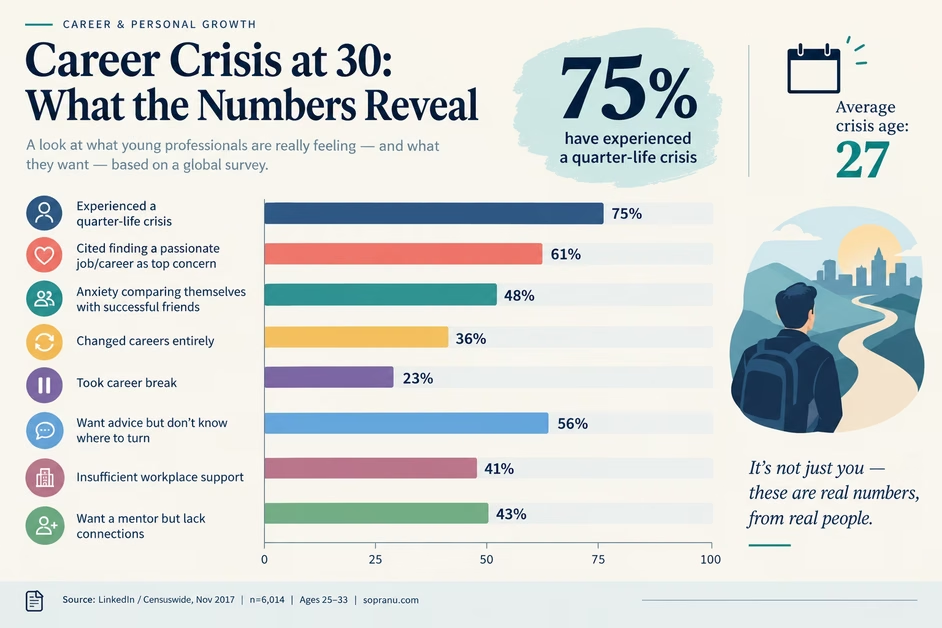
Maybe you’re watching friends get promotions, start businesses or move abroad while you feel stuck. If that sounds familiar, you have a lot of company. A 2017 LinkedIn survey of more than 6,000 people found that 75% of 25 to 33 year-olds said they had experienced a quarter-life crisis, at an average age of 27.
This article covers nine realizations that tend to arrive around 30, what research says about each, and how to turn a career crisis into a better next chapter rather than a long, quiet regret.
Table of Contents
At a Glance
A career crisis at 30 is extremely common. LinkedIn’s 2017 research found 75% of 25 to 33 year-olds had a quarter-life crisis, and 61% blamed not having a job or career they feel passionate about.
You’re not uniquely unhappy at work. Gallup’s 2026 State of the Global Workplace report found only 20% of employees worldwide were engaged in 2025, and just 19% of workers under 35.
The 9 realizations: passion is built more than found, comparison is rigged, your degree isn’t your destiny, changing jobs is normal, money matters differently than you thought, most people feel disengaged, past years aren’t wasted, burnout can pose as a career problem, and 30 is earlier than it feels.
Research by psychologist Oliver Robinson suggests a quarter-life crisis often ends in new commitments that fit your values better.
What helps: run small experiments before big leaps, protect a financial buffer, talk to people already doing what you’re curious about, and set a 90-day decision window.
What Is a Career Crisis at 30?
A career crisis at 30 is a period of serious doubt about your work and direction, usually triggered by the gap between where you expected to be by 30 and where you actually are.
It’s closely related to what psychologists call a quarter-life crisis. In May 2011, psychologist Oliver Robinson of the University of Greenwich presented research at a British Psychological Society meeting in Glasgow based on 50 in-depth case studies of people going through this kind of crisis.
According to Fox News’s report on the presentation, Robinson found that people aged 25 to 35 could feel as much panic and anxiety as people in a midlife crisis.
He described a typical pattern: feeling trapped in a job or relationship, the pressure building until it breaks out, a period of mourning for the old life, an uneasy stretch of rebuilding, and finally new commitments that better reflect the person’s own interests and values.
That last stage is the part most people don’t hear about. A career crisis feels like a collapse while you’re in it. Robinson’s research suggests it is often the beginning of a better fit.
How Common Is a Career Crisis at 30?
A career crisis at 30 is very common. In November 2017, LinkedIn published research based on a survey of 6,014 people aged 25 to 33 in the United States, United Kingdom, India and Australia. Three in four said they had experienced a quarter-life crisis, and the average age it struck was 27.
The most common cause, cited by 61%, was not having a job or career they felt passionate about. Nearly half, 48%, said comparing themselves to more successful friends had caused them anxiety.
In Bangladesh, the pressure has an extra edge.
The Dhaka Tribune reported that the Bangladesh Bureau of Statistics’ Labour Force Survey 2023 counted about 906,000 unemployed graduates, up from 799,000 in 2022, and that the graduate unemployment rate had risen to 12% in 2022 from 4.9% in 2010.
When finding any graduate job is hard, admitting you’re unhappy in the one you have can feel ungrateful, which often keeps people silent for years.
9 Realizations Nobody Prepares You For
1. Passion Is Usually Built, Not Found
The first realization of a career crisis at 30 is that you may have been waiting for a passion that was never going to arrive fully formed. The LinkedIn data shows that a lack of passion is the top driver of quarter-life crises. Yet much of the advice we grew up with, “find your passion,” assumes passion is a hidden object you’ll stumble across if you look hard enough.
Many people discover the opposite. Interest often grows from competence, autonomy and seeing your work matter to someone. Cal Newport made this argument in his 2012 book So Good They Can’t Ignore You, where he challenged “follow your passion” advice and argued that skill tends to come before love for the work.
What to do: Instead of asking “What’s my passion?”, ask “Which parts of my work have ever made time disappear?” Those moments are clues worth following.
2. Comparison Is a Rigged Game
Comparison is a rigged game, and by 30 most of us are playing it constantly. You compare your behind-the-scenes life with other people’s highlight reels: the promotion announcement, the new car, the startup funding, the wedding abroad.
LinkedIn’s survey found that 48% of 25 to 33 year-olds felt anxiety from comparing themselves to more successful friends, with women more affected (51%) than men (41%).
The comparison is rigged because you’re only seeing outcomes, not costs. You don’t see the debt behind the car, the 80-hour weeks behind the promotion, or the anxiety behind the confident post.
What to do: Mute or unfollow accounts that reliably make you feel behind. Then compare yourself only with your own past self. Are you more skilled than you were three years ago? More financially stable? Wiser? That’s the comparison that actually means something.
3. Your Degree Doesn’t Have to Decide Your Path
Your degree doesn’t have to decide your entire career, even though it may feel that way when you’ve invested years and money in it. Many people at 30 realise they chose a subject at 18 based on family pressure, school results or job security, not genuine interest.
David Epstein makes a strong case for this in Range, arguing that people with broad experience and late specialisation often do well in complex, changing fields. Our summary of Range by David Epstein goes through his evidence and the criticisms of it.
What to do: List the transferable skills your degree and job have given you: analysis, writing, managing people, handling clients, solving technical problems. These skills travel far further than a job title.
4. Changing Jobs Is Normal, Not Unstable
Changing jobs in your late twenties and early thirties is normal, not a sign of instability. Many people still carry an older idea of a single, lifelong employer, and feel guilty for wanting to move.
The data suggests that model is far from typical. The US Bureau of Labor Statistics reported that in January 2026, workers aged 25 to 34 had been with their current employer for a median of just 3.0 years, compared with 9.6 years for workers aged 55 to 64.
Job tenure naturally rises with age, but the numbers show that moving around in your twenties and thirties is common.
What to do: Stop asking “Will people think I’m unstable?” and start asking “Will this move teach me something or pay me better or fit my life better?” If the answer to at least one is clearly yes, the move may be worth considering.
5. Money Matters Differently Than You Thought
By 30, money stops being abstract. Rent, family responsibilities, a possible marriage, children, parents’ health, loans. Many people realise they either dismissed money too easily in their twenties (“I’ll follow meaningful work”) or chased it too hard (“I’ll be happy once I earn X”).
Both views tend to crack around 30. You learn that financial stability buys real freedom, especially the freedom to change careers. You also learn that a bigger salary in a job you dread doesn’t fix the dread.
What to do: Build a financial buffer before making a big career move. A common rule of thumb is three to six months of essential expenses, though I couldn’t trace that figure to a single authoritative study, so treat it as a practical guideline rather than a law. The buffer turns a terrifying leap into a manageable step.
6. Most People Are Disengaged at Work, Not Just You
One of the most surprising realizations of a career crisis at 30 is that your unhappiness at work is not unusual. You may feel like everyone else loves their job. The global data says otherwise.
Gallup’s State of the Global Workplace 2026 report, based on data collected through 2025, found that only 20% of employees worldwide were engaged at work, down from 21% in 2024, and 40% experienced a lot of stress the previous day.
Among workers under 35, engagement was 19%, and 42% reported daily stress.
That doesn’t mean you should accept a job that makes you miserable. It does mean you can stop interpreting your dissatisfaction as a personal defect. Something about how work is organised leaves most people disengaged.
What to do: Before quitting, separate the job from the work. Is the problem the field itself, or this particular manager, team, workload or company? Many people discover that the same work in a better environment feels completely different.
7. The Years Behind You Aren’t Wasted
The fear of wasted years is one of the strongest forces keeping people stuck. “I’ve spent eight years becoming an accountant. If I leave now, all of that was for nothing.”
Economists call this the sunk cost trap: letting past investment drive future decisions even when the future no longer looks worth it. Yet career years are rarely truly sunk. Skills, contacts, discipline, knowledge of how organisations work, and self-knowledge all carry forward.
Robinson’s research supports a more hopeful reading. The quarter-life crises he studied often ended with people making new commitments that better reflected their values. The earlier years were part of how they figured out what those values were.
What to do: Write a short “inventory” of what your past years gave you: skills, relationships, money, lessons, and clarity about what you don’t want. Clarity about what you don’t want is underrated. It narrows the search.
8. Burnout Can Pose as a Career Problem
Sometimes a career crisis at 30 is really burnout in disguise. When you’re emotionally exhausted, almost any job can look wrong. Everything feels pointless, every task feels heavy, and escaping seems like the only solution.
The World Health Organization’s ICD-11 definition of burnout includes exhaustion, mental distance or cynicism toward one’s job, and reduced professional efficacy. Those feelings can make you believe you’re in the wrong career when you might actually be in the right career under the wrong conditions.
What to do: Before making a major career change, check whether you’re exhausted.
If you’ve been under heavy stress for months, sleeping badly and feeling numb, try to rest and reduce the load first, then reassess. Our companion piece on emotional exhaustion signs covers this in detail. [Editor: link to the emotional exhaustion signs article once published.]
9. Thirty Is Earlier Than It Feels
The final realization is perhaps the most comforting: 30 feels late, but in the span of a working life, it’s early. If you work into your sixties, you may have more than three decades of career ahead of you, longer than you’ve been alive as an adult so far.
Research on happiness across the lifespan also suggests your thirties aren’t the low point. Economist David Blanchflower of Dartmouth College analysed data from 132 countries and found that happiness tends to follow a U-shape, bottoming out around age 47.2 in developed countries and 48.2 in developing countries, according to BBC Science Focus’s report on the research.
A career crisis at 30 can feel like the end of something, but statistically, there’s plenty of road ahead and room to change direction.
What to do: Replace “It’s too late” with “What could I build in ten years?” Ten years is enough time to retrain, change industries, start a business or become genuinely skilled at something new.
How Do You Get Through a Career Crisis at 30?
You get through a career crisis at 30 by gathering information before making big moves, testing ideas in small, low-risk ways, and giving yourself a clear decision deadline so the crisis doesn’t drag on for years.
Here’s a practical 90-day plan:
| Phase | Weeks | What to do |
|---|---|---|
| Diagnose | 1 to 3 | Separate burnout, bad environment and wrong field. Write down what you’d keep and what you’d change. |
| Investigate | 4 to 8 | Talk to at least five people working in roles you’re curious about. Ask what a normal week looks like and what they wish they’d known. |
| Test | 6 to 10 | Try a small experiment: a short course, a freelance project, a weekend volunteer role, or shadowing someone. |
| Prepare | 8 to 12 | Build your financial buffer, update your CV, strengthen one key skill. |
| Decide | Week 12 | Choose: stay and improve, move within your field, or begin a planned transition. |
The aim isn’t to have every answer in 90 days. It’s to replace vague dread with specific information.
If you’re facing a big life change and want to understand how people handle transitions well, our review of The Other Side of Change by Maya Shankar is a practical, research-based read. For a reflection on ambition itself, the Good Enough memoir summary asks what life looks like when you stop chasing the next rung.
Should You Quit Your Job During a Career Crisis at 30?
You usually shouldn’t quit your job in the first rush of a career crisis at 30 unless the job is harming your health or safety. It’s generally better to plan your exit while you still have an income.
Quitting impulsively can turn a career crisis into a financial crisis, which narrows your choices instead of widening them. On the other hand, staying for years in a job that’s slowly draining you has costs too. They’re just quieter.
A middle path works for many people: stay while you investigate, test and prepare, then leave on your own timeline. That way, the decision is driven by direction, not just escape.
What I’ve Learned From My Own Doubts About Work
When I hit my own version of this crisis, the hardest part wasn’t not knowing what to do. It was feeling ashamed that I didn’t know. Everyone around me seemed certain. I assumed my doubt was a sign I’d gone wrong somewhere.
What helped was realising that certainty is often a performance. Many of the people who seemed sure of themselves were privately wrestling with the same questions. Once I started asking honest questions in conversations, I heard the same doubts everywhere.
I’ve also stopped believing that a career has to be a straight line. A career is closer to a series of experiments, each one teaching you something about what you value and what you’re good at. Some experiments fail. That isn’t wasted time. It’s data.
If you want something deeper on meaning and work, Max Weber’s classic argument about how work became tied to our sense of worth is discussed in our review of The Protestant Ethic and the Spirit of Capitalism, and Oliver Burkeman’s Four Thousand Weeks is a calm reminder that you’ll never do everything, so you might as well choose what matters.
Frequently Asked Questions About a Career Crisis at 30
Is it normal to have a career crisis at 30?
Yes. A 2017 LinkedIn survey of 6,014 people found that 75% of 25 to 33 year-olds had experienced a quarter-life crisis, with an average age of 27.
Is 30 too late to change careers?
No. If you work into your sixties, you may have more than 30 years of working life left. Many people retrain or change industries in their thirties, and the skills from earlier jobs often transfer.
How do I know if I’m in the wrong career or just burned out?
Ask whether the same work would feel different in a better environment, with less stress and more rest. If the answer is yes, burnout or a poor workplace may be the real problem. If even the core tasks feel wrong after rest, the career itself may not fit.
What is a quarter-life crisis?
A quarter-life crisis is a period of intense doubt about career, relationships and direction, typically in your mid-twenties to early thirties. Psychologist Oliver Robinson’s research found it often moves through stages and ends with new commitments that better match a person’s values.
How long does a career crisis last?
There’s no fixed length, and I couldn’t find a reliable research figure for it. For many people, it eases once they start taking concrete steps, such as talking to people in other fields, testing small projects or setting a decision deadline.
Should I quit my job without another one lined up?
Generally, it’s safer to plan your move while employed, unless the job is seriously harming your health. A financial buffer and a clear plan give you more choices and less pressure.
Final Thoughts
A career crisis at 30 often arrives with a heavy feeling that you’ve wasted time or chosen wrong. The nine realizations tell a different story. Passion grows with skill.
Comparison distorts. Your degree is a starting point, not a sentence. Changing jobs is normal. Money gives you freedom when you plan for it. Most people feel disengaged at work. Your past years carry forward. Burnout can disguise itself as a career problem. And 30 is much earlier than it feels.
Don’t rush to escape, and don’t settle into silent regret either. Gather information, run small experiments, protect your finances and give yourself a clear deadline.
As Robinson’s research suggests, many people come out of this kind of crisis with a career that fits them better than the one they had before. Yours can be one of them.