
Last updated on July 8th, 2026 at 10:30 pm
What if the reason you never feel caught up isn’t because you’re lazy, but because the productivity game itself is impossible to win?
That was the uncomfortable realization I had while reading Four Thousand Weeks. I expected another book filled with scheduling tricks and productivity hacks. Instead, Oliver Burkeman dismantled nearly everything I believed about time management and replaced it with something far more honest.
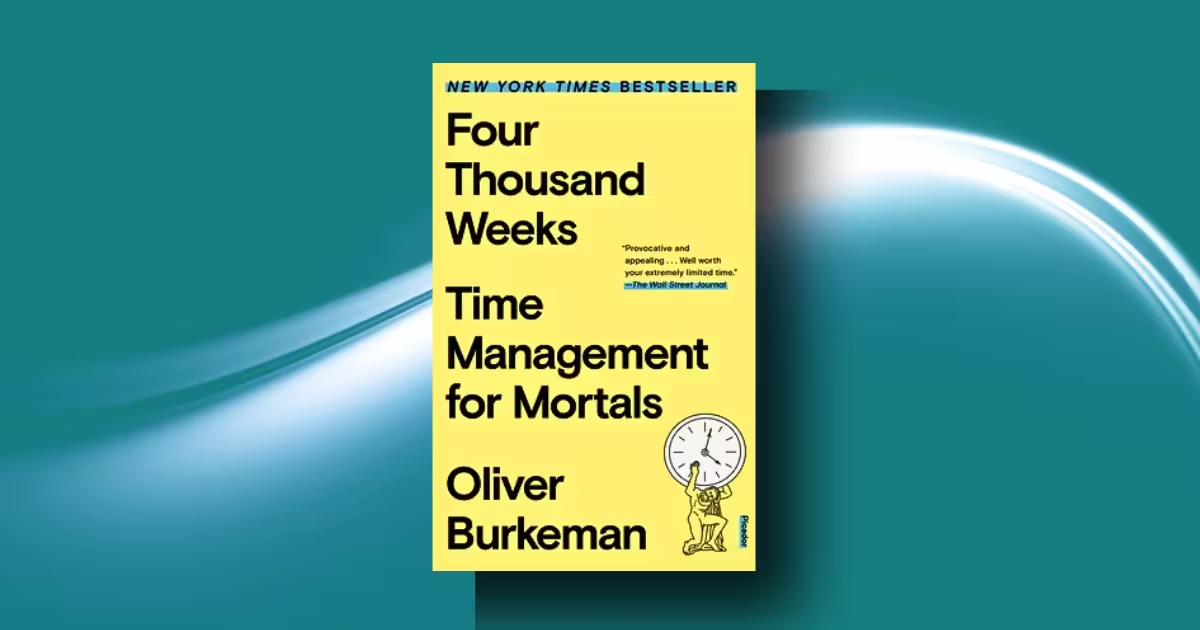
Four Thousand Weeks: Time Management for Mortals is not a traditional productivity book. Instead of teaching readers how to fit more into their lives, Oliver Burkeman argues that the desire to do everything is the real source of modern anxiety.
His central message is simple but unsettling:
You will never finish everything.
Once I accepted that uncomfortable truth, many ideas about success, ambition, work-life balance, and even happiness started making much more sense.
Rather than maximizing productivity, Burkeman encourages us to embrace our limitations and choose what genuinely deserves our limited attention.
It is one of the few books on time management that made me think less about managing my calendar and more about managing my life.
Best For
✔ Professionals overwhelmed by endless work
✔ Students suffering from productivity anxiety
✔ Entrepreneurs constantly chasing efficiency
✔ Readers of philosophy and psychology
✔ Fans of self-improvement books that question conventional wisdom
✔ Anyone experiencing burnout
✔ People who feel guilty about “wasting time”
Not For
✘ Readers looking for step-by-step productivity systems
✘ Those expecting a daily planner or scheduling framework
✘ People wanting quick life hacks
✘ Readers who dislike philosophical discussions
Table of Contents
Introduction
Four Thousand Weeks: Time Management for Mortals
Author: Oliver Burkeman
Published: 2021
Most productivity books begin with an optimistic promise.
Wake up earlier.
Organize your calendar.
Respond to emails faster.
Build better habits.
Eventually, you will have everything under control. Oliver Burkeman starts from the exact opposite position. He argues that complete control is impossible.
That single idea completely changes the direction of the book. Instead of helping readers squeeze more tasks into twenty-four hours, Burkeman asks a more fundamental question:
What if our obsession with productivity is actually preventing us from living?
This is why Four Thousand Weeks feels different from nearly every other book in the self-help genre. It is part philosophy, part psychology, part history, and part memoir. Instead of treating time as a problem to solve, it treats time as the defining condition of being human.
The title comes from a startling calculation that frames the entire book. If someone lives to about eighty years old, that person has roughly 4,000 weeks to live. Burkeman opens by reminding readers that even exceptional longevity only modestly increases that number.
That number is surprisingly small.
Seeing life measured in weeks rather than years immediately changes your perspective.
Context
Oliver Burkeman spent years writing about productivity, including his long-running “This Column Will Change Your Life” column for The Guardian. Ironically, he became what he jokingly calls a “productivity geek,” constantly experimenting with increasingly sophisticated systems designed to optimize every minute. Eventually, he concluded that every new system only created fresh obligations instead of greater freedom.
That personal struggle gives the book unusual credibility.
He is not criticizing productivity from the outside.
He lived inside that culture for years.
Purpose of the Book
The book argues that modern time management is based on a false promise.
Most productivity systems imply that if we become organized enough, disciplined enough, and efficient enough, we will eventually reach a point where everything is under control.
Burkeman rejects this entirely.
Instead, he writes that productivity itself becomes a trap because greater efficiency often produces even more work, more commitments, and higher expectations. The imagined day when all obligations are finally complete never arrives.
The purpose of the book is not to help readers conquer time.
It is to help them make peace with it.
Background
For decades, the personal development industry has been dominated by one basic assumption:
More productivity equals a better life.
Books such as Getting Things Done, The 4-Hour Workweek, and countless habit guides have encouraged readers to optimize schedules, eliminate wasted minutes, and increase output.
Burkeman argues that this cultural obsession did not appear overnight.
He traces it back centuries.
One of the book’s most fascinating historical sections explains how medieval societies experienced time very differently from modern workers. Before mechanical clocks became central to daily life, people organized their activities around natural tasks instead of fixed schedules. Farmers harvested crops when they were ready, milked cows when they needed milking, and generally experienced life through what historians call “task orientation.”
According to Burkeman, the Industrial Revolution fundamentally changed this relationship.
Once time became measurable, it also became something to buy, sell, schedule, and optimize. That shift laid the foundation for today’s obsession with efficiency.
I found this historical perspective especially valuable because it shows that our anxiety about productivity is not simply a personal weakness. It is partly the result of cultural ideas that have been developing for hundreds of years.
Four Thousand Weeks Summary
1. You Only Get About Four Thousand Weeks
The book opens with one of the simplest yet most memorable statistics I have encountered in any nonfiction book.
If an average person lives to around eighty years, that equals roughly 4,000 weeks.
Burkeman immediately expands that perspective.
Modern humans have existed for approximately 200,000 years.
Scientists estimate that life on Earth may continue for roughly another 1.5 billion years before the increasing heat of the sun makes the planet uninhabitable. Against that timeline, an individual human life is astonishingly brief.
This realization becomes the foundation for everything that follows.
Four Thousand Weeks does not encourage despair. Instead, it argues that accepting our limited lifespan allows us to make better decisions about how we spend the weeks we actually have.
Rather than pretending time is limitless, Burkeman asks readers to face reality directly. Only then, he argues, can meaningful priorities emerge.
2. Productivity Has Become a False Religion
One of the book’s strongest arguments is that modern productivity culture promises something it can never deliver.
The promise sounds reasonable.
Answer emails faster, improve your workflow, build better habits, use smarter software, eventually, everything will be under control.
Burkeman argues that reality works in exactly the opposite direction.
The more efficient you become, the more work arrives.
He illustrates this with his own experience of achieving “Inbox Zero.” Instead of reducing stress, answering emails more efficiently simply generated more incoming messages because people learned he replied quickly.
This is what he later calls the efficiency trap.
Rather than creating freedom, productivity often creates additional obligations.
That idea alone completely changed how I think about modern work.
3. The Efficiency Trap: Why Getting More Done Creates More Work
One of the book’s most memorable concepts is what Burkeman calls the efficiency trap.
At first, the idea sounds counterintuitive. Most of us assume that becoming more efficient will eventually reduce our workload. Work faster today so tomorrow becomes easier.
Burkeman argues the opposite.
The more efficient you become, the more people expect from you. Every improvement simply raises the standard.
He illustrates this through email. Because incoming email is practically unlimited while your time is not, processing email more quickly doesn’t solve the problem. It often creates more conversations, more replies, and more expectations. In his words, productivity becomes like “getting faster and faster at climbing up an infinitely tall ladder.”
He compares this modern reality to the Greek myth of Sisyphus, eternally pushing a boulder uphill, except today’s Sisyphus empties an inbox only to hear another notification moments later.
I laughed at this comparison because it felt painfully accurate.
Most professionals have experienced the strange disappointment of finally clearing their inbox only to discover that the inbox immediately starts filling again.
The problem, Burkeman says, isn’t email.
It’s the belief that one day the work will finally end.
It won’t.
Accepting that truth is surprisingly freeing.
4. Busyness Is Not the Same as Meaning
Burkeman makes an important distinction between being busy and living meaningfully.
Being occupied is not necessarily bad.
In fact, many fulfilling lives are full of activity.
The problem begins when activity becomes an identity.
Modern society often treats busyness as evidence of importance. People compete over who works longer hours, answers emails faster, or has the fullest calendar.
According to Burkeman, this creates constant psychological pressure because we confuse motion with progress.
He observes that it is logically impossible to do more than time allows. Yet we continue feeling guilty for failing to accomplish the impossible. That guilt comes from refusing to accept our limitations.
Reading this chapter forced me to question how often I describe myself as “busy” without asking whether the things keeping me busy actually matter.
5. The Real Problem Is Refusing to Choose
Perhaps the book’s deepest argument is that human beings dislike making irreversible choices.
We prefer to keep every option available.
We postpone commitments.
We delay difficult decisions.
We tell ourselves we’ll decide later.
Burkeman argues that this desire for limitless possibility quietly destroys satisfaction.
Every meaningful decision automatically excludes countless alternatives.
Choosing one career means not choosing another.
Choosing one partner means not dating everyone else.
Choosing one project means letting dozens of other ideas remain unfinished.
Rather than seeing this as tragic, Burkeman argues it is exactly what gives our choices significance.
As he writes, missing out is not a failure of life. Missing out is what makes commitment meaningful.
That idea stayed with me long after finishing the book.
Instead of fearing missed opportunities, I started asking a different question:
What is worth missing everything else for?
6. Why FOMO Never Ends
The book also explains why Fear of Missing Out (FOMO) has become one of the defining emotions of modern life.
Today’s world presents nearly unlimited possibilities.
Thousands of books.
Millions of videos.
Countless careers.
Infinite travel destinations.
Unlimited online courses.
No matter how much you accomplish, there is always something else you could be doing. Social media makes this far worse by constantly advertising lives you are not living. Burkeman argues that our culture teaches us to treat life like a bucket list.
The problem is that the bucket has no bottom.
Every completed experience simply introduces more experiences we now feel obligated to pursue. This explains why highly successful people often remain restless. Success expands possibilities instead of satisfying them.
7. Why “Clearing the Decks” Never Works
One chapter describes a productivity mistake I immediately recognized in myself.
Burkeman calls it clearing the decks.
The logic sounds sensible.
Finish all the small tasks first.
Then you’ll finally have uninterrupted time for the important work.
Except that day never comes.
New small tasks appear before the important work begins.
Eventually weeks, months, or even years pass while life’s most meaningful projects remain untouched.
Burkeman admits he repeatedly answered trivial administrative emails while postponing major writing projects and personal correspondence that truly mattered.
That chapter felt uncomfortably personal.
How many meaningful goals are delayed because we keep waiting for the mythical moment when our task list becomes empty?
According to Burkeman, that moment does not exist. The important work must happen before everything else is finished.
Not after.
8. Productivity Cannot Solve Existential Anxiety
One of the most philosophical sections of the book argues that many productivity habits are emotional coping mechanisms.
We imagine that becoming perfectly organized will eliminate uncertainty.
We assume enough planning will remove fear.
We hope enough discipline will guarantee success.
Burkeman argues these hopes are illusions. Life remains uncertain regardless of how carefully we plan. Relationships remain risky.
Careers remain unpredictable.
Health remains fragile.
Mortality remains unavoidable.
Instead of trying to eliminate uncertainty, he encourages readers to participate in life despite uncertainty. That shift transforms productivity from an obsession into a practical tool.
9. The Courage to Accept Limits
This may be the central lesson of the entire book.
Burkeman repeatedly returns to one uncomfortable truth.
Human beings are finite.
We have limited time.
Limited energy.
Limited attention.
Limited talent.
Limited control.
Most self-help books promise to overcome those limits.
Burkeman asks readers to embrace them instead.
One passage captures his philosophy perfectly:
“The more you confront the facts of finitude… the more productive, meaningful, and joyful life becomes.”
I found this idea surprisingly hopeful.
Instead of feeling defeated by limitation, Burkeman suggests limitation gives life its shape. Without limits, priorities would be impossible. Without scarcity, choices would lose meaning.
10. Relationships Matter More Than Perfect Schedules
Another recurring theme is that meaningful lives depend on other people.
Modern productivity culture encourages total control over personal schedules.
But marriage, friendship, parenting, teamwork, and community all require surrendering some of that control.
You cannot optimize every relationship.
Real relationships interrupt calendars.
Children ignore schedules.
Friends need unexpected help.
Families create obligations.
Burkeman argues that trying to eliminate those interruptions often eliminates the very experiences that make life worthwhile. That insight reminded me that productivity should serve relationships, not replace them.
11. Let Time Use You
Perhaps the book’s most radical suggestion appears near the end.
Instead of asking:
“How can I use time?”
Burkeman proposes another question:
“How can I let time use me?”
Rather than treating life as a project to optimize, he suggests responding faithfully to the opportunities, responsibilities, and people already present in our lives.
That subtle change completely alters the meaning of success.
Instead of constantly asking whether we are accomplishing enough, we begin asking whether we are paying attention to what actually matters.
It is a quieter philosophy.
But it feels more sustainable.
My Biggest Takeaways from Four Thousand Weeks
After finishing the book, these were the lessons that stayed with me the most:
- I will never finish everything, and that’s normal.
- Productivity should support life, not become life’s purpose.
- Every “yes” automatically means saying “no” to something else.
- Trying to control everything creates more anxiety than freedom.
- Important work rarely appears after all the small tasks are finished.
- Meaning grows from commitment, not endless options.
- Mortality is not merely something to fear. It is what makes each decision matter.
- Peace comes less from mastering time than from accepting that time cannot be mastered.
By the final chapter, I realized this wasn’t really a book about calendars or productivity systems.
It was a book about what it means to be human.
That is why Four Thousand Weeks continues to stand out in a crowded field of productivity literature. Unlike books that promise to help you do more, Oliver Burkeman offers something rarer: permission to stop chasing the impossible and start investing your limited weeks in what truly deserves them.
Four Thousand Weeks Evaluation
Does Burkeman Support His Arguments Well?
Overall, yes.
One reason the book feels persuasive is that Burkeman doesn’t rely only on personal stories.
Throughout the book, he draws from philosophy, psychology, history, sociology, and religion.
Readers encounter thinkers such as:
- Seneca
- Martin Heidegger
- Friedrich Nietzsche
- Carl Jung
- Hartmut Rosa
- Lewis Mumford
- Bruce Tift
Rather than quoting them simply to sound intellectual, Burkeman connects their ideas to modern problems such as burnout, social media addiction, endless email, and work culture.
That interdisciplinary approach makes the arguments stronger.
For example, his discussion of the historical transition from task-oriented societies to clock-oriented societies gives readers historical context for why modern people experience time so differently.
Likewise, his discussion of existential limitation is supported by both philosophical reasoning and everyday examples that almost anyone recognizes.
Does the Book Fulfill Its Purpose?
Absolutely.
The subtitle is Time Management for Mortals, but this is almost a misleading description.
This is not a manual about calendars.
It is a book about mortality.
Time management simply becomes the doorway. By the final chapter, Burkeman has accomplished something surprisingly rare.
Instead of making readers obsessed with managing time more efficiently, he encourages them to become less obsessed with time altogether.
That is precisely the transformation the book promises.
My Personal Opinion
If someone asked me to recommend one productivity book that is unlike every other productivity book, this would be my first choice.
I expected practical advice.
I found philosophy.
I expected scheduling techniques.
I found questions about mortality.
I expected another motivational bestseller.
Instead, I found one of the most thoughtful books I’ve read on what it means to spend a life well. That doesn’t mean I agreed with every conclusion.
There were moments when the philosophical discussions felt longer than necessary, and readers looking for immediately actionable systems may become impatient.
Still, those slower sections often contain the ideas that linger longest after finishing the book. Very few books continue changing the way I think weeks after reading them.
This one did.
Books Like Four Thousand Weeks
If this book resonates with you, these titles explore similar themes from different perspectives:
| Book | Similarity |
|---|---|
| The Ruthless Elimination of Hurry | Slowing down and resisting modern busyness |
| Essentialism | Choosing fewer priorities |
| Deep Work | Focus over distraction |
| The One Thing | Concentrating on what matters most |
| Digital Minimalism | Technology and intentional living |
| Man’s Search for Meaning | Finding meaning despite limitation |
| Meditations | Stoic reflections on mortality and purpose |
Final Verdict
Some books change your opinions. A much smaller number change your habits. Only a handful change the questions you ask yourself.
Four Thousand Weeks belongs to that final category. Before reading it, I kept asking:
“How can I fit more into my day?”
After finishing it, I started asking:
“What deserves one of my remaining weeks?”
That single shift makes the book worth reading. Oliver Burkeman never promises that readers will become more productive.
He promises something better. A healthier relationship with time. I believe he delivers.
Overall Rating
| Category | Score |
|---|---|
| Originality | 10/10 |
| Writing Style | 9.5/10 |
| Practical Value | 9/10 |
| Research & References | 9.5/10 |
| Readability | 9.5/10 |
| Long-term Impact | 10/10 |
FAQs
Is Four Thousand Weeks worth reading?
Yes. If you feel overwhelmed by endless work, productivity guilt, or the pressure to “do it all,” this book offers a refreshing alternative to conventional time-management advice.
Is Four Thousand Weeks a productivity book?
Partly. It discusses productivity, but its primary focus is philosophy, psychology, and how accepting human limits can lead to a more meaningful life.
Why is it called Four Thousand Weeks?
The title refers to the approximate number of weeks in an eighty-year lifespan, reminding readers how limited human time really is.
What is the main message of Four Thousand Weeks?
The central argument is that trying to master time completely is impossible. Accepting your limits allows you to make better choices and live more intentionally.
Who should read Four Thousand Weeks?
Professionals, entrepreneurs, students, academics, creatives, and anyone struggling with burnout or constant busyness will likely benefit from the book.







