
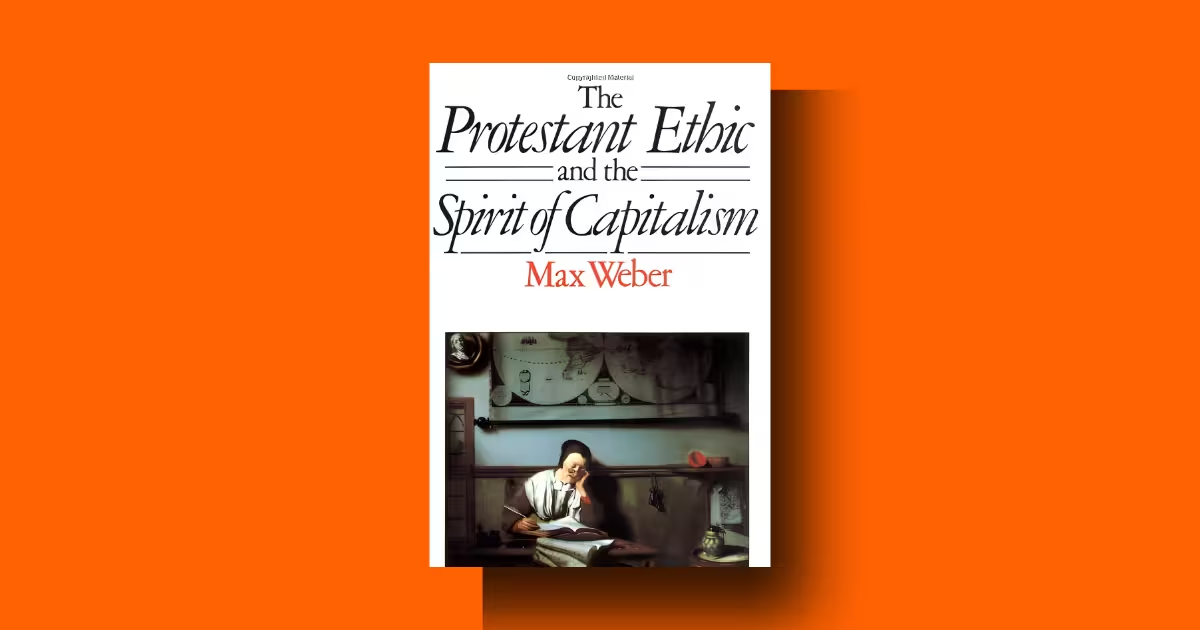
Why does resting still feel like something you owe an apology for, long after nobody prays over a ledger anymore? I picked up Max Weber’s The Protestant Ethic and the Spirit of Capitalism expecting a dry lecture on religion and money. I closed it with an answer to a question about my own head that I had not even known I was asking.
Overview
The Protestant Ethic and the Spirit of Capitalism is Max Weber’s 1904 to 1905 essay arguing that a specific strain of Protestant belief, mainly Calvinism, helped produce the discipline, thrift, and constant labour that modern capitalism runs on.
Weber is not claiming Protestants invented greed. He is claiming that a particular religious anxiety, the need to prove to yourself that you were one of God’s chosen, turned tireless work into a spiritual duty.
That duty outlived the religion. What is left, in Weber’s own words, is a cage. Below, I walk through the whole argument chapter by chapter, weigh what still holds up against modern criticism, and explain why a 120 year old sociology essay keeps surfacing in conversations about burnout, hustle culture, and the nagging feeling that your success still is not enough.
Reader suggestion
I highly recommend The Protestant Ethic and the Spirit of Capitalism to:
- Readers who want to understand where the “your work is your worth” mindset actually came from, not just how to cope with it
- Anyone studying sociology, economics, religious history, or the sociology of religion as a formal subject
- People who enjoyed Adam Smith’s The Wealth of Nations or Das Kapital and want the missing piece: the psychology behind the machine, not just the mechanics of it
- Readers comfortable with a dense, footnote-heavy 1904 academic essay in translation, not a breezy pop-history retelling
The Protestant Ethic and the Spirit of Capitalism may not be a good read for:
- Anyone looking for a step by step history of capitalism as an economic system; Weber is interested in one specific psychological hinge, not the whole story
- Readers who want Weber to say religion “caused” capitalism outright; he is far more careful and qualified than that, and the hedging can frustrate readers expecting a punchier thesis
- Anyone allergic to long sentences and 1920s academic prose in translation, since even Talcott Parsons’ English version keeps Weber’s habit of packing three clauses into one sentence
Table of Contents
Introduction
The Protestant Ethic and the Spirit of Capitalism (German: Die protestantische Ethik und der Geist des Kapitalismus) is a sociology essay by the German scholar Max Weber, first published as a two part article in 1904 and 1905 in the Archiv für Sozialwissenschaft und Sozialpolitik, a journal Weber himself co-edited.
Weber revised and expanded it in 1920 for inclusion in his Gesammelte Aufsätze zur Religionssoziologie (Collected Essays on the Sociology of Religion), a project left unfinished when he died of pneumonia in Munich on 14 June 1920, at 56.
Talcott Parsons translated the revised 1920 text into English in 1930 for Allen and Unwin, and that Parsons translation, now with an introduction by British sociologist Anthony Giddens, is what I am working from here, in the Routledge Classics edition.
The main essay runs to roughly 125 pages; the rest of the 314 page volume is Weber’s own dense endnotes and the index, which tells you something about how much unpacking this short piece has needed for over a century.
Weber was not a theologian.
He trained in law, then worked across economic history, jurisprudence, and what would become sociology, and he is grouped today with Karl Marx and Émile Durkheim as one of the three people usually credited with founding sociology as a discipline. That matters here because this essay is often mistaken for a work of religious history. It is not. Weber’s central claim, his main thesis, is that a specific psychological byproduct of Calvinist theology, the anxious need for “proof” of one’s own salvation, pushed believers toward tireless, disciplined, profit-seeking labour as a kind of evidence for themselves.
Once that religious anxiety faded, the discipline it had produced did not fade with it. It became a habit the whole culture inherited, stripped of the faith that once gave it meaning.
Background
Weber wrote this essay at a strange and specific point in his own life.
As Anthony Giddens notes in his introduction to this edition, Weber had just come out of a depressive breakdown that had left him unable to do serious academic work for roughly four years. Before that collapse, most of his output had been technical: studies of medieval trading law, Roman land tenure, and rural labour conditions in eastern Germany, all shaped by the German “historical school” of economics that insisted on studying economic life inside its actual cultural and historical setting rather than through abstract universal laws.
That backdrop matters. German social thought at the turn of the twentieth century was caught between the rising influence of Marxism and an older tradition, the Geisteswissenschaften, that insisted human conduct had to be interpreted through meaning, not just explained through cause and effect the way natural science explains a chemical reaction. Weber tried to hold both at once.
He accepted that history and culture mattered enormously, and he took Marx’s economic analysis seriously, working alongside and against contemporaries such as Werner Sombart, who had his own rival theory of capitalism’s origins. But Weber refused to reduce human behaviour to material forces alone.
The Protestant Ethic and the Spirit of Capitalism is essentially his first attempt to prove that an idea, in this case a specific religious doctrine, could shape economic history just as forcefully as material conditions could.
The Protestant Ethic and the Spirit of Capitalism Summary
The puzzle Weber starts with
Weber opens not with theology but with a statistic. Looking at occupational data across religiously mixed countries, he notes that business owners, capital holders, and skilled technical staff in modern enterprises were disproportionately Protestant, a pattern that had already provoked debate in the Catholic press of his day.
He is careful here, more careful than people often give him credit for.
He does not simply say Protestants got rich because they were Protestant. He walks through the obvious counter-explanations first, inherited wealth, historical accident, the fact that wealthier German towns had converted to Protestantism generations earlier, and finds them insufficient on their own. Something about the psychological orientation of ascetic Protestantism itself, he argues, needs explaining.
Defining the spirit of capitalism through Benjamin Franklin
Before he can connect religion to capitalism, Weber needs to define what he even means by “the spirit of capitalism.” Rather than offering an abstract definition, he turns to a real document: several paragraphs from Benjamin Franklin, the ones urging a young tradesman to remember that time is money, that credit is money, and that money left idle is squandered opportunity multiplying itself through generations, like a breeding sow whose litter is destroyed.
Weber picks Franklin deliberately because Franklin has no religious motive left in his advice at all; it is pure ethic, stripped of doctrine. What strikes Weber is that Franklin is not describing shrewd business tactics.
He is describing a duty. Wasting time or money is not treated as foolish, in Weber’s reading of Franklin, it is treated as close to sinful. That, for Weber, is the actual spirit of capitalism: not greed, which has existed in every culture in history, but the idea that the tireless, disciplined pursuit of profit is a virtue and an obligation in itself, detached from what the money will ever be spent on.
Luther and the calling
Weber then traces where that sense of duty came from, and lands on Martin Luther’s Bible translation. Before Luther, Weber notes, neither Catholic nor classical languages had a word that carried the same weight as the German Beruf or the English “calling,” meaning an ordinary, everyday occupation understood as a task assigned by God.
Luther introduced this usage through his German Bible, and it spread through Protestant Europe from there. The theological shift underneath it was significant: rather than the highest religious life being monastic withdrawal from the world, Luther argued that fulfilling your ordinary worldly duties, whatever your trade, was the only way to live acceptably before God.
Every legitimate occupation now carried equal religious weight. That alone, Weber argues, gave worldly labour a moral seriousness it had never carried before in Christian Europe.
But Luther’s own version of the calling, in Weber’s reading, was still fairly passive and traditionalist; Luther expected people to stay content in whatever station they were born into, not to strive upward. Something else was needed to turn the calling into a driver of restless economic ambition, and Weber finds it in Calvinism.
Calvinism and the anxiety of predestination
This is the heart of the whole essay, and the part I found genuinely unsettling to read. Calvinism’s doctrine of predestination held that God had already decided, before time began, exactly who would be saved and who would be damned, and that nothing a person did in their lifetime could change that outcome.
Calvin himself, Weber notes, was untroubled by this; he felt personally certain of his own salvation and considered it almost blasphemous to go looking for signs one way or the other. But his followers, and the ordinary believers who came after him, could not sit with that kind of uncertainty.
As Weber lays it out, the question of whether one truly belonged among the saved became impossible to leave alone, and pastoral advice from Calvinist clergy converged on two responses: first, treat any doubt about your own salvation as a temptation from the devil to be fought off, and second, treat tireless, disciplined work as the most reliable available evidence, not a cause of salvation, but a sign of it. Wealth itself was still morally suspect if it led to comfort or idleness.
The sin was never having money.
The sin was resting.
This is where Weber’s language gets almost clinical about time itself. He writes that wasted time became, in the Puritan worldview, the first and in principle the deadliest of all sins, since every lost hour was an hour not spent labouring for the glory of God.
Sleeping more than six to eight hours, idle conversation, even inactive religious contemplation at the expense of one’s daily work, all of it fell under suspicion. Baxter, the Puritan divine Weber quotes constantly through this section, warned that worldly goods should sit as loosely on a believer as a light coat that could be shrugged off in an instant, never as a comfortable resting place.
Weber’s own verdict on what happened next is the single line most people quote from this entire book, and it is worth reading exactly as he wrote it: “But fate decreed that the cloak should become an iron cage” (Ch. 5, “Asceticism and the Spirit of Capitalism,” p. 123, Parsons translation, Routledge Classics edition).
Pietism, Methodism, and the Baptist sects
Weber does not stop at Calvinism proper.
He runs the same analysis, more briefly, across Pietism, Methodism, and the Baptist sects, showing that each of these ascetic Protestant branches developed its own version of the same underlying mechanism, a doctrine that pushed believers toward methodical, disciplined self-examination and worldly diligence as evidence of inward grace, even where the theology differed from Calvin’s strict predestination.
The common thread across all of them, in Weber’s summary, is what he calls worldly asceticism: a religious seriousness that does not withdraw from the world into a monastery, but instead disciplines and rationalizes everyday economic life from the inside.
The iron cage
The essay’s final movement is where Weber steps back from history into something closer to cultural diagnosis.
The religious motive, he argues, has by his own time in 1904 largely burned itself out. Nobody today, he writes, needs the doctrine of predestination to justify working tirelessly hard; the habit survives the belief that once produced it.
The pursuit of wealth, once its religious and ethical meaning has fallen away, starts to attach itself instead to purely secular passions, sometimes even taking on what Weber calls the character of sport. What remains, in his famous closing image, is a cage built from the very asceticism that was supposed to set people free from material attachment in the first place.
Weber ends the historical essay itself on a note of genuine uncertainty about where all this goes next, refusing to predict whether new prophets, a revival of old ideals, or simply what he calls mechanized rigidity will define the future. That refusal to offer a tidy conclusion is, I think, one of the most honest choices in the entire The Protestant Ethic and the Spirit of Capitalism.
My Analysis of The Protestant Ethic and the Spirit of Capitalism
The Protestant Ethic and the Spirit of Capitalism is a genuinely startling piece of writing, not because Weber shouts his argument, he almost never does, but because of how quietly and carefully he builds toward a conclusion that still reframes how you think about your own Tuesday afternoon.
Does Weber actually support his central claim with evidence?
Largely, yes, though the kind of evidence he uses is textual and interpretive rather than statistical in the modern sense. He builds his case out of sermons, catechisms, pastoral manuals, and Puritan devotional writing, especially Richard Baxter’s, tracing a consistent psychological logic across denominations rather than asserting a single smoking gun document. Weber himself is unusually cautious about overclaiming; he explicitly states, more than once in the essay, that he is not arguing religion single-handedly created capitalism, only that this particular religious anxiety shaped the ethical character capitalism took on in Protestant Europe.
That qualification tends to get lost whenever the book gets summarized secondhand, and reading the original made me notice how often Weber hedges his own claim more than his critics or his fans ever give him credit for.
Where the argument feels thinnest, to my eye, is in the jump from private religious psychology to broad social and economic outcome.
Weber is extremely persuasive on what individual believers were told to feel and do. He is far less detailed on the mechanics of how millions of individual psychological states actually aggregated into an economic system, and that gap is exactly where a century of critics has aimed its strongest objections, which I get into below.
Does The Protestant Ethic and the Spirit of Capitalism fulfil its own stated purpose? I think it does, on its own narrow terms. Weber set out to identify one thread in a much larger fabric, not to write a total history of capitalism, and he says as much directly. Judged against that specific, modest goal rather than against the grander claim popular culture has flattened it into, the essay holds up as a careful, self-aware piece of historical sociology.
What struck me most personally, reading this as someone who reviews books on philosophy and social criticism for a living, was how exactly the Calvinist “proof of grace” mechanism maps onto modern imposter syndrome.
The Calvinist could never simply feel saved and stop there; the doubt always crept back in, so the only response was more work, more evidence, more proof. That is, almost word for word, how a lot of high achievers today describe their own relationship with success. The promotion does not settle anything.
The good review does not settle anything. There is always another performance review, another quarter, another chance for the doubt to return, so the only available response is to keep producing. Weber never uses the phrase “imposter syndrome,” obviously, since Pauline Clance and Suzanne Imes would not coin that term until 1978, decades after his death.
But the psychological shape he describes in Calvinist believers, achievement as a form of self-reassurance that never actually reassures, is close enough to the modern phenomenon that reading this book felt less like history and more like a diagnosis.
Strengths and Weaknesses
What I found genuinely compelling is Weber’s discipline as a writer. He resists the temptation to turn this into a morality tale about either capitalism or Protestantism, and he keeps returning to qualify his own claims rather than let the thesis run away from the evidence.
The Benjamin Franklin passage in Chapter 2 is, on its own, one of the sharpest pieces of close reading I have come across in a work of sociology; Weber uses a handful of paragraphs to build an entire definition that the rest of The Protestant Ethic and the Spirit of Capitalism then tests against real religious material.
The Protestant Ethic and the Spirit of Capitalism‘s weaknesses, though, are well documented, and I do not think a fair review can skip past them.
Historians including Fernand Braudel and Hugh Trevor-Roper have argued that capitalism was already developing inside pre-Reformation Catholic communities, which would undercut Weber’s implied uniqueness of the Protestant contribution.
Fernand Braudel writes in his Afterthoughts on Material Civilization and Capitalism:
All historians have opposed this tenuous theory, although they have not managed to be rid of it once and for all. Yet it is clearly false. The northern countries took over the place that earlier had so long and so brilliantly been occupied by the old capitalist centers of the Mediterranean. They invented nothing, either in technology or in business management. Amsterdam copied Venice, as London would subsequently copy Amsterdam, and as New York would one day copy London.
The Swedish economic historian Kurt Samuelsson made a similar argument at length in his 1957 book Religion and Economic Action, challenging the statistical correlation Weber leans on in his opening chapter.
Weber’s own contemporary, Werner Sombart, offered a rival account crediting other factors, including Jewish merchant communities, with a larger role in shaping modern capitalism than Weber assigns them, a point that later critics, including scholars examining Weber’s treatment of non-Western economic rationality, have pushed further by noting how thoroughly Weber’s frame sidelines Islamic, Jewish, and Catholic economic actors who were pursuing rational profit seeking on their own terms during the same centuries.
My own reservation sits closer to structure than to fact.
Weber spends a genuinely long stretch of the book, especially across the Pietism, Methodism, and Baptist sections, restating variations on the same mechanism in slightly different theological language, and a reader who has already absorbed the Calvinism chapter can start to feel the essay circling rather than advancing.
The endnotes, which run longer than the main essay itself in this edition, contain material that is sometimes more interesting than the text they are attached to, but flipping back and forth breaks the read badly enough that I would recommend reading them as a second pass rather than in real time.
How It Compares to Other Books on Capitalism
Weber’s essay sits at a strange angle to the two books most people default to when they think about the origins of capitalism. Adam Smith’s The Wealth of Nations (1776) explains the mechanics of markets, the division of labour, and self-interest as a coordinating force, but Smith has almost nothing to say about where the psychological drive to work so hard in the first place actually came from.
Weber, interestingly, references Smith directly in his own third chapter, contrasting Luther’s naive religious justification of the division of labour with Smith’s far more developed economic account of the same phenomenon. Read together, Smith explains the machine and Weber explains why anyone was willing to run it so hard in the first place.
Karl Marx’s Das Kapital, discussed alongside Smith in our own roundup of economics books that changed the world, sits on the opposite side of Weber’s argument almost by design.
Marx locates the engine of historical change in material conditions and class relations; Weber, without ever fully rejecting Marx, insists that ideas, in this case a specific religious doctrine, can drive material history rather than simply reflect it. R.H. Tawney’s Religion and the Rise of Capitalism (1926), quoted approvingly on this very edition’s cover, broadly accepted Weber’s thesis but widened it, arguing that political pressure and a rising spirit of individualism mattered as much as Calvinist theology specifically.
If you want a more contemporary, conversational entry point into how economic ideas shape everyday behaviour without wading through 1904 German academic prose, our review of Planet Money’s guide to the economic forces shaping your life is a far gentler place to start before circling back to Weber.
Conclusion
I would recommend The Protestant Ethic and the Spirit of Capitalism to anyone seriously curious about where the modern instinct to treat rest as something you have to justify actually came from, and I would recommend it especially to readers who have already sat with the discomfort of feeling like their achievements never quite settle the question of whether they are good enough.
This is not a beginner’s introduction to sociology, and it demands patience with long, clause-stacked sentences even in Parsons’ careful translation.
For students of sociology, economics, or the history of religion, it remains close to essential reading, not because every claim in it has survived a century of criticism intact, but because the psychological mechanism it names, achievement as anxious self-reassurance rather than genuine security, is still doing quiet, uncredited work in how a lot of us relate to our own effort.







