
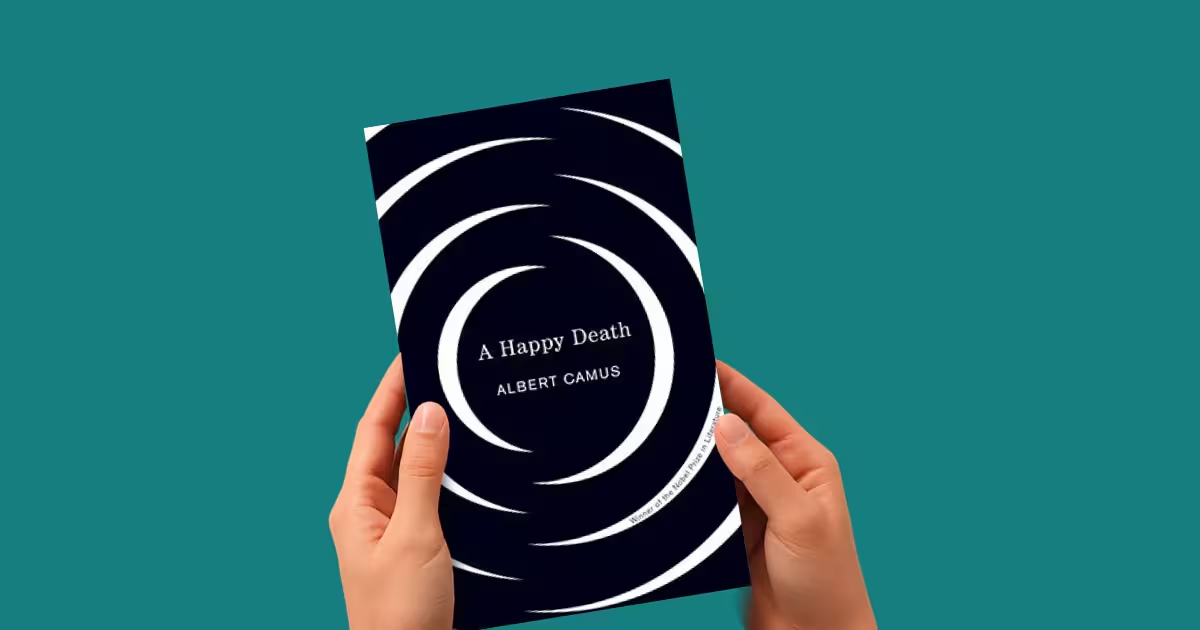
What if the secret to dying happy wasn’t about avoiding death at all, but about learning to live with such intensity that death itself becomes just another gesture? That’s the question at the heart of Albert Camus’s first, abandoned novel, A Happy Death, a book he wrote in his twenties, then locked away, never to publish.
Overview
A Happy Death follows Patrice Mersault, a young man who believes money is the key to freedom. After murdering a wealthy invalid to inherit his fortune, he leaves behind ordinary work and spends years searching for a life of genuine happiness.
Camus explores whether true fulfillment comes from wealth, freedom, or simply embracing life with full awareness of its inevitability. The novel concludes that happiness is not something we possess but something we consciously choose to live, even in the face of death.
A Happy Death is perfect for readers who love philosophical fiction, Camus completists, anyone fascinated by the creative process behind literary masterpieces, and those who’ve ever wondered what it really takes to live a meaningful life.
A Happy Death is not for readers seeking a tightly plotted thriller or a fully polished novel. This is a raw, uneven work—a fascinating “first draft” of genius, but undeniably a draft.
Table of Contents
1. Introduction
A Happy Death (La mort heureuse) is Albert Camus’s first novel, written when he was just twenty-three years old. He composed and reworked it between 1936 and 1938. Then he put it aside. He never published it. It remained in his private papers until after his death in 1960, eventually released in 1971, over eleven years later.
The English translation by Richard Howard appeared in 1972. The novel, published posthumously, was greeted as a literary event—but also with considerable critical skepticism. It’s the work of a young man still finding his voice, still wrestling with ideas that would later crystallize into some of the most influential philosophy and fiction of the twentieth century.
Camus was awarded the Nobel Prize for Literature in 1957 “for his important literary production, which with clear-sighted earnestness illuminates the problems of the human conscience in our times”. He died just three years later in an automobile accident at the age of forty-six.
A Happy Death was among the manuscripts retrieved from his private papers.
2. Background
Historical Context
Camus wrote A Happy Death during a turbulent period in his own life. He was battling tuberculosis, working at the maritime commission in Algiers, and struggling through a troubled marriage. The novel draws heavily on his own experiences: the working-class Belcourt neighborhood where he grew up, his job at the docks, his travels through central Europe in 1936, his time in Italy, and his stays in sanatoriums.
The “House above the World,” where Mersault lives with three young women in the novel’s second half, is based on the Fichu house where Camus lived in November 1936. The novel also reflects his two-year marriage to Simone Hié and their stormy breakup.
Why Wasn’t It Published?
Camus was a severe critic of his own work. He published nothing heedlessly. He likely recognized that A Happy Death was flawed, too autobiographical, too uneven, too dependent on philosophical dialogue rather than dramatic action. The novel’s “latent defect,” as one critic put it, was that its elements of observation—fragments of autobiography—remained disjointed. It was first published in 1971.
Meanwhile, a new idea was taking shape in his mind. The Stranger would be published in 1942, and it would make Camus’s reputation. Compared to that spare, devastating masterpiece, A Happy Death feels like a rough sketch, a “Mersault-in-embryo,” as Kirkus Reviews called it.
3. A Happy Death Summary
Part One: Natural Death
The novel opens with a shocking act. Patrice Mersault walks to the villa of Roland Zagreus, a wealthy invalid with amputated legs. It’s a beautiful April morning, cold and bright. Mersault carries a suitcase. He lets himself in, finds Zagreus reading by the fire, and without a word, opens the chest, takes out the revolver, and shoots the cripple in the temple.
But this isn’t a random act of violence. Zagreus has been waiting for this. He has left a letter explaining his desire to die, and his money—nearly two million francs—is neatly packed in the chest. Mersault takes the money, leaves the letter, and walks away. He sneezes in the cold air, shivers, and returns to his room, where he sleeps until afternoon.
From there, the novel flashes back to Mersault’s ordinary life. He works a boring office job at the Algiers docks, checking shipping bills and translating provision lists. He lives in the apartment his mother died in, surrounded by her ghost and his own poverty. He spends his Sundays watching the neighborhood from his balcony, doing crossword puzzles, eating alone.
He has a girlfriend, Marthe, who is beautiful and unfaithful. He’s jealous of her past lovers, but he doesn’t love her—he loves what she represents: his own power, his own vanity. He meets Zagreus through her. The cripple was Marthe’s first lover.
The conversation between Mersault and Zagreus is the philosophical heart of the novel. Zagreus tells Mersault that happiness takes time—a lot of time—and that money is simply a way to buy that time. He says: “To be rich is to have time to be happy, if you deserve it”. Zagreus, trapped in his ruined body, has all the money in the world but no way to use it. He offers Mersault a kind of inheritance: his fortune, in exchange for death.
The chapter ends with Cardona, the barrelmaker, weeping over a photograph of his dead mother. Mersault sees in Cardona’s misery a mirror of his own rebellion against poverty and solitude. The next morning, he kills Zagreus.
Part Two: Conscious Death
The second half of the novel follows Mersault’s journey after the murder. He travels to Prague, where he is haunted by the smell of vinegar and cucumbers. He wanders through the city in a fever, visits churches, eats in a cellar restaurant where a blind accordionist plays. He witnesses a man lying dead in the street, his head in a pool of blood. He feels utterly alone, alienated from everything.
He travels on through Europe—Breslau, Vienna, Genoa. In Vienna, he writes to his friends Rose and Claire, describing the city’s civilization and his longing for the sun. He sleeps with a prostitute named Helen and leaves her too much money. He receives a letter from his friends, inviting him back to Algiers.
Returning through Genoa, he swims in the harbor, walks through the narrow streets, and feels the sun and the sea reawaken something in him. On the ship back to Algiers, he reflects on his life. He realizes he was never made for love—only for the “innocent and terrible love” of life itself. He understands that happiness is not something you find; it’s something you create, consciously, deliberately, every day.
Back in Algiers, he moves into the “House above the World” with Rose, Claire, and Catherine. They spend their days in the sun, eating, laughing, teasing each other. This is happiness—simple, sensual, present. But Mersault knows he can’t stay. He buys a house on the Chenoua, between the sea and the mountains.
He marries Lucienne, a silent, beautiful woman who agrees to live with him but keep her own apartment. He tries to establish a routine: swimming every morning, walking, reading, doing nothing. But the solitude is harder than he expected. He invites Lucienne to stay, then sends her away. He visits his old neighborhood, meets Marthe again, and feels a strange tenderness toward her.
He returns to the Chenoua and begins to find his rhythm. He swims, fishes with Perez the one-armed fisherman, and plays pool on Sundays. He befriends Bernard, the village doctor. He watches the seasons turn: the almond trees blooming in January, the grapes ripening in June, the wheat sprouting in the rain.
Then he falls ill. Pleurisy confines him to his bed. He coughs, his heart fails, he faints. Bernard gives him adrenaline to keep him conscious. Mersault refuses to die in a coma. He wants to see what’s happening, to face death with his eyes open.
In his final hours, he thinks of Zagreus. He realizes that by killing him, he consummated a union that bound them together forever. He understands that fear of death is just fear of life—that those who haven’t lived fully are the ones who dread dying. He has lived. He has played his part. He has fashioned his role.
As dawn breaks, he looks at Lucienne, then at the sea. He smiles. The stone rises in his throat. He throws himself back on the bed, and “stone among the stones, he returned in the joy of his heart to the truth of the motionless worlds”.
4. A Happy Death Analysis
4.1 Characters
Patrice Mersault
Mersault is the prototype for the Meursault of The Stranger, but he’s a very different creature. He’s more open, more talkative, more driven. He doesn’t simply drift through life; he actively seeks a philosophy, a way of living. He tells Zagreus: “I know what kind of life I’d have. I wouldn’t make an experiment out of my life: I would be the experiment of my life”.
He’s also younger, more Romantic, more naive. He believes happiness can be willed, that the mind can crown the body king. He talks about himself with a kind of lyrical self-importance that the later Meursault would never indulge.
Yet there’s something hollow about him. He sleeps constantly—more than any fictional character since Rip Van Winkle, as one critic noted. He drifts from one woman to another without real attachment. He kills a man for his money, then spends the rest of the novel trying to justify it.
Roland Zagreus
Zagreus is the novel’s philosopher-king, a figure of tragic irony. He has everything Mersault wants—money, freedom, time—but he’s trapped in a body that makes it all meaningless. He’s “a wreck,” Mersault thinks. “A zero in the world”.
Yet Zagreus is also the novel’s moral center. He tells Mersault that happiness is the only aim worth considering, the ultimate moral good. He’s the one who articulates the novel’s central thesis: “To have money is to have time. Everything can be bought. To be or to become rich is to have time to be happy, if you deserve it”.
Zagreus’s name is significant. In Greek mythology, Zagreus was a god of the Orphic mysteries, associated with Dionysus, who was torn apart by the Titans and reborn. The cripple’s death is a kind of sacrifice, a transfer of vital energy from one man to another.
Marthe
Marthe is Mersault’s girlfriend, a beautiful but unfaithful woman who serves as a symbol of his vanity and his jealousy. He doesn’t love her; he loves what she represents: his power, his status, his ability to possess. When he learns about her past lovers, he’s devastated—not because he loves her, but because his pride is wounded.
Lucienne
Lucienne is Mersault’s wife, a silent, beautiful woman who represents the possibility of simple, physical happiness. She’s described as “not very intelligent,” which pleases Mersault. There’s “something divine in mindless beauty,” he thinks. She’s a vessel for his desires, not a person in her own right.
Rose, Claire, and Catherine
These three young women live with Mersault in the “House above the World.” They represent a kind of innocent, sun-drenched happiness—a life of laughter, friendship, and simple pleasures. Catherine is the most developed of the three; she’s “a force of nature,” sensual and instinctive. She’s the one who asks Mersault if he’s happy, and she’s the one who sees through his philosophical justifications.
4.2 A Happy Death Themes and Symbolism
The Will to Happiness
The novel’s central theme is the conscious creation of happiness. Zagreus articulates it: happiness isn’t something that happens to you; it’s something you choose, something you work for. It requires time, money, and—most of all—will.
But the novel complicates this idea. Mersault gets the money, buys the time, and still struggles. Happiness isn’t just about material conditions; it’s about an inner state, a way of being in the world. As one analysis puts it, Mersault’s “failure to gain happiness is his inability to recognize that true happiness emerges from within rather than from outside”.
Money and Time
Zagreus’s philosophy is brutally simple: money buys time, and time is the raw material of happiness. “In almost every case,” he says, “we use up our lives making money, when we should be using our money to gain time”. This is a kind of inverted Marxism—not the abolition of class, but the individual’s escape from it through wealth.
Mersault takes this lesson to heart. He murders Zagreus for his money, then uses it to buy himself a life of leisure. But the novel suggests that money alone isn’t enough. Mersault still has to learn how to use his time, how to be happy in the present moment.
Self-Knowledge vs. Happiness
Zagreus and Mersault ponder whether a happy person can truly understand themselves. The inverse is also true: someone who truly understands themselves can never be happy. Zagreus, trapped in his body, has done nothing but think. He knows himself better than most people, but he’s deeply unhappy.
Mersault, by contrast, seeks a kind of unconscious happiness—a life of sensation, of physical presence, of “abandonment to the world.” He wants to stop thinking and start living. The novel’s ending suggests he achieves this, dying with his eyes open, “stone among the stones.”
The Sun and the Sea
The sun and the sea are the novel’s recurring symbols. They represent life itself—warmth, sensation, presence. Mersault is drawn to them again and again. In Prague, far from the sun, he’s miserable. In Genoa, swimming in the harbor, he feels alive again. The sun and the sea are his gods.
The House above the World
The house where Mersault lives with Rose, Claire, and Catherine is a symbol of pure, uncomplicated happiness. It’s a place of laughter, friendship, and sensual pleasure—a kind of earthly paradise. But Mersault can’t stay there. He needs something more: solitude, discipline, a confrontation with his own mortality.
Death as a Gesture
The novel’s title suggests that death can be happy—that it’s not something to fear, but something to embrace. Mersault learns this in his final hours. He refuses to die in a coma; he wants to see what’s happening, to face death consciously. His death is described as a kind of return: “stone among the stones, he returned in the joy of his heart to the truth of the motionless worlds”.
5. A Happy Death Evaluation
My Verdict
A Happy Death is not a great novel. It’s uneven, self-indulgent, and philosophically muddled. The characters are often stick figures. The female characters are particularly underdeveloped—objects of desire rather than people. The plot lurches from one episode to another without organic connection. It’s the work of a young man still learning his craft.
Yet it’s also fascinating. Reading it is like watching a master painter’s early sketches—you can see the genius struggling to emerge, the raw materials that would later be refined into something extraordinary. The lyrical passages are often beautiful. The philosophical dialogues are provocative, even if they don’t fully cohere. And the novel’s central question—how to live a life that makes death itself happy—is one that Camus would explore for the rest of his career.
Kirkus Reviews called it “a melange of autobiography, travel notes, philosophic dialogue, vignettes and epigrams”. That’s accurate. But it’s also a rare, unguarded glimpse of the turbulence that Camus would later master.
Strengths
The philosophical core. The novel’s exploration of happiness, money, and time is genuinely provocative. Zagreus’s speeches are some of the best writing in the book.
The lyrical descriptions. Camus could write about the sun, the sea, and the Algerian landscape with astonishing beauty. Passages like “the sky was radiant, but there was no warmth in the glistening sunshine” are pure poetry.
The glimpse of a young genius at work. A Happy Death shows us Camus before he became Camus—still searching, still experimenting, still finding his voice.
Weaknesses
The plotting. The novel’s structure is disjointed. The murder happens in the first chapter, then the novel flashes back, then forward again, without a clear sense of dramatic momentum.
The characters. Apart from Mersault and Zagreus, the characters are thinly drawn. The women in particular are treated as symbols rather than people.
The philosophical didacticism. The novel too often stops to lecture. Characters deliver speeches rather than having conversations. The ideas are interesting, but they’re not always integrated into the drama.
Impact and Controversy
The novel has been controversial for several reasons. Some critics have questioned the ethics of publishing an abandoned manuscript. Others have noted the ableism in Zagreus’s characterization—his life is deemed “not worth living” because of his disability. The murder of a disabled man for his money is treated as a kind of liberation, which is troubling.
There’s also the question of misogyny. Mersault’s relationships with women are transactional and objectifying. He marries Lucienne because she’s beautiful and “not very intelligent.” He treats Marthe as a symbol of his own vanity. This reflects the attitudes of the time, but it’s still uncomfortable to read.
Comparison with Similar Works
The Stranger
The comparison is inevitable. A Happy Death is clearly the precursor to The Stranger. Both novels feature a French-Algerian clerk named Mersault/Meursault who commits a murder. Both explore themes of alienation, absurdity, and death.
But the differences are equally striking. The Stranger is written in the first person, A Happy Death in the third. The Stranger is spare and minimalist; A Happy Death is lyrical and expansive. Meursault is passive, drifting through life without conscious purpose. Mersault is active, seeking, striving. Meursault dies because of society’s judgment; Mersault dies on his own terms, having achieved a kind of beatitude.
In many ways, A Happy Death is the novel Camus had to write in order to write The Stranger. It’s the rough draft, the working out of ideas that would later be refined into something far more powerful.
There are echoes of Dostoevsky. Mersault, like Raskolnikov, commits murder for a philosophical reason—to prove a theory about the world. But unlike Raskolnikov, Mersault feels no guilt. He’s more like Nietzsche’s Übermensch, transcending conventional morality.
6. Personal Insight with Contemporary Educational Relevance
One of the most striking aspects of A Happy Death is its argument that happiness requires time—and that money is simply a way to buy that time. Zagreus puts it bluntly: “In almost every case, we use up our lives making money, when we should be using our money to gain time”.
This feels remarkably relevant today. We live in a culture of hustle—of side hustles, of burnout, of grinding ourselves into exhaustion in pursuit of success. We work longer hours than ever, yet feel more time-poor than ever. We’re constantly told that if we just work hard enough, we’ll eventually have the time to enjoy our lives. But that time never comes.
Camus’s novel offers a different vision. It suggests that time isn’t something you earn; it’s something you claim. That happiness requires not just money, but a conscious decision to prioritize living over working, presence over productivity. Mersault’s journey is one of learning to do nothing—to swim, to walk, to lie in the sun, to simply be.
That’s a lesson many of us still need to learn. The World Health Organization has identified burnout as an “occupational phenomenon.” Studies show that more than half of workers report high levels of stress. We’re more connected than ever, yet more isolated. We have more possessions than ever, yet less time to enjoy them.
A Happy Death won’t solve these problems. But it offers a provocative starting point for thinking about them. What would it mean to treat happiness not as a reward for hard work, but as a choice we make every day? What would it mean to use our money not to acquire more things, but to buy back our own time?
7. A Happy Death Quotes
Here are some of the most striking passages from the novel:
On happiness and money:
“Only it takes time to be happy. A lot of time. Happiness, too, is a long patience. And in almost every case, we use up our lives making money, when we should be using our money to gain time.”
On the relationship between money and dignity:
“Money is one of the surest and swiftest means of acquiring one’s dignity.”
On the pursuit of happiness:
“The craving for happiness seemed to me the noblest thing in man’s heart. In my eyes, that justified everything. A pure heart was enough.”
On the need for consciousness:
“It takes time to live. Like any work of art, life needs to be thought about.”
On the idea of the “happy death”:
“Stone among the stones, he returned in the joy of his heart to the truth of the motionless worlds.”
8. Conclusion
A Happy Death is not Camus’s finest work. It’s uneven, flawed, and at times frustrating. But it’s also fascinating—a rare glimpse of a great writer in the process of becoming himself.
What makes the novel valuable is its honesty. It shows us Camus struggling with the ideas that would define his career: the absurdity of existence, the search for meaning, the relationship between happiness and death. It’s not a finished product; it’s a sketchbook, a rehearsal, a working out of themes that would later find their perfect expression in The Stranger.
For readers who love Camus, A Happy Death is essential. It illuminates his later work, showing us the raw material he would later refine. It’s also a testament to his creative process—his willingness to abandon a manuscript that wasn’t working, to start over, to keep pushing toward something better.
For readers new to Camus, I’d recommend starting with The Stranger or The Myth of Sisyphus. But if you’re curious about the early work, if you want to see the young man before he became the master, A Happy Death is worth your time.
It’s not a happy book. But it’s a book about happiness—about the struggle to find it, to create it, to hold onto it in the face of death. And in that struggle, there’s something deeply moving, something that speaks to the human condition in all its complexity and contradiction.







