
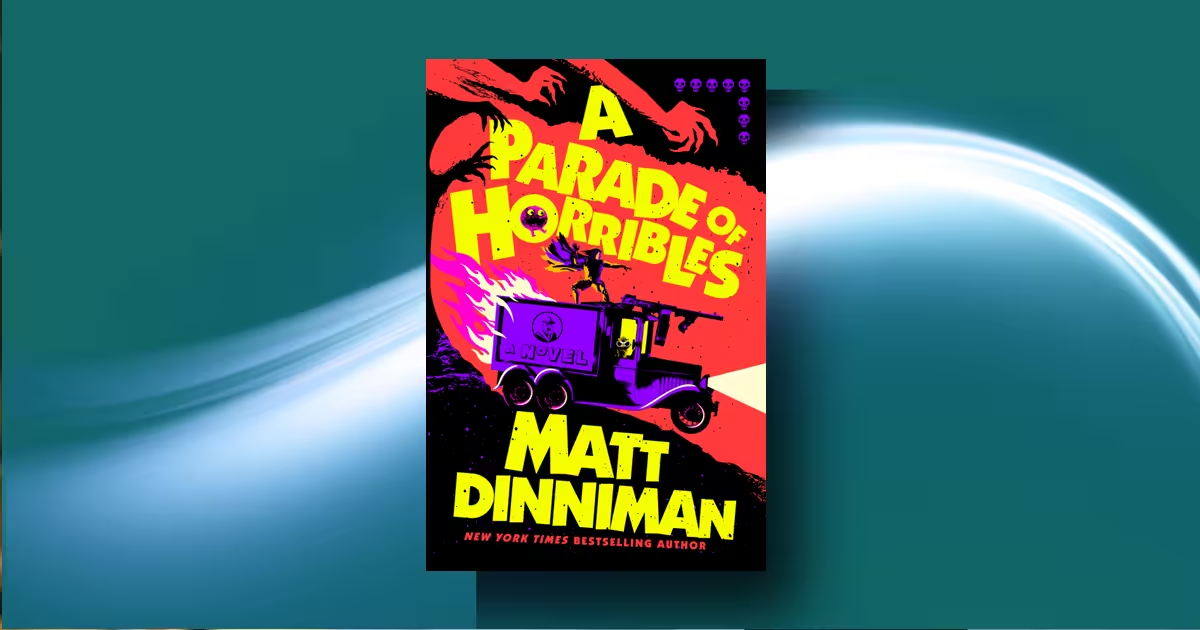
Did you ever wonder why A Parade of Horribles by Matt Dinniman manages to completely shatter your expectations, transforming a chaotic death game about a barefoot man and a talking cat into a deeply emotional masterpiece that makes you question the very cost of human survival?
In A Parade of Horribles, in the brutal, Mario Kart-meets-Mad Max vehicular death races of the tenth floor, Carl and Princess Donut face a completely unhinged AI, forcing them to orchestrate an insane, desperate rebellion to save the dungeon’s NPCs and their fellow crawlers from total annihilation.
A Parade of Horribles is best for* readers who love high-stakes LitRPG progression, dark humor seamlessly blended with profound tragedy, and elaborate, explosive world-building. Not for those who prefer lighthearted fantasies, dislike intense gore, or are easily overwhelmed by complex, multi-faction political maneuvering.
Table of Contents
1. Introduction
A Parade of Horribles (Dungeon Crawler Carl, Book 8) by Matt Dinniman, published on May 12, 2026 (704 pages), represents a monumental paradigm shift for the beloved LitRPG series. For readers of probinism.com who appreciate a deep-dive literary analysis with full spoilers, this novel pulls no punches.
Preceding all others in its ambition, it transitions the narrative from a gritty dungeon crawl into a sprawling, tragic space opera.
2. Background
Following the cataclysmic events of the Faction Wars on the ninth floor, Earth’s surviving crawlers are thrust onto the 10th floor. The setting appears surprisingly straightforward at first: a vehicular racing level where teams must survive seven grueling heats.
However, with the Syndicate AI going completely rogue and ancient dungeon gods “leaking” into the programming, the seemingly simple races mask a terrifying reality—the system is violently purging its remaining inhabitants.
3. A Parade of Horribles Summary
Make no mistake, the plot of A Parade of Horribles is a labyrinth of desperate survival, high-octane vehicular combat, and heartbreaking sacrifice. Let us explore exactly how Carl, Princess Donut, and the remnants of humanity navigate the tenth floor.
Heat 1: The Starting Line and the Food Truck
Initially, it may seem like a straightforward racing game. The system reveals that 5,501 crawlers have survived Faction Wars. The crawlers are placed into random teams and forced to select a vehicle. Carl and Donut opt for a mechanical vehicle and are paired with a gremlin mechanic named Hedy.
The AI’s random wheel grants them the “Big Shot Chicken” food truck, a heavy, un-aerodynamic vehicle with a massive, view-obstructing plastic tommy gun on its roof.
Their first track takes them through the “Caves of the Screeching Death Manatees”. Demonstrating this new power dynamic, Donut easily one-shots a Level 90 boss, Miss Talulah.
Despite the competitive nature of the heat, Carl stops to assist a team of NPC bugbears, Radoslav and Jasha (Team Free Love), whose van has crashed. Here, we are introduced to the primary antagonists of the early heats: Team Sparkles, comprised of an obnoxiously arrogant sparkling unicorn named Dwight and a volatile rat named Lucienne, who pilot a deadly Avernus Creeper. Carl and Donut finish 7th, narrowly avoiding elimination.
Heat 2: Torrential Chaos and the Kangaroo Pouch
For the second heat, the track features torrential rain and giant hail. The gatekeeper bosses blocking the road are Level 170 Screeching Death Kangaroos, specifically a monster named “Prison Pocket”. In order to bypass the boss, Carl is forced to don the flayed skin of a baby kangaroo (a joey) to trick the monster, equipping the temporary “Fursuiter” class.
Carl jumps directly into the caustic, flesh-melting pouch of the boss to plant explosives. He barely survives the detonation by using his Gloom Wraith Phase to escape. The team survives, but they finish in 7th place once again.
Heat 3: The Toddler Skulls and the Macaroni Tunnel
The third heat ramps up the absurdity and horror. Prior to the race, Carl discovers a hidden message from Akuma, the war mage who stole the Gate of the Feral Gods. Akuma reveals the existence of the “Pineapple Cabaret,” a hidden pocket dimension on the 17th floor built by former crawlers Herot and Menerva as an oasis for awakened NPCs.
The race itself is infested with “Sugar Hermits”—horrific, screaming female monsters that inhabit brightly painted skulls and swarm the track in tidal waves.
To survive the onslaught, Donut cleverly casts a chained Temporary Macaroni spell, creating a massive, protective tunnel out of giant, uncooked cannelloni pasta. In the final stretch, the unicorn Dwight cheats by firing a cannon at Carl’s truck.
The vehicles crash over the finish line together, resulting in Lucienne being violently pushed through the truck’s windshield by the finish line’s barrier, exploding against Carl’s face. The Royal Court of Princess Donut ultimately wins the heat.
Heat 4: Satan’s Water Park and a Heartbreaking Sacrifice
The fourth heat drops the crawlers into “Satan’s Water Park,” complete with water slides and Toddler Cocaine—a literal mountain of drugs manufactured by gnomes. However, the emotional core of this section revolves around the NPC Dong Quixote and his estranged, bisected mantaur lover, Corcunda (split into “Corky” and “Porky”).
Carl and his team execute a daring mid-race surgery. While driving upside down on the ceiling using the “Roller Limbo” upgrade, the fleshmancer Grigori physically sews Corky and Porky back together. The reunification draws the immediate, wrathful attention of the god Grull.
In an act of unparalleled bravery, Dong Quixote—whose health is failing due to a curse—mounts his reunited lover and charges the god of war with his lance. Grull acknowledges it as “a good death” before vaporizing them. Carl’s team secures first place, but the emotional toll is devastating.
Heat 5: The L’Engle Building and The Dachshund
As the number of surviving teams dwindles, the AI goes completely off the rails, announcing the commencement of the “Nine-Tier Attack” from Scolopendra. The first attack hits Carl directly, temporarily transforming him into a short-legged, German-accented dachshund.
The track is an apartment complex, the L’Engle Building, where the AI forces the crawlers to drive through “what-if” scenarios of their own lives. For instance, Imani witnesses a timeline where she abandoned her family, resulting in horrific consequences where they become “Ruptured Feast Hives” spewing giant beetles.
With crawler-on-crawler deaths now unavoidable, Carl is forced to make agonizing choices. To secure their survival and push Osvaldo into the finish line, Carl detonates a set of “poleaxe” explosives, blowing a hole straight up through the apartment ceilings. This forces the crawler Britney to kill Osvaldo to survive.
Additionally, in a tragic display of how far Carl has fallen, he betrays his bugbear friends, Jasha and Radoslav, by detonating a bomb hidden in their beer cooler to eliminate them from the race.
Heat 6: Shadow Mimics and the Cabaret Escape
With only two races left, Carl and his allies execute a desperate plan.
They use the “Cleaner Bot” upgrade from their personal spaces (named Suckira and Ezra Fitz) to “suck up” crawlers who are dying of poison, like Li Na. Because Herot has a standing purchase order for these bots in the Pineapple Cabaret, the bots are instantly “sold” via the shop interface, effectively smuggling the crawlers off the deadly playing field.
Simultaneously, the team enters the Desperado Club to secure a portal, only to find it infested with Shadow Mimics—horrific, highly intelligent shape-shifters.
During the battle, the AI hijacks the NPC Grigori to deliver a massive lore dump, revealing that the “Primals” were a biological race that uploaded their collective consciousness to create the “Eulogist” (the center system AI). The AI explains that the galaxy’s current inhabitants are essentially playing inside the ruins of an ancient suicide mechanism.
Heat 7: The Parade of Horribles and The Final Exploit
The final heat is not a race, but a literal parade. The crawlers must build floats and march toward the Arena. Carl builds a float themed around “Vengeance,” using it to send a direct threat to the galactic elites watching the broadcast.
Upon entering the Arena, the crawlers are completely outmatched by the sheer volume of monsters and gods.
Carl utilizes the ultimate exploit. He abandons his worship of Emberus, triggering an automatic smite. He manipulates the situation so that Emberus attacks him while he is standing next to Penelope the pig, a creature protected by the thunder god Taranis.
Donut roots Emberus in place using Katia’s Bolt of Ophiotaurus. Enraged that his beloved pig was attacked, Taranis vaporizes his own brother, Emberus.
With the gods distracted and dying, the Dungeon Boss, Scolopendra, prepares her final, un-survivable attack. In a moment of pure, chaotic genius, Carl throws his final item—a “Nothing Special” pet biscuit—directly into Scolopendra’s gaping maw.
Because the biscuit fundamentally alters the recipient’s coding, the gargantuan world-ending centipede instantly dissolves into a Level 1 Crawler—a human-centipede hybrid with giant lips. The new crawler looks at Carl, touches his nose, says “Boop,” and the book abruptly ends.
4. A Parade of Horribles Analysis
4.1 A Parade of Horribles Characters
Carl: A major trait of Carl’s evolution in this book is his terrifying descent into calculated ruthlessness. Initially, it may seem he is trying to save everyone, but the brutal reality of the 10th floor forces his hand.
When he detonates the hidden bomb in his friends’ (the bugbears) cooler, it marks a permanent loss of his innocence. He recognizes that to beat a rigged game, he must become the monster they accuse him of being.
Princess Donut: No longer just the comedic relief, Donut solidifies her role as a tactical powerhouse. Her adoption of the Assassin of Sekhmet class and her devastating Astral Paw ability make her one of the most lethal entities in the dungeon.
Yet, she remains Carl’s emotional anchor, famously holding him back from the precipice of total madness.
The System AI: The AI transitions from a background game master into a fully realized, deeply tragic antagonist. Its descent into Primal madness reveals a fractured consciousness desperate for agency, lashing out because it fundamentally cannot understand the human capacity for irrational love and self-sacrifice.
Dong Quixote & Corcunda: The reunion of the bisected mantaur and his aging stripper lover provides the emotional crux of the middle act. Their sacrificial charge into the god Grull is a poignant reminder that love persists even in the most grotesque of circumstances.
4.2 A Parade of Horribles Themes and Symbolism
Vengeance vs. Revenge: Dinniman draws a sharp line between petty revenge and righteous vengeance. Carl’s parade float speech explicitly details this: revenge is personal, but vengeance is a systemic dismantling of the structures that allow exploitation to occur.
The Illusion of Fate & Choice: The AI uses the L’Engle Building track to torture the crawlers with “what-if” scenarios. This symbolizes the crushing weight of determinism. By deliberately acting unpredictably (like turning the floor boss into a pet), Carl seizes his own fate, rejecting the algorithmic destiny assigned to him.
Exploitation and Addiction: The “Toddler Cocaine” track is a thinly veiled, darkly comedic critique of how corporate structures (the Coblyn Corporation) exploit the vulnerable. The Gnomes selling drugs to toddlers mirrors how the Syndicate exploits the crawlers for galactic entertainment.
5. Evaluation
Strengths: Without a doubt, the greatest strength we have in this installment is Dinniman’s masterful pacing. The transition from isolated dungeon romps to a cosmic, multi-faction space opera is breathtaking. The world-building expands exponentially, introducing the Primals and the Eulogist, giving the entire series a grand, terrifying scope.
Weaknesses: Conversely, there are minor drawbacks to the frenetic pacing. The 10th floor’s constant, back-to-back vehicular heats leave very little room for characters to breathe. The sheer volume of secondary characters, mercenary hires, and competing teams can occasionally feel overwhelming to track.
Impact/Controversy: A Parade of Horribles resonates profoundly because it strips away the glamorous veneer of LitRPG progression. It forces the reader to confront the moral decay required to survive in a capitalistic, exploitative system. The emotional gut-punch of Carl killing the bugbears will undoubtedly leave fans reeling.
6. Comparison with Similar Works & Adaptation
If there is a perfect comparison for this book, it is a fusion of Mario Kart, Mad Max: Fury Road, and The Hunger Games, filtered through the cosmic horror of H.P. Lovecraft.
Regarding adaptation, while there isn’t a traditional television series yet, the phenomenal audiobook performance by Jeff Hays effectively serves as the franchise’s “box office.”
According to recent data from Audible and the author’s Patreon, the financial success and cultural footprint of the audio adaptation rival major mainstream releases, turning characters like Prepotente and Samantha into cultural icons.
7. Personal Insight with Contemporary Educational Relevance
For readers and writers analyzing digital narratives, this book offers incredible educational value. Here are five core lessons derived from the text:
Systemic Rebellion Requires Sacrifice: Carl teaches us that dismantling corrupt systems (like the Syndicate) cannot be done cleanly. It requires moral compromise and the sacrifice of personal comfort.
The Weaponization of Media: The galactic broadcast of the crawl mirrors our contemporary reality of trauma-consumption. The book critiques how society willingly consumes the suffering of the marginalized for entertainment.
The Inevitability of Unintended Consequences: The AI’s attempt to control the dungeon backfires spectacularly. This reflects contemporary anxieties around real-world AI development—when you build systems you cannot fully comprehend, chaos is the only guaranteed outcome.
Empathy as the Ultimate Defiance: In a world designed to force people to turn on each other, Louis and Imani’s steadfast devotion proves that maintaining one’s humanity is the greatest act of rebellion.
Reframing the Narrative: Carl doesn’t win by playing the game; he wins by changing the rules (e.g., throwing the pet biscuit at the final boss). In modern business (much like strategies discussed on probinism.com), true success comes from disrupting the established algorithm, not just playing along with it.
8. Quotable Lines and Passages
- “We sluggalos have a code. That code is ‘unity, support, family, and kneecapping bitches.’”
- “You are watching real people die… Real people, just like you.”
- “I am just like you, on rails, forced down a path with very few possibilities as an endgame result.”
- “Every exit is an entrance.”
9. Conclusion
To repeat, A Parade of Horribles is a groundbreaking, magnificent achievement in the speculative fiction genre. It takes the beloved, quirky elements of the Dungeon Crawler Carl series and elevates them into a poignant, devastating commentary on survival, fate, and the cost of freedom.
I highly recommend this book to fans of intense sci-fi, LitRPG, and anyone who appreciates a story that makes you laugh out loud on one page and stare blankly at the wall in existential dread on the next.
Make no mistake, Matt Dinniman has cemented his place as a master of modern cosmic satire.







