

Last updated on November 2nd, 2026 at 11:04 am
Is Netflix’s Adolescence worth watching? Yes, though not for comfort. In this four-episode British drama a 13-year-old boy is arrested for killing a classmate, and the series became one of the most decorated limited series on record, with eight Emmys for the series itself and four Golden Globes followed by four BAFTA TV awards in 2026.
I watched all four episodes and I think the praise is earned. Still, the public reaction ran ahead of the evidence in places, so this review does something most others skip: it checks what researchers say the show gets right and wrong.
Adolescence at a glance: what you need to know
- Verdict: a harrowing, brilliantly made drama. My rating is 4.5 out of 5.
- Format: four episodes of about an hour, each filmed in one continuous shot.
- Ending: Jamie did kill Katie, and by the finale he decides to plead guilty (Netflix Tudum).
- Real subject: the series cares about why a boy did it, not who did it.
- Reach: 24.3 million views in its first four days and 6.45 million UK viewers in week one.
- Caveat: researchers argue it overstates some links between online misogyny and violence (AIBM).
- Aftermath: the UK announced an under-16 social media ban in June 2026, expected from spring 2027.
Who will love it, and who may bounce? Parents of teenagers, teachers and anyone who wants a serious drama about boys, shame and screens will get the most from it. If you want a puzzle, look elsewhere, because the killer is revealed in episode 1. Viewers who struggle with child violence or a father’s grief may find it too heavy, and that is a fair reason to skip it.
The UK made it available to secondary school pupils aged 11 to 18, yet I would watch it first as an adult and then decide who else should.
What is Adolescence, and who made it?
Adolescence reached Netflix on 13 March 2025. Jack Thorne and Stephen Graham created and wrote it, and Philip Barantini directed. Graham also plays Eddie Miller, the father. Owen Cooper plays 13-year-old Jamie, Ashley Walters is Detective Inspector Luke Bascombe, and Erin Doherty plays the clinical psychologist Briony Ariston.
The story is set in an unnamed Yorkshire town, and much of it was shot in Pontefract, West Yorkshire.
Where did the idea for Adolescence come from?
Graham says it started with news reports of young boys involved in knife crime, including a case in which a boy allegedly stabbed a girl.
Thorne found a second spark in Cries Unheard, Gitta Sereny’s book about Mary Bell, who was convicted of two child killings in 1968, and he wanted a “why-done-it, rather than a whodunit”. Barantini and Graham had already made the one-shot restaurant film Boiling Point in 2021.
Despite the headlines it inspired, Jamie’s story is not based on a real person.
What happens in Adolescence, episode by episode?
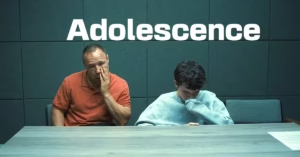
Episode 1, the arrest. Armed police break into the Miller home at dawn and arrest Jamie. The script has him wet himself when an officer points a gun at him, a deliberate reminder that he is still a child. Eddie goes with him to the station as his appropriate adult, and Jamie insists he has done nothing.
In the last ten minutes detectives play CCTV footage of Jamie stabbing Katie seven times in a car park, and the creators wanted viewers to feel what Eddie feels as he watches.. Eddie can only ask, “What have you done?”
Episode 2, the school. Three days after the killing, Bascombe and DS Frank, played by Faye Marsay, visit Bruntwood Academy, where a memorial has gone up. Katie’s best friend Jade lashes out because she thinks police are turning the case on Katie.
The detectives still need the murder weapon and a motive (same source). The break comes from Bascombe’s own son Adam, who attends the school. He tells his father that the emoji comments Katie left under Jamie’s Instagram posts were not friendly, and that he could show 15 more.
They were a coded way of calling Jamie an incel, and the dynamite emoji, for instance, stands for an exploding red pill. The episode closes with a chase partly filmed by drone, Eddie leaving flowers at the murder site, and Bascombe inviting Adam to lunch.
Episode 3, the session. Seven months later, Jamie sits across from Briony while she prepares a report on his mental state. Almost the whole hour is a two-person duel in one room. Jamie can switch from polite, thanking her for a hot chocolate, to furious, sweeping the cup off the table.
He admits he asked Katie out while she was being publicly humiliated, reasoning that she might like him if she felt weak. Katie had accused him of being an incel on Instagram, he became embarrassed and enraged, and the stabbing followed soon after.
The hour ends with Jamie asking Briony whether she likes him, then demanding an answer as a guard pulls him away.
Episode 4, the family. Thirteen months after the arrest, the Millers try to mark Eddie’s 50th birthday.
A vandalised car and a run-in with an incel spoil the day, and then Jamie phones to say he will plead guilty. Eddie and Manda ask what they did wrong. Eddie recalls the violence he suffered from his own father and the promise never to repeat it.
The series ends where it began, in Jamie’s bedroom, as Eddie tucks in his son’s teddy bear and apologises to it, while Aurora’s “Through the Eyes of a Child” plays in a version sung by Emilia Holliday, the actor who plays Katie.
So why did Jamie do it? Thorne and Graham point to a mix of low self-esteem, perceived bullying at school and access to online incel propaganda, and they deliberately show a hardworking, loving family so viewers cannot blame one bad parent.
Why does the one-take format work so well?
It works because it removes every place to hide. Barantini describes the method plainly: “You just press record, and then press stop an hour later”.
The crew used a DJI Ronin 4D camera and handed it from person to person without stopping, then used a drone for the episode 2 chase (same source). The Guardian’s Lucy Mangan called the series “the closest thing to TV perfection in decades”. Not every critic agreed on every detail. What’s on Netflix found the format masterful in episode 3 but thought episode 4 might have suited a conventional approach, and the Irish Times felt Graham’s opening performance was over-egged.
I understand both points. Even so, I think episode 3 is one of the best uses of the technique on television, because one room and one hour force you to watch two people change from moment to moment.
How good are the performances?
Owen Cooper had never acted professionally before this role, and he had only taken drama classes as a hobby for under three years (Forbes). Casting a boy from near Warrington even shaped the filming location, so he never had to fake an accent.
He moves from frightened child to cold menace inside a single scene, which is why the Emmy, Golden Globe and BAFTA wins did not surprise me.
Graham carries the heartbreak. Barantini says the take used in the final scene was different because Graham spotted photos of his own family, placed in the wardrobe by the art department with a note saying the family loved and was proud of him.
Doherty’s Briony is quiet, sharp and visibly shaken by the end. Walters earned a Golden Globe nomination, and Christine Tremarco, who plays Manda, won the BAFTA for supporting actress over Doherty (Gold Derby).
The standout chemistry is the Cooper and Doherty duel in episode 3, which Netflix itself calls a “chess match”.
What is Adolescence really about?
It is about the distance between what adults see and what children live. In episode 2 an experienced detective cannot read a row of emojis until his teenage son translates them. Graham chose an ordinary family over a story about gangs or an abusive parent so viewers would think it could happen to them.
Shame is the second theme. Humiliation, not hatred, is the trigger in the script. Fathers and sons are the third. Eddie recalls taking Jamie to football to toughen him up, then watching other dads laugh when his son was put in goal. Responsibility is the fourth. Thorne says no one in the family is to blame, yet Manda and Eddie tearfully take accountability for their parenting choices.
An academic analysis in The Communication Review reads the series as showing how family, school and digital spaces together normalise gender-based violence.
What does the research say Adolescence gets right and wrong?
It gets the scale of exposure plausibly right and the cause-and-effect story too neatly. On exposure, a paper on PubMed Central cites a Hope Not Hate survey suggesting 80% of 16- and 17-year-old boys have seen manosphere content, although its authors say adequate data on consumption patterns does not yet exist.
The Center for Countering Digital Hate found the largest incel forum had nearly doubled to 30,000 members since its 2022 report, and 67% of the 658 posts it reviewed about the series criticised it, often saying it misrepresented incel communities.
The criticism is sharper elsewhere. The American Institute for Boys and Men says a teenage boy killing a girl is thankfully very rare in the UK, that evidence on social media harm is contested, that the show blurs distinct manosphere groups, and that no evidence supports a secret emoji language (AIBM).
It also cites research finding that only 1.39% of incel forum posts legitimise violence. I could read only the search excerpt of that commentary, so check the full text before quoting its figures. A paper in the European Journal of Cultural Studies similarly argues that framing the series as an exposé of incel radicalisation misses how most boys engage with this material.
From the opposite direction, the Centre for Male Psychology calls the series propaganda, and Spiked described the reaction as a moral panic.
My reading is that the writers made a drama about one boy, not a statistical portrait. Judge it as a study of how attention fails inside a loving home, and do not treat it as proof that every lonely boy online is one step from violence.
The newest evidence sits between the show’s alarm and its critics’ caution. On 30 October 2026, a report in The Lancet argued the manosphere should be treated as a public health problem, with regulation aimed at platforms rather than users and messaging that avoids describing boys and men as the problem.
What has changed in the UK since Adolescence?
The government moved fast, though the credit is disputed. In April 2025 Keir Starmer said he had watched the series with his teenage children and that it “hit home hard” (AFP via Jamaica Observer).
On 15 June 2026 the government announced a ban on social media use by under-16s, expected from spring 2027, and on 15 July it announced default midnight to 6am curfews for 16- and 17-year-olds (House of Commons Library).
A Forbes contributor says the show spurred the ban. I found no official statement saying so, and the Commons Library briefing ties the legislation to Lords defeats on the Children’s Wellbeing and Schools Bill, so I treat the causal link as unproven.
Critics object too: the Electronic Frontier Foundation argues the ban will cause more harm than it prevents.
How does Adolescence compare with Baby Reindeer, Boiling Point and Time?
Commercially, it passed Baby Reindeer’s cumulative first four weeks in just two weeks, reaching 66.3 million views. Creatively, its closest relative is Boiling Point, the one-shot film by the same director and star, and Thorne and Graham had worked together before on the This Is England mini-series and The Virtues.
What sets Adolescence apart is that it hands you the answer to who did it, then spends three hours on why. If you want another British drama about violence and institutions, my review of the BBC prison drama Time is a useful companion.
Where Adolescence falls short against a conventional true-crime series is the victim. DS Frank complains that the perpetrator always gets the front line, and the series only partly answers that.
How was Adolescence received, and which awards did it win?
Audiences arrived in huge numbers. It drew 24.3 million views in its first four days, grew 72.8% to 42 million in week two, and topped Netflix’s chart in 71 countries.
In the UK the opening week drew 6.45 million viewers, described as the biggest single-week audience for a streaming series there (same source). Within a month it ranked among Netflix’s five most-watched series, according to a dpa-AFX report.
Critics were warm, with Times writer Tom Peck calling it “complete perfection”. Jack Thorne has said he does not think a second series is right.
The awards list is long. The series won eight 2025 Emmys, including Outstanding Limited Series, lead actor for Graham, supporting actor for Cooper, supporting actress for Doherty, writing, directing, cinematography and casting. Its making-of series won a ninth, which explains why some outlets count nine. Cooper became the youngest male winner of an acting Emmy.
At the 2026 Golden Globes it won four of its five nominations.
At the BAFTA TV Awards, it won Limited Drama, Leading Actor, Supporting Actor and Supporting Actress, the most for any series at the main ceremony, plus two craft awards.
At 16, Cooper completed a full set of major TV honours (Variety).
What does Adolescence teach us today?
The lesson I keep returning to is that being present is not the same as being informed. Eddie and Manda are not neglectful. Graham says he wanted to rule out any reading of Eddie as violent, and he wanted Jamie’s mother and sister to be equally decent (Netflix Tudum). Yet the bedroom where Jamie absorbed the ideas that shaped him sat inside the family home. That is why the series frightened so many parents, and it is why I came away thinking less about monsters and more about attention.
The evidence outside the drama supports a careful version of that worry. The Hope Not Hate figure cited in the peer-reviewed paper suggests most older teenage boys have seen manosphere content.
The authors of the October 2026 Lancet report say outrage is good for business, and co-author Professor Sarah Hawkes puts the practical point simply: “We need to offer boys something better.”
Here are the five lessons I take from the series and the debate around it.
- Learn the language your child uses. Bascombe needs his son to decode the emojis. You do not need to become fluent, but you do need to ask.
- Treat humiliation as a warning sign. In the script, public mockery pushes Jamie from resentment to violence.
- Say the warm sentence aloud. Graham describes Eddie as a hardworking father who does not constantly say he loves his boy (same source), and Jamie spends episode 3 begging for reassurance.
- Give boys somewhere to belong. The Lancet authors warn that removing the manosphere without offering something credible in its place will fail.
- Hold policy to the evidence. The AIBM says policymakers need more rigorous research before adopting new measures, and the EFF warns of costs. A ban is a tool, not a conversation.
If one problem sits at the centre, it is the gap between adult attention and a child’s private online world. The series does not solve it. It makes the gap impossible to ignore, which is a real achievement for four hours of television.
Which lines from Adolescence stay with you?
- Eddie, Episode 1: “What have you done?”
- Jamie, Episode 3: “Do you like me?”
- Eddie, Episode 4: “So if my dad made me, how did I make that?”
- Eddie, Episode 4, final scene: “I’m sorry, son. I should have done better.”
The last line lands because Eddie says it to a teddy bear.
Pros and cons
| Pros | Cons |
|---|---|
| Four unbroken takes that never feel like a gimmick | Episode 1 and the finale are emotionally punishing |
| Cooper and Doherty in a gripping episode 3 | Some critics found Graham’s opening performance over-egged (Irish Times) |
| A family-first finale that avoids easy blame | The incel and manosphere framing blurs distinct groups (AIBM) |
| Four hours with no filler | Katie, the victim, gets less depth than Jamie |
| Started a debate that reached Parliament | Episode 4 may have suited conventional editing (What’s on Netflix) |
Should you watch Adolescence?
Yes. My rating is 4.5 out of 5. It earns its awards for craft and performance, and its weakest claims are often the ones people made about it, not the ones it makes itself. Watch it if you can bear it, then read the research before you repeat any statistic from the debate. A second series looks unlikely, which suits a story that ends exactly where it began.
Related reading on Sopranu
- Time (2021) TV series review
- How Social Media Algorithms Are Changing Modern Democracy
- Unrequited Love Hurts Like Addiction, but Science Shows a Way Out
Adolescence
Director: Philip Barantini
Date Created: 2026-11-05 19:14
4.5
Pros
- One-take craft, Cooper and Doherty in episode 3, family-first finale, tight four-hour length, sparked a national debate
Cons
- Emotionally punishing, manosphere framing blurs distinct groups, Katie gets less depth than Jamie, some critics found episode 1 acting over-egged







