

Last updated on April 22nd, 2026 at 12:05 pm
Does love feel like a craving you just can’t control—like hunger, thirst, or even an addiction? Anatomy of Love will show you why that’s not just a metaphor; it’s a biological fact. If you’ve ever been baffled by why we flirt the way we do, why you chose him instead of that guy, or why the “seven-year itch” actually strikes closer to year four, this book isn’t just a read—it’s a user manual for the human heart.
Who will devour this book:
Anyone who’s ever been in love, heartbroken, or just endlessly curious about why humans behave like… well, humans.
This is a holy grail for psychology students, sociology buffs, anthropology nerds, and even the skeptical romantic who wants to know if “chemistry” is real. If you’re navigating dating apps, considering marriage, or recovering from a breakup, Helen Fisher’s insights will feel like a flashlight in a very dark, very confusing cave.
Who should maybe skip it:
If you’re looking for a fluffy, self-help guide promising “10 Easy Steps to Make Him Commit” or a spiritual treatise on soulmates, this isn’t it.
Fisher is a scientist first. She digs into hard data, animal mating habits, and brain scans. Additionally, if you’re deeply uncomfortable with the idea that some aspects of love, adultery, and divorce might have evolutionary roots rather than purely moral or spiritual explanations, this book will challenge you—hard.
Table of Contents
1. Introduction
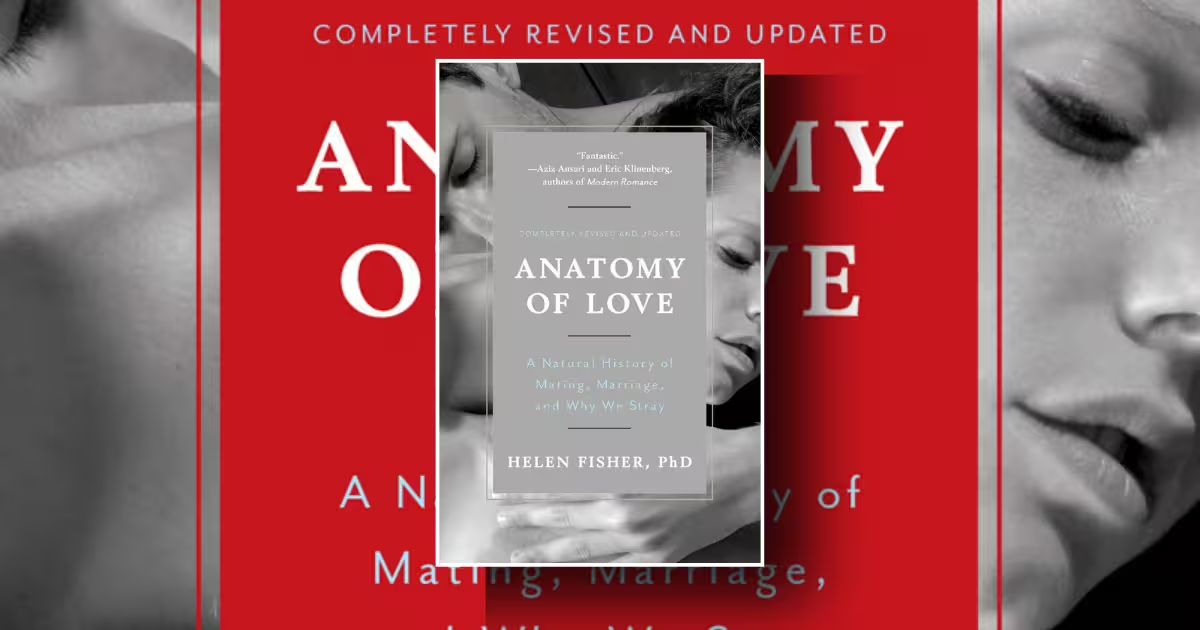
The book is “Anatomy of Love: A Natural History of Mating, Marriage, and Why We Stray” by Helen Fisher, PhD. First published in 1992 and revised with groundbreaking new data in 2016, Fisher—a renowned biological anthropologist and Senior Research Fellow at The Kinsey Institute—distills decades of research into a single, cohesive narrative about our most primal drive.
This isn’t just a pop-science book; it’s a deep-time exploration. Fisher doesn’t just talk about Tinder or modern divorce rates.
She takes us back 20 million years into the trees of Africa to explain why you like a particular jawline or why your heart races when a date touches your wrist.
She bridges the gap between the flirting tactics of Amazonian tribes and the dopamine hits we get from a late-night “You up?” text.
Fisher’s central thesis is bold: Humans are built for serial monogamy mixed with clandestine adultery. We are “a pair-bonding species” designed to fall in love, raise children together, and then—quite naturally—experience a “three- to four-year itch” that often leads us to seek new partners.
She argues that our modern struggles with love, divorce, and infidelity aren’t signs of a broken society but echoes of a reproductive strategy that evolved over four million years ago on the African savanna.
2. Background: The Scientist Who Mapped Love
Before Helen Fisher became a TED All-Star and the Chief Scientific Advisor to Match.com, she was a researcher at the American Museum of Natural History asking a deceptively simple question: What is the one thing all humans share?. Her answer: our reproductive strategies.
Fisher is no armchair theorist. She is a pioneer in using functional Magnetic Resonance Imaging (fMRI) to peer inside the brains of people who are madly in love, recently dumped, or happily married for decades.
Her 2005 study, co-authored with neuroscientists, was the first to light up the brain’s reward system—specifically the ventral tegmental area (VTA)—in response to photos of a beloved, proving that romantic love is a fundamental human drive akin to thirst and hunger.
In 2010, she launched the “Singles in America” study, a massive annual survey of over 5,000 U.S. singles (totaling over 25,000 respondents by 2014), providing the largest data set ever assembled on modern courtship. This blend of brain scanning and “big data” makes Fisher uniquely qualified to dissect the anatomy of love.
3. Anatomy of Love Summary
This section is your cheat sheet to the entire book. If you read this, you’ve essentially audited Fisher’s entire course on human mating.
🕺🏻 Games People Play: The Universal Courting Dance
Fisher opens with a fascinating look at “body talk.” Drawing on the work of ethologist Irenäus Eibl-Eibesfeldt, she reveals that flirting is a universal, often subconscious, language. From the highlands of New Guinea to the salons of Paris, women use the same sequence: smile, eyebrow flash, gaze, look away.
She breaks down the bar pickup into five distinct stages: 1) Attention-getting (the “chest thrust” or hair toss), 2) Recognition (eye contact), 3) Grooming Talk (higher, softer voices), 4) Touch, and 5) Body Synchrony (moving in rhythm like a dance). This isn’t learned; it’s etched into our evolutionary psyche.
💞 Why Him? Why Her? The Chemistry of Choice
Why do we fall for one person and not another? Fisher dismantles the mystery, pointing to a combination of:
Odor Lures: Like emperor moths crossing miles to find a mate, we subconsciously sniff out partners with different immune system genes (Major Histocompatibility Complex). Fisher notes that women prefer the smell of T-shirts worn by men whose genes differ from their own.
Love Maps: An unconscious list of desirable traits we build in childhood, shaped by family, friends, and early experiences.
The Chase: Barriers, mystery, and a touch of difficulty intensify passion (the “Romeo and Juliet effect”).
Brain Circuitry: Using fMRI, Fisher found that when we look at a lover, the brain floods with dopamine and norepinephrine—natural stimulants that make us feel euphoric, focused, and obsessed. This is the same neural pathway activated by cocaine. Love is a natural addiction.
👫 Is Monogamy Natural? Human Bonding (and Cheating)
This is the heart of Fisher’s argument. She asserts that while polygyny (one man, multiple wives) is permitted in 84% of cultures, only 5–10% of men actually practice it. The vast majority of humans are monogamous.
But here’s the catch: It’s serial monogamy. We are designed to pair-bond, but not necessarily for life. Fisher points to the three- to four-year itch. By analyzing divorce data from 62 societies between 1947 and 1989 (and updated data from 80+ societies in 2011), she discovered that marriages consistently peak in divorce around the fourth year.
This aligns with the traditional human birthing cycle: in hunter-gatherer societies, constant nursing suppresses ovulation, spacing births about four years apart. Fisher’s theory: our ancestors evolved to stay together just long enough to raise a single child through the most vulnerable period of infancy, and then they often moved on.
💔 Why Adultery? The Nature of Philandering
Why do people cheat, even when they’re happy? Fisher’s data from 2014 shows that 60% of men and 53% of women admit to “mate poaching” (trying to woo someone away from a relationship).
She explains this through evolutionary logic: men have historically sought “fresh features” to spread genes, while women sought extra lovers for resources, better genes, or “insurance” should their primary mate die.
Crucially, she notes that the brain systems for lust (testosterone), romantic love (dopamine), and attachment (oxytocin/vasopressin) are not always well-connected.
You can be deeply attached to a spouse while feeling romantic love for someone else and lust for a third person—a neurological recipe for infidelity.
📉 Blueprint for Divorce: The Three- to Four-Year Itch
Forget the “seven-year itch.” Fisher’s analysis of United Nations data is one of the book’s most cited revelations: Divorce peaks at year four of marriage. She notes that 43% of divorces occur among couples with no dependent children, and the risk of divorce drops dramatically with each additional child.
This pattern holds true across wildly different cultures, from the U.S. to Egypt, suggesting a biological, rather than purely cultural, underpinning.
🌲 “When Wild in Woods the Noble Savage Ran”: Life in the Trees
Fisher reconstructs the sex lives of our ancestors. From the promiscuous bonobos (“make love, not war”) to the harem-building gorillas and the political chimpanzees, she builds a case for the origins of our own behavior.
She uses the fossil record, like the 3.2-million-year-old Lucy (Australopithecus afarensis), to argue that walking on two legs (bipedalism) forced females to carry infants, creating a “monogamy threshold” where they needed a protective mate to help them survive.
🧬 Gender Differences and Power: Like Two Feet
Fisher dives into the biology of gender differences, noting that fetal testosterone “sexes” the brain, building a more compartmentalized male mind suited for focused tasks (hunting), and a more connected female brain suited for “web thinking” (multitasking and childcare).
She offers a fascinating critique of “male dominance,” pointing to examples like the Igbo Women’s War of 1929, where tens of thousands of Nigerian women revolted against British colonial officers who had stripped them of their traditional economic and political power.
Fisher argues that the sexual double standard—where women’s sexuality is rigidly controlled—is a relatively recent invention of plow agriculture, which tethered women to the home and made their labor secondary to a man’s.
🔮 Future Sex: Forward to the Past
In the final chapter, updated with her “Singles in America” data, Fisher predicts a return to “slow love.” She notes that 58% of singles have had a “friends with benefits” relationship, and 33% of one-night stands turn into long-term partnerships.
She argues that living together before marriage and long courtships are modern versions of ancient “trial marriages.”
Despite the panic about hookup culture, 89% of singles still believe you can stay married to the same person forever.
She warns, however, about the rise of SSRI antidepressants, which can blunt the dopamine system and potentially jeopardize feelings of romantic love.
4. Anatomy of Love Analysis
In my opinion, Anatomy of Love is an intellectually electrifying and profoundly reassuring masterpiece.
Fisher doesn’t just explain love; she contextualizes it.
By looking at our behavior through the long lens of prehistory, she removes the heavy moral judgment we often place on ourselves and our partners.
When you realize that the “three-year itch” might be a relic of an ancient survival strategy, a failing marriage feels less like a personal moral failing and more like a collision between our Stone Age brains and our modern expectations of “happily ever after.”
The most groundbreaking aspect is Fisher’s reframing of romantic love as a drive, not an emotion.
In a 2005 interview with UPI, she explained: “When you’re in the throes of this romantic love it’s overwhelming, you’re out of control, you’re irrational… This drive for romantic love can be stronger than the will to live.” This explains why heartbreak feels like withdrawal—because it neurologically is.
The book is not without its critics. Some reviewers on The StoryGraph feel that Fisher’s narrative is “speculative storytelling” based on thin archeological evidence, arguing that she builds grand theories of human nature on “a few tools found on a riverbank”.
While Fisher is careful to note that genetics provide “a natural inclination, not an imperative,” the book’s reliance on evolutionary psychology means it will always face pushback from those who prefer purely cultural or sociological explanations for behavior.
5. Strengths and Weaknesses
My Pleasant Experience (What I Loved):
The Four-Year Itch Data: Seeing the actual divorce charts from the United Nations spanning decades is a “wow” moment. It’s hard data that makes you re-evaluate the entire institution of marriage.
Cross-Species Comparisons: The sections on red foxes and eastern robins—animals that also pair up just long enough to raise the young—are beautifully written and deeply compelling.
Optimistic Lens: Fisher ends on a high note, calling herself “America’s last optimist.” She firmly believes that if we understand our biological predispositions, we have a better shot at making conscious, happy partnerships.
My Unpleasant Experience (Where It Faltered):
Heteronormative Focus: While Fisher acknowledges that the same brain systems apply to LGBT+ individuals, the book’s evolutionary narratives are heavily structured around heterosexual mating and reproduction.
Density of Prehistory: If you’re not a fan of primatology or fossil records, the middle chapters on Australopithecus afarensis and Homo erectus can feel like a bit of a slog compared to the juicy modern dating stats.
The Speculative Leap: As mentioned, some of the connections between ancient bones and modern flirting are just that—leaps of faith. It’s brilliant storytelling, but it’s not always hard science.
6. Comparison with Similar Works
If you’ve read Fisher’s other books, Why We Love (2004) is the deep dive into the brain chemistry of infatuation, while Why Him? Why Her? (2009) expands on the four personality types (Explorers, Builders, Directors, Negotiators) linked to brain chemicals.
Anatomy of Love is the foundational text; it’s the wide-angle lens that establishes the entire evolutionary backdrop.
In the broader field, Esther Perel’s Mating in Captivity explores similar tensions between security and eroticism but from a clinical, therapeutic perspective.
Christopher Ryan’s Sex at Dawn makes a bolder, more controversial case for human promiscuity, whereas Fisher’s Anatomy of Love remains more anchored to the pair-bonding model. Fisher is the measured, data-driven anthropologist standing between the romantic idealists and the cynical hedonists.
7. Conclusion: A Must-Read for the Modern Romantic
If you are a human being who has ever loved, lost, or wondered “Why me?”, this book is for you. It is not just for academics; it’s for the person staring at a dating app profile, the couple celebrating their 20th anniversary, and the friend nursing a broken heart.
Fisher’s final message is one of radical hope: “If we survive as a species, we will still fall in love and form pair-bonds a million years from now.”
Anatomy of Love doesn’t just teach you about mating; it teaches you that our restless, churning search for connection is not a flaw. It’s the very engine of our humanity.