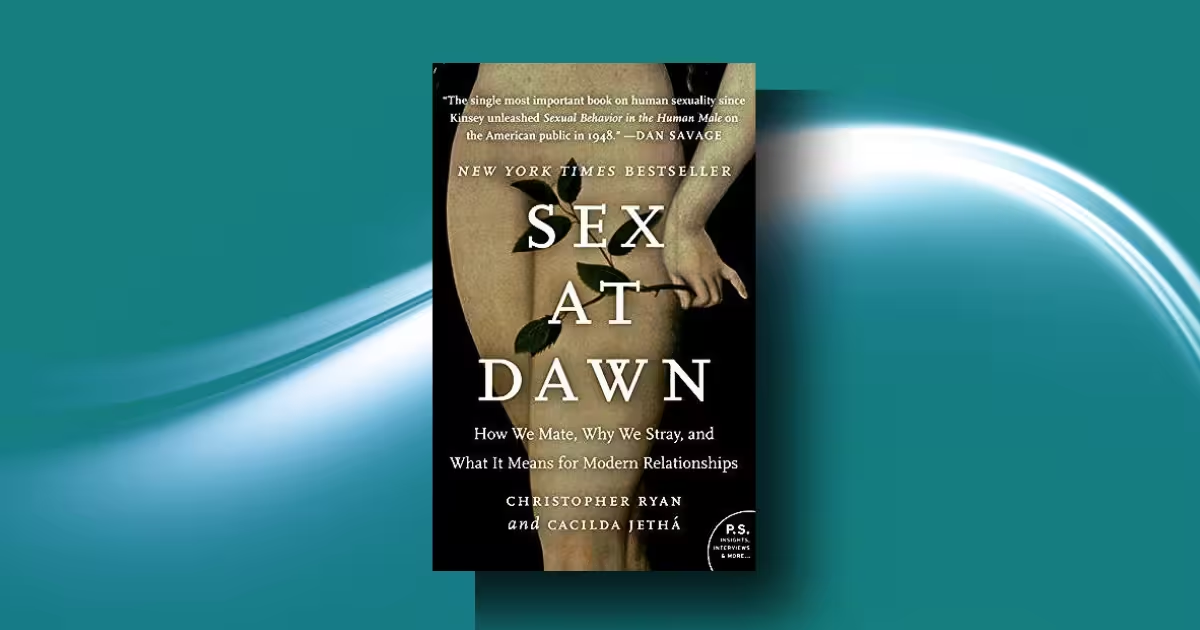
Sex at Dawn by Christopher Ryan and Cacilda Jethá: the book that made me question everything I was taught about love, monogamy, jealousy, and “human nature”
Why does desire so often outlive the rules we build around it? Why do so many people love deeply yet still struggle with monogamy, boredom, jealousy, or sexual shame? Sex at Dawn gave me one of the boldest, most unsettling, and most liberating frameworks I have ever read for thinking about those questions.
Sex at Dawn is best for readers of anthropology, sexuality studies, feminism, psychology, marriage debates, and taboo-shattering nonfiction. Not for anyone looking for a conservative defense of monogamy, a neat self-help manual, or a cautious academic book that avoids provocation.
Table of Contents
1. Introduction
Sex at Dawn: The Prehistoric Origins of Modern Sexuality is a nonfiction book by Christopher Ryan, PhD, and Cacilda Jethá, MD. The hardcover edition went on sale on June 29, 2010, and the first Harper Perennial edition followed in 2011.
The publisher lists it as a controversial, idea-driven blend of evolutionary psychology and anthropology that challenges mainstream assumptions about sex, monogamy, marriage, and family.
Christopher Ryan’s official site describes the book as a New York Times bestseller, translated into more than twenty languages, and notes that it won the 2011 Ira and Harriet Reiss Theory Award from the Society for the Scientific Study of Sexuality, along with SSTAR’s Consumer Book of the Year recognition.
The author backgrounds matter here. In the book’s own author notes, Ryan is presented as a researcher whose doctoral work focused on “trying to distinguish the human from the cultural by analyzing the prehistoric roots of human sexuality,” while Jethá is a physician and psychiatrist whose work in rural Mozambique included sexual-behavior research connected to AIDS prevention.
That blend of psychology, medicine, and cross-cultural observation shapes the entire book.
This is not a timid book. It is part anthropology, part evolutionary argument, part cultural criticism, part anti-Victorian manifesto. HarperCollins summarizes its central wager with a question that gets right to the nerve: what if our struggles with monogamy, jealousy, and libido are not personal failures, but an evolutionary mismatch?
The publisher’s synopsis also highlights the book’s three main lanes: the authors’ attack on the “standard narrative” of human monogamy, their use of bonobos as an alternative primate model, and their insistence that prehistoric foragers lived in fiercely egalitarian groups that shared not just food and child care, but often sexual intimacy as well.
Purpose: the central thesis of Sex at Dawn
The central thesis of Sex at Dawn is blunt: human beings did not evolve primarily for lifelong sexual monogamy.
Ryan and Jethá argue that for most of human evolutionary history, people lived in small, relatively egalitarian foraging bands where sexuality was more communal, less possessive, and less organized around property, paternity certainty, and exclusive pair-bonding than later agricultural societies demanded.
In the book’s introduction, they write that human beings evolved “in intimate groups where almost everything was shared—food, shelter, protection, child care, even sexual pleasure.”
They also argue that the social upheavals associated with agriculture around 10,000 years ago transformed sexuality, gender status, and family structure in ways that still haunt modern relationships.
What I found most powerful is that the book does not merely say, “Monogamy is hard.” It says the difficulty may not be a personal defect at all. It may be the result of a deep mismatch between ancient appetites and recent institutions. That is why the book still lands like a slap.
2. Background
Ryan and Jethá begin by positioning their argument against what they call the “standard narrative” of human sexual evolution. That narrative says men and women evolved in strategic conflict: men seek fertility and sexual fidelity, women seek provision and protection, pair-bonding emerges as the “fundamental condition” of our species, and jealousy serves reproductive interests.
In the book, the authors summarize this model almost like a script: boy meets girl, both assess mate value, and then form a long-term pair bond shaped by male concern for paternity and female concern for resources.
The authors think that the story is far too neat, too Victorian, and too dependent on projecting modern assumptions backward into prehistory. They even coined a memorable term for this mistake: “Flintstonization”—the habit of imagining prehistoric life as basically a stone-age version of our own institutions and moral expectations.
This background matters because Sex at Dawn is really fighting on two fronts. First, it is fighting a scientific battle against a dominant explanatory model in popular evolutionary psychology.
Second, it is fighting a cultural battle against shame, sexual panic, and the assumption that exclusive monogamy is the natural baseline from which everything else is a deviation. In that sense, the book is not just about prehistory. It is about why so many modern people feel broken when they do not fit the romantic script they were handed.
3. Sex at Dawn summary
a. Humans are apes, and our sexual story cannot be isolated from primatology
Very early, the book reminds us that humans did not “descend from apes” in some distant metaphorical sense; we are apes. Ryan and Jethá stress that humans shared a common ancestor with bonobos and chimpanzees only around five million years ago, which in evolutionary time is astonishingly recent.
They treat that fact as a rebuke to every theory that tries to imagine human sexuality as if it arose outside nature.
From there, they ask a provocative question: if chimpanzees have been used as a model for violent, jealous, competitive origins, why have bonobos not been given equal weight as a model for sexuality, cooperation, social bonding, and reduced aggression?
They repeatedly return to the contrast between the chimpanzee and the bonobo, and they argue that the bonobo’s use of sex for affiliation and group cohesion deserves much more attention in theories of human origins.
b. Agriculture, not nature alone, may explain much of what we call “normal” sexuality
One of the book’s biggest claims is historical rather than anatomical.
Ryan and Jethá argue that settled agriculture changed nearly everything: land ownership, hierarchy, inheritance, female status, warfare, and the importance of paternity certainty. In the introduction they emphasize that anatomically modern humans may have existed for roughly 200,000 years, while agriculture reaches back only to around 8000 BCE—meaning agricultural life represents only a thin slice of human experience.
They cite Jared Diamond’s description of agriculture as a “catastrophe from which we have never recovered,” and they treat private property as the turning point that hardened possessive sexuality.
This is where the book becomes larger than a sex book. It becomes a book about civilization, ownership, and power. It suggests that what later became marriage law, patriarchal control, sexual shame, and obsession with fidelity may owe more to fields, fences, and inheritance than to timeless biology.
c. The “female as coy, male as eager” story gets dismantled
A major target throughout the book is the old assumption that women are naturally less sexual than men. Ryan and Jethá trace that idea from Darwin and Victorian medicine into modern pop science.
They quote Darwin’s line that the female, “with the rarest exception, is less eager than the male,” and then spend many chapters showing how cultural repression, bad methodology, and male bias shaped that conclusion.
Their argument is not that men and women are identical. It is that women’s eroticism has been radically underestimated, pathologized, or moralized. One of the book’s most memorable lines appears when they describe our species as “shamelessly, undeniably, inescapably sexual.” That claim applies to both sexes.
The book is especially interesting when it pushes back against tidy campus experiments and simplistic mating theories. Ryan and Jethá argue that much research supposedly proving women’s lack of interest in casual sex says as much about safety, social conditioning, and context as it does about innate desire.
Even when I did not agree with every leap they made, I appreciated the force of the challenge.
d. The body itself is presented as evidence
The middle of the book leans heavily on anatomy.
The authors argue that body-size dimorphism, testicle size, penis morphology, female orgasmic capacity, breasts, vocalization, and patterns of sexual response all make more sense in a species shaped by multi-male, multi-female mating than by strict monogamy. They explicitly ask whether present-day anatomy can tell us anything reliable about ancient social life, and answer, “Yes we can.”
For example, the book notes that male gorillas and orangutans are roughly twice the size of females, while in humans the average male is only about 10 to 20 percent larger and heavier than the average female.
The authors take that as one clue that intense winner-take-all male competition over women was probably not the defining system for our species over the last few million years.
They also emphasize that human males have larger testicles than gorillas but smaller ones than chimpanzees, which they interpret as consistent with substantial sperm competition rather than either strict monogamy or full harem-style polygyny. Whether that evidence is decisive is debatable, but the argument is one of the book’s most famous and most discussed contributions.
e. Hunter-gatherers and cross-cultural examples matter to the thesis
The book repeatedly argues that foraging societies are generally more egalitarian than agricultural ones and that sharing was mandatory, not sentimental. The authors insist that food sharing, alloparenting, diffuse investment, and low concern for exclusive paternity were practical features of survival in immediate-return economies.
One of the strongest recurring examples is the Mosuo near Lugu Lake in southwest China.
The book describes a society of roughly 56,000 people organized around matrilineal households, sexual autonomy, and “walking” relationships rather than husband-wife marriage. The authors stress that the Mosuo language has no words for husband or wife, preferring azhu, meaning “friend.” That example is used to challenge the claim that human societies naturally converge on the nuclear family.
Elsewhere, the book cites Cacilda Jethá’s own World Health Organization-linked fieldwork in rural Mozambique.
According to the book, the 140 men in her study group were involved with 87 wives, 252 other long-term sexual partners, and 226 occasional partners, averaging roughly four ongoing sexual relationships per man. The authors use that kind of data to argue that modern monogamous ideals do not map neatly onto actual sexual behavior.
f. Marriage, jealousy, and modern misery are reinterpreted
Ryan and Jethá do not argue that love is fake. They argue that the modern fusion of love, sexual exclusivity, domestic partnership, co-parenting, property, and lifelong expectation is a historically unstable package. That is why the book spends so much time on jealousy, boredom, dysfunction, and the collapse of passion in long relationships.
The introduction is packed with statistics meant to dramatize that crisis.
The authors cite the American Medical Association’s claim that 42 percent of American women suffer from sexual dysfunction, note that global pornography revenue has been reported at $57 billion to $100 billion annually, and observe that in the United States, porn generated more revenue than the major broadcast networks combined and more than major football, baseball, and basketball franchises combined.
They also point to the Church scandal, political hypocrisy, and divorce as signs that official morality and lived sexuality are badly out of alignment.
Whether every number in that section has aged well is another question. But the emotional force of the argument still lands: if monogamy were as effortless and “natural” as we are told, why does it so often produce secrecy, frustration, guilt, performance anxiety, and repetitive heartbreak?
4. Sex at Dawn analysis
My own feeling, in plain terms, is this: Sex at Dawn is one of the most exciting and destabilizing books I have read on human sexuality, but it is also a book I would never recommend uncritically.
It is exciting because it gives language to experiences many people privately carry.
The book says, in effect, that love and erotic restlessness can coexist; that sexual dissatisfaction inside long relationships may be structural rather than purely personal; that jealousy is not the only authentic response; and that shame has often been mistaken for science. Reading it, I often felt the release Dan Savage described in the book’s back matter and companion interview: the feeling of “Oh my god, I’m not crazy.”
It is also genuinely learned. The range is enormous: Darwin, Hobbes, Rousseau, bonobos, the Mosuo, the Yanomami controversy, orgasm research, Victorian medicine, partible paternity, breasts, testicles, agricultural hierarchy, and anthropology of sharing.
Ryan and Jethá write with wit, energy, and unusual readability for a book playing in such contested territory. Even critics have acknowledged the book’s accessibility and cultural reach.
The New Yorker summarized its core provocation as the claim that pre-Neolithic promiscuity fostered cooperation and reduced violence; Christopher Ryan’s official site notes its wide translation history and major awards; and HarperCollins still pitches it as a challenge to almost everything readers think they know about sex and family.
But here is the other side. The book often writes like a brilliant closing argument rather than a slow, cautious scientific synthesis. It is strongest when it questions certainties; it is weaker when it seems to replace one grand story with another. Scholarly critics have said exactly that.
Ryan Ellsworth’s review in Evolutionary Psychology argues that the book relies on biased reporting of data, theoretical weaknesses, and problematic assumptions, while even sympathetic commentators have warned that the authors sometimes oversimplify the science they oppose.
That criticism matters. I do not think the fairest reading is that Sex at Dawn “proves” humans are naturally promiscuous in any simple, universal sense. What it does prove, or at least very powerfully suggest, is that the case for strict natural monogamy has often been overstated, moralized, and smuggled into science as common sense.
That is why, for me, the deepest value of the book is not in any single conclusion. It is in the permission it gives readers to ask better questions.
5. Strengths and weaknesses
Strengths
The first great strength is its provocative reframing. The book makes familiar assumptions strange again. That alone is intellectually valuable. Its concept of “Flintstonization” is one of those rare phrases that, once learned, keeps explaining things long after the book ends.
The second strength is its interdisciplinary reach. Few trade books move so fluidly between primatology, anthropology, history, anatomy, medicine, and cultural criticism without becoming unreadable. The result is that even when the book overreaches, it remains deeply stimulating.
The third strength is its human sympathy. I never felt that Ryan and Jethá were mocking people for wanting commitment. Instead, I felt they were trying to remove the moral panic around desire and disappointment. That distinction matters.
The fourth strength is its feminist edge. Not because it is perfect, but because it repeatedly challenges ideas that reduce women to coy gatekeepers, reproductive bargainers, or passive prizes. In that sense, it overlaps with broader feminist critiques of biological determinism and private-property patriarchy.
That overlap is one reason readers interested in works like The Second Sex may find Sex at Dawn surprisingly relevant. In it, Beauvoir emphasizes her claim that women’s subjugation is socially constructed rather than naturally ordained, a line of thought that resonates with Ryan and Jethá’s attack on supposedly “natural” patriarchal arrangements.
Weaknesses
Its biggest weakness is overconfidence. The book is so good at puncturing the “standard narrative” that it sometimes seems too eager to canonize its own counter-narrative.
Another weakness is selectivity. Critics have argued that it downplays evidence for pair-bonding, jealousy, paternal concern, and reproductive strategy whenever those complicate the authors’ broader thesis. That criticism does not invalidate the book, but it does prevent me from calling it definitive.
A third weakness is tonal. I enjoyed the humor, but I can also see why some readers find parts of the book snarky or too breezy for the seriousness of the claims. Christopher Ryan himself later said that if he wrote it again, he would probably “tone down some of the snarkier bits.”
6. Comparison with similar works
If I had to place Sex at Dawn beside a few other books, I would say this:
Compared with David Buss’s The Evolution of Desire, Sex at Dawn is the insurgent opposite. Buss tends to emphasize mate choice, evolved sex differences, competition, and resource logic; Ryan and Jethá attack exactly that framework as too narrow, too Victorian, and too supportive of possessive institutions.
Compared with Simone de Beauvoir’s The Second Sex, this book is less philosophical but surprisingly adjacent in one crucial sense: both books question the idea that current gender arrangements are simply biological destiny.
Beauvoir dissects the social construction of womanhood; Ryan and Jethá question the historical naturalization of marriage, monogamy, and female sexual restraint.
Compared with more relationship-centered books like Esther Perel’s work on eroticism in long-term partnership, Sex at Dawn is more anthropological and less therapeutic. Perel asks how desire survives domestication; Ryan and Jethá ask whether the entire domestic script was ever a clean fit for our species in the first place.
7. Conclusion
I would recommend Sex at Dawn strongly, but with one condition: read it as a powerful challenge, not as the last word.
If you are someone who has ever felt uneasy with the fairy tale that one person should forever satisfy every erotic, emotional, domestic, and existential need, this book may feel revelatory.
If you are interested in anthropology, sex studies, primatology, feminism, or the history of marriage, it is absolutely worth your time.
If you are trying to understand why modern relationships can feel both loving and sexually strained, it may be one of the most useful books you read.
At the same time, I would not tell anyone that this book settles the science. It does not. What it does is something almost as important: it exposes how shaky, moralized, and culturally saturated many confident stories about “human nature” have been.
My final judgment is this: Sex at Dawn is groundbreaking, exasperating, funny, overreaching, humane, and unforgettable. I did not finish it thinking, “Now everything is proven.” I finished it thinking, “Now the old certainty is broken.” For a serious book, that is already a major achievement.
Who will benefit most? Open-minded general readers, students of sexuality and anthropology, couples questioning inherited norms, and anyone interested in how prehistory still speaks through modern desire. Specialists will read it more skeptically, but even they will have to reckon with its cultural force and its refusal to let easy stories stand.