
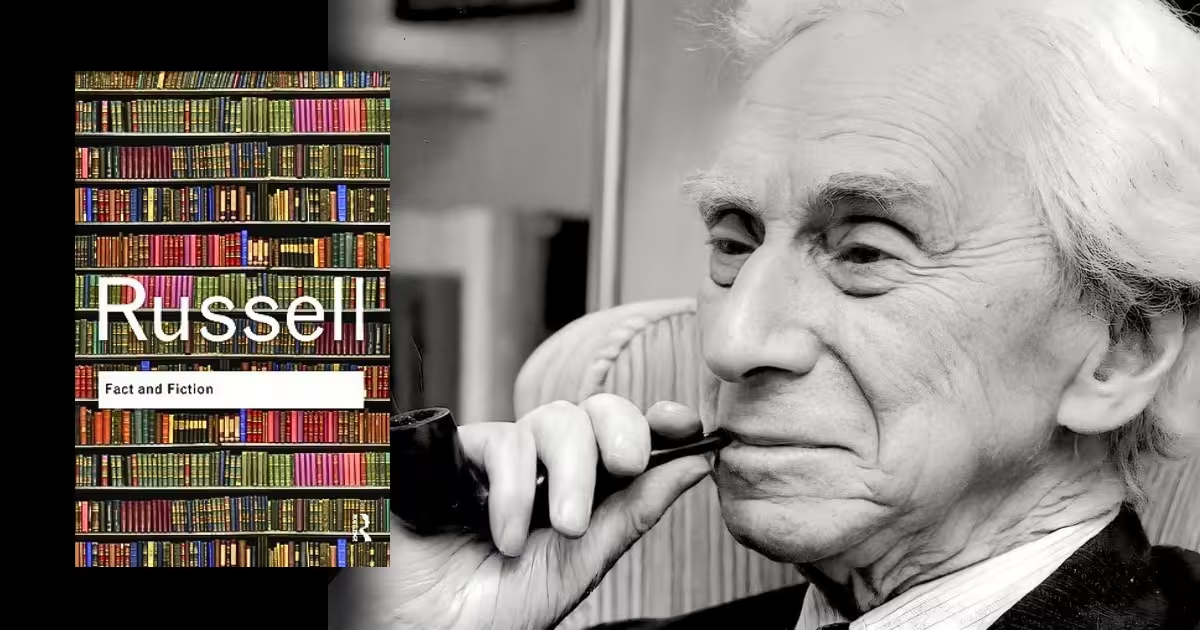
Fact and Fiction (1961) is Bertrand Russell’s masterclass in intellectual honesty—a collection where the Nobel laureate dissects the books that shaped him, skewers political hypocrisy, warns of nuclear annihilation, and even lets his imagination run wild in satirical parables. It’s part memoir, part political treatise, part philosophical meditation, and part dark comedy.
Russell argues that humanity’s survival depends on reason, tolerance, and the courage to face unpleasant truths—and that the line between fact and fiction is often dangerously blurred by those in power.
Preferred readers
Fact and Fiction is best for readers who enjoy intellectual autobiography, political philosophy with sharp wit, and essays that feel like conversations with one of the 20th century’s most brilliant minds. If you’re interested in how a great thinker processes the world—from Shelley’s poetry to the hydrogen bomb—this book is for you.
Not for those seeking a systematic philosophical treatise or a light read. Russell assumes a certain level of cultural literacy, and his opinions are unapologetically confrontational. If you’re easily offended by critiques of nationalism, religion, or conventional morality, you’ll find plenty to disagree with.
Table of Contents
1. Introduction
Fact and Fiction by Bertrand Russell (1872–1970). First published in 1961 by George Allen & Unwin, later reissued as a Routledge Classic in 2010. Russell—mathematician, logician, philosopher, and public intellectual—was awarded the Order of Merit in 1949 and the Nobel Prize in Literature in 1950.
The Times Literary Supplement called the book “captivating” for its “literary and dialectical skill”, while The Observer described it as “an attractive haul of small bright items”.
Context
Fact and Fiction is a collection of Russell’s shorter works from the latter half of the 1950s.
This was a period when Russell, then in his eighties, had pivoted sharply toward anti-nuclear activism following his famous 1954 Christmas broadcast, “Man’s Peril from the Hydrogen Bomb”. The book reflects that urgency: its final section, “Peace and War,” occupies nearly a third of the entire volume.
But Russell hadn’t abandoned his earlier loves—literature, history, education, and the sheer pleasure of intellectual mischief.
Purpose
The book’s central argument is twofold. First, the pursuit of truth requires intellectual courage: “It is not by delusion, however exalted, that mankind can prosper, but only by unswerving courage in the pursuit of truth”.
Second, the survival of civilization depends on replacing dogma with rational discussion—whether in science, politics, or international relations. Russell warns that nationalism, ideological fanaticism, and fear are driving humanity toward self-destruction, and only a global shift in consciousness can avert disaster.
2. Background
Russell wrote Fact and Fiction at a unique juncture. He was 89 years old, had lived through two world wars, and had witnessed the rise of nuclear weapons. His personal journey—from a Victorian aristocrat educated by a grandmother who hoped he’d become Prime Minister, to a pacifist imprisoned during World War I, to a Nobel laureate leading the Campaign for Nuclear Disarmament—gave him an unparalleled perspective.
The 1950s were marked by escalating Cold War tensions, the Korean War, the Suez Crisis, and the development of the hydrogen bomb. Russell’s response was to become arguably the world’s most prominent anti-nuclear activist.
In 1955, he issued the Russell-Einstein Manifesto, signed by nine other eminent scientists, calling for the renunciation of war. Fact and Fiction consolidates his thinking during this period, blending personal reflection with urgent political advocacy.
3. Fact and Fiction Summary
Part I: Books That Influenced Me in Youth
This section is Russell at his most personal. He recounts how six literary figures shaped his adolescence and early adulthood.
Shelley—Russell discovered Shelley at fifteen and was “entranced.” He loved Shelley’s lyricism, his romantic despair, and his apocalyptic hopes. He quotes:
“The world’s great age begins anew, / The golden years return, / The earth doth like a snake renew / Her winter weeds outworn”
Russell admits that Shelley’s weaknesses are now apparent to him, but he still values “the purity of his passion, the intensity of his love of beauty, and the scope of his constructive imagination”.
Turgenev—Russell found in Turgenev’s novels “a society of eager and hopeful young people” that was infinitely more sympathetic than the Victorians he knew. He was especially moved by Fathers and Children and its nihilist hero, Bazarov. Russell confesses he admired Bazarov’s ruthlessness but remained “much more like Arkady”—admiring rebellion without being able to practice it.
Ibsen—Here Russell is more critical. He admits that Ibsen no longer impresses him as it once did. He finds Ibsen’s heroines “intolerable” and his ethic essentially Nietzschean—valuing strong feelings regardless of whether they are good or bad. Yet he acknowledges Ibsen’s dramatic skill and the sublimity of Brandt.
Swift—Russell read an unexpurgated Gulliver’s Travels at fifteen. The Yahoos impressed him with “growing horror.” He credits Swift with being the first to envision science as a means of ruthless tyranny. He writes:
“Science in itself is ethically neutral. It confers power, but for evil just as much as for good”
Milton—Russell found the antidote to Swift’s despair in Milton’s Areopagitica. He quotes Milton’s defense of free speech:
“Where there is much desire to learn, there of necessity will be much arguing, much writing, many opinions; for opinion in good men is but knowledge in the making”
History and Mathematics—Russell describes his Whig education, his discovery of Gibbon, and his lifelong love of mathematics. He explains how Newton’s Principia affected him “in the same kind of way as the greatest music”
Part II: Politics and Education
This section is where Russell engages directly with the major political questions of his time.
What is Freedom?—Russell distinguishes national, group, and individual freedom. He argues that freedom is not an absolute good: “The only kind of freedom which is undesirable is that which diminishes the freedom of others”. He discusses economic freedom, mental freedom, and the limits of tolerance. He warns that “where public opinion is intolerant a man may be gravely damaged by the publication of something which is in no way to his real discredit”.
What is Democracy?—Russell notes that the word means different things in East and West. He traces democracy from ancient Greece to modern representative government. He argues that democracy’s greatest merit is preventing large-scale atrocities:
“It is only democracy that makes us better. While the English upper class had a monopoly of political power, it was just as bad as Stalin”
A Scientist’s Plea for Democracy—Russell argues that science and democracy are linked by their reliance on free discussion rather than authority. He writes:
“Empiricists, who owe their influence mainly to the rise of science, have a quite different view of the way of arriving at true beliefs”
Nationalism—Russell acknowledges nationalism’s cultural merits but condemns its political dangers. He argues that “nationalism triumphant becomes imperialism” and that the world needs international institutions to prevent war.
The World I Should Like to Live In—Russell envisions a world where poverty is abolished, population is stabilized, and fear no longer dominates human life. He argues that “the obstacles to universal happiness in the present day are, at bottom, psychological, not physical”.
Old and Young Cultures—In his Sonning Prize address, Russell contrasts the values of established and emerging cultures. He notes that young cultures emphasize work and action, while old cultures value contemplation and play. He warns that the scientific-technical culture now emerging may be as hostile to traditional beauty as early Christianity was to classical learning.
Education for a Difficult World—Russell argues that education must combine skill with wisdom. He warns that “skill without wisdom may be purely destructive”. He advocates teaching history from the perspective of mankind as a whole, not from a nationalist viewpoint.
University Education—Russell critiques the massification of education and argues for separating abler from less able students. He insists that universities should promote “an undogmatic temper, a temper of continual search and not of comfortable certainty”.
Part III: Divertissements
This is Russell at his most playful—and most subversive.
Cranks—Russell recounts encounters with eccentrics: a man who thought he was Julius Caesar, devotees of the Great Pyramid, and a letter from “the God Osiris” with His telephone number. He develops a technique for dealing with them: gentle disagreement rather than confrontation.
The Right Will Prevail or The Road to Lhasa—A satirical novella about a secret society called “The League of the Fight for the Right” (meaning Right as opposed to Left). Its leader, Aguinaldo, uses a psychoactive herb to blackmail politicians into supporting reactionary causes. The story is a Swiftian indictment of ideological extremism.
Newly Discovered Maxims of La Rochefoucauld—Russell offers cynical aphorisms in the style of the 17th-century French moralist. Examples:
“Men do as much harm as they dare, and as much good as they must”
“Liberty is the right to do what I like; licence, the right to do what you like”
Nightmares and Dreams—Russell recounts actual dreams, including one where he meets God and asks for Noah’s Ark, only to be told it’s already been given to an American friend. Another dream features a lynching where a little girl cries “because she has not got a catalogue”—a chilling comment on the bureaucratization of violence.
Parables—Three science-fictional parables. “Planetary Effulgence” describes Martian and Jovian civilizations repeating Earth’s nuclear folly. “The Misfortune of Being Out of Date” imagines ideological colonists on Sirius learning that Earth has moved beyond their conflicts. “Murderers’ Fatherland” is a fable about a country where murderers form a club and take over the government.
Part IV: Peace and War
This is the heart of Fact and Fiction—and the reason Russell wrote it.
Psychology and East-West Tension—Russell argues that “the source of the trouble lies in the minds of men and not in any non-mental facts”. He calls for a Conciliation Committee of East, West, and neutrals to reduce mutual suspicion.
War and Peace in My Lifetime—Russell reflects on his anti-war activism from the Boer War to the Cold War. He laments that “the world since 1914 has been one in which civilized ways of life and humane feeling have steadily decayed”.
The Social Responsibilities of Scientists—Russell argues that scientists cannot remain neutral about how their discoveries are used. He quotes Faraday’s refusal to help with poison gas during the Crimean War as an example of moral courage.
Three Essentials for a Stable World—Russell lists: (1) world government with a monopoly of armed force, (2) approximate economic equality between nations, and (3) a stable or slowly growing population.
Population Pressure and War—Russell presents alarming statistics: the world’s population grows by “one a second or eighty thousand a day or thirty million a year”. He notes that two-thirds of the world is undernourished and warns that “nothing is more likely to lead to an H-bomb war than the threat of universal destitution through over-population”.
Vienna and Manchester Addresses—Russell tells the Pugwash Congress that nuclear war should be viewed “as some new epidemic would be viewed, as a common peril to be met by concerted action”. In Manchester, he warns that “the doctrine of instant retaliation involves local initiative” and that a single accident could trigger annihilation.
What Neutrals Can Do—Russell proposes that neutral nations investigate the probable effects of a world war and present their findings to both sides.
The Case for British Neutralism—Russell controversially argues that Britain should withdraw from NATO because the American alliance increases rather than diminishes Britain’s danger.
Can War Be Abolished?—Russell insists that “either Man will abolish war, or war will abolish Man”. He calls for a “world-wide movement of public opinion” to reverse the trend toward self-destruction.
Human Life Is in Danger—Russell’s final essay is a call to civil disobedience. He argues that “only large-scale civil disobedience, which should be non-violent, can save populations from the universal death which their governments are preparing for them”.
4. Fact and Fiction Analysis
What Makes Fact and Fiction Remarkable
Fact and Fiction is not a systematic work. It’s a collection—and Russell himself acknowledged in his Autobiography that he used fiction to express ideas he “half believed in but had no good solid grounds for believing”. This hybridity is the book’s strength.
Russell moves effortlessly from literary criticism to political philosophy to dark satire, showing that the same mind capable of rigorous logical analysis could also spin parables and crack jokes.
Fact and Fiction’s structure mirrors Russell’s own intellectual journey. He begins with the books that made him, moves to the political questions that consumed him, indulges in literary play, and ends with the existential crisis that defined his final decades.
The result is a portrait of a mind in motion—never settled, never comfortable, always searching.
Russell’s Method: Argument by Aphorism
Russell’s style is deceptively simple. He rarely uses jargon. He prefers clarity to profundity. But beneath the surface lies a razor-sharp dialectical skill. Consider this passage on democracy:
“Holders of power, always and everywhere, are indifferent to the good or evil of those who have no power, except in so far as they are restrained by fear”
This is not a nuanced argument—it’s a blunt assertion. But Russell supports it with historical examples: Lord Melbourne’s wealth from child labor, Marx living on Engels’ exploitation of Manchester workers, Stalin’s collectivization. The cumulative effect is devastating.
The Central Tension: Fact vs. Fiction
The title isn’t just a play on words. Russell is concerned throughout with how humans distinguish truth from falsehood—and why they so often prefer the latter. In the “Books That Influenced Me” section, he shows how literature can illuminate truth through fiction.
In the political essays, he shows how governments manufacture fictions to maintain power. In the parables, he shows how entire civilizations can destroy themselves by believing their own propaganda.
His conclusion is sobering: “It is not by delusion, however exalted, that mankind can prosper, but only by unswerving courage in the pursuit of truth”.
The Nuclear Question
Russell’s arguments about nuclear war remain disturbingly relevant. He warns of accidental war—a plane encountering a meteor, a radar malfunction, a nervous breakdown.
He predicts the spread of nuclear weapons to more countries. He insists that “the interests of East and West are almost wholly identical” but that “the emphasis is placed upon the few points where they differ”.
In 2024, with nine nuclear-armed states and ongoing conflicts in Ukraine and the Middle East, Russell’s warnings feel prophetic.
5. Strengths and Weaknesses
Strengths
1. Intellectual Range. Russell writes authoritatively about literature, history, politics, science, and philosophy. His reading is vast, and he deploys it with effortless grace.
2. Moral Clarity. Russell doesn’t equivocate. He names names—Stalin, Hitler, McCarthy—and condemns their crimes without qualification.
3. Prophetic Vision. His warnings about nuclear war, overpopulation, and environmental degradation have aged remarkably well.
4. Literary Skill. Russell is one of the great English prose stylists. His sentences are clear, cadenced, and often memorable.
5. Self-Awareness. Russell admits his own biases. He acknowledges that his youthful admiration for Ibsen was naive, that his mathematical outlook was limited, and that his romanticism persisted despite objections.
Weaknesses
1. Overconfidence. Russell is sometimes too sure of his own judgments. His dismissal of Ibsen as “sinking into oblivion” has proven premature.
2. Elitism. His arguments for separating “abler” from “less able” students reflect a class bias that many readers will find uncomfortable.
3. Simplification. Russell occasionally reduces complex issues to slogans. His claim that “democracy makes us better” ignores the many ways democratic majorities have oppressed minorities.
4. Dated References. Some of Russell’s examples—the China Lobby, McCarthyism, the Suez Crisis—require historical context for modern readers.
5. Pacing. Fact and Fiction’s final section, though urgent, becomes repetitive. Russell makes the same arguments about nuclear war in multiple essays.
6. Comparison with Similar Works
Fact and Fiction belongs to a tradition of essay collections by public intellectuals. It invites comparison with:
George Orwell’s The Lion and the Unicorn (1941)—Both Russell and Orwell write with moral urgency about nationalism and war. But Orwell is more grounded in class analysis, while Russell is more philosophical.
Aldous Huxley’s Brave New World Revisited (1958)—Both warn of technological tyranny. But Huxley focuses on psychological manipulation, while Russell focuses on nuclear annihilation.
Karl Popper’s The Open Society and Its Enemies (1945)—Both defend liberal democracy against totalitarianism. But Popper is more systematic; Russell is more personal.
Isaiah Berlin’s Four Essays on Liberty (1969)—Both explore the concept of freedom. But Berlin is more nuanced; Russell is more polemical.
Russell’s unique contribution is his combination of philosophical rigor, literary sensibility, and political activism. No other 20th-century thinker moved as easily between logic and poetry, between the lecture hall and the protest march.
7. Conclusion
Fact and Fiction is for anyone who wants to understand how a great mind grappled with the defining issues of the 20th century—and why those issues remain unresolved. It’s for readers who appreciate intellectual autobiography, political philosophy with teeth, and prose that crackles with energy.
Russell doesn’t offer easy answers. He offers something rarer: the example of a life lived in pursuit of truth, undeterred by convention, unafraid of controversy. He writes:
“Truth is a shining goddess, always veiled, always distant, never wholly approachable, but worthy of all the devotion of which the human spirit is capable”
In an age of misinformation, polarization, and existential risk, that devotion matters more than ever.







