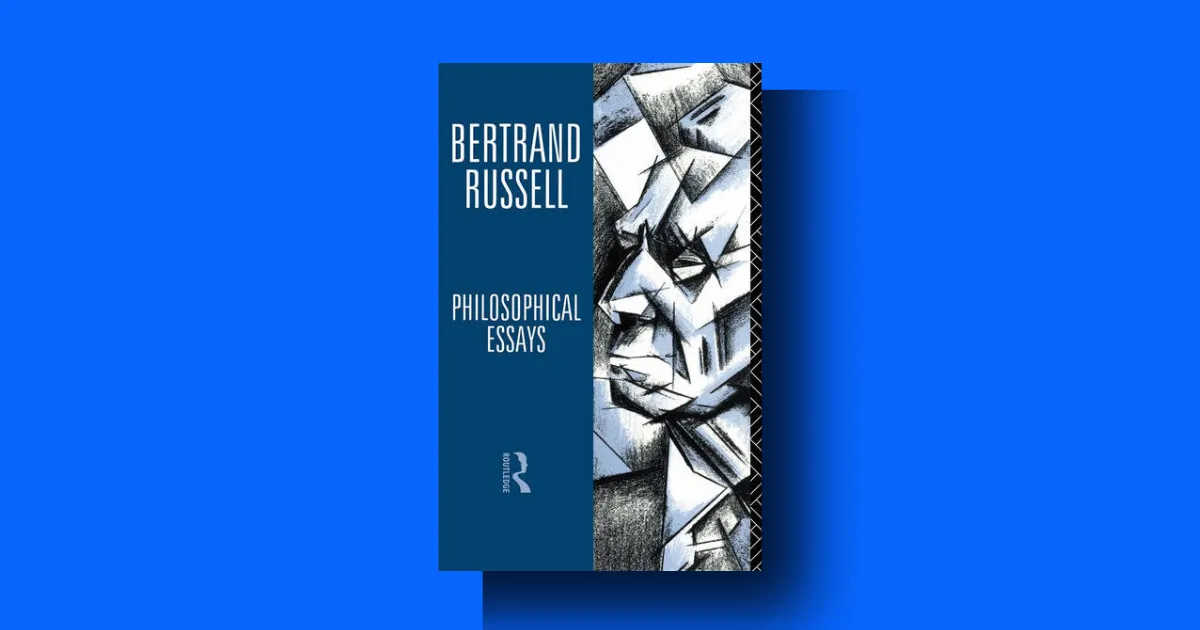

Ever wonder why you feel a nagging sense that truth should be something more solid than just “what works”? Do you find yourself frustrated by philosophical jargon that seems designed to obscure rather than clarify? If so, you’re not alone. Bertrand Russell’s Philosophical Essays—first published in 1910—throws a lifeline to anyone drowning in the murky waters of abstract thought.
This isn’t just a dusty relic from a bygone era; it’s a masterclass in clear thinking that feels surprisingly urgent in our post-truth, hyper-pragmatic age.
Table of Contents
Overivew
Bertrand Russell’s Philosophical Essays is a collection of seven razor-sharp pieces that dissect ethics, the nature of truth, and the emerging philosophy of pragmatism.
Writing with his trademark clarity and wit, Russell dismantles the idea that “good” can be defined in terms of pleasure or desire, argues that determinism doesn’t destroy morality, and delivers a devastating critique of the pragmatist view that truth is simply “what works.”
He then offers his own compelling theory of truth as a correspondence between judgment and reality. It’s a foundational text of analytic philosophy, but written in a style so engaging that it remains accessible to any curious reader.
Preferred readers
Philosophical Essays by Bertrand Russell is best for:
- The intellectually curious but philosophy-shy reader: Russell wrote these essays to “appeal to those who take an interest in philosophical questions without having had a professional training in philosophy”. He lives up to this promise.
- Students of philosophy: This is a primary text that showcases Russell’s early, pre-WWII thought and his engagement with G.E. Moore and the pragmatists.
- Fans of clear, forceful argumentation: If you enjoy watching a brilliant mind systematically dismantle an opponent’s position with logic and wit, this is your book.
- Anyone skeptical of “post-truth” and relativism: Russell’s defense of objective truth and his critique of pragmatism is a powerful antidote to the idea that truth is merely a matter of personal or social utility.
Not For:
- The casual reader looking for light entertainment: This is philosophy, not a thriller. It requires focus and engagement.
- Those who prefer a “softer,” more mystical or spiritual approach to philosophy: Russell is a staunch rationalist, and his tone is often dismissive of what he sees as sentimentality or muddled thinking.
- A reader seeking a comprehensive overview of Russell’s entire philosophical system: This is a collection of essays on specific topics, not a systematic treatise like his later History of Western Philosophy.
1. Introduction
Book Title: Philosophical Essays
Author: Bertrand Russell (1872–1970)
Publication Details: First published in 1910 by Longmans, Green & Co.
Context
Philosophical Essays is a collection of seven essays, mostly reprinted from various periodicals like The New Quarterly, The Hibbert Journal, and The Edinburgh Review, with the final essay being newly written for the volume.
The book marks a pivotal period in Russell’s intellectual development. At this time, he was at the height of his creative energy, having recently collaborated with Alfred North Whitehead on the monumental Principia Mathematica. Russell was a British philosopher, logician, and social critic, best known for his work in analytic philosophy and mathematical logic.
This collection showcases his early engagement with ethical theory (influenced heavily by his friend G.E. Moore) and his critical response to the major philosophical movements of his day, namely Pragmatism and Idealism.
Purpose
The central purpose of Philosophical Essays is twofold. First, Russell aims to clarify fundamental philosophical concepts—namely, “good,” “right,” and “truth”—which he believes have been muddied by imprecise thinking and bad theories. He argues that “good” is a simple, indefinable concept and that ethics is not a separate realm but “merely one among sciences”.
Second, he mounts a vigorous defense of a common-sense, correspondence theory of truth against the rising tide of pragmatism and the monistic (coherence) theory of truth. The book is an attempt to “bring to an end” the unsatisfactory state of philosophy by applying rigorous logic to its most basic questions.
2. Background
To understand Philosophical Essays, one must appreciate the intellectual climate of early 20th-century Britain. Philosophy was divided between the lingering influence of German Idealism (associated with Hegel and F.H. Bradley) and the burgeoning movements of Pragmatism (in America) and Analytic Philosophy (in Britain).
Russell, along with Moore, was a leading figure in the analytic revolt against Idealism. They championed clarity, logic, and a return to common sense.
The ethical essay, “The Elements of Ethics,” was heavily influenced by Moore’s Principia Ethica (1903). Moore had famously argued that “good” is a simple, non-natural property that cannot be defined in terms of anything else (like “pleasure” or “desire”)—a view known as ethical non-naturalism. Russell largely adopts this position in 1910, though he would later abandon it.
The other essays are a direct response to William James’s pragmatism, which was gaining popularity, and the coherence theory of truth proposed by idealists like Harold Joachim.
3. Philosophical Essays by Bertrand Russell Summary
Reading Philosophical Essays is like watching a master craftsman at work. Russell takes complex, often obfuscated ideas and strips them down to their bare essentials. The book is divided into seven distinct essays, each a self-contained argument, but together they form a coherent picture of Russell’s early philosophical worldview. Here is a detailed breakdown of what I learned from each.
1. The Elements of Ethics
This is the longest and most foundational essay. Russell starts by defining the subject matter of ethics. He rejects the common view that ethics is merely a practical guide to conduct. Instead, he insists that ethics is a science: its aim is “to discover true propositions about virtuous and vicious conduct”.
The core of the essay is Russell’s argument that “good” is a simple, indefinable concept. He writes, “Good and Bad… are ideas which everybody, or almost everybody, possesses.
These ideas are apparently among those which form the simplest constituents of our more complex ideas, and are therefore incapable of being analysed or built up out of other simpler ideas”.
He uses a clever argument to prove this: if someone says “good means desired,” we don’t accept this as a definition in the way we accept “a pentagon is a five-sided figure.” Instead, we feel they are making a substantial claim about what things are good, which means we already have an independent idea of “good” in our minds.
Russell then distinguishes between right and wrong conduct. A right action, he argues, is one that will probably have the best consequences.
It’s “the one which will produce the greatest excess of good over evil”. However, he also introduces a “subjective” sense of rightness: an action is moral or virtuous if the agent would judge it to be right after appropriate, candid thought, even if they are mistaken about its consequences.
In a fascinating section on Determinism, Russell tackles the question of free will. He firmly comes down on the side of determinism, stating “the grounds in favour of determinism appear to me overwhelming”. But crucially, he argues this does not destroy morality.
Even if our choices are caused, we can still distinguish between right and wrong because we deliberate between alternatives, and our will is a cause of our actions. “It is not determinism but freewill that has subversive consequences,” he concludes. This is a remarkably pragmatic defense of moral responsibility within a deterministic framework.
2. On History
This essay is a beautiful departure from the purely analytical tone of the others. Russell argues for the intrinsic value of history, not just for its utility in predicting the future or forming political analogies. He writes that history is valuable “because it is true”, but its value goes beyond mere facts.
He critiques the historian who sees their role as merely presenting documents without interpretation. Russell argues that selection is inevitable, and selection requires a standard of value. History’s greatest gift, he says, is to enlarge the imagination and connect us to the past, providing an antidote to the narrow, materialistic spirit of the present.
He writes with poetic power: “In the quiet country of the Past, the march is ended, the tired wanderers rest, and all their weeping is hushed”. It’s a stirring reminder that history is not just a record of data but a source of wisdom and solace.
3. Science and Hypothesis (A Review)
This is a review of Henri Poincaré’s book of the same name. Russell engages with Poincaré’s conventionalist view that the principles of geometry and mechanics are not true descriptions of the world but are convenient conventions.
Russell pushes back.
He argues that Poincaré’s position that “experiment is the sole source of truth” is itself a principle that cannot be proved by experiment.
This essay shows Russell grappling with the philosophy of science, defending a realist position against the growing skepticism that scientific laws are merely useful fictions.
4. Pragmatism
This essay is a landmark critique of the philosophy that was taking America and Britain by storm. Russell identifies the core of pragmatism as the idea that “the significance of a thought lies in the actions to which it leads”. He zeroes in on William James’s theory of truth: that an idea is “true” if it is “good in the way of belief,” meaning it is profitable or useful to our lives.
Russell’s critique is devastatingly logical. He argues that pragmatism confuses two things: the meaning of the word “truth” and a criterion for identifying truth. To say “this belief is useful” is not the same as saying “this belief is true.”
For example, it might be useful to believe that your friend is loyal, but that doesn’t make it true if they are betraying you. The belief that another person exists is useful, but it is not made true by its usefulness; it is true because the person actually exists.
Russell concludes that pragmatism is a form of “scepticism” that ultimately leads to “the appeal to force and the arbitration of the big battalions”—a chillingly accurate prediction of the dangers of a philosophy that abandons objective truth.
5. William James’s Conception of Truth
This essay is a focused follow-up to the previous one, specifically dissecting James’s arguments. Russell reiterates the distinction between a proposition being useful and being true.
He points out that we can clearly distinguish between the belief that something is true and the belief that it is useful to believe. He writes, “there is a transition in my mind from seeing that the belief is useful to actually holding that the belief is true,” which proves the two ideas are different.
He also attacks the pragmatist defense of religion. A pragmatist might say, “If the hypothesis of God works satisfactorily, it is true.”
Russell retorts that this is a tautology: it simply says, “If it works, it works.” It does not provide evidence for the existence of God.
The comfort of religious belief comes from believing God exists, not from believing the belief is useful. Russell accuses pragmatism of playing an “unconscious play upon words”, taking the word “true” in an unusual sense and then quietly slipping back into its ordinary meaning to give comfort.
6. The Monistic Theory of Truth
Here, Russell takes on the Idealists, specifically the “coherence” theory of truth. This theory, associated with philosophers like F.H. Bradley and Harold Joachim, holds that a proposition is true only if it coheres with the entire system of truth. A partial truth is not really true; only the whole truth is completely true.
Russell dismantles this view with a series of logical objections.
First, if no partial truth is quite true, then the statement “no partial truth is quite true” is itself only a partial truth, and therefore not quite true—it’s self-defeating.
Second, the theory cannot explain error. If all propositions are partially true, what makes one “more” true than another? Russell argues that the coherence theory presupposes a more usual, correspondence-based notion of truth in order to even get started.
He concludes that the theory is based on a false axiom, namely, that “every relation is grounded in the natures of the related terms”. By rejecting this axiom, we can accept a world of many things with real relations between them.
7. On the Nature of Truth and Falsehood
This final essay is Russell’s constructive attempt to provide his own theory of truth. He rejects the idea that a judgment is a relation between a mind and a single “objective” (like a fact), because this would mean false judgments have no object, which is nonsensical.
Instead, he proposes a multiple-relation theory of judgment. When I judge “A loves B,” my mind is related to multiple objects: A, B, and the relation of “loving.” The judgment is true if that relation (loving) actually exists between A and B in the real world. If it doesn’t, the judgment is false.
Russell explains this through the infallibility of perception.
When we perceive a complex fact, like “knife-to-left-of-book,” the perception is not a judgment and cannot be wrong. It simply presents a complex object. The judgment based on it is true if it accurately analyzes that perceived complex.
This account successfully shows how truth and falsehood are both possible and how truth depends on a “correspondence” with reality, without needing to posit strange “false” objects.
4. Philosophical Essays Analysis
Reading Philosophical Essays is an outstanding intellectual experience. Russell’s prose is a model of clarity. He doesn’t just tell you what he thinks; he takes you by the hand and walks you through his reasoning, step by step, making you feel like you’re discovering the truth alongside him. This is philosophy as it should be written: accessible, engaging, and fiercely intelligent.
The book is historically significant because it captures a crucial moment in the history of philosophy. We see Russell, at the height of his powers, synthesizing the ethical insights of Moore, the logical tools he was developing, and a no-holds-barred critique of his philosophical rivals.
As The Oxford Magazine noted, “It is rare for a man of great learning to come down into the philosophical arena and dispute with such lucidity, and above all with such sympathy, the views that he is criticising”. This is a key point: Russell is a devastating critic, but he is not a straw-manner. He engages with his opponents’ best arguments and shows exactly where they go wrong.
Russell’s central thesis about the indefinability of “good” is a powerful one, though it’s important to note that he himself later changed his mind on this point. In his later years, he came to believe that ethical statements were expressions of emotion rather than assertions of objective fact.
This shift makes the first essay a fascinating document of a philosopher in the process of working out his ideas. It is also a testament to his intellectual honesty that he was willing to abandon a view he had once held so forcefully.
Furthermore, his critique of pragmatism feels remarkably prescient. In an age where “alternative facts” and “post-truth” are commonplace, Russell’s insistence that truth is a matter of correspondence with reality, not social utility or personal benefit, is a vital corrective. His fear that pragmatism would lead to “the appeal to force” has been borne out in countless ways across the 20th and 21st centuries.
The book therefore holds up not just as a historical artifact but as a living, breathing argument for intellectual integrity.
5. Strengths and Weaknesses
Strengths
Clarity and Accessibility: Russell’s writing is a joy to read. He avoids unnecessary jargon and explains complex ideas with vivid metaphors and straightforward language. This makes a challenging subject matter accessible to a wide audience.
Rigor of Argument: Russell is a master of logical analysis. He doesn’t just assert his views; he builds them from the ground up, carefully defining his terms and anticipating objections.
Historical Importance: The book is a key text in the development of analytic philosophy and is essential reading for anyone wanting to understand the intellectual currents of the early 20th century.
Relevance: The critiques of pragmatism and relativism are more relevant today than ever.
Weaknesses
Dated References: Some of the philosophical battles Russell is fighting (e.g., with the now-obscure monistic idealists) may feel a bit antiquated to a modern reader.
Russell’s Later Revisions: As noted, Russell himself abandoned some of the core positions (like ethical non-naturalism) that he defends here. A reader should be aware that this is not Russell’s “final” word.
Potential Overconfidence: Russell’s tone can sometimes be a little too dismissive of opposing views. He is so certain of his own logic that he can seem to underestimate the genuine difficulties that other philosophers are wrestling with.
7. Comparison with Similar Works
Philosophical Essays can be compared to other classic collections of early analytic philosophy.
G.E. Moore’s Principia Ethica (1903): This is the direct inspiration for Russell’s ethical essay. Moore is more systematic and less polemical than Russell, but Russell’s essay is a more concise and accessible introduction to the same core ideas.
William James’s Pragmatism (1907): This is the very book Russell is critiquing. Reading them together is a fascinating intellectual debate. James is more charming and rhetorically persuasive; Russell is more logically devastating.
F.H. Bradley’s Appearance and Reality (1893): This is the quintessential expression of the monistic idealism that Russell attacks. Bradley is dense and difficult; Russell is clear and incisive. Russell’s essay is, in many ways, a reaction against the entire Hegelian tradition that Bradley represents.
Russell’s own The Problems of Philosophy (1912): Published just two years later, this is a more general and perhaps even more accessible introduction to philosophy. Philosophical Essays is more specialized and argumentative.
8. Conclusion
Bertrand Russell’s Philosophical Essays is a magnificent achievement. It’s a book that rewards careful reading, offering profound insights into ethics, truth, and the art of clear thinking. Russell’s arguments are not just historically important; they are a powerful weapon against the intellectual laziness and relativism that plague our own time.
I would highly recommend this book to any student of philosophy, but also to anyone who has ever felt frustrated by the lack of clarity in public discourse or who wants to sharpen their own critical thinking skills. As one reviewer put it, Russell’s writing is “timeless and his ideas are as relevant today as they were when he first penned them”.
In a world that often seems to value convenience over truth, Russell stands as a defiant and eloquent voice for reason. Philosophical Essays is not just a book to read; it’s a book to think with. It will challenge you, enlighten you, and, if you let it, make you a better thinker.