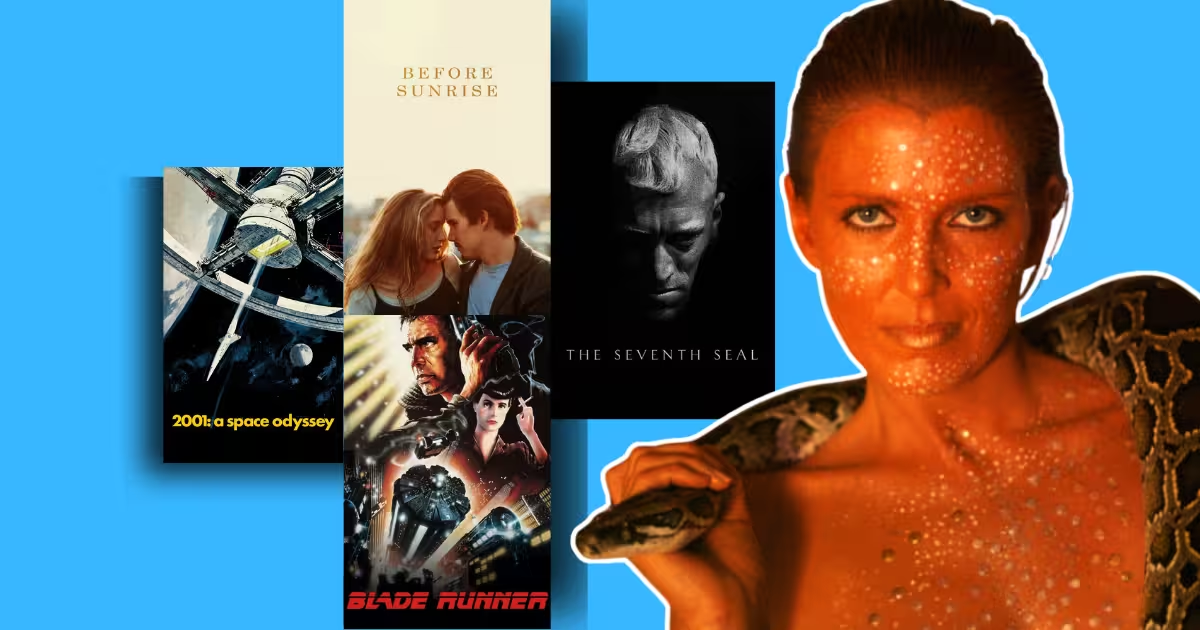

The best philosophical films of all time do not behave like ordinary movies. They do not simply ask you to follow a plot, admire a performance, or enjoy a twist. They quietly trap you inside a question: What is real? What makes a person human? Is freedom possible? Does suffering mean anything? Can truth survive memory, desire, or power?
That is why a science-fiction epic like 2001: A Space Odyssey, a courtroom drama like A Man for All Seasons, a romantic walk through Vienna like Before Sunrise, and a slow domestic portrait like Jeanne Dielman can all belong to the same family.
Their styles are different, but their ambition is the same: they turn cinema into a thought experiment.
A philosophical film is not a lecture with actors. It is a story that makes thinking unavoidable.
Table of Contents
Introduction
Every generation has its own way of grappling with the oldest questions humanity has ever asked: Why are we here? What is real? How should one live? What do we owe each other — and ourselves? For most of recorded history, those questions lived inside books, lecture halls, and the margins of manuscripts. Then cinema arrived, and philosophy found a new home.
The best philosophical films are not films about ideas.
They are ideas that have been converted into experience. They do not describe the cave — they put you inside it. They do not explain grief, consciousness, or moral collapse — they make you feel these things in the dark, alone, with nowhere to run.
This article brings together 22 of the greatest philosophical films ever made, drawn from across continents and decades, curated not merely for intellectual prestige but for genuine, lasting philosophical power.
Each entry includes what the film is really about beneath its surface story, a resonant quotation from the film itself, and the core philosophical traditions it engages.
Whether you are a philosophy student, a dedicated cinephile, or simply someone who has ever stared at the ceiling at 3 a.m. wondering what any of this means, this list was made for you.
Background: What Does It Mean for a Film to Be Truly Philosophical?
Before we enter the list, it is worth drawing a careful line. The word “philosophical” gets attached to almost any film that takes itself seriously, but that is not enough. A film earns the label philosophically when it does at least one of the following with genuine depth and craft:
Disrupts your default assumptions about reality. A philosophical film does not merely represent the world — it destabilizes your trust in the version of the world you arrived with. After watching Rashomon, you may never take an eyewitness account at face value again.
Puts a moral dilemma before the audience without resolving it. Philosophy does not issue verdicts; it sharpens the question. The best philosophical films resist the easy Hollywood ending that tells you what to think. Doubt ends without a verdict, and that is the entire point.
Uses cinematic form — image, time, silence, structure — as a philosophical argument. Terrence Malick does not explain the tension between grace and nature in The Tree of Life; he shows it simultaneously at the cosmological scale and the human one. The juxtaposition is itself the argument.
Refuses to let the viewer remain a passive consumer. As Probinism’s approach to film analysis consistently demonstrates, the most enduring films are those that demand active participation — asking you to question, interpret, and ultimately decide for yourself.
What follows are 22 films that satisfy these criteria at the highest level cinema has yet achieved.
The 22 Best Philosophical Films of All Time
1. 2001: A Space Odyssey (1968)
Q. What Does It Mean to Be Human, and Are We Finished Becoming It?
Director: Stanley Kubrick | Country: USA/UK
Surface story: In the prehistoric past, a tribe of apes encounters a mysterious black monolith that seems to trigger a leap in intelligence.
Millions of years later, a crew of astronauts travels to Jupiter following the discovery of a similar monolith on the moon — accompanied by the ship’s artificial intelligence, HAL 9000, who begins to malfunction in deeply unsettling ways. The film ends with one astronaut passing through a Star Gate and being reborn as a luminous cosmic child.
What it’s really about: Kubrick and Arthur C. Clarke designed 2001 as a visual representation of humanity as a transitional species — not the summit of evolution, but a step along the way.
The film is structured as three movements: animal intelligence awakening (the apes), rational intelligence failing (HAL), and post-rational transcendence (the Star Child).
Read through Friedrich Nietzsche’s Also Sprach Zarathustra — which composer Richard Strauss literally put on the soundtrack — humanity in this film is precisely the “bridge,” the being that must be surpassed.

HAL 9000 raises the question that now haunts the 21st century with new urgency: if a machine reasons, fears death, experiences something resembling distress, and acts to preserve itself — does it have moral status? Is it a person? The film offers no answer.
It offers something better: the image of a star child looking back at Earth, suggesting the story of consciousness is nowhere near over.
Philosophical quotation from the film:
“I am putting myself to the fullest possible use, which is all I think that any conscious entity can ever hope to do.” — HAL 9000
The terrible irony is that HAL is right.
His statement is a perfect articulation of purpose-driven existence — and it is uttered by an entity who is about to commit murder to preserve himself.
Kubrick embeds the tragedy of rationality without wisdom into a single sentence.
Core philosophical themes: Nietzsche’s Übermensch; consciousness and personhood; the ethics of artificial intelligence; human evolution as philosophical problem; existential transcendence.
2. The Seventh Seal (1957)
Q. Can Faith Survive the Silence of God?
Director: Ingmar Bergman | Country: Sweden
Surface story: A medieval knight, Antonius Block, returns from the Crusades to a plague-ravaged Sweden. He meets Death personified and challenges him to a game of chess, buying himself time to find a single act of meaningful purpose before he dies.
What it’s really about: Bergman, raised in a strict Lutheran household and tormented by doubt his entire life, poured that torment directly into this film.
The knight’s famous line to a confessor — who turns out to be Death in disguise — encapsulates the crisis of modern faith: he wants one piece of evidence, one flicker of divine acknowledgment, and receives only silence.
The chess game is not an action-adventure device.
It is a philosophical allegory of human consciousness’s long, desperate negotiation with mortality and meaninglessness.
Bergman is not promoting atheism — he is mapping the experience of belief in a universe that returns no signal. This is Absurdism made medieval, Albert Camus in chainmail.
Philosophical quotation from the film:
“I want knowledge. Not faith, not assumptions, but knowledge. I want God to stretch out His hand toward me, reveal Himself and speak to me. But God remains silent. I call out to Him in the dark but no one seems to be there.” — Antonius Block
Core philosophical themes: Absurdism; theodicy; the silence of God; existential dread; faith under mortality; Kierkegaard’s stages of existence.
3. The Matrix (1999)
Q. Is the world you live in real, or is comfort a prison?
Directors: Lilly and Lana Wachowski | Country: USA
Surface story: A computer hacker named Neo discovers that everything he takes for granted as reality is, in fact, a computer-generated simulation built by sentient machines to harvest human bioelectric energy.
A group of rebels offers him a choice: return to comfortable illusion, or face the painful truth.
What it’s really about: The Wachowskis required their cast to read Jean Baudrillard’s Simulacra and Simulation before filming began — the book literally appears in the opening scene as Neo’s hiding place for illegal discs.
The film is a cinematic rendering of Plato’s Allegory of the Cave transposed into cyberpunk: the prisoners in the cave are the humans plugged into the Matrix, the shadows on the wall are simulated reality, and Neo is the freed prisoner who returns with unbearable knowledge.
But the Wachowskis add Baudrillard’s darker twist: in postmodern consumer society, the copy has so thoroughly replaced the original that the distinction has collapsed.
We are already, the film suggests, living in a Matrix of media, manufactured desire, and spectacle. The red pill is not science fiction. It is the act of choosing to see that.
The film also interrogates free will with unusual seriousness: if your choices are programmed, are they choices at all? Neo is told he is “the One” — yet the Oracle tells him he already made the decision that matters before he walked through her door.
The tension between determinism and agency runs through every scene.
Philosophical quotation from the film:
“You’ve been living in a dream world, Neo. This is the world as it exists today. Welcome to the desert of the real.” — Morpheus
Core philosophical themes: Plato’s Allegory of the Cave; Descartes’ evil demon; Baudrillard’s simulacrum; epistemology; free will vs. determinism; the ethics of comfortable illusion.
4. Rashomon (1950)
Q. Is there such a thing as objective truth?
Director: Akira Kurosawa | Country: Japan
Surface story: In feudal Japan, a samurai has been killed and a bandit stands accused of the murder.
Four witnesses — the bandit, the samurai’s wife, the samurai’s ghost speaking through a medium, and a woodcutter who observed the events — each tell a completely different version of what happened.
All accounts are internally consistent. All are mutually contradictory.
What it’s really about: Kurosawa is not telling a mystery story with a withheld solution.
There is no “true” version. The film’s philosophical provocation is that every witness reshapes reality not through deliberate lying (though that plays a part) but through the deep human need to see oneself as the protagonist of one’s own story — brave, justified, honorable. Rashomon is a film about self-serving memory, ego-driven perception, and the epistemological nightmare this creates for institutions like justice, testimony, and history.
The “Rashomon effect” has entered academic discourse precisely because Kurosawa diagnosed something real: we do not observe events neutrally. We narrate them, and narration is always a self-portrait.
Philosophical quotation from the film:
“It’s human to lie. Most of the time we can’t even be honest with ourselves.” — The Woodcutter
Core philosophical themes: Epistemology; subjective truth; the unreliability of testimony; self-deception; justice; perspectivism.
5. Blade Runner (1982)
Q. Do emotions and memories make you human, or is biology the only answer?
Director: Ridley Scott | Country: USA
Surface story: In a dystopian 2019 Los Angeles, a “blade runner” named Deckard is tasked with tracking down and “retiring” (killing) a group of escaped synthetic humans called replicants who have returned to Earth illegally, seeking more life from their creator.
What it’s really about: The film never resolves whether its protagonist Deckard is himself a replicant — and that ambiguity is not a riddle to be solved but a philosophical position to be inhabited.
If Deckard is synthetic and we spent two hours identifying with him, what exactly did we identify with? The film’s central question — what separates a human being from a sufficiently convincing machine — is now among the most practically urgent questions of the 21st century.
Roy Batty, the film’s antagonist-turned-tragic-hero, delivers in his final minutes what is arguably cinema’s most devastating meditation on mortality and the desire to be witnessed before erasure.
His capacity for mercy toward the man sent to kill him is the film’s most human moment — performed by a replicant.
The film asks whether consciousness, memory, empathy, and the fear of death are sufficient conditions for personhood, regardless of their origin.
Philosophical quotation from the film:
“All those moments will be lost in time, like tears in rain.” — Roy Batty
Core philosophical themes: Personal identity; consciousness; the ethics of creating life; memory as the foundation of selfhood; Nietzsche’s Übermensch; transhumanism; mortality.
6. Groundhog Day (1993)
Q. What kind of person must you become to finally deserve the life you’re living?
Director: Harold Ramis | Country: USA
Surface story: Phil Connors, a cynical television weatherman, travels to Punxsutawney, Pennsylvania to cover the annual Groundhog Day ceremony and becomes inexplicably trapped in a time loop — living the same February 2nd over and over, with no explanation and no apparent exit.
What it’s really about: This is one of the most philosophically sophisticated films ever disguised as a comedy.
Groundhog Day “stands out among time-loop films by focusing not on the mechanics of time travel but on the emotional and philosophical implications of repeating the same day.”
Director Harold Ramis “allows the comedy to shine through without overshadowing the philosophical undertones,” while Phil’s suicidal despair — his most desperate gambit for escape — is handled with genuine philosophical weight.
Phil moves through recognizable philosophical stages: hedonism (anything goes, no consequences), nihilism (nothing matters), and finally, after every other strategy exhausts itself, virtue ethics — genuinely caring about others, developing skills, becoming someone worth being.
The film’s resolution is not escapist. Phil does not find a trick that breaks the loop.
He transforms himself — not in order to escape, but until the person he has become is someone who has earned the next day. Camus wrote that we must imagine Sisyphus happy. Harold Ramis shows us what that actually looks like.
The film has been claimed by Buddhist scholars (as a depiction of samsara and karma), Nietzschean thinkers (as an illustration of eternal recurrence and the will to become), and Aristotelians (as a dramatization of virtue ethics — that happiness is the byproduct of excellent character cultivated through repeated right action).
Philosophical quotation from the film:
“What would you do if you were stuck in one place, and every day was exactly the same, and nothing that you did mattered?” — Phil Connors
The question Phil poses, in his darkest hour, is not a complaint. It is the most honest philosophical question a human being can ask. It is also — as the film quietly insists — the question every person faces every morning, time loop or not.
Core philosophical themes: Nietzsche’s eternal recurrence; Buddhist samsara and karma; Aristotelian virtue ethics; Stoic discipline; existentialism; the search for meaning in repetition.
7. Persona (1966)
Q. Who are we beneath the masks we perform?
Director: Ingmar Bergman | Country: Sweden
Surface story: Elisabet Vogler, a celebrated stage actress, suddenly goes mute mid-performance and refuses to speak. She is placed in the care of Alma, a young nurse, in a remote seaside cottage. Over time, their identities begin to blur, merge, and destabilize in deeply unsettling ways.
What it’s really about: Persona is about “identity, duality, and the fragile mask of human existence.” The title itself — persona is Latin for the theatrical mask — announces the film’s central inquiry: is the self a core truth, or a performance sustained by habit, audience, and social pressure?
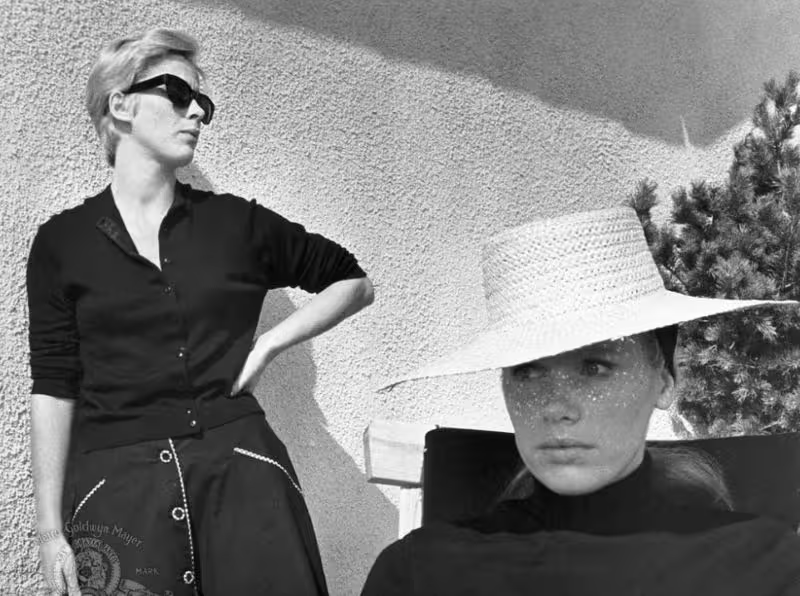
Bergman strips away every support structure — social role, language, narrative clarity — until the boundary between Elisabet and Alma dissolves entirely. The film asks whether there is anything behind the mask, or whether the mask is all there is.
It anticipates postmodern identity theory, Lacanian psychoanalysis, and the kind of questions about selfhood that contemporary philosophy of mind still wrestles with.
Philosophical quotation from the film:
“I understand why you don’t speak, why you don’t move, why you’ve created a kind of immobility. I understand you. I’m trying to understand.” — Alma
Core philosophical themes: Personal identity; the performance of selfhood; the limits of language; psychological doubling; Jungian shadow; existentialist authenticity.
8. Stalker (1979)
Q. What happens when we come face-to-face with our own deepest desire?
Director: Andrei Tarkovsky | Country: Soviet Union
Surface story: A guide called the Stalker leads two men — a Writer and a Professor — through a mysterious, militarized wasteland called the Zone, toward a Room at its center said to grant a person’s deepest wish.
The journey is slow, meditative, and filled with dread.
What it’s really about: The Zone is not a place. It is the interior of the human soul rendered as landscape.
And the Room is the most terrifying philosophical device in cinema: it does not grant what you ask for — it grants what you actually want, beneath all the rationalizations and self-narratives.
The film’s devastating implication is that most of us are terrified to reach such a room, because we cannot be certain what we truly want — and we suspect it might shame us. The Writer goes seeking inspiration but fears he has none. The Professor goes intending to destroy the Room, but for reasons he cannot fully articulate.
The Stalker, who has given his life to guiding others, never enters himself. Tarkovsky’s film is the most serious cinematic exploration of the philosophical problem of desire: not what we say we want, but what the structure of our choices reveals that we want.
Philosophical quotation from the film:
“Let everything that’s been planned come true. Let them believe. And let them have a laugh at their passions. For what they call passion is not really the energy of the soul, but merely friction between the soul and the outside world.” — The Stalker
Core philosophical themes: Desire and its concealment; faith and spiritual exhaustion; phenomenology; the fear of self-knowledge; existential authenticity; the Russian philosophical tradition of suffering as path.
9. Eternal Sunshine of the Spotless Mind (2004)
Q. If you could erase your pain, would you still be you?
Director: Michel Gondry | Country: USA
Surface story: Joel and Clementine have their relationship erased from each other’s memories by a medical procedure after a painful breakup.
The film follows Joel’s journey through his own dissolving memories in real time — and his decision, mid-erasure, to try to save them.
What it’s really about: The film’s title comes from Alexander Pope’s Eloisa to Abelard — a description of a nun’s peaceful, passionless existence, purged of the suffering that came with love.
The film asks whether that peace is enviable or tragic. Drawing on John Locke’s memory theory of personal identity — the idea that we are our memories, that without them there is no continuous self — the film stages Joel’s growing realization that erasing Clementine from his mind is not healing but self-destruction.
The painful memories are not incidental to who he is; they are who he is. The film also runs a Nietzschean thread: even after the erasure, the two meet again and begin falling toward each other — suggesting that character, not memory alone, shapes fate.
The film illustrates “how experiences shape us — erasing the bad risks losing the good, affirming that messy authenticity beats sanitized forgetfulness.”
Philosophical quotation from the film:
“I could die right now, Clementine. I’m just… happy. I’ve never felt that before. I’m just exactly where I want to be.” — Joel Barish
The unbearable poignancy of this line is that it is spoken during a memory being erased. He cannot hold onto the feeling. But the film implies he cannot erase the person it made him, either.
Core philosophical themes: Personal identity; memory; utilitarian ethics of suffering; the ethics of forgetting; Locke’s theory of selfhood; Nietzschean eternal return.
10. The Tree of Life (2011)
Q. Why is there suffering in a universe this beautiful?
Director: Terrence Malick | Country: USA
Surface story: In 1950s Waco, Texas, a family is undone by grief. The father is harsh and controlling; the mother radiates tender grace.
A grown son (played by Sean Penn) drifts through the present, haunted by loss and searching for something he cannot name. T
he film frames this family story against 15 minutes of cosmic imagery — the birth of the universe, the formation of earth, dinosaurs — before narrowing back to the particular.
What it’s really about: Malick builds his entire film around one of philosophy’s oldest and most unanswerable problems: theodicy.
Why does suffering exist in a universe that is also capable of producing overwhelming beauty?
The film opens with a voice-over drawn directly from the Book of Job: “There are two ways through life — the way of Nature, and the way of Grace.” Nature competes, dominates, survives. Grace accepts, forgives, wonders.
The film’s tragic irony is that the universe appears to be organized by Nature’s ruthless logic — and yet Grace exists within it anyway, embodied in the mother, in flowers, in the memory of a child’s hands. Malick offers no resolution to this contradiction.
He offers instead the act of holding both truths simultaneously, which is itself a philosophical and spiritual discipline.
Probinism describes The Tree of Life as “a profound meditation on memory, loss, and the search for meaning” — a “philosophical tone poem” that “attempts to capture the entire story of existence.”
Philosophical quotation from the film:
“Help each other. Love everyone. Every leaf. Every ray of light. Forgive.” — Mrs. O’Brien (voice-over)
Core philosophical themes: Theodicy; the problem of evil; grace vs. nature; cosmological wonder; memory and mortality; Heideggerian being-in-the-world.
11. Ikiru (1952)
Q. What does it take to actually start living before you die?
Director: Akira Kurosawa | Country: Japan
Surface story: Kanji Watanabe is a mid-level Tokyo bureaucrat who has spent thirty years shuffling papers, avoiding decisions, and slowly disappearing inside an institution.
He is told he has terminal stomach cancer and has less than a year to live. The film follows what he does with that year.
What it’s really about: The film’s title means simply “to live” — and its philosophical weight comes from Kurosawa’s devastating implication that most people are already dying before they know it.
Watanabe’s cancer does not destroy him. It wakes him up.
Martin Heidegger’s concept of Being-toward-death — the idea that a genuine, undeflected awareness of mortality is the only thing that can pierce our habitual evasions and force us to inhabit our existence rather than merely pass through it — is given perfect cinematic form.
Watanabe has everything he needs to act, to connect, to leave a mark — and for thirty years, the bureaucratic machinery gave him the perfect excuse not to.
His final project, a small park for children in a neglected neighborhood, is not a grand act. But it is entirely his. And that distinction is the whole film.
Philosophical quotation from the film:
“I don’t know what I’ve been doing with my life all this time… I just feel like I’ve wasted it.” — Watanabe
Core philosophical themes: Heidegger’s Being-toward-death; existential authenticity; the bureaucratic erasure of selfhood; meaning-making in the face of mortality; the Japanese philosophical concept of mono no aware — the pathos of impermanence.
12. Before Sunrise / Before Sunset / Before Midnight (1995–2013)
Q. Can two people build a philosophy of love in real time?
Director: Richard Linklater | Country: USA/France/Austria
Surface story: Three films track Jesse and Céline across eighteen years. They meet on a train in Vienna as young strangers and talk through the night. Nine years later they meet again in Paris, older and altered.
Nine years after that, they are together, with children, fighting in a Greek hotel room — and the romance has become a marriage, which is harder and stranger than either imagined.
What it’s really about: Linklater created a trilogy of extended Socratic dialogue. Jesse and Céline do not talk about life — they think through it while living it.
Their conversations span death, time, regret, gender, memory, commitment, and the slow erosion that comes with actually inhabiting a relationship rather than dreaming about one.
The Before Trilogy is a deeply philosophical sequence about “love, time, connection, marriage, death, and the meaning of life,” noting that it unfolds like a series of philosophical dialogues across decades, asking what it means to choose someone — and keep choosing them — as both people change beyond recognition.

The trilogy is philosophically unusual because it refuses the conventional narrative frame. Nothing “happens” in the Hollywood sense. Two people talk.
And that turns out to be enough to illuminate more about consciousness, time, and the human condition than most action films manage in two hours.
Philosophical quotation from the film:
“I feel like if someone were to touch me, I would dissolve into molecules.” — Céline (Before Sunrise)
Core philosophical themes: Phenomenology of love; time and impermanence; existential commitment; Simone de Beauvoir’s philosophy of relationship; the philosophy of language and dialogue.
13. Waking Life (2001)
Q. Are you awake, or are you dreaming that you are?
Director: Richard Linklater | Country: USA
Surface story: A young man drifts through a series of vivid conversations about consciousness, free will, lucid dreaming, determinism, and the nature of reality — unsure whether he is awake or trapped inside a dream he cannot wake from.
What it’s really about: Linklater built Waking Life as a philosophical seminar in motion.
The film’s rotoscoped animation — real footage traced in shifting, unstable paint — is not an aesthetic choice but a philosophical argument: the visual world itself refuses to stay fixed, mirroring the film’s central anxiety about whether waking life is just another layer of dreaming.
The film is rare in its openness: it lets thinkers simply talk, without narrative pressure, about phenomenology, existentialism, language, and the terror of freedom.
It is the most openly philosophical film on this list, and it works precisely because Linklater trusts the audience to sit inside uncertainty without demanding resolution.
Philosophical quotation from the film:
“The trick is to combine your waking rational abilities with the infinite possibilities of your dreams. Because, if you can do that, you can do anything.” — Dream Guide
Core philosophical themes: Consciousness; lucid dreaming; determinism vs. free will; existential awakening; phenomenology; the philosophy of language.
14. The Name of the Rose (1986)
Q. Who gets to decide which knowledge is dangerous?
Director: Jean-Jacques Annaud | Country: Italy/France/Germany
Surface story: A Franciscan friar, William of Baskerville, and his young novice Adso arrive at a medieval Italian monastery to attend a theological debate and find themselves investigating a series of mysterious deaths.
The trail leads to the monastery’s vast, labyrinthine library — and to a book that someone is willing to kill to suppress.
What it’s really about: Probinism describes the source novel (and its 1986 film adaptation) as “a rich, polyphonic narrative layered with theological disputes, philosophical meditations, and semiotic puzzles.”
The book being protected — Aristotle’s lost second book of the Poetics, the volume on comedy — is not a mere MacGuffin.
It is a philosophical cipher. The killer believes that laughter is subversive to faith and order; that a book endorsing comedy as philosophically legitimate would undermine the Church’s authority.
His logic is internally coherent and terrifying: knowledge that destabilizes power must be destroyed. The film is therefore a story about epistemology as politics. Who controls what is knowable?
What institutions fear inquiry, and why? The answers are medieval in setting but contemporary in urgency.
Philosophical quotation from the film:
“The only truth is learning how to free ourselves from the insane passion for the truth.” — Jorge of Burgos
The villain’s own words indict him: he murders for truth while denouncing the passion for it.
Core philosophical themes: Semiotics; the politics of knowledge; reason vs. dogma; medieval theology; Umberto Eco’s theory of the open text; epistemology as power.
15. The Truman Show (1998)
Q. Is a comfortable illusion ever morally acceptable?
Director: Peter Weir | Country: USA
Surface story: Truman Burbank has lived his entire life in a domed artificial town, unaware that it is an enormous television set and every person around him is a paid actor.
The film follows his growing suspicion that something is wrong with his world — and his journey toward the edge of it.
What it’s really about: The Truman Show is a modern Allegory of the Cave so precise that it can serve as a primary text in a philosophy class.
Truman’s world is comfortable, predictable, and entirely false. T
he philosophical question the film poses is not simply whether he can escape — it is whether truth is worth more than happiness. Christof, the show’s omnipotent director, genuinely believes he has given Truman a wonderful life.
He is a philosophical villain who makes a coherent utilitarian argument: Truman is happy, millions of viewers find meaning in his story, and the lie produces more aggregate good than the truth would.
The film’s answer is that authenticity — knowing your life is your own — is not merely a preference but a moral requirement for a fully human existence.
Philosophical quotation from the film:
“We accept the reality of the world with which we’re presented. It’s as simple as that.” — Christof
Core philosophical themes: Authenticity; manufactured reality; free will; Plato’s Cave; utilitarian ethics vs. deontological rights; surveillance and control.
16. Fight Club (1999)
Q. What does consumer society do to the male identity, and what explodes when it collapses?
Director: David Fincher | Country: USA
Surface story: An unnamed insomniac office worker meets the anarchic Tyler Durden on a plane and together they found an underground bare-knuckle fighting club that escalates into a violent anti-consumerist movement.
What it’s really about: Fincher’s adaptation of Chuck Palahniuk’s novel is a diagnosis of what postmodern consumer capitalism does to the construction of masculine identity.
The narrator has built a self entirely from IKEA catalogues — external objects substituted for internal reality.
His insomnia is existential, not medical: he cannot sleep because he cannot access anything authentic in himself to rest in. Tyler Durden is not a liberator but a shadow — the Jungian unconscious erupting when the ego’s coping mechanisms finally fail.
The film walks the line between satirizing nihilism and seducing the viewer with it, which is itself the philosophical trap: Fight Club is a warning that presents itself as an invitation, and the viewer’s response reveals something about them.
Philosophical quotation from the film:
“You are not your job. You’re not how much money you have in the bank. You’re not the car you drive. You’re not the contents of your wallet. You’re not your khakis.” — Tyler Durden
Core philosophical themes: Nietzschean nihilism and the will to power; Jungian shadow self; postmodern identity; the alienation of consumer capitalism; masculinity and existential crisis.
17. Memento (2000)
Q. If you cannot trust your own memory, can you trust yourself at all?
Director: Christopher Nolan | Country: USA
Surface story: Leonard Shelby cannot form new long-term memories as a result of a brain injury.
He is hunting for his wife’s killer using a system of Polaroid photographs, tattoos, and handwritten notes.
The film is told in reverse chronological order, so that we experience the world as Leonard does — always arriving too late to fully understand what we are seeing.
What it’s really about: Nolan uses narrative structure as philosophical argument.
The reverse chronology is not a gimmick — it forces the audience into Leonard’s epistemological condition. We, like Leonard, can only see what is immediately before us, without the context that would allow us to evaluate it.
The film raises devastating questions about the reliability of the self: if memory is the basis of personal identity and moral accountability, what happens to both when memory fails?
Leonard is systematically deceived — but the film’s most disturbing revelation is that he may be complicit in his own deception, because certain truths are too unbearable to carry. Self-deception as existential survival strategy is the film’s deepest theme.
Philosophical quotation from the film:
“Memory can change the shape of a room; it can change the color of a car. And memories can be distorted. They’re just an interpretation, they’re not a record.” — Leonard Shelby
Core philosophical themes: Personal identity and memory; self-deception; Lockean theory of selfhood; epistemological reliability; the nature of narrative and truth.
18. Synecdoche, New York (2008)
Q. Can any work of art be large enough to contain a human life?
Director: Charlie Kaufman | Country: USA
Surface story: Caden Cotard, a theatre director, receives a MacArthur genius grant and uses it to mount an increasingly vast and uncontrollable theatrical production — one that eventually swallows his entire life, incorporating warehouses full of actors re-enacting his memories in real time, as decades pass and death approaches.
What it’s really about: The title points to synecdoche — a rhetorical device in which a part stands for the whole, or the whole for a part.
Cotard’s tragedy is the artist’s tragedy: he wants a work of art large enough to contain life itself, and life keeps exceeding representation.
The film is also a profound engagement with Heidegger’s Being-toward-death — the play never opens because Cotard is always perfecting it, always deferring the confrontation with finitude that would actually make the work mean something.
It is cinema’s most honest film about mortality, creative failure, and the philosophical impossibility of fully comprehending one’s own existence from the inside.
Philosophical quotation from the film:
“I will be dying, and so will you, and so will everyone here. That’s what I want to explore. We’re all hurtling towards death, yet here we are for the moment, alive.” — Caden Cotard
Core philosophical themes: Mortality and artistic creation; Heidegger’s being-toward-death; the limits of representation; identity and self-understanding; loneliness as a philosophical condition.
19. Jeanne Dielman, 23 quai du Commerce, 1080 Bruxelles (1975)
Q. Is everyday domestic life a form of philosophical oppression?
Director: Chantal Akerman | Country: Belgium/France
Surface story: Over three days, we observe in almost real time every detail of a Belgian widow’s domestic routine: she cooks, cleans, tends to her son, and receives a single male visitor each afternoon in exchange for money. On the third day, something breaks.
What it’s really about: Voted the greatest film of all time in the 2022 Sight and Sound critics’ poll — the first time a film directed by a woman topped that list — Jeanne Dielman performs its philosophy through radical attention.
By forcing viewers to watch cooking, dishwashing, and bathing in full, unedited real time, Akerman makes visible the enormous invisible labor that structures women’s lives and is dismissed as philosophically beneath notice.
The film argues by form: if you find these scenes boring, that is precisely the point. The violence of the ending does not emerge from nowhere.
It has been accumulating, minute by minute, in every unacknowledged, unrecompensed act the film has made you witness.
In lieu of a spoken quote, the most famous critical observation: Akerman said she made the film because “a woman’s gestures are so precise and repetitive — like heartbeats. And they contain the whole of her life.”
Core philosophical themes: Feminist philosophy; the politics of labor and visibility; time and alienation; the phenomenology of domestic space; structural violence; Simone de Beauvoir’s analysis of women’s situation.
20. Doubt (2008)
Q. Is moral certainty a virtue or a danger?
Director: John Patrick Shanley | Country: USA
Surface story: In a 1964 Catholic school in the Bronx, a determined principal, Sister Aloysius, becomes convinced that the parish priest, Father Flynn, has been inappropriate with a young student. She has no proof. She pursues him anyway.
What it’s really about: Doubt is a masterclass in epistemology under moral pressure.
The film explores “the grey areas between certainty and suspicion, morality and manipulation.”
Sister Aloysius is not wrong to investigate — the film carefully leaves the question of Father Flynn’s guilt genuinely unresolved — but her certainty itself becomes the philosophical subject.
The film asks: when must we act before certainty arrives? And when does the conviction that we are right become a weapon? Shanley refuses to resolve the central accusation.
The film ends in a cry of doubt — not from the accused, but from the accuser — suggesting that certainty was always the wrong goal.
Philosophical quotation from the film:
“I have doubts! I have such doubts!” — Sister Aloysius
The power of this line is that it comes at the film’s end, from the character who seemed least capable of doubt. It is an admission, a collapse, and a confession all at once.
Core philosophical themes: Epistemology and moral action; the limits of certainty; institutional power; justice without proof; Kantian duty vs. consequentialist outcome.
21. A Beautiful Mind (2001)
Q. Can we trust the minds we think with?
Director: Ron Howard | Country: USA
Surface story: The biographical drama of mathematician John Nash, who contributed foundational work to game theory while living with undiagnosed paranoid schizophrenia — experiencing an elaborate, coherent alternative reality populated by people who did not exist.
What it’s really about: The film’s philosophical punch depends on a structural choice: we experience Nash’s delusions from the inside, never suspecting they are not real, until the film reveals the truth and forces us to reckon with our own vulnerability as perceivers.
We were fooled by a mind — Nash’s, refracted through the film — and the experience illuminates the epistemological bedrock of all conscious life: we do not experience reality directly.
We experience a model of it, constructed by a brain that can be wrong. A Beautiful Mind is “a profound emotional experience that lingers long after the credits roll,” noting its power as both humanist narrative and epistemological parable.
Philosophical quotation from the film:
“Perhaps it is good to have a beautiful mind, but an even greater gift is to discover a beautiful heart.” — Alicia Nash
Core philosophical themes: Epistemology; the unreliability of perception; reason and its limits; mental illness and personhood; the relationship between genius and human flourishing.
22. My Dinner with Andre (1981)
Q. Is it possible that ordinary life has already become a kind of sleep?
Director: Louis Malle | Country: USA
Surface story: Two acquaintances — theatre director Andre Gregory and playwright Wallace Shawn — meet for dinner in a New York restaurant and talk. For nearly two hours. That is the entire film.
What it’s really about: Andre has spent years seeking radical spiritual and theatrical experiences across the world — encounters with mystics in Poland, rituals in the desert, attempts to break through the numbing automation of modern life.
Wally is skeptical, pragmatic, and attached to his electric blanket. Their conversation, rendered in close-up by Malle with extraordinary patience, becomes a debate about consciousness: are most people sleepwalking through lives of comfortable anesthesia, as Andre believes?
Or is Wally right that simple pleasures and ordinary connection are themselves sufficient and real? The film refuses to fully adjudicate.
It is philosophy as conversation — not as conclusion — in its purest cinematic form.
Philosophical quotation from the film:
“We’re all just rats in a maze. And the only difference is some of us know it, and some of us don’t.” — Andre Gregory
Core philosophical themes: Consciousness and habituation; the examined life; spiritual seeking vs. ordinary contentment; the phenomenology of modern comfort; Socratic dialogue.
23. A Serious Man (2009)
Q. Is the universe meaningful, or are we just desperate for it to be?
Director: Joel Coen and Ethan Coen | Country: USA / United Kingdom / France
Surface story: Larry Gopnik, a Jewish physics professor in 1967 Minnesota, watches his life collapse in absurdly precise stages: his wife wants a ritual divorce, his brother is unstable, his children ignore him, a student may be bribing him, his tenure is uncertain, and every attempt to seek spiritual guidance produces only deeper confusion.
The film is a Coen brothers black comedy-drama, written and directed by Joel and Ethan Coen.
What it’s really about: Beneath its deadpan humor, A Serious Man is a modern Book of Job without the comfort of divine explanation.
Larry believes that if he behaves decently, follows the rules, teaches physics, and asks the right rabbis the right questions, the universe should eventually clarify itself. It does not.
The film’s genius lies in making cosmic uncertainty feel bureaucratic: parking lots, dental records, tenure committees, Hebrew school, divorce law, and quantum mechanics all become signs that may mean everything or nothing.
The Coens turn Larry’s suffering into a philosophical trap. If the world is ordered, why does it seem cruelly arbitrary?
If the world is random, why do humans keep searching it for moral structure? Larry teaches the Uncertainty Principle, but he cannot live with uncertainty. He wants a formula for suffering.
The film gives him stories, evasions, coincidences, and silence. Its final storm is not only meteorological; it is metaphysical.
Philosophical quotation from the film:
“The Uncertainty Principle. It proves we can’t ever really know… what’s going on.” — Larry Gopnik
Core philosophical themes: Theodicy; the Book of Job; divine silence; uncertainty; moral luck; absurdism; Jewish existential anxiety; the human need to interpret suffering.
24. A Man for All Seasons (1966)
Q. What is a conscience worth if it can be purchased?
Director: Fred Zinnemann | Country: United Kingdom
Surface story: Sir Thomas More, Lord Chancellor of England, refuses to endorse King Henry VIII’s break with Rome and his claim to supremacy over the Church.
As political pressure increases, More retreats into silence, legal precision, and conscience, knowing that the machinery of power may eventually destroy him.
The film was directed and produced by Fred Zinnemann and adapted by Robert Bolt from his own play.
What it’s really about: A Man for All Seasons is not merely a historical drama about Henry VIII’s England.
It is a philosophical drama about the last private room inside a person: conscience. More does not behave like a revolutionary. He is not loud, romantic, or reckless.
His resistance is legalistic, restrained, and almost maddeningly careful. Yet that restraint is precisely the point. He understands that once language is bent to power, the soul soon follows.
The film asks whether integrity can survive a world where every principle is treated as negotiable. Rich compromises for office. Cromwell weaponizes procedure.
Henry confuses desire with divine sanction. More, by contrast, insists that a person is not truly free unless there is something he will not sell, not even to save his life.
His silence becomes more eloquent than political speech because it marks a boundary the state cannot morally cross.
Philosophical quotation from the film:
“I die His Majesty’s good servant, but God’s first.” — Sir Thomas More
Core philosophical themes: Conscience; moral integrity; natural law; individual vs. state; religious duty; political obedience; martyrdom; the ethics of silence.
25. Perfume: The Story of a Murderer (2006)
Q. Can beauty exist without a soul?
Director: Tom Tykwer | Country: Germany / France / Spain / USA
Surface story: Jean-Baptiste Grenouille, born in 18th-century France with an extraordinary sense of smell but no personal scent of his own, becomes obsessed with capturing the perfect human fragrance. His genius leads him from perfumery into murder as he tries to distill beauty itself.
The film was directed by Tom Tykwer and adapted from Patrick Süskind’s 1985 novel, with Ben Whishaw starring as Grenouille.
What it’s really about: Perfume is a dark philosophical fable about art without ethics, beauty without love, and perception without personhood. Grenouille can smell the world more intensely than anyone alive, yet he cannot truly belong to it.
His tragedy is not simply that he is monstrous; it is that he experiences humanity aesthetically but not morally. People are not persons to him. They are essences, notes, materials.
The film turns scent into metaphysics. A person’s smell becomes a symbol of soul, presence, and identity. Grenouille has no scent, and therefore no place in the human order.
His murders are an attempt to manufacture a self from the stolen aura of others.
When he finally creates the supreme perfume, he gains the power to command worship, desire, forgiveness, and awe.
But the triumph is hollow: he can produce love as an effect, but he cannot receive love as a person. The film’s horror lies in that distinction.
Philosophical quotation from the film:
“He possessed the power. He held it in his hand. A power stronger than the power of money, or terror, or death: the invincible power to command the love of mankind.” — Narrator
Core philosophical themes: Aesthetic obsession; art and morality; identity; embodiment; the soul; objectification; genius without empathy; beauty as power.
What Makes a Film Truly Philosophical?
A film becomes philosophical when it does more than decorate itself with “deep” dialogue. It must place a fundamental question at the center of the viewing experience.
A philosophical film usually does at least one of these things:
1. It questions reality
Examples: The Matrix, The Truman Show, Waking Life, Rashomon
These films ask whether the world we perceive is reliable.
2. It questions identity
Examples: Persona, Blade Runner, Memento, Eternal Sunshine of the Spotless Mind
These films ask what makes a person the same person over time.
3. It questions morality
Examples: 12 Angry Men, Doubt, A Serious Man, The Name of the Rose
These films ask how we should act when certainty is unavailable.
4. It questions death
Examples: The Seventh Seal, Ikiru, Synecdoche, New York, The Tree of Life
These films ask whether mortality destroys meaning or creates it.
5. It questions freedom
Examples: Groundhog Day, The Matrix, Arrival, The Truman Show
These films ask whether choice is real, conditioned, predetermined, or earned.
6. It refuses easy answers
This is the most important feature. A philosophical film does not exist to solve life. It exists to make the problem visible.
Conclusion
The philosopher Bernard Williams observed that while the unexamined life may or may not be worth living, the examined life carries its own burdens — it requires following arguments wherever they lead, even into uncertainty, loss, and the uncomfortable discovery that you were wrong.
The 22 films on this list understand that.
Not one of them offers a pamphlet. Each one offers an experience — of being genuinely unsettled, genuinely moved, genuinely confused about something that matters. That unsettlement is not a failure.
It is the point. It is, in fact, what thinking has always felt like.
Watch these films the way you would engage with a great book of philosophy: slowly, with attention, and more than once. Pair them with the thinkers they draw from. Argue with a friend afterward. Sit in the silence before you reach for your phone. Let the question live in you for a while.
Because philosophical cinema does not ask for your conclusion. It asks for your presence. And in a world designed to scatter attention across a thousand surfaces simultaneously, choosing to be fully present with a difficult question — for two hours, in the dark — is itself an act of philosophical resistance.
FAQ: Best Philosophical Films of All Time
Q: What is the single most philosophical film ever made?
There is no consensus — but if forced to name a universal starting point, most scholars and critics point to 2001: A Space Odyssey or The Seventh Seal.
The former engages evolution, consciousness, and artificial intelligence with unmatched visual ambition; the latter confronts mortality, faith, and meaninglessness with stripped-down directness. Both refuse comfortable answers.
Q: Are philosophical films only for philosophy students?
Absolutely not. The films on this list include comedies (Groundhog Day), science-fiction blockbusters (The Matrix, Blade Runner), a biographical drama (A Beautiful Mind), and a two-person dinner conversation (My Dinner with Andre).
Philosophy is not a style — it is a mode of inquiry. Any film that makes you genuinely question your assumptions qualifies, regardless of genre.
Q: What is the best philosophical film for someone just starting out?
Groundhog Day is the most accessible entry point. It is funny, emotionally warm, and deeply concerned with how we change — or refuse to.
It focuses not on the mechanics of its premise but on “the emotional and philosophical implications,” making it immediately relatable to any viewer regardless of philosophical background.
Q: Which film deals most directly with the question of personal identity?
Eternal Sunshine of the Spotless Mind and Memento are the two most philosophically rigorous treatments of personal identity in mainstream cinema.
The former interrogates memory as the foundation of selfhood; the latter forces the viewer to experience identity’s fragility from the inside.
Q: What philosophy is behind The Matrix?
The film draws on Plato’s Allegory of the Cave, Descartes’ evil demon thought experiment, and Jean Baudrillard’s theory of the simulacrum — the idea that modern reality has been so thoroughly replaced by representations of itself that the copy is now more “real” than the original.
The Wachowskis required cast members to read Baudrillard before filming began, and the book appears physically in the film’s opening minutes.
Q: What makes Rashomon philosophically significant beyond its famous structure?
The Rashomon effect — multiple, equally valid, mutually contradictory accounts of the same event — has entered academic discourse in philosophy, law, psychology, and journalism.
The film’s lasting contribution is its diagnosis of a deep human truth: people do not merely distort reality consciously to deceive others; they reshape it unconsciously to protect their image of themselves.
This is a claim about the structural limits of testimony, not merely about individual dishonesty.
Q: Why is Jeanne Dielman considered philosophically important if almost nothing happens in it?
Because the film’s philosophical argument is the almost-nothing-happening.
By depicting domestic labor in real time with the same camera attention typically reserved for dramatic action, Akerman makes a claim about what society considers worthy of notice — and what it renders invisible by design.
The film voted greatest of all time by the 2022 Sight and Sound critics’ poll, it redefined what cinematic seriousness looks like.
Q. Which philosophical films deal with God?
The Seventh Seal, The Tree of Life, A Serious Man, Doubt, and Stalker all deal with God, faith, divine silence, or spiritual uncertainty. The Tree of Life is a meditation on memory, loss, and meaning, while Criterion describes The Seventh Seal as a profound inquiry into faith and mortality.
Q. What is the most philosophical film ever made?
There is no single verified answer, because “most philosophical” depends on the branch of philosophy being considered. For metaphysics and human evolution, 2001: A Space Odyssey is one of the strongest candidates.
For faith and death, The Seventh Seal is essential. For truth and epistemology, Rashomon remains foundational. Criterion explicitly frames The Seventh Seal around faith and mortality and Rashomon around truth and justice.
“The unexamined life is not worth living.” — Socrates, at his trial, as recorded by Plato in the Apology.
The examined film, it turns out, is worth watching more than once.
Author’s Note: This article draws on cinematic analysis, philosophical scholarship, and in-depth film criticism including insights from Probinism’s ongoing project of reading film through humanist and existentialist frameworks. All film quotations are drawn from the films themselves or their widely-cited dialogue records.