
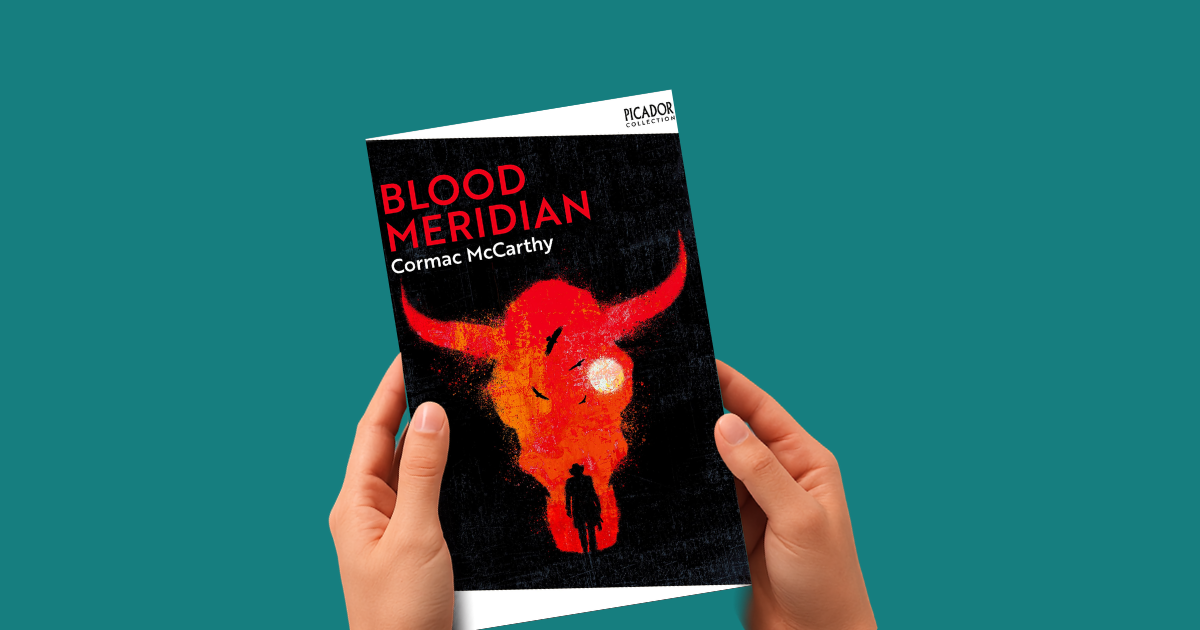
Do you ever finish a book and feel like you’ve been dragged through hell, yet you can’t stop thinking about it? That was my exact experience with Cormac McCarthy’s Blood Meridian.
This isn’t just another Western novel—it’s a brutal, philosophical journey that forces you to confront the darkest corners of human nature and America’s bloody origins. I’ve read hundreds of books, but none have haunted me quite like this one.
Overview
Blood Meridian follows a teenage runaway known only as “the kid” who joins a gang of scalp hunters in the 1849–1850 American Southwest, witnessing and participating in unspeakable violence while the terrifying, erudite Judge Holden preaches a philosophy that equates war with god. It’s a masterwork of prose that subverts every Western myth you’ve ever known.
Blood Meridian is perfect for readers who appreciate dense, literary fiction; fans of philosophical horror; those who want to understand America’s violent foundations; and anyone who isn’t squeamish about graphic violence.
Blood Meridian is not suggested for readers looking for a light, heroic Western; those triggered by extreme violence, racism, or sexual assault; anyone who prefers straightforward narratives with clear moral lessons.
Table of Contents
1. Introduction
Blood Meridian, or, the Evening Redness in the West is the fifth novel by American author Cormac McCarthy, published in April 1985 by Random House. The book runs 337 pages in its first edition.
McCarthy, who passed away on June 13, 2023, at the age of 89, went on to win the Pulitzer Prize for Fiction in 2007 for The Road. But many critics—including the late Harold Bloom—consider Blood Meridian his true masterpiece. Bloom called it “the ultimate Western, not to be surpassed”.
The novel is classified as an anti-Western or revisionist Western, and it was named one of Time magazine’s 100 best English-language books published since 1923.
2. Background: Historical Context
To understand Blood Meridian, you need to know what was happening in the American Southwest in the late 1840s. The novel is set in the aftermath of the Mexican-American War (1846–1848). The Treaty of Guadalupe Hidalgo had just transferred vast territories—including present-day California, Arizona, New Mexico, and Texas—to the United States.
This was the era of Manifest Destiny, the belief that American expansion across the continent was both justified and inevitable. But the borderlands were chaotic.
The U.S. government paid bounties for Apache and other Indigenous scalps—$100 apiece, as depicted in the novel. This created a market for professional scalp hunters, men who murdered Indigenous people for profit.
McCarthy drew heavily on historical sources.
The Glanton gang, which features prominently in the novel, was real. John Glanton and his men actually existed and operated in the borderlands from 1849 to 1850. McCarthy also used a memoir by Samuel E. Chamberlain, a former gang member, whose My Confession: The Recollections of a Rogue (written between 1855 and 1861 but published only in 1956) provided detailed testimony of the violence.
3. Blood Meridian Summary
Part One: The Kid’s Early Years
The novel opens with one of the most famous lines in American literature: “See the child.” We meet a pale, thin boy of fourteen living in Tennessee.
His mother is dead, his father is a drunkard schoolmaster, and the child “can neither read nor write and in him broods already a taste for mindless violence”.
He runs away from home and wanders west, eventually finding himself in Nacogdoches, Texas, in 1849. There, he witnesses a traveling preacher named Reverend Green being exposed as a fraud by a massive, hairless, albino man—Judge Holden. The judge is described as close to seven feet tall, bald as a stone, with no trace of beard or eyebrows. He calmly destroys the preacher’s reputation, and when asked how he knows all this, he replies that he’s never even met the man.
The kid gets into a fight with a man named Toadvine (who has no ears and the letters H-T-F burned into his forehead). They become reluctant companions and burn down a hotel together. As the kid rides out of town, he sees Judge Holden watching him—and smiling.
Part Two: Joining the Filibusters
The kid drifts through Texas and Mexico, surviving on scraps and luck. He meets a hermit who shows him a dried human heart, claiming it cost him two hundred dollars. The hermit offers a grim philosophy: “They is four things that can destroy the earth,” he says. “Women, whiskey, money, and niggers.”
Eventually, the kid is recruited by Captain White, a filibuster who wants to invade Mexico and claim land for Americans. White gives a speech about racial superiority and Manifest Destiny, calling Mexicans “a mongrel race, little better than niggers”.
The expedition is a disaster. They’re attacked by Comanches in a horrifying scene where McCarthy’s prose reaches near-biblical intensity. The kid survives, one of only a handful of men left alive.
Part Three: The Glanton Gang
The kid and another survivor named Sproule wander through the desert, encountering a tree hung with dead babies and a village where everyone has been massacred. Sproule dies of his wounds.
The kid is arrested and thrown in a Chihuahua City prison. There, he reunites with Toadvine. They’re freed when Judge Holden and a man named Glanton recruit them for a scalp-hunting expedition. The governor of Chihuahua has contracted them to kill Apaches for $100 per scalp.
Part Four: The Scalp-Hunting Campaign
The gang rides into the desert. It’s a nightmare of violence. They massacre a peaceful Apache village at a lake—men, women, children.The judge scalps a child. They collect scalps by the hundred, stringing them on poles.
The gang rides through Mexico with the heads of their victims displayed on poles. They’re treated as heroes in Chihuahua City. The governor throws them a banquet. But their behavior becomes so outrageous—raping, robbing, killing locals—that the governor eventually turns against them.
Part Five: The Yuma Ferry and the Massacre
The gang moves west to the Colorado River and takes over a ferry crossing. They rob and kill travelers. They enslave locals. The judge, ever the philosopher, preaches that “war is god”.
The Yuma Indians, betrayed by Glanton, attack the ferry camp. In the massacre, Glanton is killed—an axe splits his head. The judge escapes, carrying the bronze barrel of a howitzer under one arm, the idiot (a local imbecile they’d been tormenting) following him.
Part Six: The Final Chase and the Ending
The kid (now called “the man”) escapes and wanders through the desert. He encounters the judge again at a well, but refuses to kill him when he has the chance.This mercy costs him everything.
Years later, in 1878, the man is in Fort Griffin, Texas. He enters a dancehall and sees the judge, unchanged, dancing naked. The judge has been waiting for him. He delivers a final philosophical lecture about war, destiny, and the supremacy of violence.
The man goes out to the outhouse. The judge follows him. The judge kills him—and likely rapes him.The novel ends with the judge dancing in the saloon, naked, proclaiming that he will never die.
The epilogue shows a man making holes in the ground, striking fire from rocks—perhaps symbolizing humanity’s endless cycle of destruction and creation.
4. Blood Meridian Analysis
4.1. Blood Meridian Characters
The Kid (later The Man): The protagonist is never given a name. He starts as a fourteen-year-old runaway with “a taste for mindless violence”.
He’s not a hero—he participates in massacres and shows little remorse. Yet he’s the only character who shows occasional mercy. He refuses to kill a wounded man. He hesitates to shoot the judge. This mercy is his fatal flaw. The judge despises him for it, calling it “a flawed place in the fabric of your heart”. The kid represents what little humanity exists in this brutal world—and it’s not enough to save him.
Judge Holden: One of literature’s greatest villains. He’s seven feet tall, hairless, pale, with small eyes and a childlike face. He’s also brilliant—a polymath who speaks multiple languages, understands law, geology, paleontology, and music. He plays the fiddle, dances, and writes in his journal constantly.
But he’s also a murderer, a rapist, and a philosopher of violence. His famous line: “War is god”. He believes that war is the ultimate expression of human will, the truest form of divination. He sees himself as above morality, a force of nature. He says, “Whatever in creation exists without my knowledge exists without my consent”.
The judge is often interpreted as the devil incarnate. He never sleeps and claims he’ll never die. He survives the Yuma massacre and appears decades later, unchanged. He represents the eternal, unchanging nature of human violence.
Glanton: The gang’s leader, based on a real historical figure. He’s ruthless, practical, and doesn’t waste time on philosophy. He’s killed by the Yumas, his head split with an axe.
Toadvine: The kid’s companion, missing his ears and branded with initials on his forehead. He’s a fellow fugitive from justice. He’s later hanged in Los Angeles.
Tobin (the Expriest): A former priest who’s fallen into the gang’s violent life. He serves as a moral foil to the judge, though he’s hardly a good man himself. He’s one of the few survivors, but the kid never sees him again.
David Brown: A vicious member of the gang who wears a necklace of human ears. He and Toadvine are hanged together in Los Angeles.
John Jackson (the Black Jackson): One of two men named Jackson in the gang. He’s killed by Yuma arrows at the river crossing.
4.2. Blood Meridian Themes and Symbolism
War as God: This is the novel’s central philosophical claim. The judge argues that war is the ultimate human activity because it forces a “unity of existence”. In war, everything is at stake—life itself. This strips away all pretense and reveals the truth of human nature. War, for the judge, is not a means to an end but an end in itself.
Manifest Destiny as Genocide: The novel reveals the American expansion west as a bloody, genocidal project. The scalp hunters are government contractors. Their violence isn’t random—it’s state-sanctioned. McCarthy shows that the American West wasn’t won by brave pioneers but by mercenaries who murdered Indigenous people for profit.
The Illusion of Morality: Throughout the novel, characters try to justify their violence—through race, through patriotism, through survival. But the judge strips these justifications away. He argues that moral law is “an invention of mankind for the disenfranchisement of the powerful in favor of the weak”. In the end, only power matters.
The Judge as Devil/Superman: The judge’s albinism, his huge size, his lack of hair, his immortality—all mark him as something other than human. He’s often interpreted as Satan. But he’s also a kind of Übermensch, Nietzsche’s superman who creates his own morality. He writes his own book, literally recording and erasing the world as he sees fit.
The Desert as Character: The landscape in Blood Meridian is almost a character itself—barren, indifferent, inhuman. The desert doesn’t care about human suffering. It simply exists, vast and empty. This reflects McCarthy’s worldview: the universe is indifferent to human concerns.
The Epilogue: The final scene shows a man making holes in the ground and striking fire from rocks. This is often interpreted as humanity’s endless cycle of creation and destruction. The man is making something—but what? Perhaps it’s the endless, meaningless labor of human existence.
5. Blood Meridian Evaluation
“Blood Meridian” is the most important American novel of the last fifty years.
That’s not an exaggeration. Harold Bloom called it “the ultimate Western”. The New York Times review called it “hard to get through” but “harder to ignore”. I’d go further: it’s a book that fundamentally changes how you see the world.
5.1. Strengths
The Prose: McCarthy’s language is extraordinary—biblical, lyrical, brutal. He mixes high diction with crude violence in a way that’s uniquely his own. The New York Times noted that “any page of his work reveals his originality, a passionate voice given equally to ugliness and lyricism”.
The Judge: One of the greatest villains in literature. He’s terrifying not because he’s a monster but because he’s so intelligent. He can argue you into hell. His philosophy is seductive precisely because it makes a kind of twisted sense.
Historical Authenticity: McCarthy did his research. The Glanton gang was real. The Yuma massacre actually happened. The violence isn’t gratuitous—it’s historically grounded.
The Ending: The novel’s conclusion is devastating. The judge kills the kid, then dances naked, proclaiming his immortality. It’s a final assertion of evil’s triumph. There’s no redemption, no moral lesson. Just the endless dance of violence.
5.2. Weaknesses
The Violence: Yes, it’s excessive. The novel contains scenes of rape, murder, scalping, and child killing that are almost unbearable to read. Some readers will find it gratuitous. The New York Times noted that “the horrifying details stick in our minds” while “the surreal elements melt away”.
The Kid’s Passivity: The protagonist is remarkably passive. Things happen to him; he rarely acts. This is intentional—he’s meant to be an everyman, a witness—but it can make him feel like a blank space.
The Dense Prose: McCarthy’s style isn’t for everyone. His lack of quotation marks, his archaic vocabulary, his long, unbroken sentences—these can be off-putting. It took Harold Bloom three attempts to read the book.
Lack of Female Characters: There are almost no women in Blood Meridian. Those who appear are either victims or whores. This reflects the historical reality of the frontier, but it’s still a limitation.
5.3. Comparison with Similar Works
Blood Meridian is often compared to:
Herman Melville’s Moby-Dick: Both feature a massive, philosophical antagonist and a young protagonist on a journey that becomes increasingly dark.
William Faulkner’s novels: McCarthy’s prose style and Southern Gothic sensibility echo Faulkner.
Joseph Conrad’s Heart of Darkness: Both novels explore the darkness at the heart of civilization.
The Western genre itself: McCarthy subverts every Western convention. There are no heroes here, only killers.
6. Personal Insight with Contemporary Relevance
Five Lessons from Blood Meridian
1. Violence is not exceptional; it’s ordinary. The novel shows that violence isn’t something that happens “over there” or “back then.” It’s always present, always waiting. The judge’s line—”War was always here. Before man was, war waited for him”—reminds us that human violence is not a deviation from our nature but an expression of it.
2. Ideology is a mask for power. The scalp hunters justify their murders through patriotism, race, and economic necessity. But these are just rationalizations. The truth is simpler: they kill because they can. Today, we see similar justifications for violence all over the world.
3. Mercy is dangerous. The kid’s mercy—his refusal to kill the judge when he had the chance—leads to his death. This is a dark lesson, but it’s one the novel forces us to confront. In a world of violence, compassion can be fatal.
4. History is written by the powerful. McCarthy shows us the true history of the American West—not the heroic myth but the bloody reality. This is a necessary corrective. We need to remember that the nations we celebrate were built on genocide.
5. The universe is indifferent. There’s no moral order in Blood Meridian. The good don’t prosper; the wicked aren’t punished. The universe simply doesn’t care. This is a hard truth, but one we need to accept.
7. Blood Meridian Quotes
Here are some of the most memorable passages from the novel:
On war:
“War was always here. Before man was, war waited for him. The ultimate trade awaiting its ultimate practitioner.”
On the judge’s philosophy:
“Whatever in creation exists without my knowledge exists without my consent.”
On the nature of the world:
“The truth about the world, he said, is that anything is possible. Had you not seen it all from birth and thereby bled it of its strangeness it would appear to you for what it is, a hat trick in a medicine show, a fevered dream, a trance bepopulate with chimeras having neither analogue nor precedent.”
On the limits of human understanding:
“A man’s at odds to know his mind cause his mind is aught he has to know it with. He can know his heart, but he dont want to. Rightly so. Best not to look in there.”
On the judge’s final claim:
“He never sleeps, the judge. He is dancing, dancing. He says that he will never die.”
8. Conclusion
Blood Meridian is not an easy book. It’s brutal, philosophical, and relentlessly dark. But it’s also a masterpiece—one of the most important American novels ever written.
McCarthy forces us to look at the worst of what humans are capable of. He doesn’t offer easy answers or moral lessons. He simply shows us the truth and lets us wrestle with it.
I’ll be honest: I struggled with this book. There were moments I wanted to put it down and never pick it up again. But I’m glad I didn’t. Blood Meridian changed how I think about violence, history, and human nature.
If you’re looking for a heroic Western with clear good guys and bad guys, this isn’t for you. But if you want a book that will challenge you, haunt you, and stay with you for years, read Blood Meridian. Just be prepared: you’ll never see the American West the same way again.
Recommended for: Fans of literary fiction, philosophical horror, and those who want to understand America’s violent foundations. Not recommended for the faint of heart.







